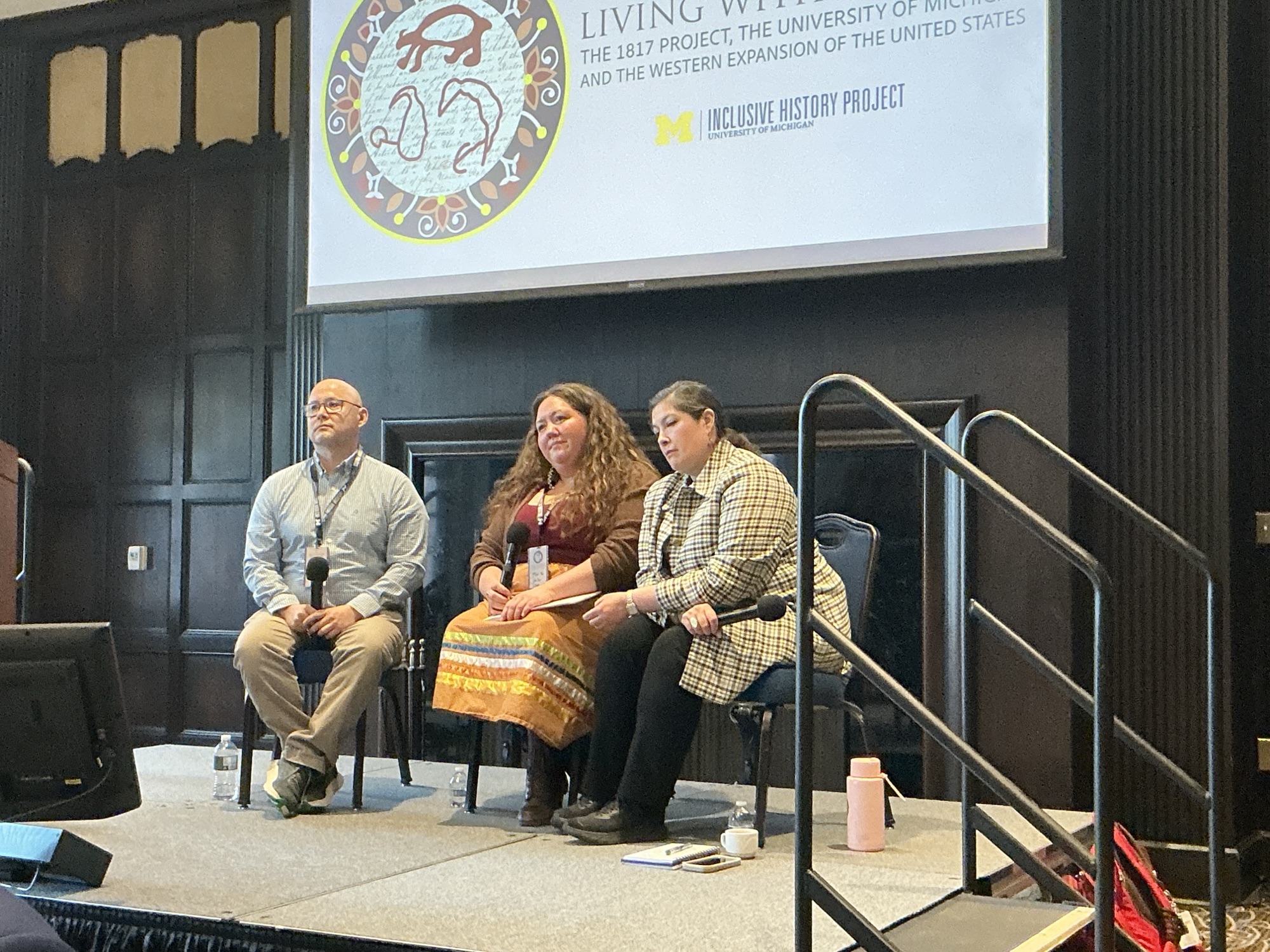
Eric Hemenway, Mae Wright, and Emily Proctor — all citizens of the Little Traverse Bay Bands of Odawa Indians — spoke today at the Living with Treaties conference. Eric worked for two decades with the tribe as historian and archivist; he now works for UM SEAS, focusing on public education. Mae is the tribal historic preservation officer. Emily is an elected official, formerly serving as tribal child protective services worker.
None are lawyers but every lawyer who represents tribal interests should listen carefully whenever people who are their clients speak. Eric, known to some wags as the “bones guy,” brought home dozens, if not hundreds, of ancestors from their places of exile. Mae must make decisions about which cultural resources to pursue under NAGPRA. Emily must make decisions on which portions of the Waganakising homeland the tribal council should pursue (she buys a lot of wetlands). They all work with extremely limited resources, forcing them to make existentially challenging decisions.
Many of these decisions involve trauma. It’s one thing to acknowledge the trauma caused by dispossession of Indigenous relatives and resources. It is another to make decisions to expend limited tribal resources to bring home relatives, sacred objects, and land. Successes happen, but disappointments do, too, and they can build up, sometimes becoming overwhelming.
Not long ago, the tribe sued Emmet County and the State of Michigan, seeking judicial recognition of their reservation boundaries established in 1836 and 1855 treaties. They did so for two reasons. First, to assume authority under NAGPRA to be able to respond to the discovery of ancestors remains and funerary objects. Second, to assume authority under the Indian Child Welfare Act. Both laws establish territorial jurisdiction within reservation boundaries. Close to LTBB is the footprint of Holy Childhood Indian Boarding School, where dozens of Anishinaabe children perished and were buried in mass graves. In the absence of recognized reservation tribe has no authority to properly bring home those relatives. Similarly, Emmet County judges long have been reluctant to transfer ICWA cases to tribal court, which would stop being a problem if the reservation boundaries were recognized. The tribe lost the reservation boundaries case, however.
These issues show reasons why tribes do what they do. From a tribal lawyer’s perspective, Eric, Mae, and Emily are clients. I don’t mean clients like the Indigenous statesmen that show up at conferences like NCAI and testify in the Senate Committee. I mean real tribal leaders, mostly unelected bureaucrats who do the real work. A panel like this should be at every Indian law conference.
 Turtle Talk
You must be logged in to post a comment.