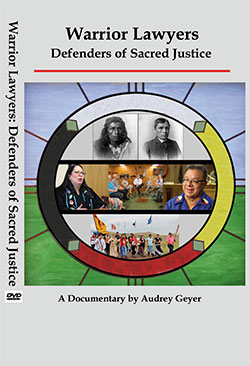
WARRIOR LAWYERS: DEFENDERS OF SACRED JUSTICE BY AUDREY GUYER
Thursday, November 4 7:00 p.m. followed by a discussion with the filmmaker & community
Warrior Lawyers: Defenders of Sacred Justice (2021) is a one-hour PBS documentary that is particularly timely and relevant given our country’s current reckoning with racial inequity and structural racism. The program focuses on the stories of Native American Lawyers, Tribal Judges and their colleagues who work with Native Nations and their citizens to achieve Sacred Justice. These unseen role models strive daily to address and resolve unique and complicated historical, governmental, legal, judicial and social welfare issues, which are most often rooted in discrimination, historical trauma and cultural destruction. Come take a journey into past and present-day Indian Country to learn of untold stories that shine a light on Native Americans rising up to create a new path for today and for the next Seven Generations.
This will be a free event, and no registration required. Please remember to bring your mask.
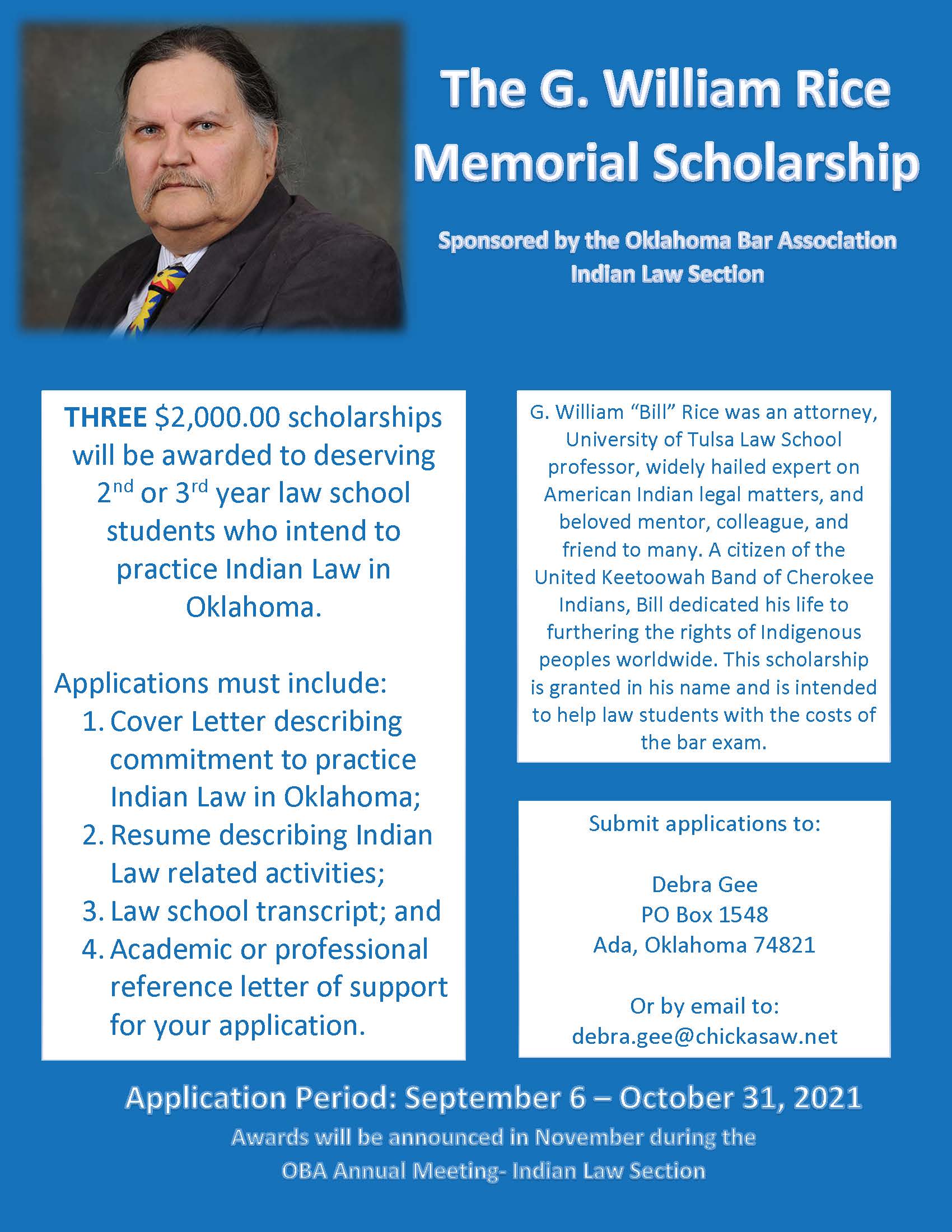
was an attorney, University of Tulsa Law School professor, widely hailed expert on American Indian legal matters, and beloved mentor, colleague, am friend to many. A citizen of the United Keetoowah Band of Cherokee Indians, Bill dedicated his life to furthering the rights of Indigenous peoples worldwide. This scholarship is granted in his name and is intended to help law students with the costs of the bar exam.
Applications due October 31st, 2021
Sponsored by the Oklahoma Bar Association Indian Law School
THREE $2,000.00 scholarships will be awarded to deserving second or third year law school students who intend to practice Indian Law in Oklahoma.
Applications must include:
Cover ketter describing commitmemnt to practice Indian Law in Oklahoma;
Resujme describing Indian Law related activities;
Law school transcript; and
Academic or porfessional reference letter of support for your application.
Submit applications to:
Debra Gee
PO Box 1548
Ada, Oklahoma 74821
Or by email to: debra.gee@chickasaw.net
Awards will be announced in November during the OBA Annual Meeting- Indian Law Section
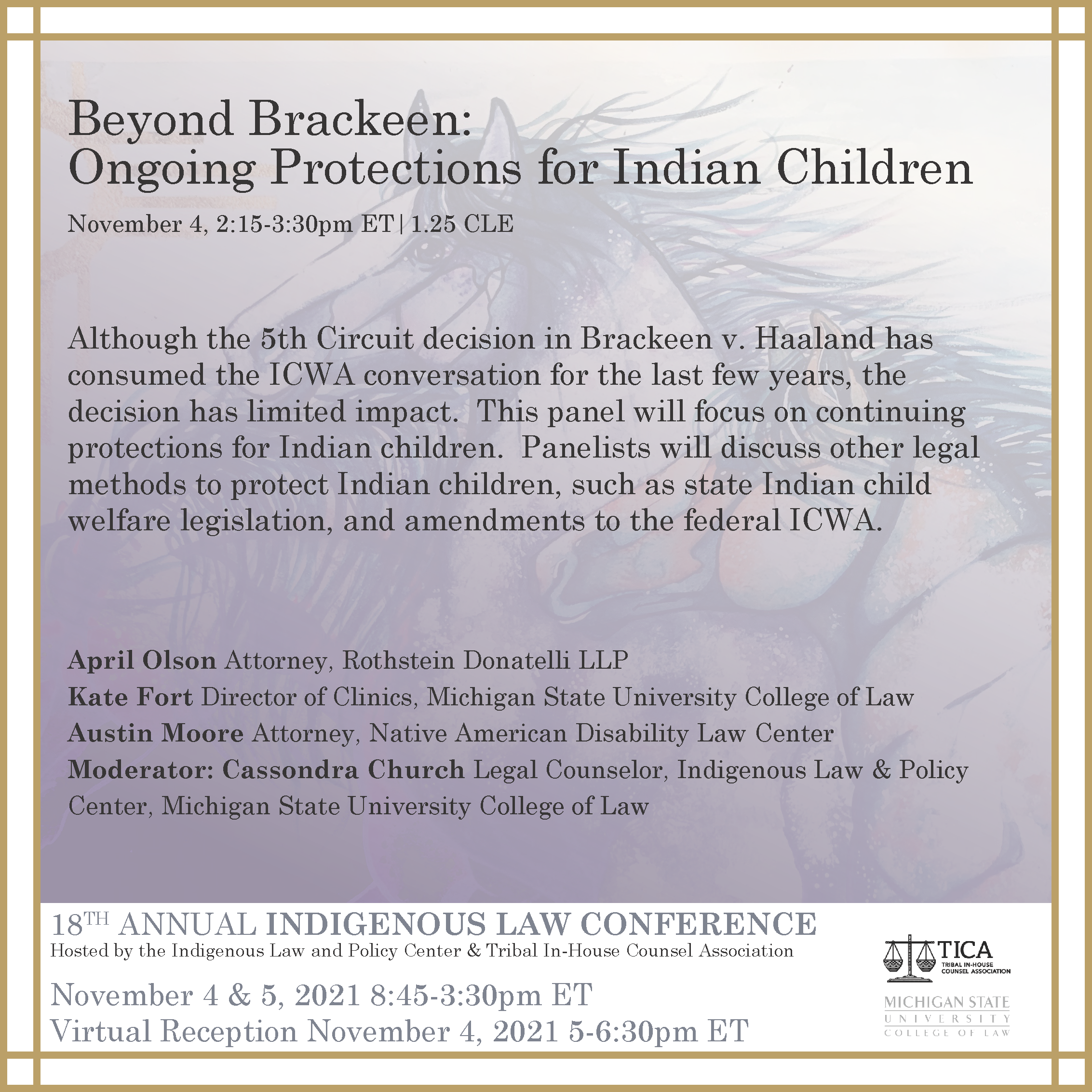
Beyond Brackeen: Ongoing Protections for Indian Children
November 4th, 2021 | 2:15pm-3:30pm ET | 1.25 CLE
Although the 5th Circuit decision in Brackeen v. Haaland has consumed the ICWA conversation for the last few years, the decision has limited impact. This panel will focus on continuing protections for Indian children. Panelists will discuss other legal methods to protect Indian children, such as state Indian child welfare legislation, and amendments to the federal ICWA.
Speakers include:
April Olson: Attorney, Rothstein Donatelli LLP
Kate Fort: Director of Clinics, Michigan State University College of Law
Austin Moore: Attorney, Native American Disability Law Center
Moderator – Cassondra Church: Legal Counselor, Indigenous Law & Policy Center, Michigan State University College of Law
Michigan Indian Legal Services and Uniting Three Fires Against Violence present a discussion with New York Times Best-Selling Author, Angeline Boulley. The author of Firekeeper’s Daughter will present with special legal guests and discuss the book, domestic violence, and criminal jurisdiction on tribal lands. The discussion will provide an interesting dissection of the relevant topics, along with the book’s unique setting in Michigan’s Upper Peninsula. Audience members are encouraged to bring their questions.
The Rennard Strickland Lecture Series was established in 2006 to honor the legacy of Dean Rennard Strickland and to build on his contributions to the field of Indian law and to legal education. The theme of the lecture series is the examination of native leadership and vision for environmental stewardship in the 21st century. This year’s speaker will be
Tribal consultation laws, whether at the federal, state, or county level, allow Indigenous people to directly participate in decisions that impact their daily lives from health to education and beyond. The presentation explains the variety of tribal consultation laws across US jurisdictions and policies that tribes can use to best suit their communities.
Speakers include:
Joe Sarcinella: Attorney, Drummond Woodsum
Wenona Singel: Associate Director & Professor, Indigenous Law & Policy Center, Michigan State University College of Law
Tehani M. Louis-Perkins: University of Hawai’i
Moderator – Ian F. Tapu: Law Clerk, Hawaii State Judiciary
Michigan Indian Services provides legal services statewide to income-eligible individuals and tribes, advocates for the rights of individuals that advances systems of justice, and works to preserve Indian families through state and tribal courts. The purpose of this survey is to identify the highest priorities related to legal services for low-income Native Americans.
MILS will use the results to prioritize services for the next seven years, so your participation is extremely important to us.
It will take approximately 15 minutes of your time, and you can choose to enter into a random drawing for a gift card valued at $ 100.00 at the end of the survey. Seven gift cards will be awarded. Should you choose to enter, you will be taken to another site to enter your contact information to ensure the anonymity of your responses to the survey questions.
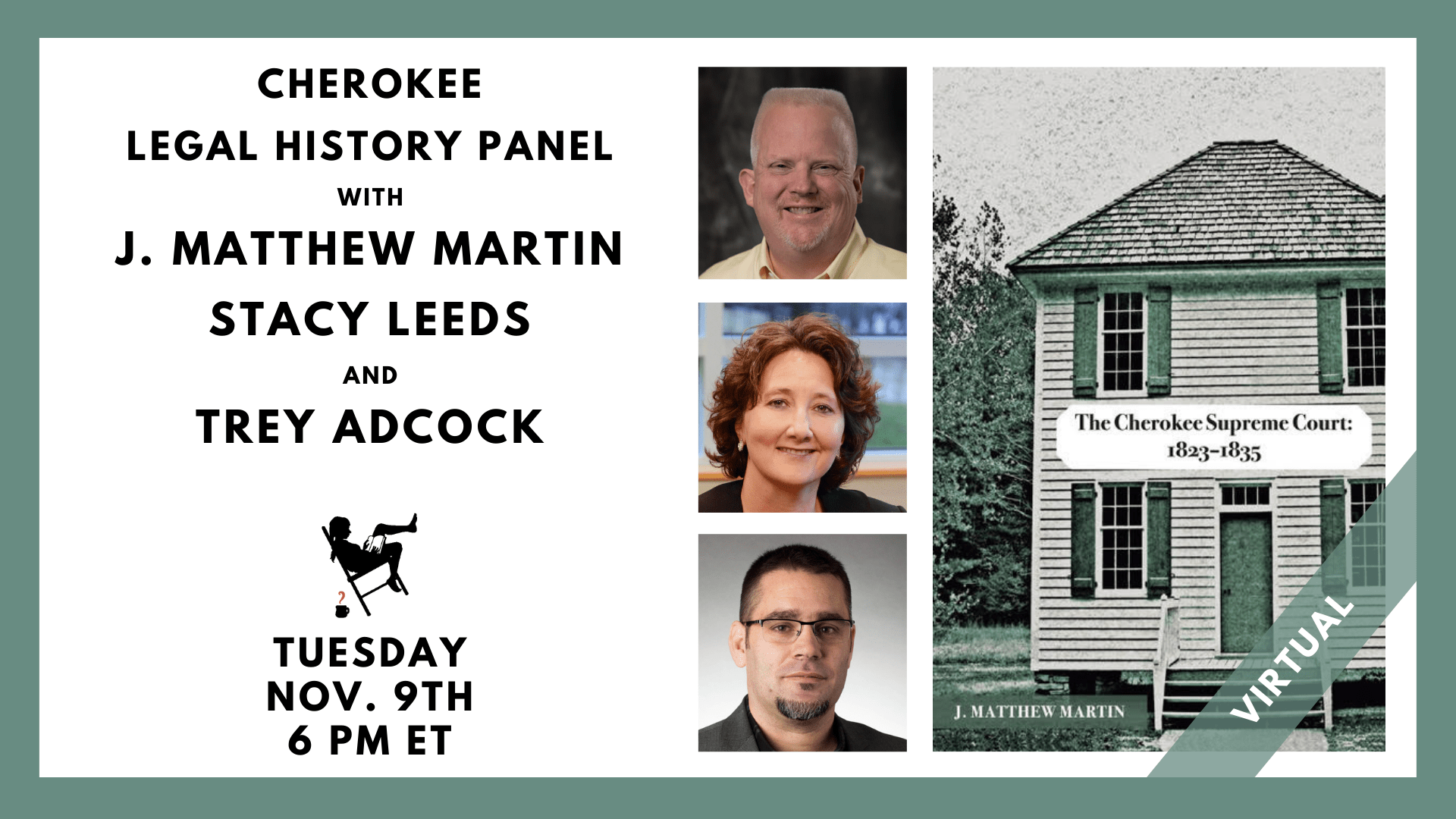
Cherokee Legal History Panel with J. Matthew Martin, Stacy Leeds, and Trey Adcock.
Tuesday, November 9th at 6:00pm ET
Like most of our events, this event is free, but registration is required. Click here to RSVP for this event. Prior to the event the link required to attend will be emailed to registrants.
If you decide to attend and purchase the authors’ books, we ask that you purchase from Malaprop’s. When you do this you make it possible for us to continue hosting author events and you keep more dollars in our community. You may also support our work by purchasing a gift card or making a donation of any amount below. Thank you!
About the Seminar:
The first legal history of the first tribal court upends long-held misconceptions about the origins of Westernized tribal jurisprudence. This book demonstrates how the Cherokee people—prior to their removal on the Trail of Tears—used their judicial system as an external exemplar of American legal values, while simultaneously deploying it as a bulwark for tribal culture and tradition in the face of massive societal pressure and change. Extensive case studies document the Cherokee Nation’s exercise of both criminal and civil jurisdiction over American citizens, the roles of women and language in the Supreme Court, and how the courts were used to regulate the slave trade among the Cherokees. Although long-known for its historical value, the legal significance of the Cherokee Supreme Court has not been explored until now.
About the Speakers:
J. Matthew Martin is the first American Bar Association (ABA) Tribal Courts Fellow. In 2013 he retired after over a decade of service as an Associate Judge of the Cherokee Court, the Tribal Court for the Eastern Band of Cherokee Indians. For over 25 years, Judge Martin has been Board Certified as a Specialist in Federal and State Criminal Law by the North Carolina State Bar. In the 1991 Term, at age 31, he argued Wade v. United States before the Supreme Court of the United States. Judge Martin has spoken nationally and internationally on issues ranging from federal Indian law to criminal law and the judicial process. He is published in multiple peer-reviewed periodicals.
Judge Martin received a BA with Honors from the University of North Carolina at Chapel Hill and a JD from the UNC School of Law. He also holds a Ph.D. in Judicial Studies from the University of Nevada-Reno. He has taught law students as an Adjunct Professor of Law at the UNC and Elon Schools of Law. He is a long-time member of the faculty of the National Judicial College and former Secretary to the College’s Board of Trustees.
Judge Martin was honored as a T.C. Roberson High School “Graduate of Distinction” and received the “Franklin Flaschner Award” from the ABA’s National Conference of Specialized Court Judges as the nation’s outstanding specialized court judge in 2014. The Cherokee Supreme Court: 1823-1835 is his first book.
Trey Adcock (ᏣᎳᎩᎯ ᎠᏰᎵ, Citizen of Cherokee Nation), PhD, is an associate professor of Interdisciplinary Studies and the director of American Indian and Indigenous Studies at the University of North Carolina Asheville. He currently serves as the Executive Director of the Center for Native Health and sits on the Editorial Board for the Journal of Cherokee Studies.
Stacy Leeds is Foundation Professor of Law and Leadership at Sandra Day O’Connor College of Law, Arizona State University. Leeds is Dean Emeritus, University of Arkansas School of Law (2011-2018) and the first Indigenous woman to lead a law school. Learn more at http://stacyleeds.com/biography
Friday, October 15, 2021 from 8:00 AM to 6:30 PM CDT
Where: Mystic Lake Casino Hotel 2400 Mystic Lake Blvd. Prior Lake, MN 55372
In previous years, the tribal leaders, scholars, and practitioners of our Indian law community gathered at the Federal Bar Association’s annual Indian Law Conference to share our knowledge, triumphs, and trials in the pursuit to protect the sovereignty of our tribal nations. As we return to congregating safely, our members now have the opportunity revive these important gatherings. In the spirit of perpetuating community, connection, and education in the Indian Law community, the Minnesota chapter of the Federal Bar Association along with the Minnesota American Indian Bar Association, the national FBA’s Indian Law Section, the New Mexico Chapter of the FBA, presents the 2021 Indian Law Seminar: Reconnecting Our Sovereign Nations. This seminar will run simultaneously with a seminar in New Mexico, and attendees will hear from two live panels and two simulcast panels in each state for CLE credit.
This event is the first of its kind within New Mexico and Minnesota. We will be hosting live sessions in both states while providing live simulcast to our partner state. Our aim is to provide participants in both states and surrounding jurisdictions with content relevant to attorneys who practice in the field of Federal Indian law.
Topics include: U.S. Supreme Court’s decision in United States v. Cooley ICWA, State ICWA laws, and possible implications of Brackeen v. Haaland Native Americans and the Criminal Justice System Yellen v. Confederated Tribes of the Chehalis Reservation
Note: We have added a virtual participation option also! The cost is the same, so please register using the link below, and then email Roshanna Toya at roshannak.toya@gmail.com to request a link to the presentations.



 Turtle Talk
You must be logged in to post a comment.