AK Bill Designed to Address Tununak ICWA Case Signed into Law by Governor Walker

Press Release here.

House Bill 200 was sponsored by Governor Walker, working in close collaboration with the Alaska Federation of Natives and Tribes. The bill is designed to correct and minimize recent legal barriers that were put in place for families interested in adopting Alaska Native children following the U.S Supreme Court Baby Girl Veronica decision and the Tununak litigation in the Alaska Supreme Court.

Bill here.

Oral Arguments in Gila River Indian Community v. Dept. of Child Safety et al

One of the children in this case was originally the named plaintiff in A.D. v. Washburn (also called Carter v. Washburn, or the Goldwater litigation). Goldwater is representing the foster parents in this case, now in state court. Tom Murphy, in-house at GRIC, is doing the oral argument for the tribe here.

Judge Ron Whitener and Kate Fort Presentations at NCJFCJ Annual Conference

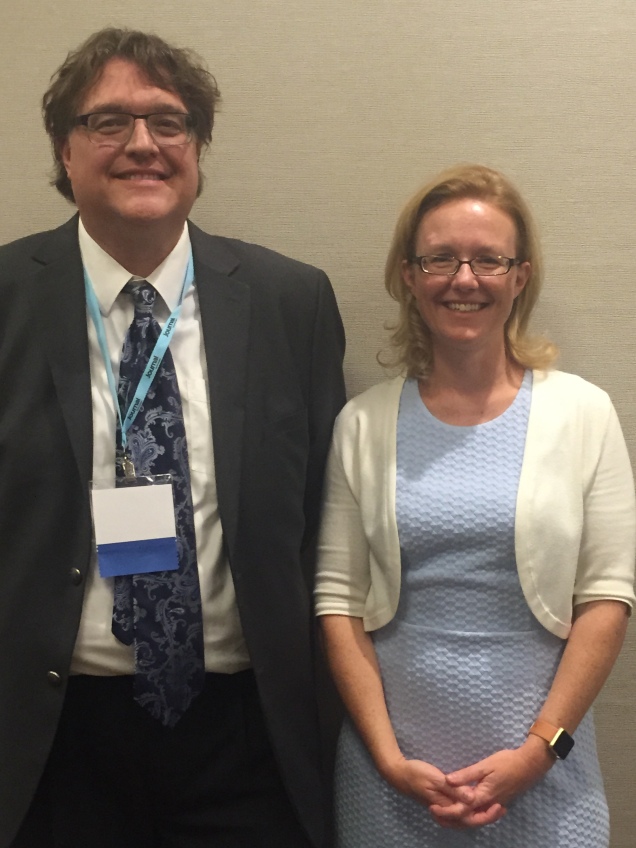
Judge Ron Whitener, Chief Judge of the Tulalip Tribal Court, was the first ever Native plenary speaker at NCJFCJ’s Annual Conference. He gave a presentation entitled “How State and Tribal Court Judges Can Work Together to Improve Outcomes.” Judge Whitener’s presentation was very well-received by the judges, and he received a standing ovation from the audience.

In addition, Kate Fort presented a well-attended session entitled “What State Court Judges Need to Know About ICWA.” Kate gave a brief update on recent court activity around ICWA and then summarized some key provisions in the new ICWA regulations. The judges were thrilled to receive this brand new and important information.

Thanks to both of them for their contributions to the conference and to NCJFCJ for its continuing commitment to tribal courts, tribal issues, and tribal-state collaborations.

IMG_4492

Globe and Mail Article on Cindy Blackstock

Here.

“What I saw were children being systemically removed from these communities. And I’d go to these communities, and there was no running water, and people would wonder why the kids weren’t clean, and I’d think maybe someone should do something about the water. We would see the multigenerational impacts of residential schools, and there are no mental-health services that are culturally appropriate. So there were all these layers of inequality and I started to realize it was the system, in many cases, that was creating conditions where families were not going to be successful in caring for their kids. And nobody was really holding the system to account.”


California Supreme Court Case on Active Efforts and Tribal Membership

Here.

The Court held this court rule to be invalid:

The rule provides: “If after notice has been provided as required by federal and state law a tribe responds indicating that the child is eligible for membership if certain steps are followed, the court must proceed as if the child is an Indian child and direct the appropriate individual or agency to provide active efforts under rule 5.484(c) to secure tribal membership for the child.” (Rule 5.482(c), italics added.) We conclude the rule is invalid as a matter of state law.

But this rule to be valid:

Rule 5.484(c)(2) provides: “In addition to any other required findings to place an Indian child with someone other than a parent or Indian custodian, or to terminate parental rights, the court must find that active efforts have been made . . . to provide remedial services and rehabilitative programs designed to prevent the breakup of the Indian family, and must find that these efforts were unsuccessful. [¶] . . . [¶] (2) Efforts to provide services must include pursuit of any steps necessary to secure tribal membership for a child if the child is eligible for membership in a given tribe, as well as attempts to use the available resources of extended family members, the tribe, tribal and other Indian social service agencies, and individual Indian caregivers.”


California Court of Appeals Finds No Good Cause to Deviate from Placement Preferences in Alexandria P. Case

Opinion here. The Court of Appeals upholds that the order placing Alexandria P. with her family in Utah.

Information page with previous posts and holdings here.

We have twice remanded the matter because the lower court used an incorrect standard in assessing good cause. The dependency court has now correctly applied the law governing good cause, considering the bond Alexandria has developed over time with the P.s, as well as a number of other factors related to her best interests. Those other factors include Alexandria’s relationship with her extended family and half-siblings; the capacity of her extended family to maintain and develop her sense of self-identity, including her cultural identity and connection to the Choctaw tribal culture; and the P.s’ relative reluctance or resistance to foster Alexandria’s relationship with her extended family or encourage exploration of and exposure to her Choctaw cultural identity.

And

The P.s also do not—and in our view cannot—provide an adequate response to an issue raised most effectively by minor’s appellate counsel. Even though they appear before the court by virtue of their status as de facto parents, the P.s’ efforts to show good cause are motivated by their own interests. Minor’s counsel, not the P.s, has a legal and ethical obligation to represent Alexandria’s interests.(In re Josiah Z. (2005) 36 Cal.4th 664, 675-677.) The P.s lack the right to assert Alexandria’s interests because Alexandria has her own counsel, who represents her interests and also acts as her guardian ad litem.
***

We recognize that the P.s are claiming that Alexandria’s best interests are served by a finding of good cause, but their argument is undermined by the fact that minor’s counsel argued just the opposite. We are unaware of any published case where a court has upheld a departure from the ICWA’s placement preferences contrary to the position of the minor. In other words, in every published case upholding a good cause finding,
counsel for the minor either advocated for the finding, was aligned with the party advocating for a finding of good cause, or was silent.

California Supreme Court on Issues ICWA Notice Opinion

Here.

This is the In re Isaiah H. decision, where amici included the United States and California Indian Legal Services on behalf of appellant mother. Briefing was completed in this case more than a year ago, and oral arguments were heard in May.

We granted review to decide whether a parent who does not bring a timely appeal from a juvenile court order that subsumes a finding of ICWA‘s inapplicability may challenge such a finding in the course of appealing from a subsequent order terminating parental rights. Because ICWA imposes on the juvenile court a continuing duty to inquire whether the child is an Indian child, we hold that the parent may a challenge a finding of ICWA‘s inapplicability in an appeal from the subsequent order, even if she did not raise such a challenge in an appeal from the initial order.

***

The continuing nature of a juvenile court‘s duty to inquire into a child‘s Indian status appears on the face of section 224.3(a). As noted, that provision reads: “The court . . . ha[s] an affirmative and continuing duty to inquire whether a child for whom a petition under Section 300 . . . has been . . . filed is or may be an Indian child in all dependency proceedings and in any juvenile wardship proceedings if the child is at risk of entering foster care or is in foster care.” (§ 224.3(a).) The plain language of this provision — declaring an “affirmative and continuing duty” that applies to “all dependency proceedings” — means that the juvenile court in this case had a present duty to inquire whether Isaiah was an Indian child at the April 2013 proceeding to terminate Ashlee‘s parental rights, even though the court had previously found no reason to know Isaiah was an Indian child at the January 2012 proceeding to place Isaiah in foster care. Because the validity of the April 2013 order is necessarily premised on the juvenile court‘s fulfillment of that duty, there is nothing improper or untimely about Ashlee‘s contention in this appeal that the juvenile court erred in discharging that duty.

Briefs here.

Motion and Briefing for Partial Summary Judgment in Oglala Sioux v. Fleming (Van Hunnik)

This filing is part of the ICWA class action case in South Dakota over the interpretation of 25 USC 1922 (emergency jurisdiction):

The third reason why this Court’s ruling on § 1922 has been inoperative is because the State’s Attorney for Pennington County, Defendant Mark Vargo, and the person Mr. Vargo has assigned to handle abuse and neglect cases in Pennington County, Deputy State’s Attorney Roxanne Erickson, see Erickson Dep. at 5-7, is failing to properly employ the federal standard. Indeed, Mr. Vargo’s interpretation of § 1922 threatens to forever prevent Plaintiffs from obtaining the benefit of this Court’s ruling on § 1922.6 The instant motion for partial summary judgment seeks to remove this final obstacle to the implementation of § 1922 in Defendants’ 48-hour hearings.

Plaintiffs deposed Ms. Erickson on May 25, 2016. Ms. Erickson testified that she interprets the word “harm” in § 1922’s standard “physical damage or harm” as including emotional harm. Id. at 131 made that ‘harm’ would also include emotional harm to the child. . . . [T]hat is how I would read it, that you have to show some form of harm which could include emotional harm.”). Thus, Defendant Vargo continues to use the state standard rather than the federal standard, given that Ms. Erickson interprets the federal standard to authorize DSS to consider emotional harm in determining whether to seek continued custody of an Indian child at the 48-hour hearing.

Motion for Partial Summary Judgment

Memorandum in Support of S.J.

Affidavit in Support of Motion

Statement of Undisputed Facts

Ex. 1-Vargo

Ex. 2-Vargo

Ex. 3-Vargo

Ex. 4-Vargo

Ex. 5-Vargo

Ex. 6-Vargo

Now Published Case out of California on Application of ICWA to Eligible Children

Here. (original unpublished opinion we posted last week). Appellants requested this opinion be published, so the published opinion is here.

We’d like to point out that the fact that mother was a minor and a dependent of the court meant that the state should have been treating MOTHER’S own case as an ICWA case, which does not seem to have happened (and if you’re keeping track, yes, I’ve now used italics, allcaps, AND red ink on this one).

In this case, BOTH the Red Cliff Band of Lake Superior Chippewa AND the Bad River Band of Lake Superior Chippewa Tribe responded to the Department’s notice. Both Bands stated the children were eligible for enrollment, and Red Cliff asked for more information. Mother was a minor and a runaway from her placement. But instead of sending the information, or following up to assist in getting the children enrolled, or provide active efforts, the Department requested the juvenile court find that ICWA did not apply. Which the juvenile court did. Specifically:

Our record discloses no further action after November 2013, until an interim review report, dated April 22, 2014, stated, “[i]t is respectfully requested that the Court make a finding as to the children’s Indian Child Welfare Act Status.” The report further stated that ICWA “does or may apply” as each child might be an Indian child in the Chippewa tribe and was ICWA “eligible” (capitalization & boldface omitted). SSA proposed the court find “ICWA does not apply,” and the juvenile court’s minute order, dated April 22, 2014, contains the finding, “ICWA does not apply.” In a minute order dated June 19, 2014, the juvenile court again stated: “Court finds ICWA does not apply.”

The Court of Appeals held:

Given the above cited authorities, the juvenile court erred by finding ICWA did not apply. Not only did insufficient evidence support that finding, but also two tribes responded to SSA’s ICWA notice, by stating that the children were eligible to enroll in them. The court was thereafter required to proceed as if the children were Indian children.

Under these circumstances, we must reverse the order terminating parental rights and remand with directions for the juvenile court to order SSA to make active efforts necessary to secure tribal membership for the children. (In re K.M. (2015) 242 Cal.App.4th 450, 458–459.)