Indian Law Resource Center Lewis and Sidley Fellowships 2015

INDIAN LAW RESOURCE CENTER
CENTRO DE RECURSOS JURIDICOS PARA LOS PUEBLOS INDIGENAS

Lewis and Sidley Fellowships 2015

Applications for the Summer 2015 Lewis and Sidley Fellowships are being accepted. The application deadline for Summer 2015 is December 19, 2014.

The Indian Law Resource Center is a non-profit legal advocacy organization dedicated to providing legal advice, assistance, and representation to Indian tribes and indigenous communities throughout the Americas. We are also committed to developing new attorneys in the fields of Indian law and international human rights law.

To this end, we offer several fellowship and clerkship opportunities in both our Helena, Montana and Washington, D.C. offices. These fellowship and clerkship opportunities require a minimum eight week commitment and entail legal research and writing on major Indian rights issues related to current projects of the Indian Law Resource Center. The Lewis and Sidley Fellowships both offer a stipend of $3,000 for the term of the Fellowship. Applicants are welcome to supplement this stipend with additional financial support through their law school’s public interest programs or through other public interest scholarships.

The John D. B. Lewis Fellowship is a competitive Fellowship awarded each year to a law student who shows particular promise for a career in international indigenous human rights issues.

The Terrance A. Sidley Fellowship is a competitive Fellowship awarded each year to a law student who shows particular promise for a career in federal Indian law and international indigenous human rights issues.

A limited number of unpaid, competitive legal clerkships are also available. Applicants for these clerkships are encouraged to seek their own financial support through their law school’s public interest programs or through other public interest scholarships.

To apply for a fellowship or clerkship, please email the following application materials to Marilyn Richardson at mt@indianlaw.org:

 Cover letter specifying the office in which you would prefer to work and whether you wish to be considered for the Lewis or Sidley Fellowships, or an unpaid clerkship position;

 Resume;

 Law school transcript;

 Legal writing sample; and

 Two letters of recommendation (preferably one from a current or former employer and one from a law school professor).

Please combine the application materials into one PDF attachment or note why you are unable to do so. We accept clerkship applications on a rolling basis, but to be considered for the Lewis or Sidley Fellowship your application must be received by December 19, 2014. Decisions regarding the Lewis and Sidley Fellowships will be made by January 14, 2015.

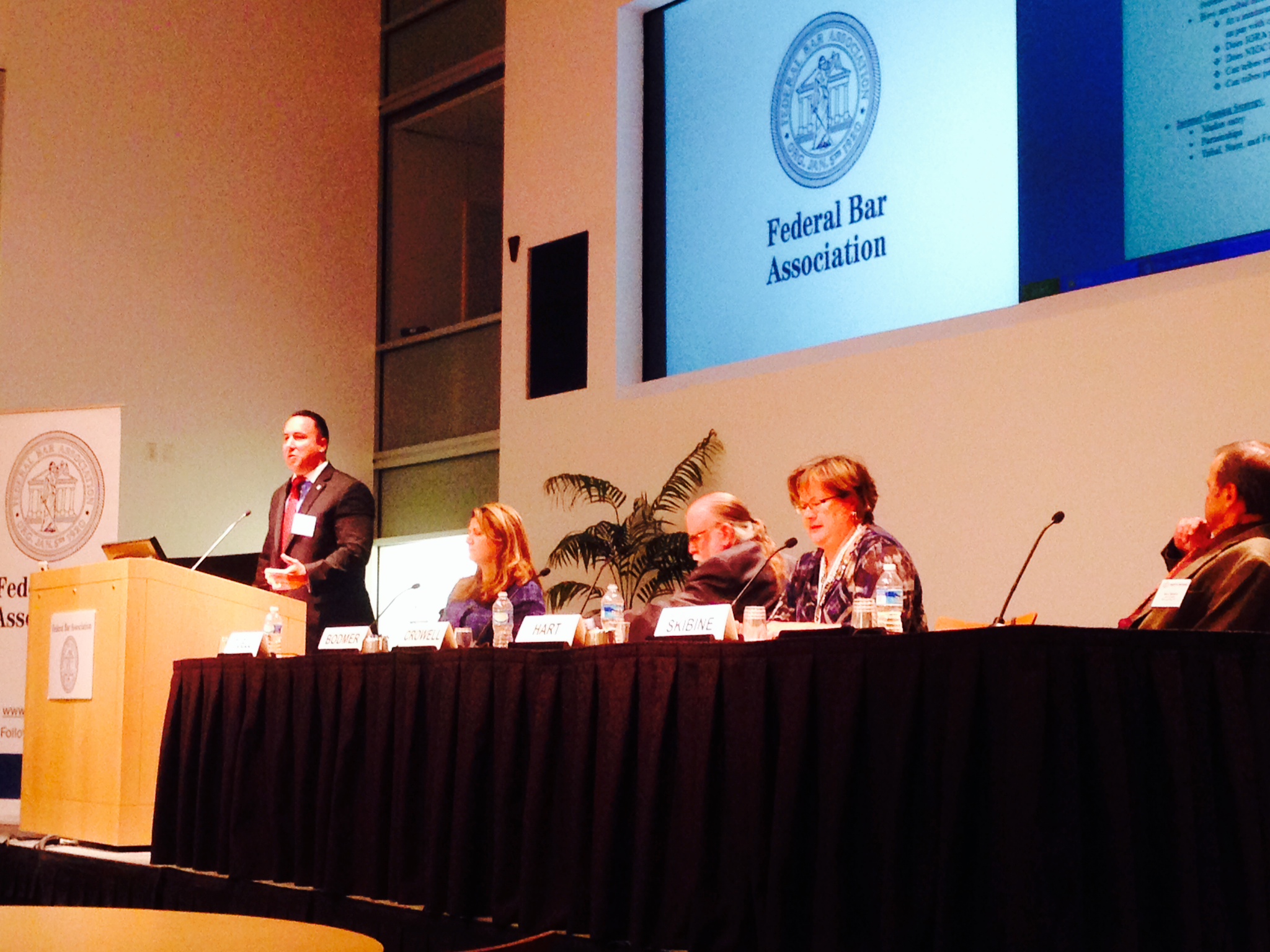
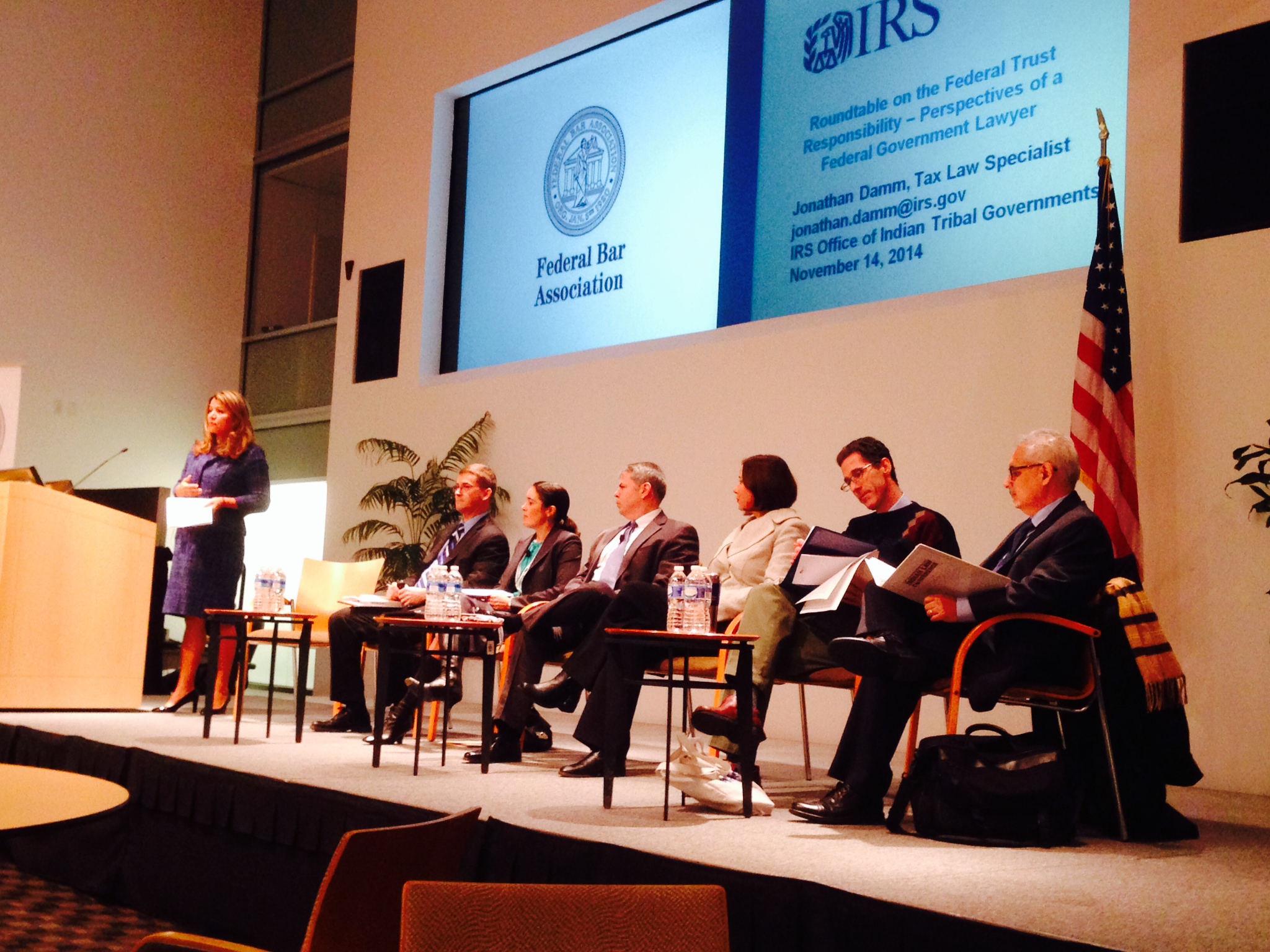
FBA DC Indian Law Conference: Photos

Panel 1
Roundtable on the Federal Trust Responsibility – Perspectives of a Federal Government Lawyer
Moderator: Loretta Tuell, Conference Co-Chair, Greenberg Traurig
Speakers:
Jonathan Binder, Environmental Protection Agency
Jonathan Damm, Internal Revenue Service
John Hay, National Indian Gaming Commission
Julia Pierce, Indian Health Service
Jeffrey Prieto, Acting General Counsel, U.S. Department of Agriculture
Venus Prince, Associate Solicitor of Indian Affairs
Maureen Rudolph, Environmental and Natural Resources Division, U.S. Dept. of Justice

Recognition
Federal Recognition
Moderator: Gina Allery, Conference Co-Chair, ENRD United States Dept. of Justice
Speakers:
Michael Anderson, Anderson Indian Law
Patty Ferguson-Bohnee, Director of the Indian Legal Clinic at the Sandra Day O’Connor College of Law
Pat Rogers, Office of Hawaiian Affairs
Heather Sibbison, Dentons

Keynote
Keynote
Kevin Gover, Director of the National Museum of the American Indian

Gaming 3
Indian Gaming Regulatory Act (IGRA)
Moderator: Loretta Tuell
Speakers:
Steve Bodmer, Deputy General Counsel, Pechanga Tribe
Scott Crowell, Crowell Law Office – Tribal Advocacy Group
Paula Hart, Director, Bureau of Indian Affairs – Office of Indian Gaming
Alex Skibine, Professor, College of Law, University of Utah

Ethics
Ethics
Moderator: Richard Guest, Native American Rights Fund
Speakers:
Rebecca Chapman, Chapman Law
Gabe Galanda, Galanda Broadman (via Skype)
Peter Lepsch, Lepsch Law Office

Energy
Tribal Energy Development
Moderator: Jennifer Turner, U.S. Dept. of the Interior – Office of the Solicitor
Speakers:
Paul Moorehead, Powers Pyles & Verville
Larry Roberts, Principle Deputy Assistant Secretary, Indian Affairs
Jennifer Weddle, Greenberg Traurig
Rollie Wilson, Fredericks Peebles & Morgan LLP

Michigan Law to Host Talk on the Treaty of Waitangi on Nov. 3

Richard Dawson, a scholar from New Zealand, will talk about modern issues of treaty and constitutional interpretation with a particular focus on the Treaty of Waitangi of 1840, between the British Crown and Maori chiefs on Monday, November 3 from 4:00 to 5:30pm in Hutchins Hall Room 236 .

The Treaty of Waitangi made various promises to the Maori, especially concerning the possession of land and fishing rights, which the New Zealand government, once it was established, systematically dishonored. In the past thirty years, the Treaty of Waitangi has gained in importance.  The central question is what weight, and interpretation, should now be given the the Treaty–by the courts, by the legislature, by the people.  This deeply contested issue in New Zealand has tremendous relevance for those concerned with aboriginal rights in the US, Canada, and elsewhere in the world, or with the question how a “constitution” can and should be defined.

Dawson, who has a Phd both  in Economics and in Law, presents a fresh look at the much-debated question of how to interpret treaties between indigenous peoples and settler states.  His book, “The Treaty of Waitangi and the Control of Language,” has been praised as the most important since Claudia Orange published her seminal study, “The Treaty of Waitangi” in 1987.

Dawson is also the author of “Justice as Attunement: Transforming Constitutions in Law, Literature, Economics, and the Rest of Life,” published in 2014 by Routledge. He is currently International Research Fellow at Mercer Law School in Macon, Georgia.

World Conference on Indigenous Peoples Poised to Launch a New Chapter in International Advocacy

(New York City) — The United Nations is prepared to adopt a formal document on Monday, Sept. 22, 2014, that will commit the UN and member states to take a number of actions to put into effect and encourage compliance with the UN Declaration on the Rights of Indigenous Peoples, which was adopted in 2007.  This UN action is set to take place as part of the two-day UN World Conference on Indigenous Peoples in New York City.

“The actions the UN is going to take will give lasting protection to the rights in the UN Declaration on the Rights of Indigenous Peoples,” said Robert Coulter, speaking on behalf of his own Indian nation, the Citizen Potawatomi Nation, and on behalf of the Indian Law Resource Center. “A permanent body in the UN system can do a great deal to assure that our rights are protected. Even more important, having Indian and other indigenous governments participating in the UN will assure that we are always here to defend our rights and to work with member states to resolve problems.”

The Conference document is expected to be adopted by consensus, without a vote, after months of drafting and consultations among member states of the UN and indigenous peoples from around the world, including more than 100 Indian tribes from the United States, as well as First Nations from Canada, and Indian nations from Central and South America.

Key elements of the outcome document:

  • Initiating a process to create a permanent body in the UN system that will monitor and encourage implementation of the Declaration;
  • Considering options for a General Assembly decision to make it possible for Indian tribal governments and other indigenous governments to participate in UN meetings on a permanent basis;
  • Giving particular attention to the epidemic of violence against indigenous women, including Indian and Alaska Native women in the United States; and
  • Measures to respect and protect places sacred to Indian and other indigenous nations and peoples.

The document, among many other things, also calls for a system-wide action plan to be developed for the UN system to bring greater coherence and effectiveness to the UN’s work relating to indigenous peoples.

The Indian Law Resource Center, an international human rights organization working on behalf of Indian and other indigenous peoples in the Americas, is one of the organizations that played a leading role in the preparations for the World Conference over the past two years.

This World Conference is the first time that large numbers of Indian and Alaska Native governments from the United States have been actively involved in UN work.  Jefferson Keel, Lieutenant Governor of the Chickasaw Nation and past president of the Nation Congress of American Indians, is one of those who has been prominently involved. “We are taking our places once again as members of the world community,”  said Keel.

According to Coulter, tribes are committed to working with the General Assembly and other UN bodies to see that the commitments in the outcome document are carried into effect in the months to come.

###

About the Indian Law Resource Center

The Indian Law Resource Center is a non-profit law and advocacy organization established and directed by American Indians. The Center is based in Helena, Montana and also has an office in Washington, DC.  The Center provides legal assistance without charge to Indian and Alaska Native nations who are working to protect their lands, resources, human rights, environment and cultural heritage. The Center’s principal goal is the preservation and well-being of Indian and other Native nations and tribes.  For more information, please visit us online at www.indianlaw.org or www.facebook.com/indianlawresourcecenter

United Nations Committee Calls for Intensified Efforts to Combat Violence Against Native Women

FOR IMMEDIATE RELEASE                             For more information contact:

September 9, 2014                                                                   Ginny Underwood

                                                                                                       (405) 229-7210

                                                                           Email: gunderwood@indianlaw.org

United Nations Committee Calls for Intensified Efforts to Combat Violence Against Native Women 

HELENA, Mont. ─ A UN Committee focused on eliminating race discrimination globally remains concerned that the United States continues to fall far short on protecting American Indian and Alaska Native women.

The UN Committee on the Elimination of Racial Discrimination released its Concluding Observations August 29, 2014. This follows its periodic review of the United States’ record in implementing a key human rights treaty ─ the International Convention on the Elimination of All Forms of Racial Discrimination. The report sites more than 20 areas of discriminatory laws, practices, and policies in the United States, including violence against women.  

“American Indian and Alaska Native women are denied meaningful access to justice and are less protected from violence than other women in the United States just because they are indigenous and are assaulted in Indian country or on Alaska Native lands,” said Jana L. Walker, senior attorney and director of the Indian Law Resource Center’s Safe Women, Strong Nations project.

According to statistics from the Department of Justice, American Indian and Alaska Native women are two and half times more likely to be assaulted in their lifetime than other women in the United States, and one in three Native women will be raped in her lifetime.

The Concluding Observations call on the U.S. “to intensify its efforts to prevent and combat violence against women, particularly against American Indian and Alaska Native women, and ensure that all cases of violence against women are effectively investigated, perpetrators prosecuted and sanctioned, and victims provided with appropriate sanctions.”

To inform the review, the National Congress of American Indians and Indian Law Resource Center, with endorsements from the National Indigenous Women’s Resource Center, Inc. and Clan Star, Inc., submitted a shadow report to the Committee, “Violence Against American Indian and Alaska Native Women ─ United States’ Violations of the International Convention on the Elimination of All Forms of Racial Discrimination.”

“The root cause of this human rights crisis is the legal framework that discriminates against Indian and Alaska Native nations and women,” says Lucy Simpson, Executive Director of the National Indigenous Women’s Resource Center. “The United States has long prohibited the 566 federally recognized Indian and Alaska Native tribes from prosecuting non-Indian offenders who commit many ─ in fact most ─ of the violent crimes against Native women. The passage of VAWA in 2013 begins to address this, but it does not go far enough.”

The Committee’s Concluding Observations follow similar ones it made in 2008. Juana Majel Dixon, Co-Chair of the National Congress of American Indians Task Force on Violence Against Women and Traditional Legislative Councilwoman for the Pauma Band of Luiseño Indians, worked on a similar shadow report in 2008. “Our message is the same ─ restoration of full tribal criminal jurisdiction, effective enforcement of tribal protection orders, and meaningful access to justice is absolutely critical in protecting American Indian and Alaska Native women from domestic and other violence within Indian country and Alaska villages,” says Majel Dixon.

The Committee acknowledged steps by the U.S. since 2008 ─ particularly the enactment of the Tribal Law and Order Act of 2010, which enhances tribal sentencing authority, and the Violence Against Women Reauthorization Act of 2013 (VAWA 2013), which includes an amendment restoring limited tribal criminal jurisdiction over certain non-Indians committing domestic violence, dating violence, or violate protection orders. But, as the Committee emphasized, this restored jurisdiction is limited.

Critical gaps in U.S. law remain, and the Committee reiterated its call for the United States “to take effective measures to guarantee, in law and practice, the right to access justice and effective remedies for all indigenous women who are victims of violence.”  

According to Lenora (Lynn) Hootch, Co-Chair of the National Congress of American Indians Task Force on Violence Against Women, one of the most discriminatory and egregious aspects of U.S. law is the special rule in VAWA 2013 that excludes all but one of the 229 Alaska Native villages from the new lifesaving protections in the tribal amendment. Hootch, who also serves on the Tribal Council for the Village of Emmonak in Alaska and is a Board Member of the National Indigenous Women’s Resource Center, notes that “Alaska Native women and girls experience epidemic levels of violence and have the highest rate of sexual assault in the country, yet the United States and Alaska have long supported laws limiting Alaska tribal governments ability to protect their citizens, including their women and children from violence.”

Recommendations from the international community, including this Committee’s Concluding Observations, send a strong message to the United States that immediate steps are needed to fix the legal system and restore safety to American Indian and Alaska Native women.

For a copy of the Committee’s Concluding Observations and the shadow report, “Violence Against American Indian and Alaska Native Women ─ United States’ Violations of the International Convention on the Elimination of All Forms of Racial Discrimination,” visit http://www.indianlaw.org.


###

Partner Organizations

About the National Congress of American Indians

Contact: Sarah Beccio, Communications Associate

(202) 466-7767, email: sbeccio@ncai.org

The National Congress of American Indians is the oldest and largest national organization of American Indian and Alaska Native tribal governments, and is dedicated to ending the epidemic of violence against American Indian and Alaska Native women. In 2003, NCAI created the NCAI Task Force on Violence Against Women to address and coordinate an organized response to national policy issues regarding violence against American Indian and Alaska Native women. (www.ncai.org).

About the National Indigenous Women’s Resource Center

Contact: Jacqueline Agtuca, Law and Policy Consultant

(406) 477-3896, email: jagtuca@niwrc.org

The National Indigenous Women’s Resource Center, Inc. is a non-profit organization that provides technical assistance, policy development, training, materials, and resource information on violence against Native women and the development of tribal strategies and responses to end the violence. (www.niwrc.org).

About the Indian Law Resource Center

Contact: Ginny Underwood, Communication Director

(405) 229-7210, email: gunderwood@indianlaw.org

Founded in 1978 by American Indians, the Indian Law Resource Center is a non-profit organization established and directed by American Indians. The Center provides legal assistance to indigenous peoples of the Americas to combat racism and oppression, to protect their lands and environment, to protect their cultures, to achieve sustainable economic development and genuine self-government, and to realize their other human rights. (www.indianlaw.org).
Cert Stage Briefs in Dollar General v. Mississippi Choctaw

Here:

Dollar General Cert Petition

Mississippi Choctaw Cert Opposition

Dollar General Reply

Mississippi Choctaw Supplemental Brief

En banc petition materials here.

CA5 Order Denying Dolgencorp En Banc Petition

Panel materials here.

Lower court decision and materials here.

Reminder: Apply to Clerk at NARF by September 29, 2014

Don’t forget to get your application in to Clerk at the Native American Rights Fund (“NARF”) by September 29, 2014. Founded in 1970, NARF is the oldest and largest nonprofit law firm dedicated to asserting and defending the rights of Indian tribes, organizations, and individuals nationwide. NARF’s practice is concentrated in five key areas: the preservation of tribal existence; the protection of tribal natural resources; the promotion of Native American human rights; the accountability of governments to Native Americans; and the development of Indian law and educating the public about Indian rights, laws, and issues.

Summer Clerkships
NARF is currently seeking candidates for its Summer 2015 Clerkships! Each year, NARF conducts a nation-wide search for law students to participate in its Law Clerk Program. Positions are available in all three of NARF’s offices: Anchorage, AK; Boulder, CO; and Washington, D.C.

Here is the advertisement.

To learn more about NARF’s work, go to its website.  

First Assignment for Advanced Topics in Indian Law: ICWA

First assignment for students in this class on Monday at MSU Law is here.

It appears there was a mix up on the official “First Assignment” page.

Assistant Secretary Washburn to Keynote 2014 MSU Indigenous Law Conference

We are pleased to announce that Assistant Secretary for Indian Affairs Kevin K. Washburn ASIA KKWhas been confirmed to serve as the keynote speaker for our 2014 annual conference, which will take place on November 20-21, 2014.

This year’s conference is titled “Dismantling Barriers in American Indian Education.” We have a working website describing the conference but the timing of the panels are still in flux, and so the agenda is still tentative. More details soon!

Miigwetch!

Matthew, Wenona, Kate, and the rest of the ILPC

ABA Now Recognizes Members of Tribal Bar Associations

The American Bar Association (ABA) recently adopted an ABA Constitutional change so that the ABA now  recognizes members of tribal bar associations as full members of the ABA – at long last putting tribal court bar membership on equal footing with the bars of states, territories and possessions of the United States.  

  • 3.1 Members. Any person of good moral character in good standing at the bar of a state, territory, possession, or tribal court of any federally recognized tribe of the United Statesis eligible to be a member of the Association in accordance with the Bylaws.