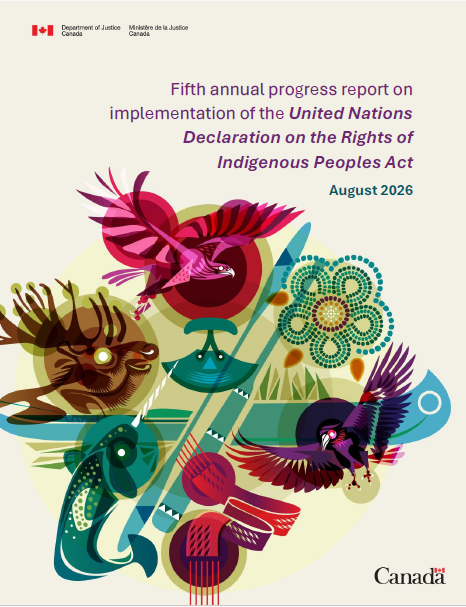
On August 28, Canada’s Justice Department released the fifth annual progress report under its statute called the United Nations Declaration on the Rights of Indigenous Peoples Act. The statute requires the federal government, in consultation and cooperation with Indigenous peoples, to take measures necessary to make Canadian laws consistent with UNDRIP. The report covers implementation of a 181-measure Action Plan and includes an Indigenous-led Action Plan Advisory Committee.
The report is interesting because it shows how five years after Canada made UNDRIP implementation a matter of federal law, it exposes what legal implementation actually requires, and where it breaks down.
This chapter addresses two broad themes within the United Nations Declaration on the Rights of Indigenous Peoples (UNDRIPS): self-identification and membership, as addressed in international jurisprudence on UNDRIP Article 33. The article protects the rights of Indigenous Peoples to ‘determine their own identity or membership in accordance with their customs and traditions’. It should be read with Article 9, which protects the right of individuals ‘to belong to an indigenous community or nation’. Together the articles protect both individual and collective self-identification, but UNDRIP does not specify what should happen when groups and individuals disagree on a person’s membership status. Recent applications of the UNDRIP in international forums link ‘self-identification’ to collective self-determination, in a way that prioritises the authority of group decisions on membership. This is a positive step that promises a more nuanced and jurisdictional approach to identity issues, one that supports the authority of Indigenous law and can potentially bring international human rights law closer to a fully realised appreciation of Indigenous-State legal pluralism. This chapter outlines the history of Article 33, discusses its recent application and interpretation and explains its potential impact on membership disputes.
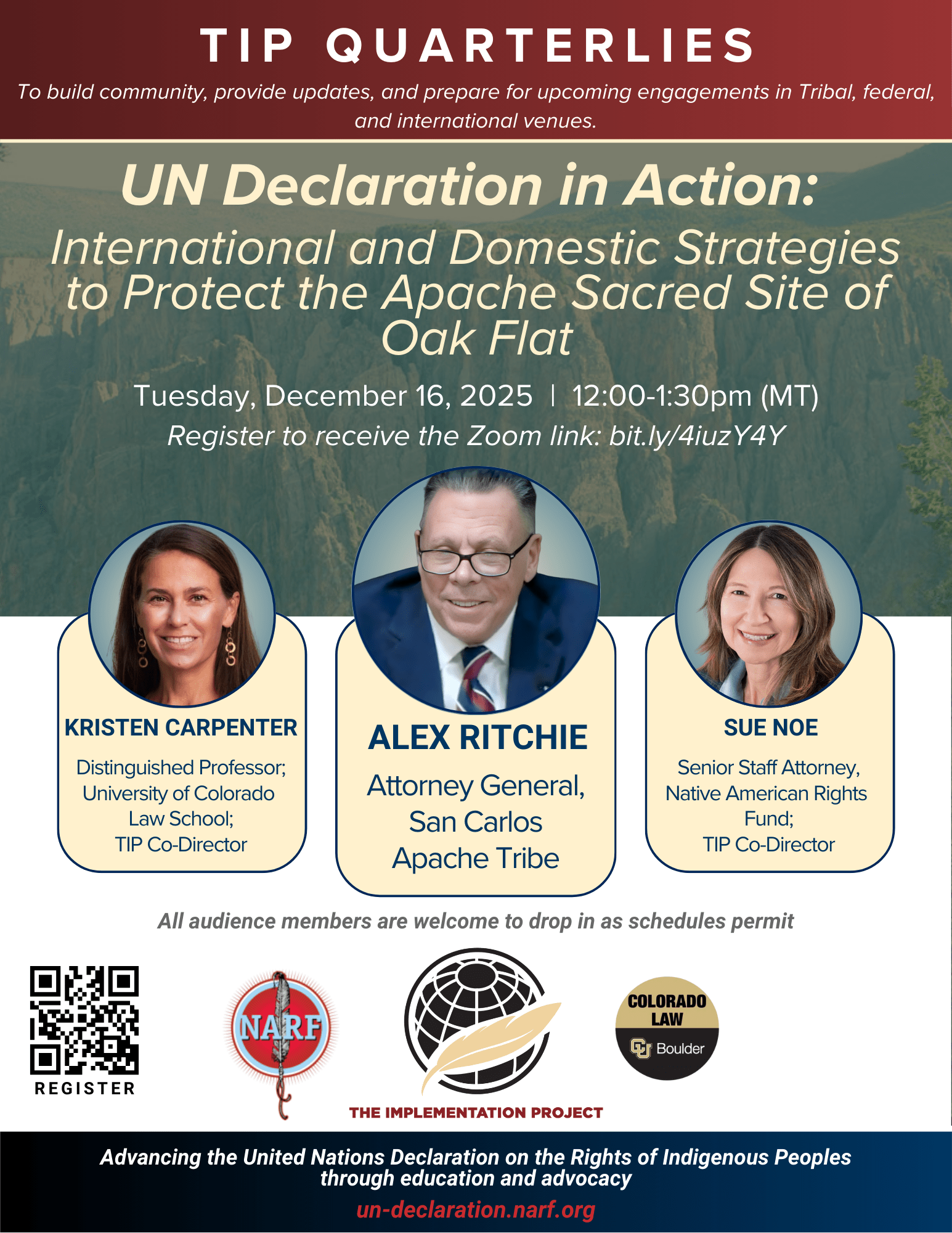
The Implementation Project will be hosting the next TIP Quarterly Meeting on December 16, 2025 from 12:00-1:30 PM (Mountain Time).
“UN Declaration in Action: International and Domestic Strategies to Protect the Apache Sacred Site of Oak Flat” will feature Mr. Alex Ritchie, San Carlos Apache Tribe Attorney General. Join us to explore the ongoing efforts to defend Oak Flat and the role the UN Declaration on the Rights of Indigenous Peoplesplays in shaping these strategies. This webinar will offer valuable insights for anyone interested in Indigenous rights, cultural preservation, or Tribal advocacy. Moderated by TIP Co-Directors: Prof. Kristen Carpenter and Ms. Sue Noe.
The United Nations Declaration on the Rights of Indigenous Peoples (UNDRIP) is the leading international instrument articulating the individual and collective rights of Indigenous Peoples. It recognizes that Indigenous Peoples have fundamental rights to freedom, equality and non-discrimination, as well as rights related to self-determination, life, land, religion and culture. The UNDRIP underscores the interrelatedness of efforts to ensure that Indigenous Peoples can live free from violence, take care of their children, revitalize their languages, and participate in lawmaking that affects them, among other rights and interests.
The product of decades of advocacy by Indigenous leaders, the UNDRIP is now embraced by all 193 Member States of the United Nations, including the United States. In 2014, at the conclusion of the World Conference on Indigenous Peoples, the United States joined a consensus resolution of the United Nations General Assembly committing to take measures to achieve the ends of the UNDRIP.
More specifically, the United States committed to “taking, in consultation and cooperation with Indigenous Peoples, appropriate measures at the national level, including legislative, policy and administrative measures, to achieve the ends of the Declaration and to promote awareness of it among all sectors of society, including members of legislatures, the judiciary and the civil service.” The United States further committed to “cooperate with Indigenous Peoples, through their own representative institutions to develop and implement national action plans, strategies or other measures, where relevant, to achieve the ends of the Declaration.”
Consistent with this commitment, during the Biden-Harris administration, the Interior Department along with other federal agencies have undertaken certain measures to achieve the ends of the UNDRIP, and advance the rights of American Indian, Alaska Native, and Native Hawaiian peoples.
It will be important for the United States, working with Indigenous Peoples, to continue to take measures to achieve the ends of the UNDRIP going forward.




You must be logged in to post a comment.