The event is tomorrow at 2pm in the Castle Board Room.

You can read more about Prof. Duthu’s book here.
Chi-miigwetch Bruce! And congrats!
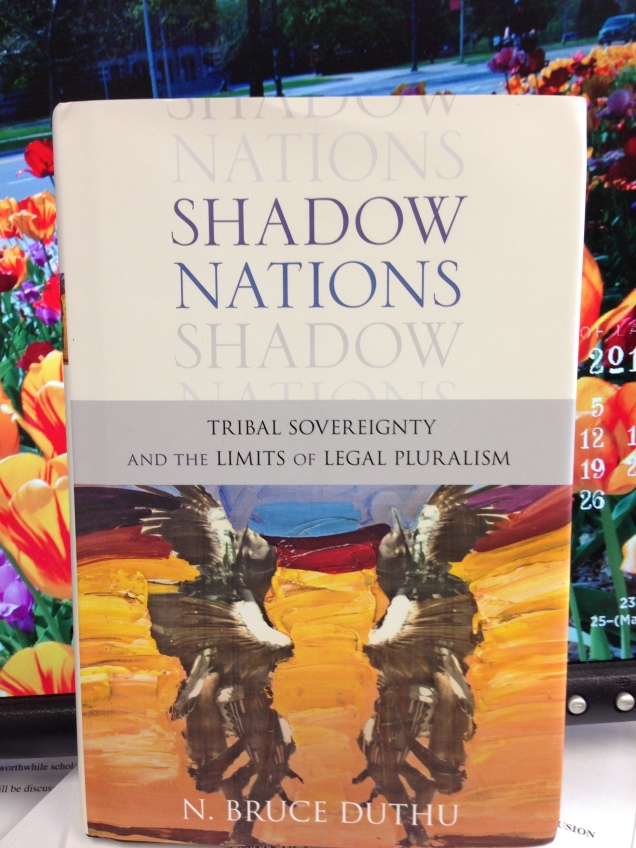

Unfortunately the article isn’t available online, but it includes snippets of an interview with Louise Erdrich, a discussion of The Round House, and some comments by both Erdrich and Professor Bruce Duthu on the problems with the current criminal jurisdiction framework on reservations. Here’s further information about where to find it.
From the NYTs:
ONE in three American Indian women will be raped in their lifetimes, statistics gathered by the United States Department of Justice show. But the odds of the crimes against them ever being prosecuted are low, largely because of the complex jurisdictional rules that operate on Indian lands. Approximately 275 Indian tribes have their own court systems, but federal law forbids them to prosecute non-Indians. Cases involving non-Indian offenders must be referred to federal or state prosecutors, who often lack the time and resources to pursue them.
The situation is unfair to Indian victims of all crimes — burglary, arson, assault, etc. But the problem is greatest in the realm of sexual violence because rapes and other sexual assaults on American Indian women are overwhelmingly interracial. More than 80 percent of Indian victims identify their attacker as non-Indian. (Sexual violence against white and African-American women, in contrast, is primarily intraracial.) And American Indian women who live on tribal lands are more than twice as likely to be raped or sexually assaulted as other women in the United States, Justice Department statistics show.
 Turtle Talk
You must be logged in to post a comment.