Call for Papers — Univ. of Oregon — Alternative Sovereignties

Conference Proposal: Alternative Sovereignties

Call For Papers

“Alternative Sovereignties: Decolonization Through Indigenous Vision and Struggle”

To be held at the University of Oregon, May 9, 2014.

The concept of “sovereignty” as both an international political norm and expression of cultural distinctiveness and political autonomy is central to American Indian and First Nations discourse in the United States and Canada. Yet this language is often an imperfect reflection of the goals that tribal nations seek to pursue, suggesting rigid political and social boundaries around and within indigenous nations. This stands in stark contrast to political relationships based in tribal epistemologies that acknowledge social flexibility, interdependence, reciprocity and non-coercive, respectful relationships between and within national communities.

This conference will explore both “alternative sovereignties” and “alternatives to sovereignty” that might better meet the political, cultural and social aspirations of American Indian and First Nations communities. We are especially interested in the relationship between vision and struggle. “Vision” theorizes alternative forms of sovereignty that might better reflect the social and political goals of American Indian and First Nations. “Struggle” interrogates the rhetorical, representational and discursive strategies necessary to pursue these visions within adversarial cultural and political environments still defined by colonial power.

Potential questions for investigation the following: What might visions of “alternative sovereignties” or “alternative to sovereignty” look like? What values, hopes and aspirations would they express? In what ways do such visions align or exist in tension with contemporary expressions of the nation, sovereignty, self-determination and human rights both in Indian Country and beyond? What forms of contemporary political and social struggle will best allow Native peoples to develop and advance tribal visions that might substantively revise or intervene in non-tribal fields of power and knowledge? Finally, what are the theoretical and practical relationships between “vision” and “struggle,” and what role does Indigenous cultural and intellectual production serve in advancing these efforts? Reflecting the interdisciplinarity of Native Studies, the conference is committed to conversation across historical periods and academic and institutional boundaries, including literature, law, philosophy, cultural studies, political science, education, anthropology, history and the arts.

Please send brief proposals of no more than 300 words to alternative.sovereignties@gmail.com by September 1, 2013. Also include brief biographical information, including for example academic affiliation, primary area of research, and relevant experience. Applications from the broader Northwest or dealing with issues relevant to Northwest indigenous nations are especially welcomed. For questions, please contact the conference organizers at the address above.
AALS Indian Nations and Indigenous Peoples Section Call for Papers

Indian Nations and Indigenous Peoples Section of the AALS

Call for Papers for the AALS Annual Meeting

New York City, NY, Jan. 2-5, 2014

The AALS Indian Nations and Indigenous Peoples Section invites submissions on the topic “The Relationship Between Indian Law and Tribal Law” for the Section’s 2014 AALS conference panel. The American Indian Law Review has agreed to publish selected papers associated with this call (the Law Review of course reserves the final publication decision). Please submit full papers, not just abstracts, to the Section Chair, Ezra Rosser, at erosser@wcl.american.edu, by August 1, 2013. We anticipate interpreting the topic broadly, so please submit if you are doing work related to this year’s topic! The Section Executive Committee (in connection with the Law Review) will inform you if you have been chosen to be on the panel by August 14, 2013 so that you will know in time for the Spring Law Review submission cycle.

Indigenous Law Journal Call for Submissions: Oct. 1, 2012 Deadline

Details here:

Call for Submissions Fall 2012

American Indian Justice Conference Call for Papers

The conference is June 4-6, 2012. Deadline for submissions is April 26, 2012. The submission form is here.  Conference information can be found here.

ABOUT THE CONFERENCE:
The American Indian Justice Conference is an annual event that is supported by funding from the Bureau of Justice Assistance through the Tribal Court Assistance Program and the Indian Alcohol and Substance Abuse Program.

The 1st Annual American Indian Justice Conference was held in Fort McDowell, AZ and was the culmination of a collaborative planning effort between the Tribal Judicial Institute and Fox Valley Technical College. Due to an overwhelmingly positive response to the past four American Indian Justice Conferences, this year’s partners, the University of North Dakota, Fox Valley Technical College and The National Judicial College, along with the host Tribe are pleased to announce the 5th Annual American Indian Justice Conference. The partners, along with this year’s host Tribe, will hold the event at the Grand Traverse Resort, Acme, MI (10 minutes from the Cherry Capital Airport).

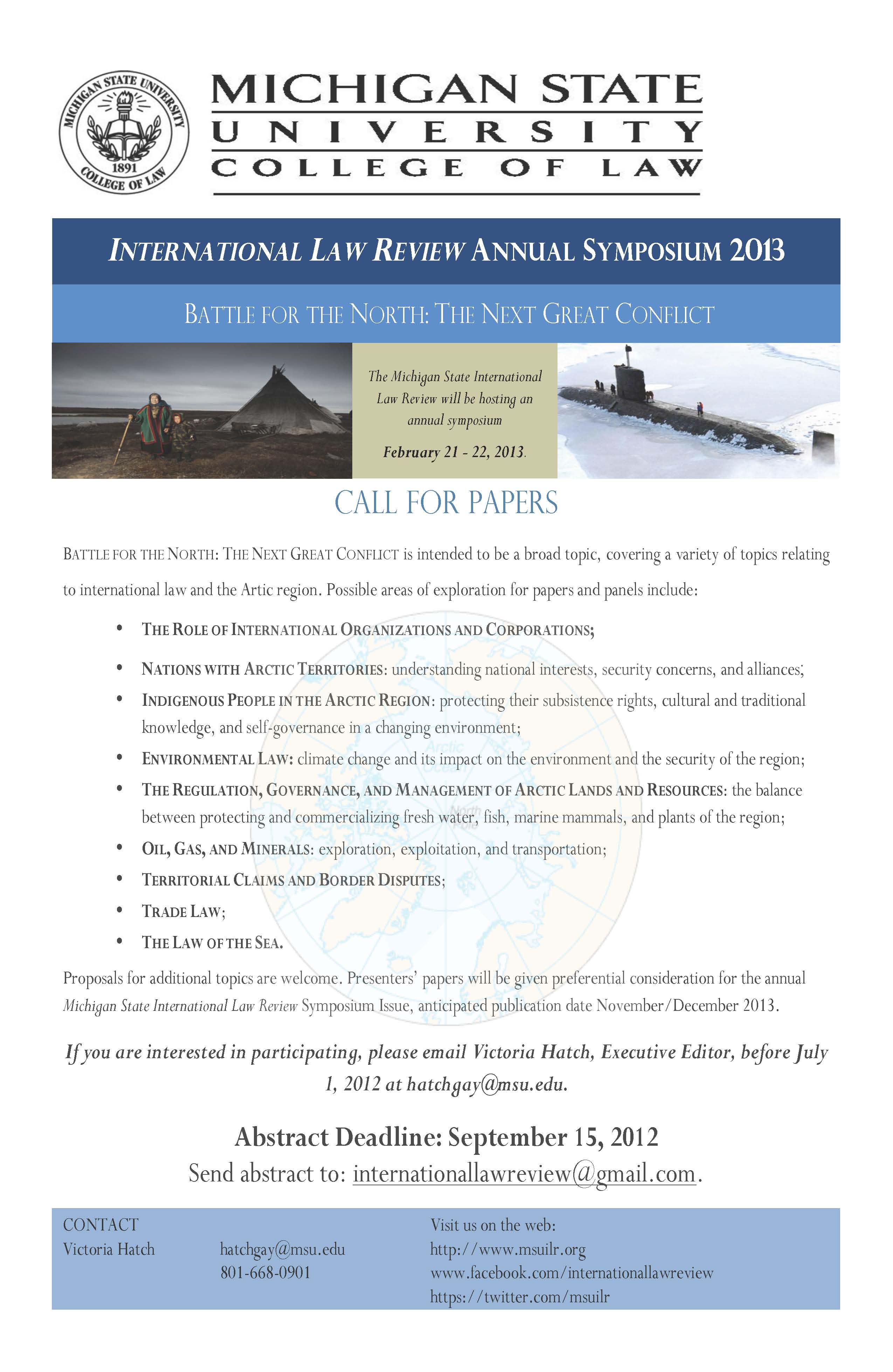
MSU International Law Review Call for Papers: Battle for the North — The Next Great Conflict

Continue reading

Call for Papers: Seattle Journal of American Indian Law

A new on-line publication has been approved for provisional status at the Seattle University School of Law, called the Seattle Journal of American Indian Law (“Journal”). To earn full accreditation, an internal trial issue will be published and circulated within the Law School. The trial issue will show the faculty and administration the caliber of substance and high level of scholarship the Journal would provide.

The editorial Board of the Journal is currently seeking articles for the trial issue. Because it is still a trial issue, they will not seek rights to any submitted content. They are looking for shorter articles, and the due date for submitting confirmation of interest and an abstract is November 20, 2011.

If interested, or if you have any questions about the Journal, please contact Stacy DeMass at demasss@seattleu.edu.

Indigenous Law Journal 2012 Call for Papers

Here.

Call for Submissions Winter 2012

Michigan State Law Review CFP

The Michigan State University Law Review is holding a symposium, “Gender and the Legal Profession’s Pipeline to Power,” April 12-13, 2012.  The symposium will serve as a catalyst to raise awareness about, discuss the dynamics of, and strategize solutions to the persistent gender disparity that exists in positions of power in the legal profession.  Scholars and experts from the fields of law, political science, journalism, and beyond will reframe and advance the course of existing dialogue on gender equality.

We are pleased to announce that the symposium will be taking place in Detroit, Michigan, at the historic Westin Book Cadillac Hotel.  MSU College of Law has its roots in this city; as Detroit College of Law it was one of the first institutions of higher education to open its doors to women and minorities, admitting Lizzie McSweeney into its inaugural class of students in 1891.  Thus it is incredibly fitting that this symposium takes place in the very city where our school was founded, remembering our legacy while also looking to the future.

Just as MSU College of Law was among the first to offer women equal access to a legal education over 50 years before many other institutions began to do so, we now seek to continue this tradition by advancing the conversation on how to resolve remaining gender disparity.

Confirmed participants to date include:

Hannah Brenner (Michigan State), Douglas Branson (Pittsburg), Keith Bybee (Syracuse University), Bridget Crawford (Pace), Christine Corcos (Louisiana State), Lee Epstein (Southern California), Erika Falk (Johns Hopkins), Judge Nancy Gertner (Harvard), Carol Greenhouse (Princeton), Linda Greenhouse (Yale), Joan Howarth (Michigan State), Sally Kenney (Tulane), Renee Newman Knake (Michigan State), Paula Monopoli (Maryland), Carla  Pratt (Penn State), Deborah Rhode (Stanford), Lori Ringhand (Georgia), Julie Suk (Cardozo), and Angela Onwuachi Willig (Iowa).

This announcement invites proposals from individuals across disciplines who are interested in contributing to this conversation by speaking on a panel at the symposium.  We especially encourage proposals from junior scholars and new voices focusing their work on the issues that will be explored through this event.  Submissions must include a title and abstract of no more than 1,000 words, due by November 15, 2011.  Please include your full contact information, including an email, phone number, and mailing address.  Participants will be notified about their acceptance by December 2011.  Some participants may have the opportunity to publish their paper as part of a special symposium issue of the MSU Law Review (please indicate if you are interested in having your paper considered for this purpose in your submission).

For questions or to submit a proposal, please contact:

Hannah Brenner, Lecturer in Law & Co-Director, Kelley Institute of Ethics and the Legal Profession at hbrenner@law.msu.edu or

Renee Newman Knake, Associate Professor of Law & Co-Director, Kelley Institute of Ethics and the Legal Profession at rk@law.msu.edu

If submitting a proposal, please include in the subject line MSU Call for Papers.

For more information about the event, please visit www.law.msu.edu/pipeline


2011 Indigenous Law Journal Call for Papers

Here:

Call for Submissions Fall 2011.

Deadline: September 30, 2011

The Indigenous Law Journal is dedicated to developing dialogue and scholarship in the field of Indigenous legal issues, both within Canada and internationally. We encourage submissions from all perspectives on these issues. Our central concerns are Indigenous legal systems and the interaction of other legal systems with Indigenous peoples.

We are the only legal periodical in Canada with this focus. We welcome the addition of your voice to the discussion.

Submissions must conform to the Canadian Guide to Uniform Legal Citation, 7th Edition.

For full details on the submissions process and student awards, please see: www.indigenouslawjournal.org
or send submissions to submissions.ilj@utoronto.ca

Continue reading

Gonzaga Law Review CFP: Modern Issues of Tribal Sovereignty and Jurisdiction

Call for Papers

 GONZAGA LAW REVIEW

Volume 47:3

 Modern Issues of Tribal Sovereignty and Jurisdiction

 Gonzaga University has historically concerned itself with the advancement of Native rights.  Father Joseph Cataldo, S.J., founded the university in 1887 as a missionary school with a primary purpose of offering education to northwestern tribal children.  This commitment has grown over the years and is exemplified by the business school’s American Indian Entrepreneurship Program and the law school’s Indian Law Clinic.

Today, we further affirm this commitment and announce that Volume 47:3 of the Gonzaga Law Review will be devoted to Modern Issues of Tribal Sovereignty and Jurisdiction.  Some of the topics that we hope to explore include, but are not limited to:

·      Public Law 83-280 and the interplay between federal, state, and tribal jurisdiction

·      Tribal court jurisdiction and non-Indian activities and lands

·      Immigration and extradition between tribal and non-tribal lands

·      The Washington State Indian Child Welfare Act and any effects it implicates on implementation of the Federal Indian Child Welfare Act

Submissions, paper proposals, and questions should be sent to Mark Melter at mmelter@lawschool.gonzaga.edu.  Final drafts of accepted submissions are due on December 1, 2011.  Volume 47:3 will be published in April 2012.  The Gonzaga Law Review and the Indian Law Clinic are also considering a conference in Spring 2012 to coincide with the release of the issue.  Please indicate in your submission whether you have interest in participating in a potential conference regarding modern issues of tribal sovereignty and jurisdiction.  We look forward to your contributions.