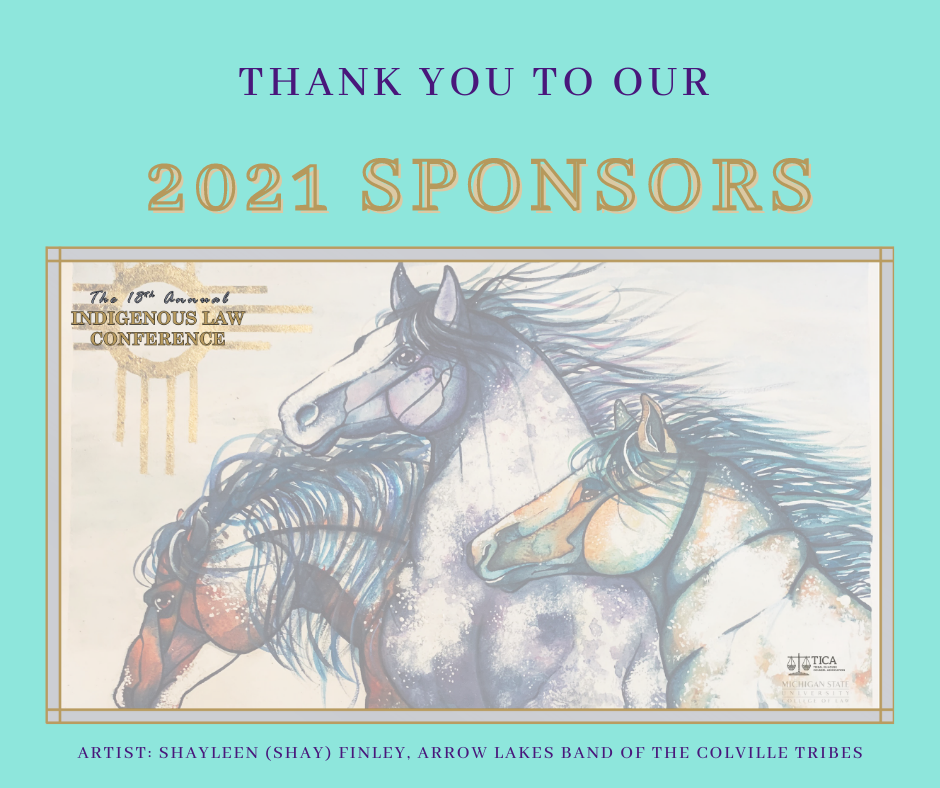
Artist: Shayleen (Shay) Finley, Arrow Lakes Band of the Colville Tribes
Registered attendees have received access to the conference materials, recordings, and CLE forms on the Participant Portal (www.indigenouslawconference.com). Check your email for more information. The conference was approved for 9.75 CLEs including 1.25 Ethics CLEs by the Minnesota State Board of Continuing Legal Education.
November 5th, 2021 | 2:15pm-3:30pm ET | 1.25 Ethics CLE
Indian Country lawyering is mostly unregulated. Tribes and tribal courts can regulate attorney conduct, but usually do not until there is egregious misconduct. This session explores how tribes could prevent and remedy misconduct. Tribal governments can and should adopt tribally specific rules of professional conduct.
Speakers include:
Matthew L.M. Fletcher: Director of the Indigenous Law and Policy Center, Michigan State University College of Law
Moderator – Doreen Nanibaa McPaul: TICA President, Attorney General for the Navajo Nation
Get the scoop from current and former law clerks who share practical advice to enhance written and oral advocacy. The panel will instruct on justiciability, writing techniques, briefing organization, court protocols, and oral argument approaches. Panelists spotlight a framework for building a coherent case for clients, opposing parties, and the courts.
Speakers include:
Lydia Locklear: (Lumbee) Deputy Tribal Attorney for the Catawba Nation
Joaquin Ray Gallegos: (Jicarilla Apache and Santa Ana Pueblo) Judicial Clerk for the U.S. Court of Appeals for the Tenth Circuit
Alexander Mallory: (Winnebago Tribe of Nebraska) Attorney Advisor through the United States Department of Justice Honors Program
Roshanna Toya: (Pueblo of Isleta) Judicial Clerk for the New Mexico Court of Appeals
Moderator – Rodina Cave Parnell: Pre-Law Summer Institute Director, American Indian Law Center, Inc.
Party or Amicus? Deciding When Your Tribal Nation Should Participate in Litigation
November 5th, 2021 | 10:30am-11:45am ET | 1.25 CLE
This presentation is designed for In-House counsel who advise tribal leadership on whether to intervene or be amicus in litigation affecting their tribal nation. We will discuss the pros and cons of becoming a direct party, whether to directly participate in the case or seek to have it dismissed, types of intervention, reasons for filing an amicus brief, and the reasons why such a brief may or may not be a good idea in specific cases.
Speakers include:
Paul Spruhan: Assistant Attorney General, Navajo Nation DOJ
Chrissi Nimmo: Cherokee Nation, Deputy Attorney General for Cherokee Nation
Megan Topkok: Iñupiaq, Staff Attorney for Kawerak, Inc.
Moderator – Jamie Williams: Student, Michigan State University College of Law
Shifting the Balance of Power: Self Governance and Consultation
November 5th, 2021 | 9:00am-10:15am ET | 1.25 CLE
Self governance is an exercise of tribal sovereignty and self-determination. Tribal self governance is, at its core, a framework for tribal progress because it empowers tribes. This panel will explore the history and key milestones of the tribal self governance movement, with an emphasis on recent developments and upcoming challenges for the expansion of self governance in agencies outside of the BIA and IHS.
Speakers include:
Rob Roy Smith: Managing Partner, Kilpatrick Townsend & Stockton LLP
Geoff Strommer: Partner, Hobbs, Straus, Dean & Walker, LLP
Debrah Gee: Navajo Nation and Muscogee (Creek) Nation, Chief Counsel for the Chickasaw Nation Office of Tribal Justice Administration
Moderator – Valerie Shuette: Student, Michigan State University College of Law
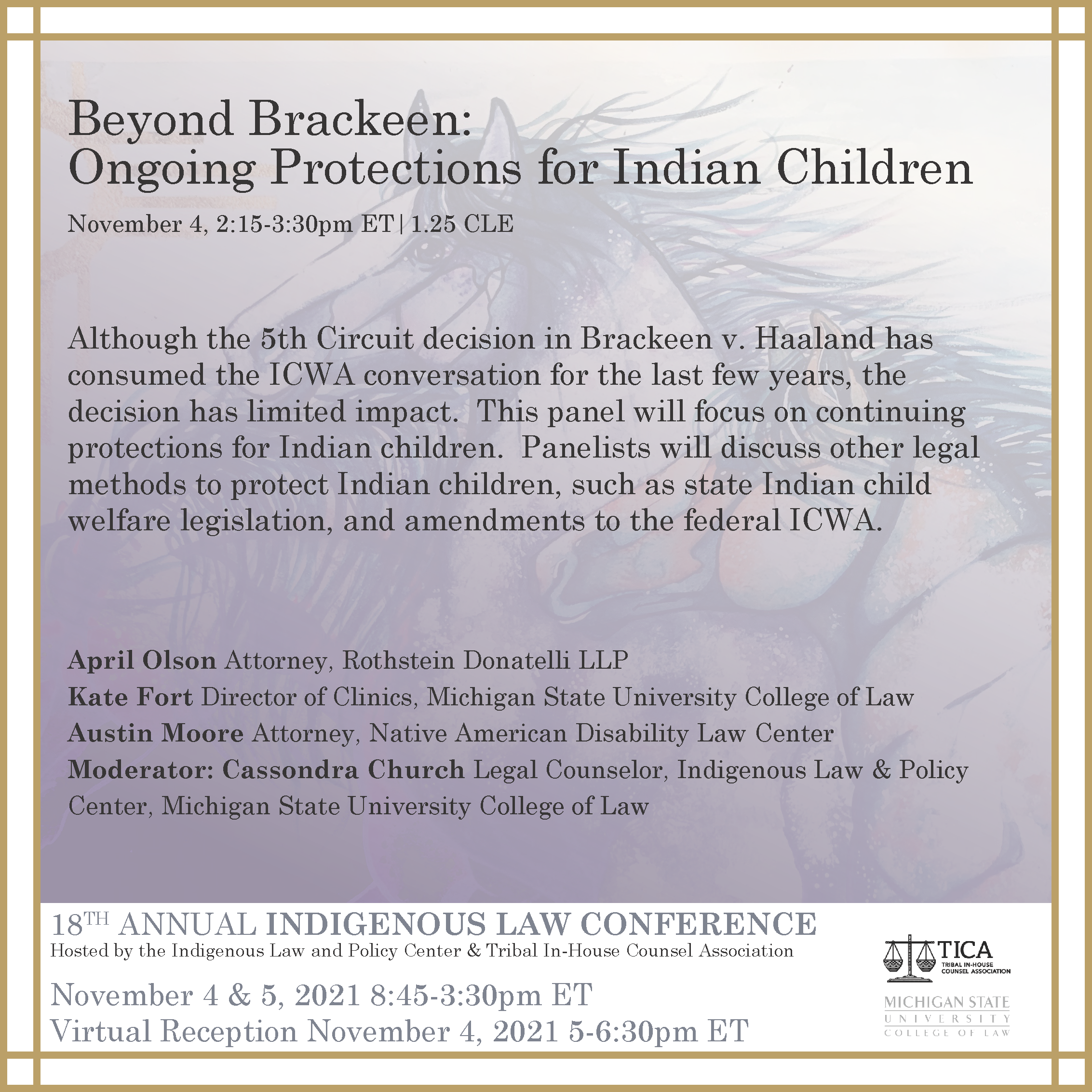
Beyond Brackeen: Ongoing Protections for Indian Children
November 4th, 2021 | 2:15pm-3:30pm ET | 1.25 CLE
Although the 5th Circuit decision in Brackeen v. Haaland has consumed the ICWA conversation for the last few years, the decision has limited impact. This panel will focus on continuing protections for Indian children. Panelists will discuss other legal methods to protect Indian children, such as state Indian child welfare legislation, and amendments to the federal ICWA.
Speakers include:
April Olson: Attorney, Rothstein Donatelli LLP
Kate Fort: Director of Clinics, Michigan State University College of Law
Austin Moore: Attorney, Native American Disability Law Center
Moderator – Cassondra Church: Legal Counselor, Indigenous Law & Policy Center, Michigan State University College of Law
Tribal consultation laws, whether at the federal, state, or county level, allow Indigenous people to directly participate in decisions that impact their daily lives from health to education and beyond. The presentation explains the variety of tribal consultation laws across US jurisdictions and policies that tribes can use to best suit their communities.
Speakers include:
Joe Sarcinella: Attorney, Drummond Woodsum
Wenona Singel: Associate Director & Professor, Indigenous Law & Policy Center, Michigan State University College of Law
Tehani M. Louis-Perkins: University of Hawai’i
Moderator – Ian F. Tapu: Law Clerk, Hawaii State Judiciary
November 4th, 2021 | 10:30am-11:45am ET | 1.25 CLE
This presentation unravels the difficulties and reliabilities of incorporating traditional law into modern practices in the context of Diné Fundamental Law statute, oral testimony of the Jemez Pueblo’s elders, and Anishinaabe law and jurisprudence.
Speakers include:
Rodgerick Begay: Assistant Attorney General, DOJ Chapter Unit, Navajo National
Matthew L.M. Fletcher: Director & Professor, Indigenous Law & Policy Center, Michigan State University College of Law
Robert Alan Hershey: Clinical Professor of Law Emeritus, Indigenous Law & Policy Program, University of Arizona College of Law
Moderator – Alyana Jimerson: Student, Michigan State University College of Law
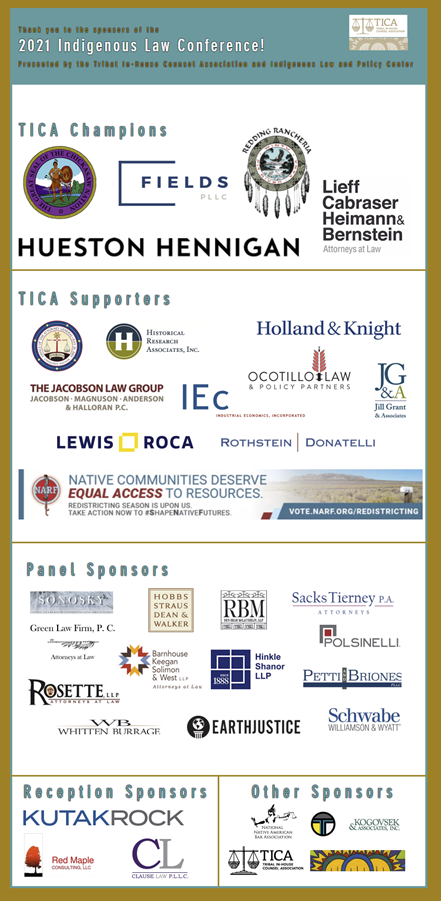
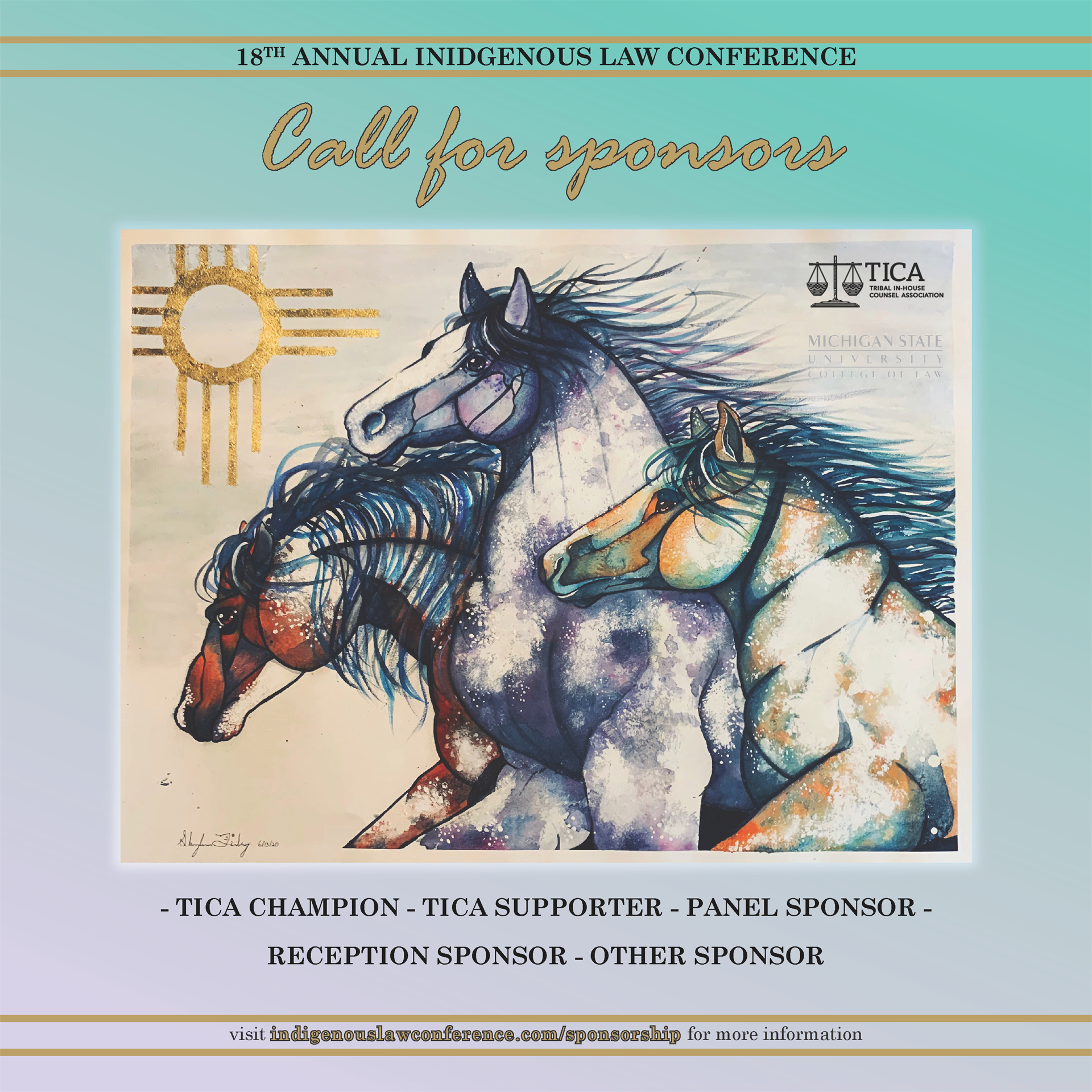
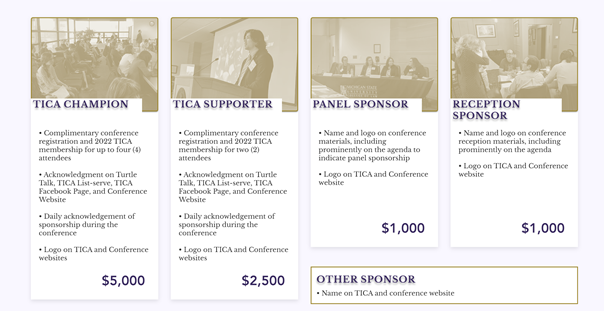
Our generous sponsors help make the Indigenous Law Conference possible each year, for which we are very grateful! We hope to repeat past success, but we need your help once again to ensure another wonderful conference. Please read below about the different sponsorship tiers and opportunities. Thank you all for your time and consideration!
None of us are quite sure what the remainder of 2021 will bring, or whether we will be able to host an in-person conference, remain virtual, or do some other hybrid; but please mark your calendars for the annual Fall Conference.





 Turtle Talk
You must be logged in to post a comment.