Link to media coverage here.
Full text of Arizona Borderlands Protection and Preservation Act here.
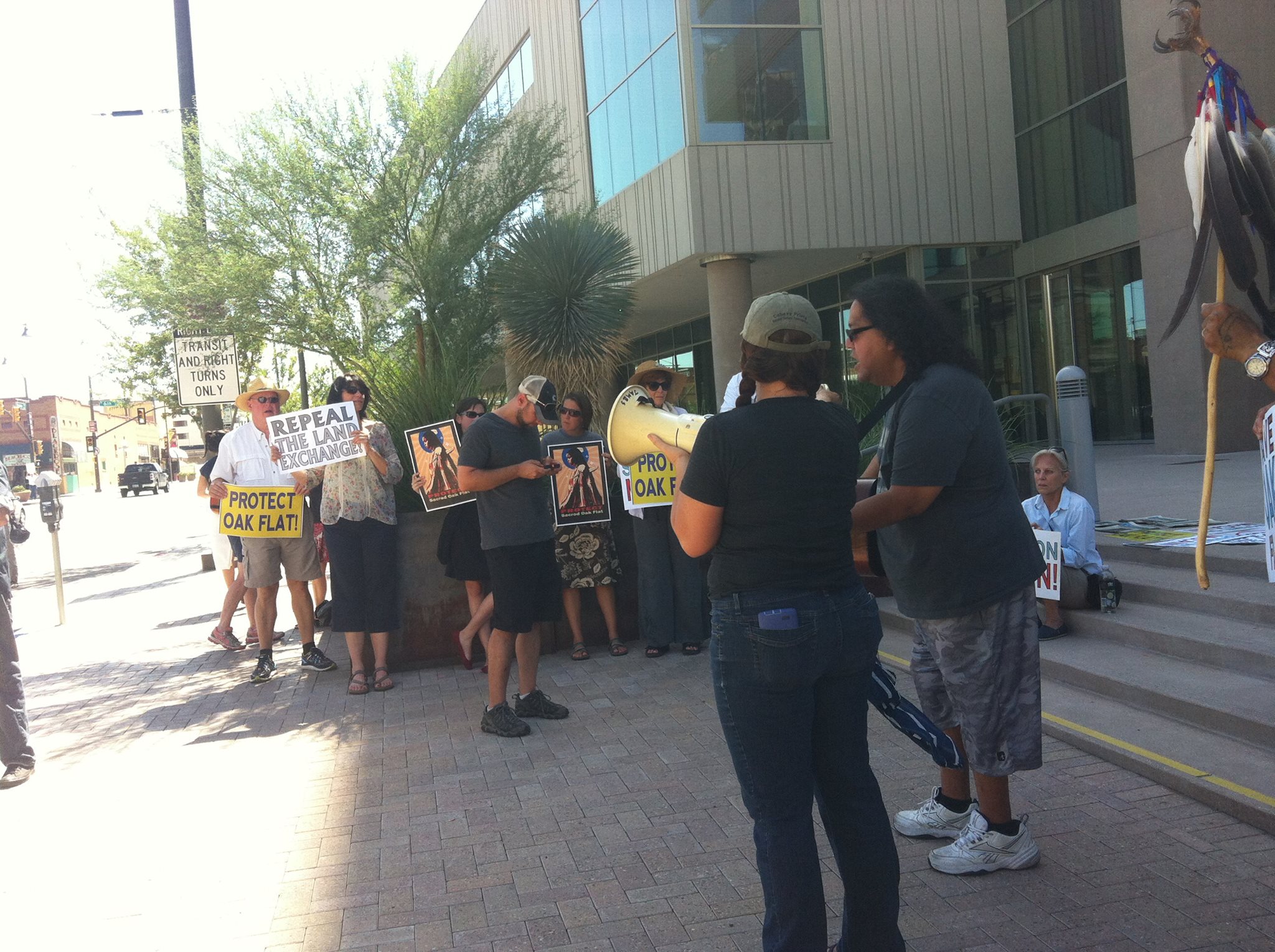
Native advocates protested a meeting today at Tucson Electric Power headquarters where Senator John McCain (R) was meeting. The protest was largely a response to the passing of a rider on last December’s National Defense Authorization Act that transfered title to sacred lands over to mining companies. It also passed along another message: No on S.R. 750.
Arizona Senators John McCain and Jeff Flake (R) introduced the Arizona Borderlands Protection and Preservation Act in March 2015 and it would allow unfettered access to federal lands in Arizona and parts of California. It was voted out of committee in May, but has yet to make an appearance on the Senate floor.
The bill calls for the Secretaries of Agriculture and the Interior to “provide U.S. Customs and Border Protection personnel with immediate access to Federal lands for border security activities, including routine motorized patrols and the deployment of communications, surveillance, and detection equipment.”
Environmental and tribal advocates are perturbed by what Arizona representatives are suggesting: unfettered entry and occupation of reservations and national parks situated within a hundred miles of the border.
This bill would waive all laws on federal public and tribal lands for 100 miles north of the U.S. Mexico Border, affecting Apache, Tohono O’odham, Hia-Ced sacred sites and the very existence of all tribal people residing on those lands. – Nellie David, Tohono O’odham
McCain believes the border will not be “secure” until 100% of it is being monitored, but analysts are not so sure this is possible:
No state has ever prevented all attempted unauthorized entries into its territory. Roberts et al. (2013) review several historical cases, including East Germany during the Cold War, which experienced mass outmigration in the 1950s and attempted to stop it completely by establishing a “kill zone” on its borders and severely punishing those who were caught and not killed. Even under such an extreme approach, in the late 1970s, 5 percent of those trying to cross succeeded. -Bipartisan Policy Center Feb. 2015 report
Even the Department of Homeland Security has criticized previous bills that purportedly expand the Border Patrol’s powers without providing additional funding.
A community forum will meet August 20, 2015, at 7:30PM at the Alliance for Global Justice at 225 E. 26th St. in Tuscon where panelists include U.S. Rep. Raúl Grijalva, who introduced a house bill to repeal the Oak Flat giveaway.
 Turtle Talk
You must be logged in to post a comment.