Michigan Law to Host Talk on the Treaty of Waitangi on Nov. 3

Richard Dawson, a scholar from New Zealand, will talk about modern issues of treaty and constitutional interpretation with a particular focus on the Treaty of Waitangi of 1840, between the British Crown and Maori chiefs on Monday, November 3 from 4:00 to 5:30pm in Hutchins Hall Room 236 .

The Treaty of Waitangi made various promises to the Maori, especially concerning the possession of land and fishing rights, which the New Zealand government, once it was established, systematically dishonored. In the past thirty years, the Treaty of Waitangi has gained in importance.  The central question is what weight, and interpretation, should now be given the the Treaty–by the courts, by the legislature, by the people.  This deeply contested issue in New Zealand has tremendous relevance for those concerned with aboriginal rights in the US, Canada, and elsewhere in the world, or with the question how a “constitution” can and should be defined.

Dawson, who has a Phd both  in Economics and in Law, presents a fresh look at the much-debated question of how to interpret treaties between indigenous peoples and settler states.  His book, “The Treaty of Waitangi and the Control of Language,” has been praised as the most important since Claudia Orange published her seminal study, “The Treaty of Waitangi” in 1987.

Dawson is also the author of “Justice as Attunement: Transforming Constitutions in Law, Literature, Economics, and the Rest of Life,” published in 2014 by Routledge. He is currently International Research Fellow at Mercer Law School in Macon, Georgia.

World Conference on Indigenous Peoples Poised to Launch a New Chapter in International Advocacy

(New York City) — The United Nations is prepared to adopt a formal document on Monday, Sept. 22, 2014, that will commit the UN and member states to take a number of actions to put into effect and encourage compliance with the UN Declaration on the Rights of Indigenous Peoples, which was adopted in 2007.  This UN action is set to take place as part of the two-day UN World Conference on Indigenous Peoples in New York City.

“The actions the UN is going to take will give lasting protection to the rights in the UN Declaration on the Rights of Indigenous Peoples,” said Robert Coulter, speaking on behalf of his own Indian nation, the Citizen Potawatomi Nation, and on behalf of the Indian Law Resource Center. “A permanent body in the UN system can do a great deal to assure that our rights are protected. Even more important, having Indian and other indigenous governments participating in the UN will assure that we are always here to defend our rights and to work with member states to resolve problems.”

The Conference document is expected to be adopted by consensus, without a vote, after months of drafting and consultations among member states of the UN and indigenous peoples from around the world, including more than 100 Indian tribes from the United States, as well as First Nations from Canada, and Indian nations from Central and South America.

Key elements of the outcome document:

  • Initiating a process to create a permanent body in the UN system that will monitor and encourage implementation of the Declaration;
  • Considering options for a General Assembly decision to make it possible for Indian tribal governments and other indigenous governments to participate in UN meetings on a permanent basis;
  • Giving particular attention to the epidemic of violence against indigenous women, including Indian and Alaska Native women in the United States; and
  • Measures to respect and protect places sacred to Indian and other indigenous nations and peoples.

The document, among many other things, also calls for a system-wide action plan to be developed for the UN system to bring greater coherence and effectiveness to the UN’s work relating to indigenous peoples.

The Indian Law Resource Center, an international human rights organization working on behalf of Indian and other indigenous peoples in the Americas, is one of the organizations that played a leading role in the preparations for the World Conference over the past two years.

This World Conference is the first time that large numbers of Indian and Alaska Native governments from the United States have been actively involved in UN work.  Jefferson Keel, Lieutenant Governor of the Chickasaw Nation and past president of the Nation Congress of American Indians, is one of those who has been prominently involved. “We are taking our places once again as members of the world community,”  said Keel.

According to Coulter, tribes are committed to working with the General Assembly and other UN bodies to see that the commitments in the outcome document are carried into effect in the months to come.

###

About the Indian Law Resource Center

The Indian Law Resource Center is a non-profit law and advocacy organization established and directed by American Indians. The Center is based in Helena, Montana and also has an office in Washington, DC.  The Center provides legal assistance without charge to Indian and Alaska Native nations who are working to protect their lands, resources, human rights, environment and cultural heritage. The Center’s principal goal is the preservation and well-being of Indian and other Native nations and tribes.  For more information, please visit us online at www.indianlaw.org or www.facebook.com/indianlawresourcecenter

United Nations Committee Calls for Intensified Efforts to Combat Violence Against Native Women

FOR IMMEDIATE RELEASE                             For more information contact:

September 9, 2014                                                                   Ginny Underwood

                                                                                                       (405) 229-7210

                                                                           Email: gunderwood@indianlaw.org

United Nations Committee Calls for Intensified Efforts to Combat Violence Against Native Women 

HELENA, Mont. ─ A UN Committee focused on eliminating race discrimination globally remains concerned that the United States continues to fall far short on protecting American Indian and Alaska Native women.

The UN Committee on the Elimination of Racial Discrimination released its Concluding Observations August 29, 2014. This follows its periodic review of the United States’ record in implementing a key human rights treaty ─ the International Convention on the Elimination of All Forms of Racial Discrimination. The report sites more than 20 areas of discriminatory laws, practices, and policies in the United States, including violence against women.  

“American Indian and Alaska Native women are denied meaningful access to justice and are less protected from violence than other women in the United States just because they are indigenous and are assaulted in Indian country or on Alaska Native lands,” said Jana L. Walker, senior attorney and director of the Indian Law Resource Center’s Safe Women, Strong Nations project.

According to statistics from the Department of Justice, American Indian and Alaska Native women are two and half times more likely to be assaulted in their lifetime than other women in the United States, and one in three Native women will be raped in her lifetime.

The Concluding Observations call on the U.S. “to intensify its efforts to prevent and combat violence against women, particularly against American Indian and Alaska Native women, and ensure that all cases of violence against women are effectively investigated, perpetrators prosecuted and sanctioned, and victims provided with appropriate sanctions.”

To inform the review, the National Congress of American Indians and Indian Law Resource Center, with endorsements from the National Indigenous Women’s Resource Center, Inc. and Clan Star, Inc., submitted a shadow report to the Committee, “Violence Against American Indian and Alaska Native Women ─ United States’ Violations of the International Convention on the Elimination of All Forms of Racial Discrimination.”

“The root cause of this human rights crisis is the legal framework that discriminates against Indian and Alaska Native nations and women,” says Lucy Simpson, Executive Director of the National Indigenous Women’s Resource Center. “The United States has long prohibited the 566 federally recognized Indian and Alaska Native tribes from prosecuting non-Indian offenders who commit many ─ in fact most ─ of the violent crimes against Native women. The passage of VAWA in 2013 begins to address this, but it does not go far enough.”

The Committee’s Concluding Observations follow similar ones it made in 2008. Juana Majel Dixon, Co-Chair of the National Congress of American Indians Task Force on Violence Against Women and Traditional Legislative Councilwoman for the Pauma Band of Luiseño Indians, worked on a similar shadow report in 2008. “Our message is the same ─ restoration of full tribal criminal jurisdiction, effective enforcement of tribal protection orders, and meaningful access to justice is absolutely critical in protecting American Indian and Alaska Native women from domestic and other violence within Indian country and Alaska villages,” says Majel Dixon.

The Committee acknowledged steps by the U.S. since 2008 ─ particularly the enactment of the Tribal Law and Order Act of 2010, which enhances tribal sentencing authority, and the Violence Against Women Reauthorization Act of 2013 (VAWA 2013), which includes an amendment restoring limited tribal criminal jurisdiction over certain non-Indians committing domestic violence, dating violence, or violate protection orders. But, as the Committee emphasized, this restored jurisdiction is limited.

Critical gaps in U.S. law remain, and the Committee reiterated its call for the United States “to take effective measures to guarantee, in law and practice, the right to access justice and effective remedies for all indigenous women who are victims of violence.”  

According to Lenora (Lynn) Hootch, Co-Chair of the National Congress of American Indians Task Force on Violence Against Women, one of the most discriminatory and egregious aspects of U.S. law is the special rule in VAWA 2013 that excludes all but one of the 229 Alaska Native villages from the new lifesaving protections in the tribal amendment. Hootch, who also serves on the Tribal Council for the Village of Emmonak in Alaska and is a Board Member of the National Indigenous Women’s Resource Center, notes that “Alaska Native women and girls experience epidemic levels of violence and have the highest rate of sexual assault in the country, yet the United States and Alaska have long supported laws limiting Alaska tribal governments ability to protect their citizens, including their women and children from violence.”

Recommendations from the international community, including this Committee’s Concluding Observations, send a strong message to the United States that immediate steps are needed to fix the legal system and restore safety to American Indian and Alaska Native women.

For a copy of the Committee’s Concluding Observations and the shadow report, “Violence Against American Indian and Alaska Native Women ─ United States’ Violations of the International Convention on the Elimination of All Forms of Racial Discrimination,” visit http://www.indianlaw.org.


###

Partner Organizations

About the National Congress of American Indians

Contact: Sarah Beccio, Communications Associate

(202) 466-7767, email: sbeccio@ncai.org

The National Congress of American Indians is the oldest and largest national organization of American Indian and Alaska Native tribal governments, and is dedicated to ending the epidemic of violence against American Indian and Alaska Native women. In 2003, NCAI created the NCAI Task Force on Violence Against Women to address and coordinate an organized response to national policy issues regarding violence against American Indian and Alaska Native women. (www.ncai.org).

About the National Indigenous Women’s Resource Center

Contact: Jacqueline Agtuca, Law and Policy Consultant

(406) 477-3896, email: jagtuca@niwrc.org

The National Indigenous Women’s Resource Center, Inc. is a non-profit organization that provides technical assistance, policy development, training, materials, and resource information on violence against Native women and the development of tribal strategies and responses to end the violence. (www.niwrc.org).

About the Indian Law Resource Center

Contact: Ginny Underwood, Communication Director

(405) 229-7210, email: gunderwood@indianlaw.org

Founded in 1978 by American Indians, the Indian Law Resource Center is a non-profit organization established and directed by American Indians. The Center provides legal assistance to indigenous peoples of the Americas to combat racism and oppression, to protect their lands and environment, to protect their cultures, to achieve sustainable economic development and genuine self-government, and to realize their other human rights. (www.indianlaw.org).
New Scholarship on Court Power and Aboriginal and Treaty Rights in Canada

The American Review of Canadian Studies has published Political Failure, Judicial Opportunity: The Supreme Court of Canada and Aboriginal and Treaty Rights, available at http://www.tandfonline.com/doi/full/10.1080/02722011.2014.941153#.U_3lbygdVUQ.  

Here is the abstract:  What role do courts play in public policymaking? This article finds that the Supreme Court of Canada revitalized the making of Aboriginal and treaty rights policy from 1990 to 2007. It offers an explanation of the Court’s engagement in this area and suggests that the standard Charter narrative about court power does not explain fully the role of the Court in Aboriginal and treaty rights policymaking. The account highlights how politics affect the Court and how the Court affects politics. The Court emerged as a significant and influential player in policymaking as the political process failed to accommodate Aboriginal and treaty rights, Aboriginal peoples mobilized legally, and the institutional power of the Court grew. The article’s emphasis on political failure provides a more nuanced view of the Court and how it exercises power vis-à-vis political elites and interest groups.

An earlier version of the article is available on SSRN at http://papers.ssrn.com/sol3/papers.cfm?abstract_id=2484744.

ABA Now Recognizes Members of Tribal Bar Associations

The American Bar Association (ABA) recently adopted an ABA Constitutional change so that the ABA now  recognizes members of tribal bar associations as full members of the ABA – at long last putting tribal court bar membership on equal footing with the bars of states, territories and possessions of the United States.  

  • 3.1 Members. Any person of good moral character in good standing at the bar of a state, territory, possession, or tribal court of any federally recognized tribe of the United Statesis eligible to be a member of the Association in accordance with the Bylaws.

Violence Against American Indian Women — UN Committee on the Elimination of Racial Discrimination Review of US to be Webcast

Today, August 13th, the UN Committee on the Elimination of Racial Discrimination (CERD) will begin a two-day review of the United States’ compliance with the International Convention on the Elimination of All Forms of Racial Discrimination.  The review, which will include questioning of U.S. representatives, will be webcast from Geneva on August 13, 9:00 a.m. to noon (ET), and on August 14, from 4:00 p.m. to 7:00 a.m. (ET) at www.treatybodywebcast.org.

To help inform CERD’s review, the NCAI Task Force on Violence against Women, National Indigenous Women’s Resource Center, Clan Star, Inc., and Indian Law Resource Center submitted a joint shadow report “Violence Against American Indian and Alaska Native Women — United States’ Violations of the International Convention on the Elimination of All Forms of Racial Discrimination.”  The shadow report is available at

http://tbinternet.ohchr.org/Treaties/CERD/Shared%20Documents/USA/INT_CERD_NGO_USA_17549_E.pdf

For more on CERD, visithttp://www.ohchr.org/EN/HRBodies/CERD/Pages/CERDIndex.aspx.


New Video Campaign on Ending Violence Against Women and Redefining Native Love

New Video Campaign on Ending Violence Against Women and Redefining Native Love

October 21, 2013

(Helena, Mont.) —  The Indian Law Resource Center and the National Indigenous Women’s Resource Center (NIWRC) have launched the first videos in a new campaign to raise awareness of and help end violence against Native women and girls.

The campaign is two-fold, featuring a series of “Survivor Stories” with Native women who have experienced domestic and sexual violence as well as a series of videos on the theme of “Native Love” with Native youth expressing what Native love means to them and the changes they want to see in their communities.

“With one in three Native women raped in their lifetimes, creating awareness to end violence against Indian and Alaska Native women and girls is the first and foremost priority for this campaign,” said Jana Walker, Senior Attorney and Director of the Center’s Safe Women, Strong Nations project.  “The epidemic of violence against Native women and girls cannot be tolerated.”

The first survivor story released in the series features Sheila Harjo, the First Lady of The Seminole Nation and Councilwoman.  In the video, Harjo describes the eight years of abuse she endured by her former husband.

“I’m not a victim. I’m a survivor,” declares Harjo in the video. “I now have the opportunity to share my story and let people know it can happen to anybody. It’s not drunks. It’s not the poor people. It’s not the uneducated. It’s anybody.”

Harjo has been a driving force in helping The Seminole Nation establish a domestic violence program and shelter for abused women and their children.

The “Native Love” video series raises awareness about violence against Native women and girls and is aimed at empowering tribal members, particularly young people, to speak out.  Justin Secakuku, a member of the Hopi Tribe of Arizona, shares a Hopi tradition involving white corn, and its symbolism of the value of women to give and produce life.

“Women should be appreciated, honored, and loved,” says Secakuku in the video. “In the concept of Native love, we have to respect what women have to contribute to society as a whole.”

The Indian Law Resource Center and the NIWRC will release four survivor stories and four “Native Love” stories through the end of the year.  The videos and other online resources including posters, Facebook banners, a domestic violence toolkit, FAQs, and a guide on how to share the campaign, will be available at www.indianlaw.org and www.niwrc.org.

“We hope to stimulate and support a national dialogue about what Native love is — and what it is not — in order to create change that will help restore safety to our Native women and girls,”  said Lucy Simpson, Executive Director of the NIWRC.  “We encourage people to watch the videos, share them through Facebook and other social media channels, and help us create change.”

The videos were co-produced by the Center and Native filmmaker Ryan Red Corn, co-founder of Buffalo Nickel Creative.  Red Corn also produced “To The Indigenous Woman” which was released by the Center in October 2011.  For more information or to download and share the videos, visit www.indianlaw.org or www.niwrc.org.

###


About the Indian Law Resource Center

The Indian Law Resource Center is a nonprofit law and advocacy organization that provides legal assistance to Indian and Alaska Native nations who are working to protect their lands, resources, human rights, environment, and cultural heritage. The Center’s principal goal is the preservation and well-being of Indian and other Native nations and tribes.  The Center, which is headquartered in Helena, Montana, and has an office in Washington, D.C., has been working for justice for indigenous peoples for 35 years. For more information, visit www.indianlaw.org.

About the National Indigenous Women’s Resource Center

The National Indigenous Women’s Resource Center (NIWRC) is a nonprofit organization that provides technical assistance, policy development, training, materials, and resource information for Indian and Alaska Native women, Native Hawaiians, and Native non-profit organizations addressing safety for Native women.  The NIWRC’s primary mission is to restore safety for Native women.  For more information, visitwww.niwrc.org.

NY Times: “Pain on the Reservation”

NY Times: “Pain on the Reservation”

The NY Times has published an article detailing how sequestration has disproportionately affected Indian country.

Opportunities for Internships at Indian Law Resource Center

The Indian Law Resource Center, a non-profit legal advocacy organization dedicated to providing legal advice, assistance, and representation to Indian tribes and indigenous communities throughout the Americas, has posted several internship opportunities for spring and summer 2013.  More information can be found at

http://www.indianlaw.org/content/internships

VAWA – Violence Against Native Women Gaining Global Attention—Will Congress Do Something?

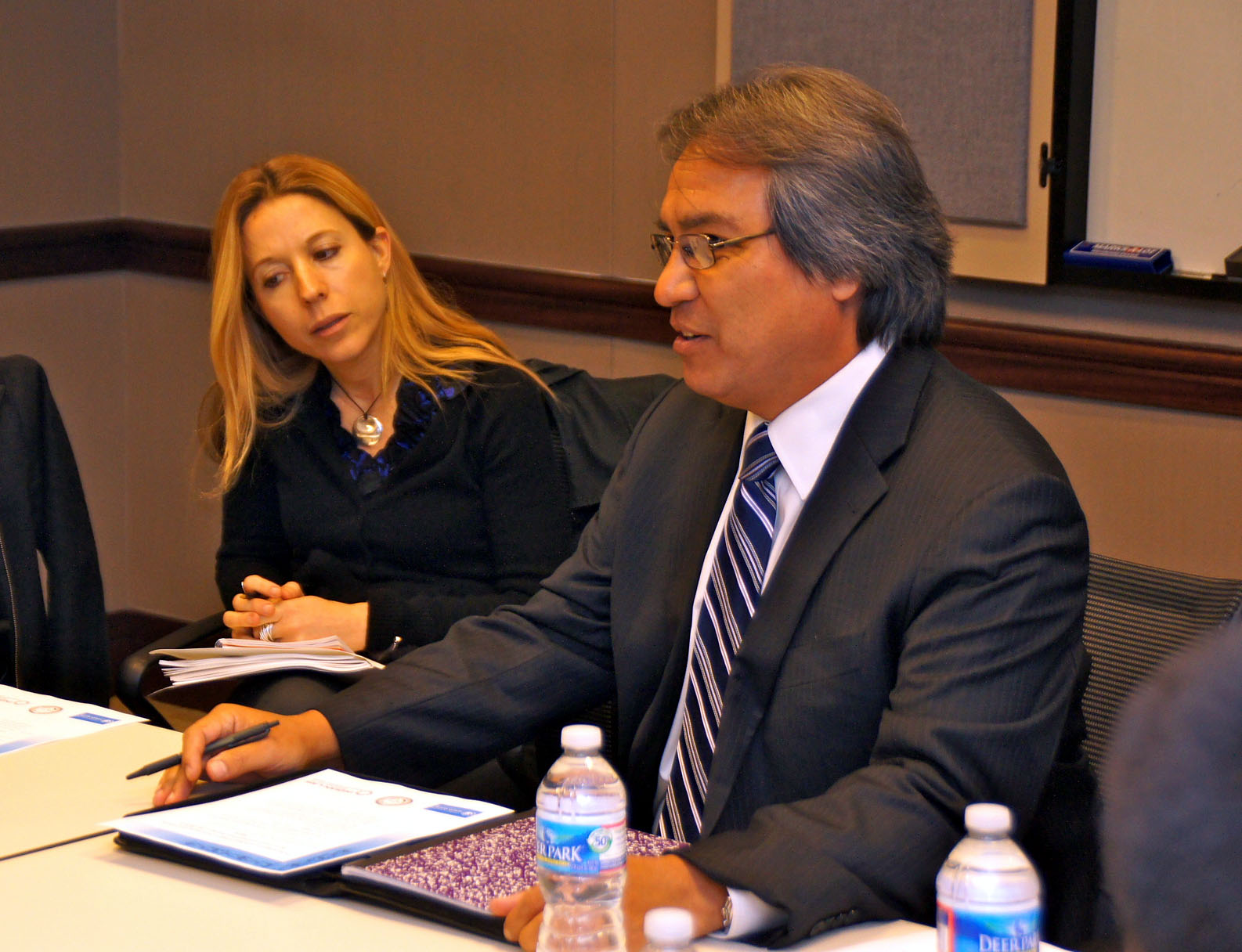
UN Special Rapporteur James Anaya meets with civil society at the Navajo Nation Washington Office on April 23, 2012. Photo courtesy of the NNWO.

Recent Report by U.N. Special Rapporteur on the Rights of Indigenous Peoples says legislation protecting Native women should be an “immediate priority” in U.S.

(Helena, Montana) – According to the U.N. Special Rapporteur on the Rights of Indigenous Peoples, James Anaya, the U.S. Congress should make legislation protecting Native women an “immediate priority.”  Following a month long tour to hear from indigenous peoples and tribal Nations within the United States, the Special Rapporteur presented his report in September on the situation of indigenous peoples in the United States to the UN Human Rights Council in Geneva.  The report recommended that the United States immediately address violence against women through legislation. Continue reading