A Citizen Potawatomi Candidate Is Running for Congress in Michigan

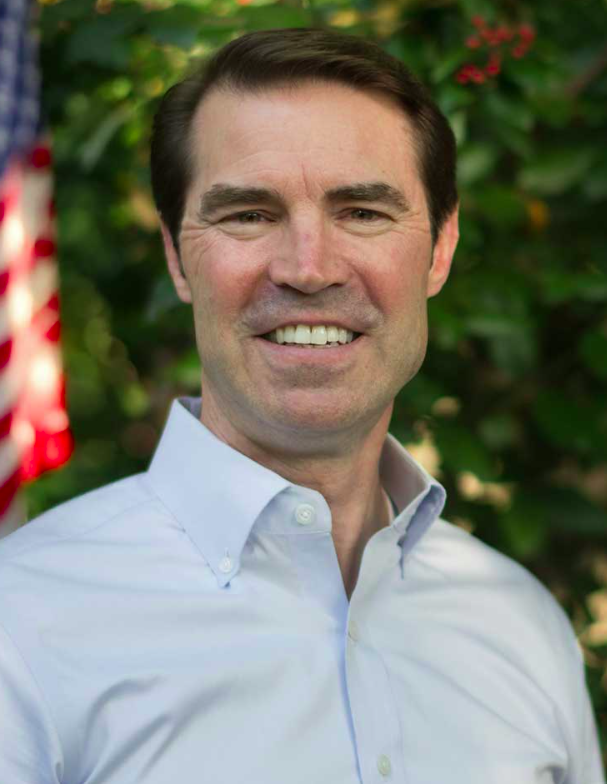
Michigan State Senator Sean McCann, a citizen of the Citizen Potawatomi Nation, is running for Congress in Michigan’s 4th Congressional District. He won the Democratic primary in August and is challenging incumbent Rep. Bill Huizenga in November. ICT reports that McCann won the primary with 67 percent of the vote. Incidentally, McCann’s democratic primary opponent was also a tribal member: Diop Harris, a citizen of the Nottawaseppi Huron Band of Potawatomi.

If elected, McCann would represent a Michigan district that includes the Pokagon Band of Potawatomi Indians, the Nottawaseppi Huron Band of Potawatomi, and the Match-E-Be-Nash-She-Wish Band of Pottawatomi Indians (the Gun Lake Tribe).

McCann’s candidacy is a remarkable example of a citizen of a Tribe whose people were displaced from the Great Lakes who’s now seeking to represent a Michigan district where several other Potawatomi governments remain.

McCann has spent more than a decade in the Michigan legislature and has worked on natural resources, appropriations, energy, and other subjects that affect Tribal governments. Indian affairs, however, haven’t been a prominent part of his public legislative profile. Apart from opposing prediction markets, which he described to ICT as an infringement on tribal sovereignty, his campaign emphasizes affordability, health care, jobs, energy costs, and elections rather than a developed platform on Tribal sovereignty, treaty rights, federal trust obligations, Indian health, or Tribal jurisdiction. His campaign priorities are here.

Asked by ICT about the Potawatomi Tribes in the district, McCann said their population, history, and heritage are important and that he’d be “thrilled to lift up and work with tribal folks” if elected. ICT’s interview is here.

Catawba Seeks Repeal of Federal Limit on its Citizenship Requirements

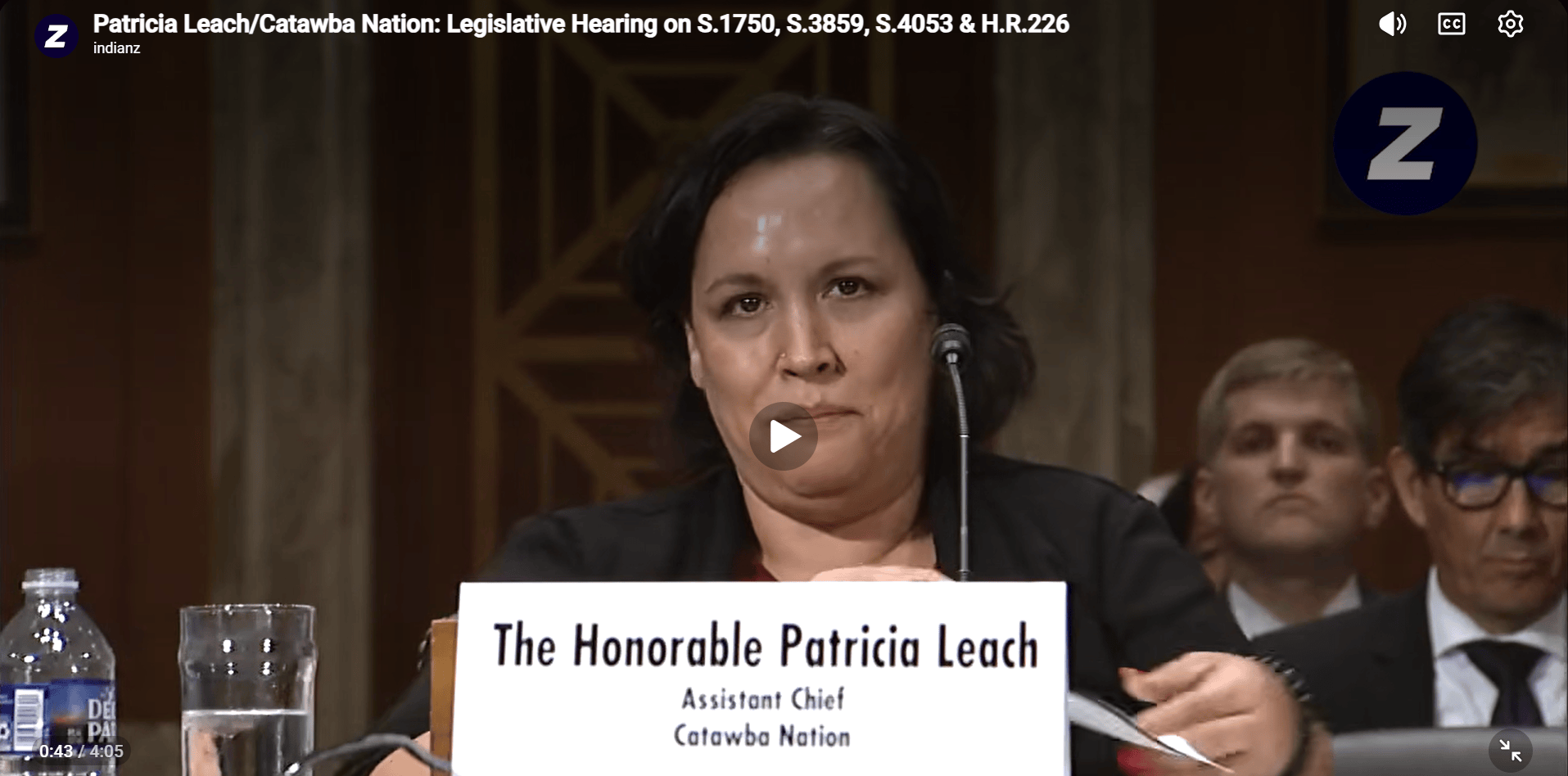
Patricia Leach/Catawba Nation: Legislative Hearing on S.1750, S.3859, S.4053 & H.R.226, Sept. 26, 2026. Click on the image above to view the video of Assistant Chief Patricia Leach’s testimony before the Senate Committee on Indian Affairs.

When Congress settled the Catawba Indian Nation’s land claims in 1993, it imposed federal requirements on who could become a citizen. Specifically, the Catawba Indian Tribe of South Carolina Land Claims Settlement Act of 1993 stated that, “[t]he Tribe shall have the right to determine future membership in the Tribe; however, in no event may an individual be enrolled as a tribal member unless the individual is a lineal descendant of a person on the final base membership roll and has continued to maintain political relations with the Tribe.” (Emphasis added.)

Those requirements helped identify recipients of settlement payments, but the payments ended decades ago, while the federal restriction remained.

Now Catawba is asking Congress to remove it. Assistant Chief Patricia Leach testified that S. 3859 would return citizenship decisions to the Nation’s Constitution and laws. If passed, the bill would strike the clause from the 1993 land claims settlement act limiting enrollment to individuals who are lineal descendants of persons on the final base membership roll and who have continued to maintain political relations with the Tribe.

The larger issue is Tribal power over membership. A federal rule created to distribute settlement money in a land claims settlement act in 1993 became an enduring restriction on Catawba’s power to define its own political community.

A portion of Assistant Chief Patricia Leach’s testimony is here:

What the Bill Does
S. 3859 strikes a portion of a single sentence from Section 7(d) of the Catawba Indian Tribe of South Carolina Land Claims Settlement Act of 1993. That clause currently prevents the Nation from enrolling any new citizen unless that person is a lineal descendant of an individual on the 1962 final roll and has maintained “continued political relations” with the Tribe.
If enacted, the bill would restore to the Catawba Indian Nation the authority to determine its own citizenship criteria under its Constitution. That authority is one of the most basic attributes of tribal sovereignty, respected by the Federal government for virtually all Tribal Nations. The bill does not rewrite the Nation’s Constitution, does not create any new federal program, and does not affect any other provision of the Settlement Act.
Why the Bill Is Needed
Congress enacted the Settlement Act in 1993 to resolve the Nation’s longstanding land claims, restore the federal trust relationship, and provide for a monetary settlement. The federal enrollment language in Section 7(d) was included in that settlement context. It helped identify a fixed number of individuals entitled to share in settlement-related distributions and provided an administrable federal standard at that time.
Those monetary distributions were completed decades ago. The federal restriction has outlived that purpose. Today, it no longer serves as a settlement-administration tool. Instead, it operates as a continuing federal limitation on the Nation’s ability to define its own political community.
The provision also includes the phrase “continued political relations,” a standard that is undefined in the Act and difficult to administer. Tribal staff must determine whether an applicant has demonstrated a sufficient political connection to the Nation, even though that standard is not clearly defined by Congress. Removing this language will allow the Nation to administer citizenship through its own Constitution and laws rather than through an outdated federal overlay.

Congress Required Assessment of State ICWA Compliance. It Didn’t Tie Shortfalls to Corrective Plans or Funding Consequences

In my earlier post today, I wrote that neither S. 4976 nor S. 4638 would require HHS to evaluate each state’s compliance with ICWA. That’s true of the bills, but it leaves out an important piece of existing law.

Congress has already required federal assessment and reporting. 42 U.S.C. § 628d directed HHS to develop an ICWA technical assistance plan by October 1, 2025. The plan must use data sufficient to assess state performance on identifying Indian children, notifying Tribes, transferring cases to Tribal court, and complying with ICWA’s requirements for placements and termination of parental rights. Every two years, HHS must report to Congress on state compliance and federal efforts to improve it.

That framework isn’t fully operating, however. In a report dated July 15, 2026, ACF described the plan as still under development. As of September 23, I couldn’t locate a published plan or an announcement that it had been completed.

Existing federal data is limited. States currently report only four categories of ICWA-related information through AFCARS, and ACF has identified serious reliability problems. A 2024 rule will substantially expand that collection, but states won’t begin collecting the new data until October 1, 2028. The first files containing the new data aren’t due to ACF until May 15, 2029. That leaves the central gap identified by the Commission on Native Children. The Commission didn’t only ask for better information. Recommendation 2 called for improvement plans when states fall short and for progress toward ICWA benchmarks to matter for federal child welfare funding.

Current law doesn’t create that system. States must describe their ICWA measures in their Title IV-B plans, and HHS has general authority to enforce compliance with approved plans. In its 2024 AFCARS rule, however, ACF stated that it has no jurisdiction to impose consequences on states under ICWA, and the Bureau of Indian Affairs has told ACF that it has no role in enforcing state compliance either. The law establishes no substantive ICWA performance benchmarks and doesn’t require ICWA-specific corrective plans or funding consequences when a state falls short.

That doesn’t mean any funding penalty would improve compliance. Justice Anne McKeig of the Minnesota Supreme Court told ACF in a 2025 comment that Minnesota law allows the state to reduce federal funding to counties it finds didn’t fully comply with ICWA in the preceding year, sometimes because of a technicality outside the county’s control. She warned that the penalty can deprive a struggling county of the money it needs to provide active efforts. The Commission proposed a more calibrated approach that includes improvement plans with benchmarks, with progress tied either to continued federal funding or to additional incentive funds.

ACF’s consultation report records Tribal recommendations for annual state reporting and actionable improvement plans. It also records a recommendation that states failing to consult with Tribes not receive administrative costs. ACF didn’t commit to those measures.

Ultimately, neither S. 4976 nor S. 4638 closes this gap. Congress has required the federal government to identify where states are falling short, but it hasn’t created the improvement and accountability system the Commission recommended.

An immediate opportunity

ACF is accepting written comments from Tribes for its 2026 Annual Tribal Consultation until 5:00 p.m. ET this Friday, September 25. Comments can be sent to tribalaffairs@acf.hhs.gov with the subject line “ACF Tribal Consultation Testimony.”

Tribal Nations could ask ACF to publish the § 628d plan, state whether and when it was completed, and explain how it will assess and respond to state noncompliance before the expanded AFCARS data become available.

Resources

The Way Forward: Report of the Commission on Native Children

42 U.S.C. § 628d

ACF Tribal Consultation Report (dated July 15, 2026)

Public Comments, Regulations.gov Docket ACF-2025-0038

ACF’s 2024 AFCARS Final Rule

ACF Annual Tribal Consultation Notice
House Democrats’ Report on Native Voting

Here.

Well, this image is hideous. . . that’s s’posed to be a voting booth in the desert.

U.S. Senators’ Letter to UC-Berkeley re NAGPRA Non-Compliance

Here.

ProPublica background reporting here.

Greg Ablavsky’s Further Thoughts on the Indian Affairs Powers of Congress

Gregory Ablavsky has posted “Further Thoughts on the Constitutional History of Federal Power Over Indian Affairs” on SSRN.

The abstract:

This short piece builds on my earlier response to Robert Natelson’s purported “cite check” of my 2015 Yale Law Journal article by addressing some of the arguments in his new Federalist Society Review article. It argues 1) that Natelson misinterprets Federalist 42, 2) that colonial-era regulations of Indian trade support a quite broad scope for the law merchant, and 3) that Natelson mischaracterized my methodology while making some odd methodological choices of his own. It also briefly offers some new evidence on the historical scope of federal authority in Indian affairs that further supports an interpretation of the meaning of “commerce with the Indian tribes” that encompasses intercourse.

House Transportation & Infrastructure Committee Report on Pebble Mine

Coverage of Rep. Elect Peltola’s Win

Alaska elected its first Alaska Native to represent it in Congress. Rep. Elect Peltola is Yup’ik and grew up in Bethel, Alaska. A few things to note–this was a special election to replace Rep. Young, so there will be another election in November for the regular election. This was also Alaska’s first use of ranked voting and an open primary, something that many democratic reformers believe is a fairer process for elections.

https://www.npr.org/2022/08/31/1120327126/palin-peltola-begich-alaska-special-house-election-results

https://www.nbcnews.com/politics/2022-election/democrat-mary-peltola-defeats-sarah-palin-special-election-become-firs-rcna45756

https://www.bbc.com/news/world-us-canada-62747378

https://www.washingtonpost.com/politics/special-election-results-expected-for-lone-alaska-house-seat/2022/08/31/8c1389b4-2969-11ed-a90a-fce4015dfc8f_story.html

RESPECT Act Press Conference

Here.

Rep. Grijalva
Chair Amber Torres, Walker River Paiute
Continue reading →

RESPECT Act Introduced [H. R. 3587]

Here (PDF).

Akwesasne Notes, Early Spring 1978