POSTPONED: CLE on Native American Tribal Claims and Federal Jurisdiction on Oct. 9

Register here

October 9, 2023 | 12:00 p.m. – 2:00 p.m.
Castle Board Room
Live Stream also available

Minnesota Credits Pending Approval: 2 hours

Course Description
Native American Tribes and Nations are self-governing sovereigns that exist simultaneously within the United States, yet separate and apart from many Federal and State laws and institutions. This panel explores the unique claims of American Indians and Alaska Natives and the Tribes, Nations, Pueblos, and Rancherias to which many belong. Specifically, it will analyze the Indian Tucker Act and its implications on Native American tribal claims within the United States. Participants will gain a thorough understanding of the jurisdictional scope and the substantive legal principles underlying tribal claims against the federal government within the United States Court of Federal Claims.

Attendees will delve into the complexities of tribal claims and fiduciary duties, while examining the historical context and legal frameworks that underpin these disputes.

Kathryn Fort, Clinic Director, will provide introduction and welcome. This panel of participants will include Judge David A. Tapp of the United States Court of Federal Claims; Joel West Williams, Deputy Solicitor for Indian Affairs in the Department of Interior; Frank Singer, senior litigation counsel with the Environment and Natural Resources Division of the U.S. Department of Justice, representing the Defendant’s perspective; and Thomas Peckham of Nordhaus Law Firm, LLC representing the Tribal Plaintiffs’ perspective.
Dear Tribal Leader Letter Regarding Uniform State ICWA Law

The Uniform Law Commission is seeking to consult with tribes regarding the need and/or benefit of a uniform ICWA law for those states that either need to update their current state laws or do not have one yet. Consultation will be held via zoom on September 6, with written comments accepted through September 30. Please see the letter for additional details on the project. Please distribute widely.

ULC ICWA Committee Report to Scope Committee

Dear Tribal Leader Letter

State ICWA Law Chart

Over the last week, I’ve put together a (large, clunky) Google sheets of all the state ICWA laws. It isn’t perfect and subject to change as I see problems or people tell me there are problems. Sheets can be difficult, but it is nice to use to keep it updated. Someday I’ll learn how to make a proper database, but I know there is a need for this now rather than later.

I’ve linked to it on the state law page here and the link directly to the sheet is here.

Free CLE on Saint Regis Mohawk Custody and Marriage Code on Aug. 30

Understanding the SRMT Family Court Code CLE (2160 × 1080 px))updated

Training is August 30 at 12pm. Kate Fort and Ron Whitener are presenting. Registration is here:

Event Registration

Information at Training Link

The CLE is hosted by the Saint Regis Mohawk Tribe and sponsored by the New York State Child Welfare Court Improvement Project. This program is pending approval by the NYS Unified Court System, Office for Justice Initiatives, Division of Policy and Planning in accordance with the requirements of the NYS Continuing Legal Education Board. This training is free of charge and is appropriate for both newly admitted and experienced attorneys.

WaPo Article on Diversity in OSG Office and Letter to the Editor in Response

Recently the Washington Post published a long article on the issues in the Office of Solicitor General regarding their lack of diversity in hiring. This conversation is a constant one in federal Indian law circles (as in, we really do talk about this ALL THE TIME), but the article failed to mention that OSG is all up in the Indian law cases but has no Native lawyers now or ever. Today, the Post published a letter to the editor in response stating this far more eloquently:
Justice For and By Native Americans:

The July 25 front-page article “A defense of diversity fell to an office that lacks it” brought much-needed attention to the lack of diversity at the Office of the Solicitor General (OSG). The article failed to mention, however, the OSG’s lack of Native American lawyers. Both omissions of Native Americans — from the article and from the OSG — merit correction.

Erasures such as these are a persistent problem for Native Americans; the resulting harm is particularly acute here. The United States owes treaty-based, trust obligations to Indian tribes, and federal law governs life in Indian country to a degree matched in few other areas. Federal law determines the bounds of tribal sovereignty, the scope of treaty rights and the rules that apply to individual tribal members in spheres such as child welfare, taxation and criminal law.

In just its past five terms, the Supreme Court decided more than 10 cases involving Indian tribes. The OSG — which is charged with fulfilling the United States’ trust obligations at the Supreme Court — plays an outsize role in these cases. The United States is often a party, and even when it is not, the OSG typically participates at oral argument. Indeed, the OSG presented oral argument in every Indian law case from the past five terms. Yet despite the OSG’s central role, the OSG has never hired a Native American lawyer, per University of Michigan professor Matthew L.M. Fletcher.

As The Post article noted, many maintain that the OSG “has a special responsibility to reflect the country it serves.” That moral imperative is especially pronounced in the case of Native Americans.

Lenny Powell, Washington

District of Alaska Dismisses Case Regarding Selawik Tribal Court Child Protection Case

The tribal child custody case here has received a lot of social media attention with very few details. The case is in Selawik Tribal Court.

Here was the attempt by the foster mother to receive a federal injunction in the case:

Memorandum In Support of Motion for Preliminary Injunction to Stay Tribal Court Judgement

Native Village of Selawik Motion to Dismiss

Exhibits accompanying Motion to Dismiss:

12-1

12-2

12-3

12-4

12-5

12-6

12-7

12-8

Opposition to Motion to Dismiss

Order Granting Motion to Dismiss


West Virginia Supreme Court Rejects EIF and Orders Transfer to Tribal Court

Opinion

Dissent

Yes, in fact, some states and foster parents are back to arguing the Existing Indian Family exception to ICWA.

Our decision in this regard is further supported by guidance from the Bureau of Indian Affairs (“BIA”) set forth in its 2016 BIA Guidelines pertaining to application of the Act’s provisions. Guidelines for Implementing the Indian Child Welfare Act (“2016 Guidelines”), 25 C.F.R. §§ 23.1 to -23.144 (2016). The 2016 Guidelines state, in relevant part:

In determining whether ICWA applies to a proceeding, the State court may not consider factors such as the participation of the parents or the Indian child in Tribal cultural, social, religious, or political activities, the relationship between the Indian child and his or her parents, whether the parent ever had custody of the child, or the Indian child’s blood quantum.

Id. § 23.103(c). This unequivocal statement plainly dispels any notion that the EIF exception is compatible with the ICWA. Accordingly, we join the “swelling chorus of [jurisdictions] affirmatively reject[ing] the EIF exception[,]” ICWA Proc., 81 Fed. Reg. 38778, 38802 (June 14, 2016), and hold that West Virginia does not recognize the Existing Indian Family exception to the Indian Child Welfare Act, 25 U.S.C. §§ 1901 to -1963 (2021). Accordingly, the circuit court erred in adopting the EIF exception and subsequently relying on that exception to determine that the ICWA was inapplicable to this case.

There are also a whole lot of parties citing to the 1979 Guidelines again these days, despite them being not in effect since 2015. It’s giving late 90’s/early 2000’s in ICWA practice these days.

Before this Court several of the parties cited this guidance as a basis for arguing that the Tribe is not entitled to transfer because it knew of these proceedings in December 2021 but did not move to transfer until eight months later in August 2022. What the circuit court and the parties fail to recognize is that the 1979 Guidelines were explicitly abrogated and replaced by the BIA when it promulgated the 2016 Guidelines. See Guidelines for Implementing the Indian Child Welfare Act, 81 Fed. Reg. 96476 (Dec. 30, 2016) (“The [2016] guidelines replace the 1979 and 2015 versions[.]”). Therefore, we do not find the 1979 Guidelines persuasive, nor do we rely upon any guidance contained therein.

But the WV Supreme Court saw through it:

For the reasons stated herein, we grant the Tribe’s petition for writ of prohibition and prohibit enforcement of the circuit court’s September 30, 2022, Order Denying Transfer. We remand this matter to the circuit court with directions to enter an order transferring jurisdiction in this action to the District Court of the Delaware Tribe.

Alaska Supreme Court Adopts In re Z.J.G. Reasoning in ICWA Reason to Know Opinion

JimmyE

[14]We consider the Washington Supreme Court’s reasoning to be persuasive and note that other states also consider a specific, recent claim of Native heritage to be a “reason to know” the child is an Indian child.47 Tribes have many methods to determine membership or eligibility for membership, including lineal descent or blood quantum.48Additionally, a tribe may enroll an eligible child after being notified by a state agency that the child is involved in a child custody proceeding.49 Because the tribe as sovereign has exclusive power to determine tribal membership or eligibility for tribal membership, notifying the tribe when a child who may be a member is involved in a child custody proceeding is imperative to implementing ICWA’s protections of tribes and tribal members.

***

Perhaps more importantly, treating a parent’s uncertain statements as determinative in a context like this could undermine tribal sovereignty, because the tribe decides who is a member.56 It is a “basic federal rule” that tribes are the exclusive authority on their membership.57 We have previously held that absent a determination by a tribe, a child’s membership or eligibility for membership in a tribe is likely not subject to judicial admission, recognizing the legal authority of tribes to determine membership.58 Giving too much weight to the statements of a party without proof or input from the tribe would undermine this fundamental principle.

***

We reiterate that a “reason to know” that children are Indian children may arise in many different ways, based upon a multitude of different pieces of information, and determining whether there is a “reason to know” is a fact-intensive analysis requiring consideration of the record of information and context presented in any given case.64 Here, Jimmy’s specific claim that he is a recent descendant of a CIRI shareholder, paired with his early assertions related to his children’s tribal affiliation, gave OCS and the court “reason to know” his children are Indian children, triggering OCS’s duty to inquire and to treat the children as Indian children pending a definitive answer as to their status.

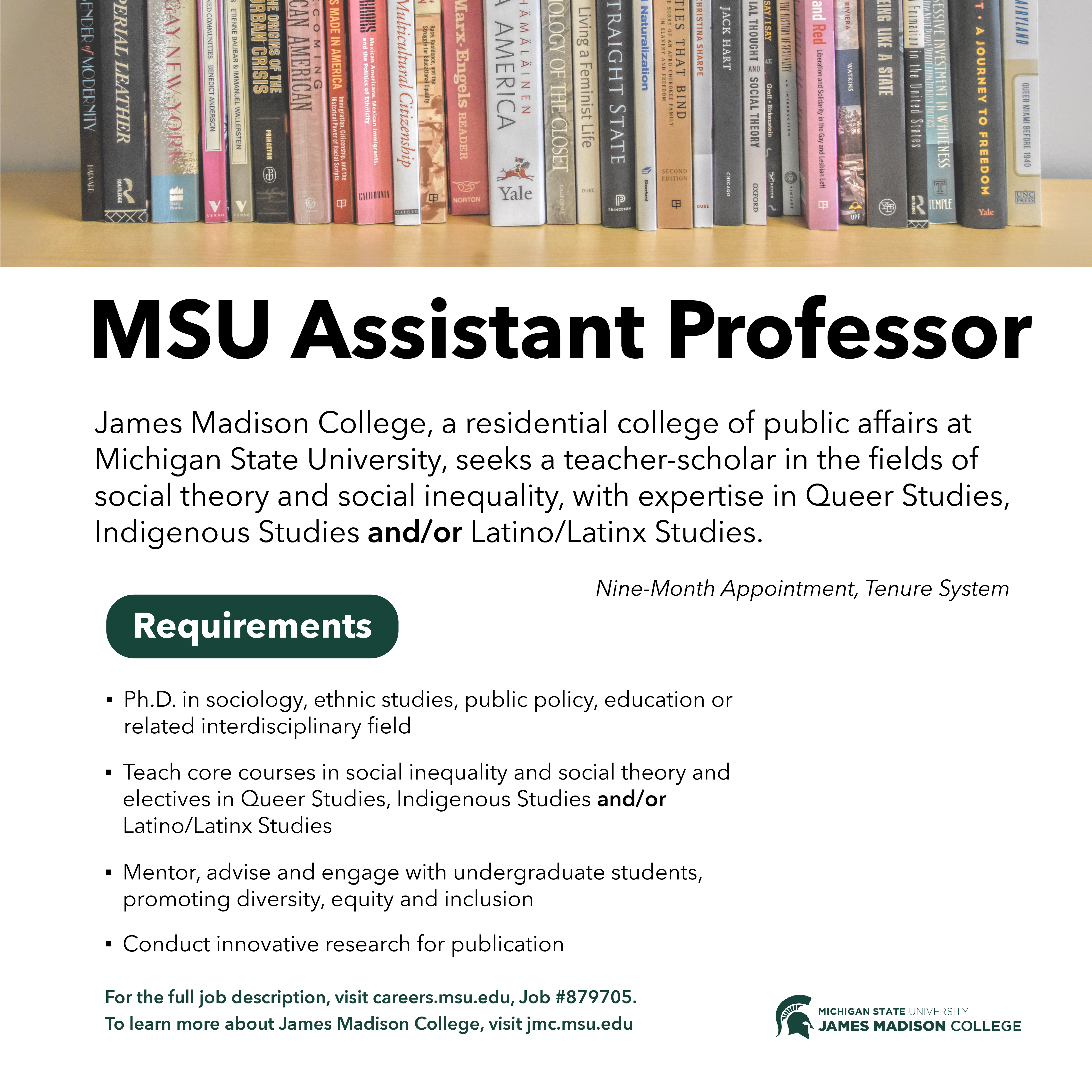
Job Posting for MSU James Madison College

State ICWA Law Signed into Law in Nevada

Not sure how this one slipped by–the Governor of Nevada signed this into law just before Brackeen came down.

AB444_EN

Media coverage here.

Assemblywoman Backus (the sponsor of the bill) graduated from ASU with an Indian Law Certificate. She is also a commissioner on the Uniform Law Commission’s study committee for a uniform state ICWA law.