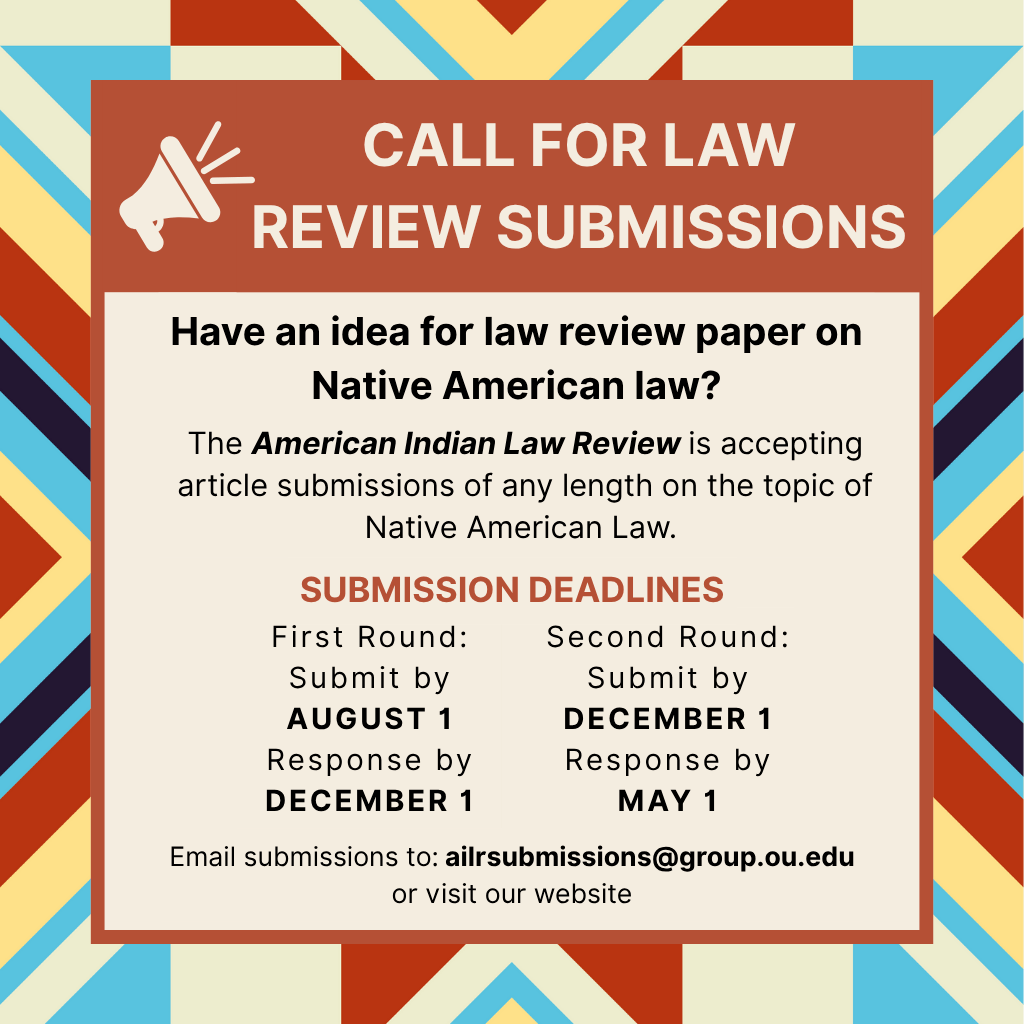
Here:
Institutions and Economic Development
Ezra Rosser
The Native Fight for Hunting Rights: The Crow Tribe and Herrera v. Wyoming
Jacob Lewis
The Need for Law in Federal Indian Law: A Response to Maggie Blackhawk in Light of the Supreme Court’s Troubling Term for Tribal Sovereignty
Nicholas B. Mauer

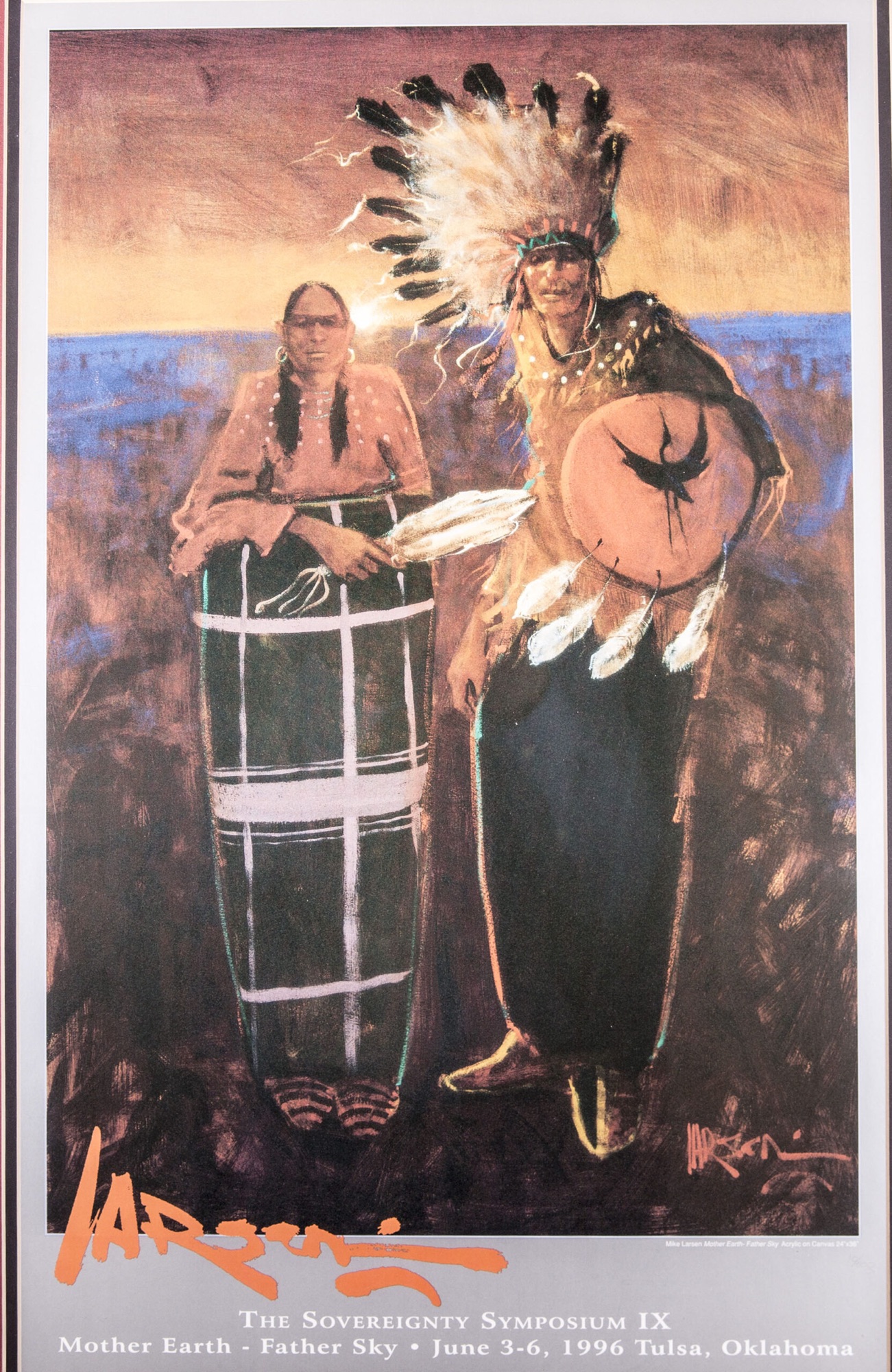
Here:
How Poor Is Poor Enough? How Jurisdictional Differences in Implementing the Right to Counsel Affect Indigent Native Americans
J. Santana Spangler-Day
Benefit Corporations—A Tool for Economic Development and Fostering Sovereignty in Tribal Business Structures
Madelynn M. Dancer
Oklahoma v. Castro-Huerta—Using Sentencing Inequities to Address the Oliphant in the Room
Dillon M. Sullivan
A Tribal Court Blueprint for the Choctaw Freedmen: Effect of Cherokee Nation v. Nash
LeeAnn Littlejohn

Here:
Oklahoma v. Castro-Huerta: Oklahoma’s Latest Power Grab and Its Implications for Native Women in a Post-Roe World
Camryn A. Conroy
A Note on Navajo Nation v. Urban Outfitters, Inc.
Brantly J. Stockton
Removing the Stain Without Undermining Military Awards: Revoking Medals Earned at Wounded Knee Creek in 1890
Dwight S. Mears
Here:
The Impact of Climate Change on the Cultural Identity of Indigenous Peoples and the Nation’s First “Climate Refugees”
Jordan K. Medaris
State ex rel. Matloff v. Wallace: Reversing Course on Subject Matter Jurisdiction
Andrew Case
Cooley’s Hidden Ramifications: Has the Supreme Court Extended the Terry Doctrine for Automobile Searches to the Point of Eliminating Probable Cause?
Thomas G. Hamilton
“The Center Cannot Hold”: Nation and Narration in American Indian Law
Chantelle van Wiltenburg
Winner, Best Appellate Brief in the 2022 Native American Law Student Association Moot Court Competition
Daniel Ahrens and Case Nieboer
Introductory Letter of the Editorial Boards
OUNALSA Remembers Professors Strickland and Hager
Ryan Sailors
Reprint: American Indian Law and the Spirit World
Rennard Strickland
Rennard Leaves Us Words of Thunder
Bill Piatt
A Legacy That Sustains – Dean and Professor Rennard Strickland
Carole Goldberg
Rennard Strickland: Legal Historian and Leader
Charles Wilkinson
Rennard Strickland Helped Shape a Young Law School
Sheila Simon
Rennard Strickland – A Remembrance
Lawrence K. Hellman
Strickland and the Fred Jones Jr. Museum of Art
Hadley Jerman, PhD
Rennard Strickland: A Legacy of Generosity
Darla W. Jackson
Professor Strickland
Joseph Harroz, Jr.
Rennard Strickland: Living Without Notes
Katheleen Guzman
Reprint: The Rule of Law: McGirt v. Oklahoma and the Recognition of the Muscogee (Creek) Reservation
C. Steven Hager
Tributes to Steve Hager
Kace Rodwell, Michael Colbert Smith, and Stephanie Hudson
Here:

Belated Justice: The Failures and Promise of the Hawaiian Homes Commission Act
Troy J.H. Andrade
The Mess That Has Become Indian Gaming in Oklahoma
Lucas Meacham
A Case for Deference in American Indian Health Law
Ashley Murphy
TOPICS: Papers will be accepted on any legal issue specifically concerning American Indians or other Indigenous peoples.
ELIGIBILITY: The competition is open to students enrolled in J.D. or graduate law programs at accredited law schools in the United States and Canada as of the competition deadline of Monday, February 28th, 2022. Editors of the American Indian Law Review are not eligible to compete.
AWARDS: The first place winner receives $1,500 and publication by the American Indian Law Review, an official periodical of the University of Oklahoma College of Law with international readership. The second place winner receives $750, and third place receives $400. Each of the three winning authors will also be awarded an eBook copy of Cohen’s Handbook of Federal Indian Law, provided by LexisNexis.
DEADLINE: All emailed entries must be received no later than 6 p.m. Eastern Standard Time on Monday, February 28th, 2022 (5 p.m. Central Standard Time). Entries will be acknowledged upon receipt. Submissions may be emailed to the American Indian Law Review at mwaters@ou.edu
JUDGES: Papers will be judged by members of the legal profession with an interest in American Indian law and by the editors of the American Indian Law Review.
STANDARDS: Papers will be judged on the basis of originality and timeliness of topic, knowledge and use of applicable legal principles, proper and articulate analysis of the issues, use of authorities and extent of research, logic and reasoning in analysis, ingenuity and ability to argue by analogy, clarity and organization, correctness of format and citations, grammar and writing style, and strength and logic of conclusions. All entries will be checked for plagiarism via an online service.
FORM: Entries must be a minimum of 20 double-spaced pages in length and a maximum of 50 double-spaced pages in length excluding footnotes or endnotes. All citations should conform to The Bluebook: A Uniform System of Citation (21st ed.). The body of the email must contain the author’s name, school, expected year of graduation, current address, permanent address, and email address. No identifying marks (name, school, etc.) should appear on the paper itself. All entries must have only one author. Entries must be unpublished, not currently submitted for publication elsewhere, and not currently entered in other writing competitions. Papers entered in the American Indian Law Review writing competition may not be submitted for consideration to any other publication until such time as winning entrants are announced, unless the entrant has withdrawn the entry or received a notification of release prior to that time. Any entries not fully in accord with required form will be ineligible for consideration.
SUBMISSION: Submissions may be emailed to the American Indian Law Review at mwaters@ou.edu by the competition deadline. Entries may be sent as Microsoft Word, PDF, or WordPerfect documents.
CONTACT: E-mail — Michael Waters, mwaters@ou.edu
Phone Numbers — (405) 325-2840 and (405) 325-5191
This rules sheet is also available on the AILR website, at http://www.ailr.net/writecomp.
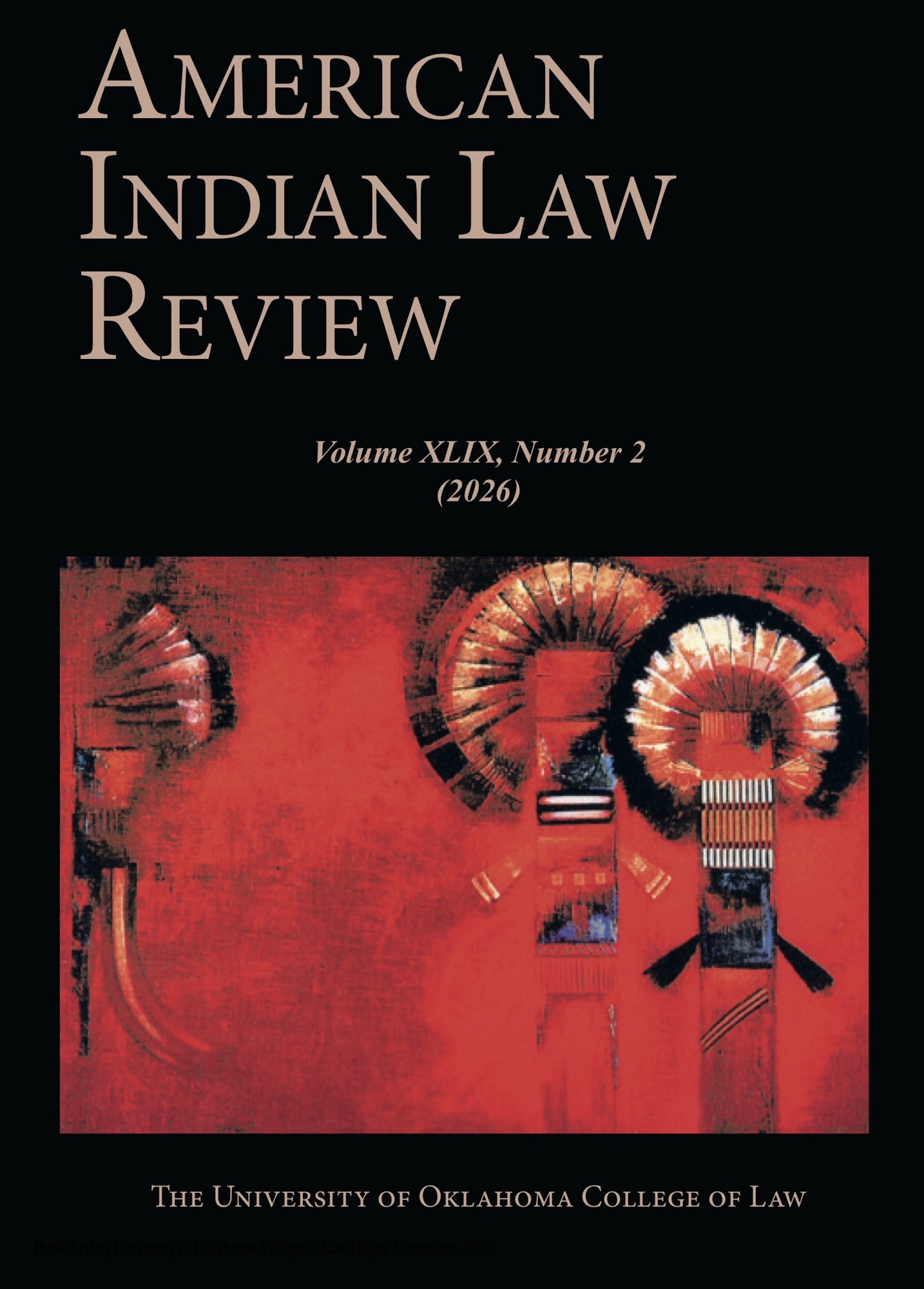
Here:
Vol. 45, No. 1 (2020-2021)
Front Pages PDF
Article
ICWA’s Irony – Marcia Zug PDF
Comments
The Secretary of the Interior Has the Authority to Take Land into Trust for Federally Recognized Alaska Tribes – Meghan O’Connor PDF
“The Desert Is Our Home” – Kayla Molina PDF
Notes
Coeur D’alene Tribe v. Hawks: Why Federal Courts Have the Power to Recognize and Enforce Tribal Court Judgments Against Nonmembers “Because of the Federal Government’s Unique Relationship with Indian Tribes” – Heath Albert PDF
The Disproportionate Effect on Native American Women of Extending the Federal Involuntary Manslaughter Act to Include a Woman’s Conduct Against Her Child in Utero: United States v. Flute – Andie B. Netherland PDF
Special Feature
Mirrored Harms: Unintended Consequences in the Grant of Tribal Court Jurisdiction over Non-Indian Abusers – Jonathan Riedel PDF
Alexander Tallchief Skibine has posted “The Tribal Right to Exclude Non-Tribal Members from Indian-Owned Lands,” forthcoming from the American Indian Law Review, on SSRN.
Here is the abstract:
In 1981, the Supreme Court issued its decision in Montana v. United States, severely restricting the ability of Indian Tribes to assume civil regulatory and adjudicatory jurisdiction over non-tribal members for activities taking place on non-Indian lands within Indian reservations. The Court in Montana stated that “it could readily agree” with the Court of Appeals’ holding that the tribe could regulate the conduct of non-member on tribal lands. Yet, twenty years later, the Court issued its opinion in Nevada v. Hicks holding that in certain circumstances, the jurisdiction of Indian tribes could also be limited even if the activities of the non-members took place on Indian-owned lands.
It has been almost twenty years since Hicks and because of the cryptic and fractured nature of that decision, the federal circuits are divided and still trying to figure out under what circumstances tribal civil jurisdiction over non-members should be restricted when these activities take place on Indian-owned lands.
In this Article, I argue that among all the possible interpretations of Hicks, the one adopted by the Ninth Circuit makes the most sense. Under that interpretation, the so-called Montana framework used to divest tribes of jurisdiction is not applicable to cases where a tribe has retained the right to exclude. I argue that Hicks can be reasonably conceptualized as endorsing the 9th Circuit methodology. However, I also argue that Hicks should have been decided as a state jurisdiction cases and not a tribal divestiture of inherent sovereignty case. Re-imagining Hicks as a state jurisdiction case would not have changed the outcome but would have avoided the last twenty years of confusion surrounding how Hicks should be interpreted.
Highly recommended!
You must be logged in to post a comment.