HHS Releases Proposed Rule to Collect ICWA Data through AFCARS, Comments Needed

If you are reading that title and thinking, “Kate, I am pretty sure you have posted this before. Like, a lot.” you are not wrong:
https://turtletalk.blog/?s=AFCARS

In fact, titles from prior posts include “Adoption and Foster Care Analysis and Reporting System (AFCARS) Notice of Proposed Rule Making. Again.” and “Déjà vu All Over Again: AFCARS Comments Needed

The short version of this 10 year saga is that at the end of the Obama administration, HHS promulgated a rule that would require Title IV-E agencies to collect information on ICWA. Before that could go into effect, the Trump administration withdrew it, and issued a different rule. After that happened, tribes and groups representing LGBTQ+ interests sued the feds to get the original rule back. Disclaimer, the MSU Indian Law Clinic represents the plaintiffs in that litigation along with Lambda Legal and Democracy Forward. Finally, the Biden administration has proposed a new rule that would go back to collecting ICWA data (this rule does not include sexual orientation or gender identity data elements). This means, yes, if you have worked in this area for the past 10 years, you may have submitted upwards of 5 sets of comments on this issue (I just checked, and we put our first one in 9 years ago, which was written by a 2L who is now a tribal leader).

The proposed regulation is here, as is the link to submit comments:

https://www.federalregister.gov/documents/2024/02/23/2024-03373/adoption-and-foster-care-analysis-and-reporting-system

What does this mean? Well, dust off your prior comments regarding the history of ICWA, the importance of ICWA, the importance of data related to ICWA, the importance of ICWA data to the children, families, and tribes involved in the system, and review the latest proposal. The actual data reporting requirements begins on 13665. Then submit an updated version of your comments in support of collecting ICWA data before April 23, 2024.

At a very first glance, this proposed rule appears to include a lot of important data questions that would inform practice and help with compliance, and limit the data collection to “state” Title IV-E agencies. The proposed rule appears marginally more limited than the original 2016 rule, but more expansive than the 2020 rule, though I will need to compare them more closely.
No Brackeen Today/Observations on Foster Parent Intervention

Next opinion day is June 8.

While we wait for Brackeen, I wanted to highlight this story from Colorado, where the Office of Respondent Parents’ Counsel has been doing great work on ICWA cases. In this case, they have collected incredibly useful data on what happens to a child protection case when foster parents intervene. This article is not ICWA specific, but the last two cases the MSU Indian Law Clinic has had on appeal are a direct result of the attempt at foster parents to intervene. In both cases, the court and agency agreed with the tribes and followed ICWA. In both cases, the foster parents sought to intervene and appealed the case. As we look past Brackeen, addressing this issue of foster parent intervention generally is vital.

Article

According to data provided by the ORPC foster parent intervention has increased in Colorado in the past decade. In 2020, 10% of Dependency and Neglect cases had Intervenors. When foster parents intervene, the chance of reunification decreases from 62% to 22% for the birth parents.

emphasis added

According to the ORPC, the average Dependency and Neglect Case costs $3,500 to litigate, but when foster parents intervene the average court cost goes up to $7,500.

Fort & Smith on ICWA During the Brackeen Years

Forthcoming in the Juvenile & Family Court Journal

From 2017 through 2022, while the Indian Child Welfare Act (“ICWA”) was under direct constitutional attack from Texas, state courts around the country continued hearing appeals on ICWA with virtually no regard for the decision making happening in Haaland v. Brackeen in the federal courts. For practitioners following or working on both sets of cases, this duality felt surreal, as they practiced their daily work under an existential threat. The data in this article draws from the authors’ previous publications providing annual updates on ICWA appeals, and now includes cases through 2021. It provides a description of appellate data trends across this time period, as well as for each year, while also highlighting key appellate decisions from jurisdictions across the country. Perhaps what this article demonstrates more than any single thing is the amount that ICWA is a part of child welfare practitioners’ daily lives now, in a way that will be difficult to upend, regardless of the Supreme Court’s ultimate decision.

This is particularly recommended for practitioners–we’ve taken the data from all our past articles to put them into one. One of our charts still needs a labels fix from our data expert, Alicia Summers, but otherwise the article has undergone peer review and will be published soon.

2021 ICWA Cases–Initial Screenshots

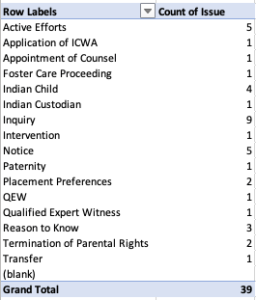
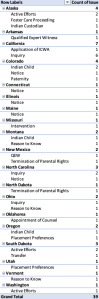
I’m still cleaning the data for the 2021 ICWA cases, but here are a few screen shots that might be interesting. Federal cases are excluded. This dataset is based on my reading of Lexis/Westlaw alerts as well as a few individual state alerts. Mistakes are mine.

AFCARS Comments Due June 18

Here are the previous posts on the Adoption and Foster Care Analysis and Reporting System.

These comments are to tell the federal government (AGAIN) to start collecting basic data on state ICWA cases. While we would like the original rule to stand (and say so in the model tribal comments), there is also an opportunity to request very specific data elements that are less complicated or confusing than the ones currently offered.

If you would like information on this issue or model tribal comments, please email Jack Trope (information handouts), Delia Sharpe (model comments), or me (both/either). If you are a law professor interested in signing on to excellent comments, email Seth Davis at Berkeley.

jtrope@casey.org

delia.sharpe@caltribalfamilies.org

fort@law.msu.edu

sdavis@law.berkeley.edu


Abigail Echo-Hawk on Decolonizing Data

Here

When we think about data, and how it’s been gathered, is that, from marginalized communities, it was never gathered to help or serve us. It was primarily done to show the deficits in our communities, to show where there are gaps. And it’s always done from a deficit-based framework. They talk about how our communities have the highest rates of obesity, have the highest rates of diabetes, highest rates of infant mortality. How our people may be experiencing high rates of opiate misuse.

What they don’t talk about is the strengths of our community. What we know, particularly for indigenous people, is that there was a genocide and assimilation policies and termination policies that were perpetuated against us. If they had worked, we wouldn’t be here. And so we were always strength-based people, who passed on and continued knowledge systems regardless of people who tried to destroy us.

AFCARS ICWA Data Elements Tribal Consultation

Here is the information on the June 3 tribal consultation on the Adoption and Foster Care Analysis and Reporting System. Comments are due June 18.

Adoption and Foster Care Analysis and Reporting System (AFCARS) Notice of Proposed Rule Making. Again.

Here.

We cannot currently track on a national level in any way how ICWA works, where children who are involved in ICWA cases are placed, what their outcomes are, or how many cases are transferred to tribal court, as examples. There is barely statewide data available, and most of it is on a county-by-county level. As just one example, Michigan is in a federal lawsuit over its data collection system.

I am deeply tired of hearing that tracking this information is simply too burdensome for the states that are putting children in care, and then getting hit in lawsuit after lawsuit with claims that are not supported by any data, but also cannot be refuted by data we refuse to collect.

If your tribe wants to submit comments, there will be model comments available before the deadline of June 18.

GAO Report on Native Youth Involvement in the Juvenile Justice System

Here

However, more Native American youth were involved in the federal system than their percentage in the nationwide population (1.6 percent). For example, of all youth arrested by federal entities during the period, 18 percent were Native American. According to Department of Justice (DOJ) officials, this is due to federal jurisdiction over certain crimes involving Native Americans. Comprehensive data on Native American youth involvement in tribal justice systems were not available for analysis. GAO’s analysis showed several differences between Native American and non-Native American youth in the federal justice system. For example, the majority of Native American youths’ involvement was for offenses against a person, such as assault and sex offenses. In contrast, the majority of non-Native American youths’ involvement was for public order offenses (e.g., immigration violations) or drug or alcohol offenses. On the other hand, in state and local justice systems, the involvement of Native American and non-Native American youth showed many similarities, such as similar offenses for each group.

via Indianz

AFCARS Data Implementation Rule Delayed and Will be Revised. Again.

From the Administration for Children and Families here.

The rule is delayed until 2020 and the Administration is going to “streamline” the data elements. And then it might just be delayed again based on the “streamlining”:

The Children’s Bureau published in the Federal Register on August 21, 2018 a final rule to delay implementation of the December 2016 AFCARS final rule until October 1, 2020 (83 FR 42225). However, since we plan to revise the AFCARS data points, we will revisit this implementation date to provide a timeframe to allow title IV-E agencies time to comply with the revised AFCARS data points.