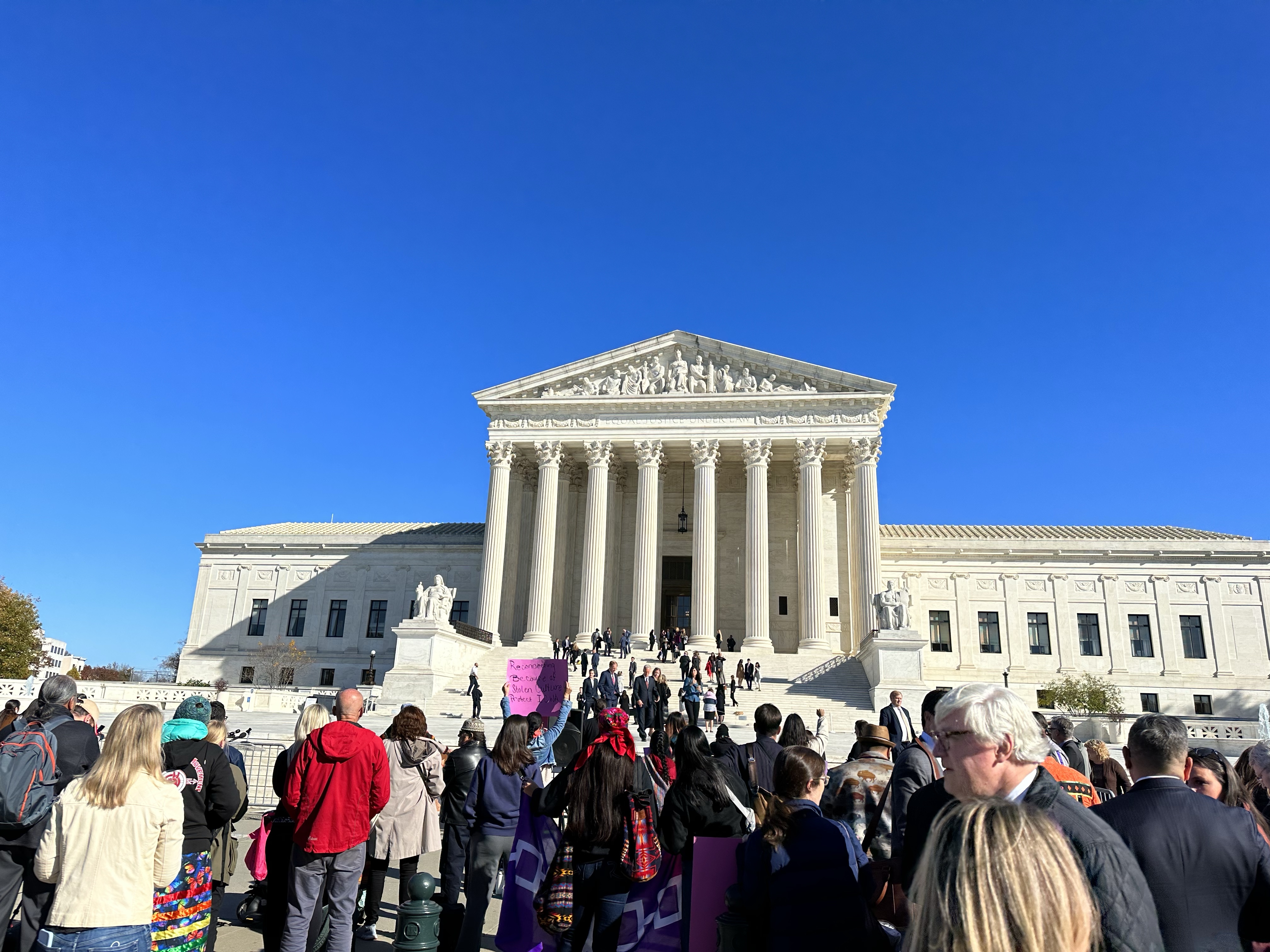
Montana Indian Law Section: ICWA, the Brackeen Decision & MT ICWA Statute — November 1, 2023

Here.

Tentative Agenda

Noon to 1 p.m.: The Impacts of the Brackeen Decision Moving Forward – 

1 to 2 p.m.: How the Brackeen Decision and the Recently Passed Montana ICWA Statute Will Impact Practitioners in Montana. 

Speakers

Professor Matthew Fletcher: Harry Burns Hutchins Collegiate Professor of Law the University of Michigan Law School

Kimberly Cluff: California Tribal Family Coalition

Kelly Driscoll: Montana Office of the State Public Defender, Missoula

April Olson: Rothstein Donatelli, Tempe, Arizona

UConn Law Review Symposium — Interrogating Haaland v. Brackeen: Family Regulation, Constitutional Power, and Tribal Resilience [October 6, 2023]

Here:

The Connecticut Law Review invites you to their 2023 symposium: Interrogating Haaland v. Brackeen: Family Regulation, Constitutional Power, and Tribal Resilience The litigation that led to Haaland v. Brackeen threatened to take down not only the Indian Child Welfare Act, but vast swaths of federal Indian policy and federal law. Instead, the Supreme Court’s decision left ICWA unscathed and affirmed the constitutional relationship between tribal nations and the United States. But threats to Native families and tribal sovereignty continue. Native children continue to be removed from their communities by a market for adoptable children. A handful of states and interest groups continue to seek ways to challenge tribal authority and federal laws that support it. And because the Supreme Court held that the Brackeen plaintiffs lacked standing to raise their equal protection challenges to ICWA, those claims can be raised another day. Leading scholars, attorneys, and tribal leaders will explore these and other issues raised by the decision in this symposium.

Connecticut Law Review Symposium on Brackeen, Oct. 6

Here.

Connecticut Law Review Symposium: 
Interrogating Haaland v. Brackeen

Family Regulation, Constitutional Power, and Tribal Resilience

Friday, October 6, 2023 | 12:00 pm-2:30 pm ET
Virtual

The Connecticut Law Review invites you to their 2023 symposium:
Interrogating Haaland v. Brackeen: Family Regulation, Constitutional Power, and Tribal Resilience

The litigation that led to Haaland v. Brackeen threatened to take down not only the Indian Child Welfare Act, but vast swaths of federal Indian policy and federal law. Instead, the Supreme Court’s decision left ICWA unscathed and affirmed the constitutional relationship between tribal nations and the United States. But threats to Native families and tribal sovereignty continue.

Native children continue to be removed from their communities by a well-funded market for adoptable children. A handful of states and interest groups continue to seek ways to undermine tribal authority and federal laws that support it. And because the Supreme Court held that the Brackeen plaintiffs lacked standing to raise their equal protection challenges to ICWA, those claims can be raised another day.

Leading scholars, attorneys, and tribal leaders, including Chairwoman Andrews-Maltais, Gregory Ablavsky, Laura Briggs, Seth Davis, Kate Fort, Ian Gershengorn, and Gerald Torres, will explore these and other issues raised by the decision in this symposium.

UNLV Law CLE on Brackeen, Sept. 20

Here

After Brackeen: Outcomes and Implications of the Supreme Court’s Decision Upholding the Indian Child Welfare Act

Approved for 2 Nevada MCLE Credit

September 20, 2023

Virtual
10:00 a.m. – 12:00 p.m (Pacific Time)

Registration is required

Click Here To Register for The Virtual Webinar

~~~~~~~~~

In Person UNLV Student Viewing and Discussion (Lunch Provided)

10:00 a.m. – 12:00 p.m (Webinar Viewing) / 12:00 p.m. – 1:00 pm (Discussion)

Boyd School of Law Room 203

In Person Registration is required

Click Here To Register For the Student Only In Person Discussion


In June, the Supreme Court issued its long-awaited decision in Brackeen v. Haaland upholding the federal Indian Child Welfare Act. Enacted in 1978, the ICWA affirms tribal jurisdiction over state child welfare matters and sets uniform standards for child welfare cases involving Indian children. As the Court recognized, the law was a necessary and largely successful action by Congress to reverse decades of federal and state campaigns to remove Native children from their homes and sever ties between tribes and their children. The Court rejected several challenges to the law that, if accepted, would have had devastating consequences for children, families, and tribal sovereignty. 

Brackeen was a major victory for tribes and Native children. The majority opinion by Justice Barrett, and concurring arguments by Justice Gorsuch, addressed questions about Congressional power over Indian affairs, tribal sovereignty, and equal protection. As a follow up to our November 2022 webinar, which explored the various arguments and the impact of a potential decision on tribal courts and jurisdiction, this webinar will bring together experts in the field to explain the decision, its practical and jurisprudential significance, and what it portends for future cases involving the ICWA and tribal sovereignty. 

Featured Panelists:

Fletcher Draft Paper: “Federal Indian Law as Method”

Please check out “Federal Indian Law as Method,” likely forthcoming in the University of Colorado Law Review. Here is the abstract:

This Essay is written in the shadow of a series of noxious attacks on core principles of federal Indian law, most notoriously Haaland v. Brackeen, a challenge to the constitutionality of the Indian Child Welfare Act (ICWA). The Supreme Court did not reach the merits of the equal protection challenges, but during oral argument, several judges expressed skepticism that Congressional Indian affairs enactments that grant privileges or preferences to Indian people could survive scrutiny under an equal protection analysis. Justice Kavanaugh, one of the judges most interested in the equal protection claims, wrote separately to highlight these issues, asserting that “the equal protection issue is serious.”
The parties siding with ICWA’s constitutionality argued to the Court that the Mancari case is a guide, whereas the opponents to ICWA’s constitutionality wanted to Court to ignore the case altogether. This Essay is a full-throated defense of the Mancari as a method of constitutional interpretation. Not only is the Mancari method correct, it is also the only justifiable method. This Essay proceeds with a short background on federal Indian law and its default interpretative rules. Next, the Essay surveys the application of and challenges to the Mancari method. Finally, the Essay concludes with a comparison of the methods proposed to replace or displace the Mancari method.
This Essay was prepared for the 31st Annual Rothgerber Symposium at Colorado Law School.

Fort on Defending ICWA, 2013-2023

Article-5_Fort

This Article lays out the history of the fight over ICWA from Baby Girl to Haaland, from my perspective as a clinical professor who has been involved with every major ICWA case since 2013, as well as my observations about why ICWA was so vulnerable to an organized litigation attack despite continued bipartisan and widespread support of the law.

The rest of the issue is here, with an essay by Chemerinsky and an article on Dobbs by Delgado and Stefancic.

Connecticut Public Radio Show on Brackeen and Ned Blackhawk’s New Book

Here.

ACS Broken Law Podcast on Brackeen Featuring Wenona Singel

Here is “A Win for Tribal Sovereignty.”

Wenona Singel at the Supreme Court

5Qs for Fletcher on Haaland v. Brackeen & LDF v. Coughlin

From U of M law school, here.

An excerpt:

ICWA was always a part of my scholarly agenda, largely because ICWA is such an important part of virtually every Native person’s personal history. My writing partner and spouse Wenona Singel can trace the removals of her ancestors from the 1830s all the way to the 1970s. Our children are the first generation of children in her family to not be removed since the 1830s. I began to focus on the constitutional defense of ICWA intensely after a 2013 Supreme Court decision, Adoptive Couple v. Baby Girl, where the Court questioned the constitutionality of the Act. Within a couple years, constitutional challenges to ICWA were swarming the courts. Occasionally joined with Singel, who was using other media to tell her family’s story, I began to write systematically on each constitutional issue in an effort to push back on the narrative that ICWA was somehow constitutionally suspect. I focused on congressional Indian affairs powers, anti-commandeering and federal preemption, equal protection, and non-delegation.

An E.S.F. sketch of his dad.

This Land Special Brackeen Decision Episode

Here.

Opinion here.