Please join us Tuesday afternoon for a discussion of Prof. Blake Watson’s book, Buying America from the Indians.
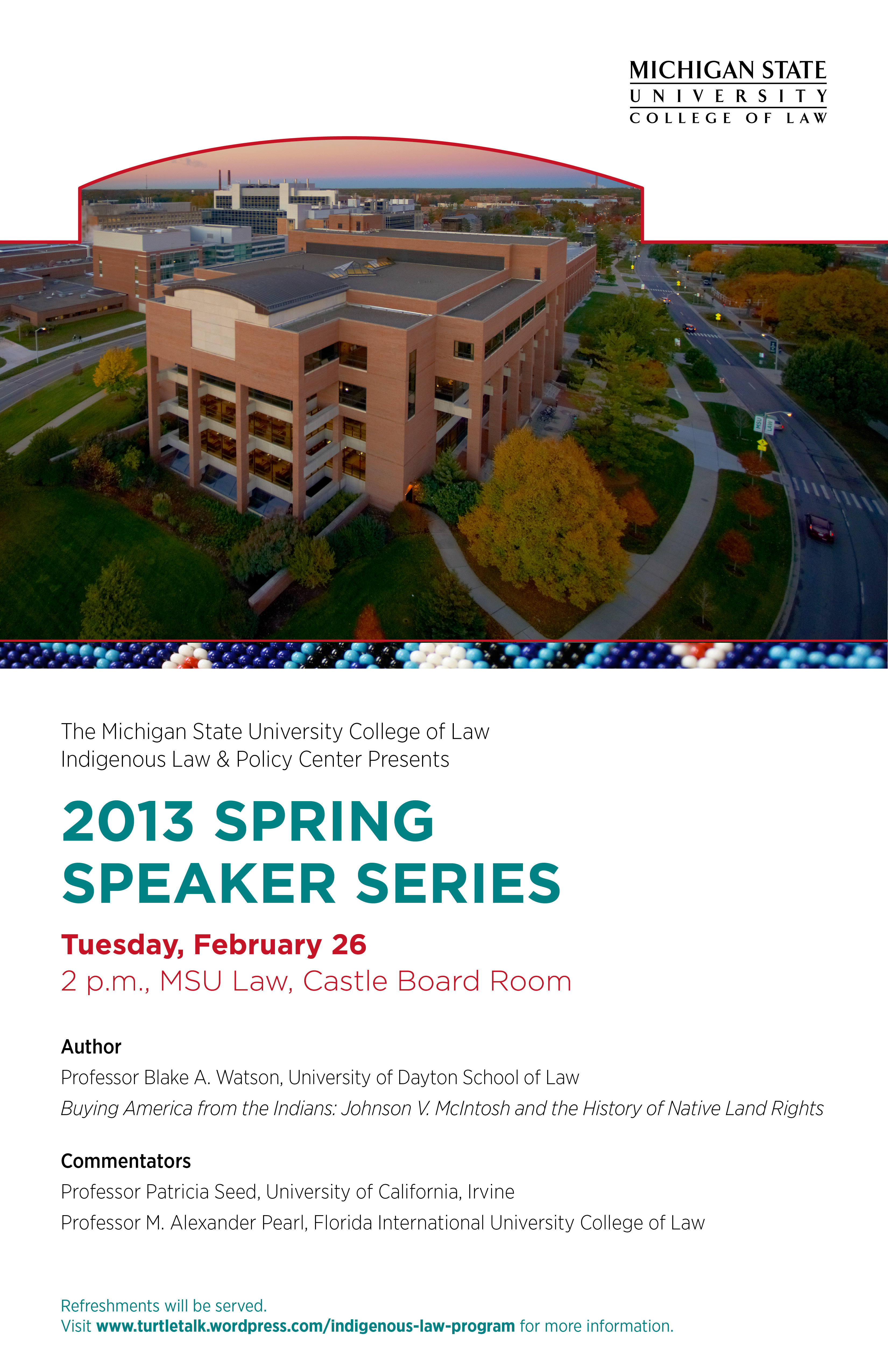
Please join us Tuesday afternoon for a discussion of Prof. Blake Watson’s book, Buying America from the Indians.
Jacob Levy has posted his new paper, “Indigenous Rights, Modern Political Concepts, and the State,” on SSRN.
Here is the abstract:
This paper considers the relationship of indigenous rights to four foundational principles of modern political theory: sovereignty, the nation, property, and constitutionalism. All took their familiar intellectual forms as the European state was crystallizing – and as European states were embarking on their imperial projects around the world. All were reshaped by both the development of the state and the European encounter with indigenous peoples. The absolutist idea of state sovereignty, developed as the modern Weberian state was crystallizing in Europe, was deeply connected with the justifications of imperial power that could lawfully conquer, expropriate, and kill indigenous peoples. The subsequent joining of the idea of the nation to state sovereignty heightened the latter’s absolutism. Settler states conceived as sovereign unitary nation-states left no normative legal space for indigenous rights, and indeed were profoundly hostile to them. By contrast, property and constitutionalism drew on natural law ideas and pluralist political traditions and were sometimes developed in ways that made room for indigenous rights, even as rival interpretations were developed in ways that subordinated both property and constitutionalism to state sovereignty. The paper argues that both nationhood and sovereignty are problematic ways to conceive of indigenous rights today, and that property and constitutionalism offer the more promising foundation.
Kristen Carpenter, Sonia Katyal, and Angela Riley have posted “In Defense of Property” on SSRN. Here is the abstract:
This Article advances a comprehensive theory to explain and defend the emergence of indigenous cultural property claims. In doing so, it offers a vigorous response to an emerging view, in scholarship and popular society, that it is normatively undesirable to employ property law as a means of protecting indigenous culture and ideas. In our view, cultural property critiques arise largely because of the absence of a comprehensive and countervailing theory of indigenous cultural property. To remedy this absence, this Article articulates a robust theory of indigenous property that challenges the individual rights paradigm animating current property law. Specifically, this piece makes two broad contributions to existing property theory. First, it draws on but departs significantly from Margaret Jane Radin’s groundbreaking work linking property and ‘personhood,’ and defends cultural property claims, in contrast, within a paradigm of ‘peoplehood.’ Second, this piece posits that, whereas individual rights are overwhelmingly advanced by property law’s dominant ownership model, the interests of peoples, particularly indigenous peoples, are more appropriately and powerfully effectuated through a theory of property characterized most aptly by stewardship.
As this Article demonstrates, our stewardship paradigm suggests a theory of property that goes far beyond the cultural property context, with implications for property law generally. By introducing a fundamental paradigm shift that locates the metaphorical bundle of rights within non-owners as well as owners, we highlight non-owners’ duties and rights to tangible and intangible goods, even in the absence of title or possession. This Article draws on a wealth of literature from the corporate, environmental, and indigenous contexts to introduce an innovative framework for rethinking ownership altogether. Ultimately, our stewardship theory of property makes a significant contribution to the field, filling an existing void in property theory and adding a much-needed perspective to the ongoing debate over cultural property protections.
Joe Singer has posted “Normative Methods for Lawyers” on SSRN.
From the abstract:
How can we defend arguments about what the law should be based on considerations of morality, justice, fairness, liberty, rights, or human values? Are such arguments anything more than assertions of personal preferences? In this article, I argue that normative arguments are crucial for the rule of law and that both lawyers (and law students) need to know how to make and defend claims of morality and justice. In recent years, cost/benefit and efficiency analysis appear to have taken over most legal scholarship and many law school classroom discussions. Such analysis suggests that the sole goal of the legal system should be to maximize human welfare and that we can best accomplish this goal by deferring to individual preferences, whatever they happen to be, valuing the relative strength of those preferences by reference to market values, and then choosing results whose social benefits outweigh their social costs. In contrast, I argue that such analysis is wholly without any normative weight unless it occurs within a framework of institutions, laws, and practices that are consistent with minimum standards for social and economic relationships in a free and democratic society. Normative arguments are designed to define that legitimate framework. Moreover, such arguments are not merely expressions of personal preference but are evaluative assertions and moral demands we are entitled to make of each other. Moral and political theory provide resources to help lawyers make evaluative assertions about human values that the legal system should respect. At the same time, lawyers possess substantial expertise in analyzing, shaping, and defending normative claims and the methods used by lawyers should be of interest to moral and political theorists.
 Turtle Talk
You must be logged in to post a comment.