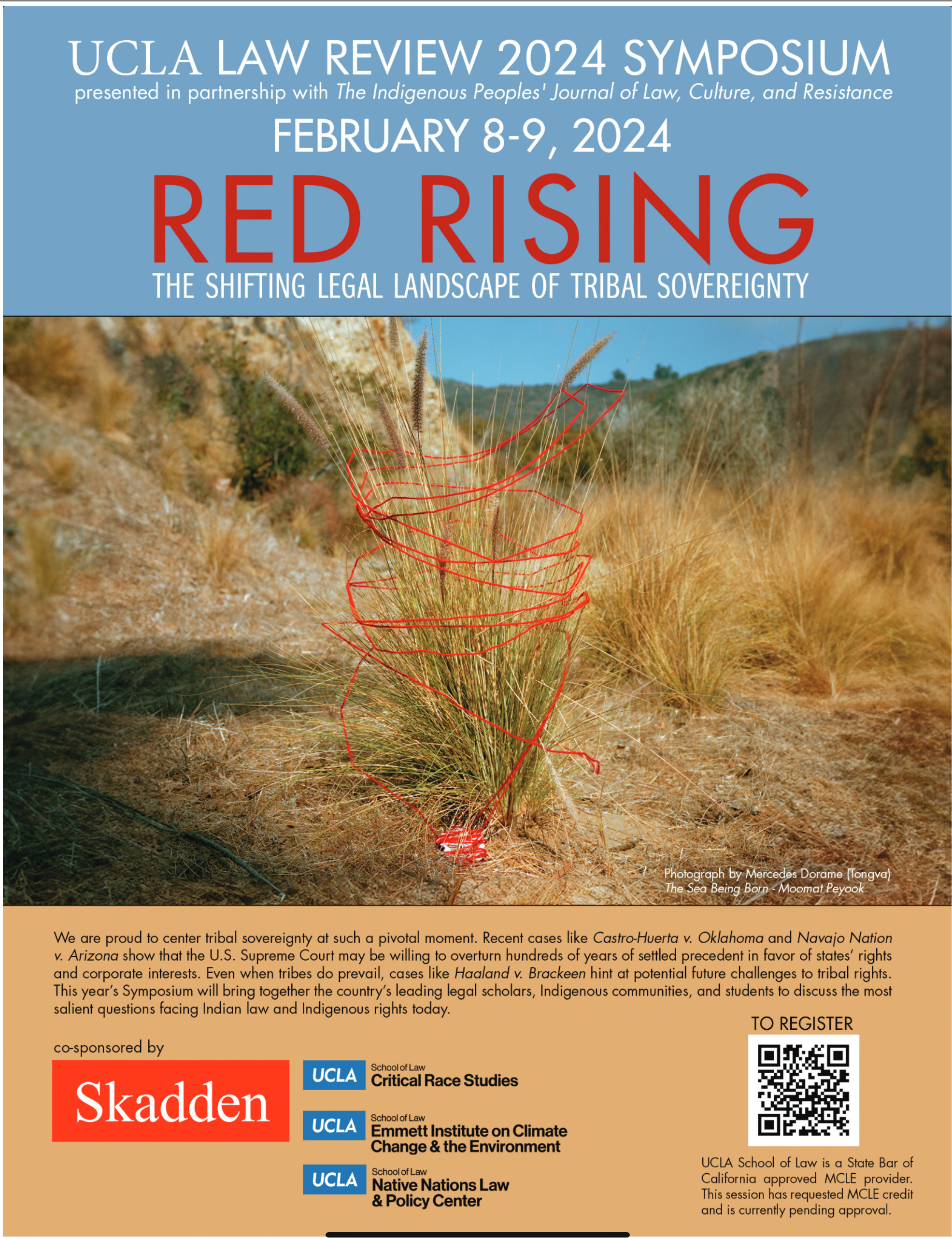
UCLA Law Review Symposium Issue — Red Rising: The Shifting Legal Landscape of Tribal Sovereignty

Here:

Jason Robison on Arizona v. Navajo Nation

Jason Robison has published “Relational River: Arizona v. Navajo Nation & the Colorado” in the UCLA Law Review.

Here is the abstract:

It is not every day the U.S. Supreme Court adjudicates a case about the water needs and rights of one of the Colorado River Basin’s thirty tribal nations and the trust relationship shared by that sovereign with the United States. Yet just that happened in Arizona v. Navajo Nation in June 2023. As explored in this Article, the Colorado is a relational river relied upon by roughly forty million people, reeling from climate change for nearly a quarter century, and subject to management rules expiring and requiring extensive, politically charged renegotiation by 2027. Along this relational river, Arizona v. Navajo Nation was a milestone, illuminating water colonialism and environmental injustice on the country’s largest Native American reservation, and posing pressing questions about what exactly the trust relationship entails vis-à-vis the essence of life. Placing Arizona v. Navajo Nation in historical context, the Article synthesizes the case with an eye toward the future. Moving forward along the relational river, the trust relationship should be understood and honored for what it is, a sovereign trust, and fulfilled within the policy sphere through a host of measures tied, directly and indirectly, to the post-2026 management rules. Further, if judicial enforcement of the trust relationship is necessary, tribal sovereigns in the basin (and elsewhere) should not view the Court’s 5–4 decision as the death knell for water-related breach of trust claims, but rather as a guide for bringing cognizable future claims and reorienting breach of trust analysis.

Kevin Washburn on Landback as Federal Policy

Kevin K. Washburn has published “Landback as Federal Policy” in the UCLA Law Review.

Here is the abstract:

Demands for the return of land to tribal nations have become much louder and more compelling in recent years. While “landback” has been part of federal policy for nearly a century, lawmakers and presidents from both parties have embraced landback initiatives more firmly in the last half century. But the quantity of lands returned is almost insignificant in comparison to the vast lands taken. Landback efforts are based in compelling moral claims. This Article summarizes the moral claims for landback by briefly recounting the widespread loss of land by Indian tribes through the nineteenth and twentieth centuries and highlighting the unique role of the federal government in this tragedy. It also showcases some of the tribal and federal counterefforts to the loss of land, including existing federal landback efforts that have returned millions of acres to tribes. The federal government has many tools available, and it should deploy them more effectively. Advocates must also be more strategic. Landback can be viewed in context with related federal initiatives, including renaming, comanagement, and costewardship, as well reservation expansion, retrocession, and other federal efforts to restore and expand tribal selfgovernance. These numerous related federal and tribal initiatives can support tribal landback and restorative justice efforts.

Lauren van Schilfgaarde on Native Reproductive Self-Determination

Lauren van Schilfgaarde has posted “Native Reproductive Self-Determination,” forthcoming in the UCLA Law Review, on SSRN. Here is the abstract:

Like the overall well-being of Indigenous peoples, Native reproductive health has been deeply impacted by the direct and collateral consequences of settler colonialism. Today, Natives experience some of the most dire reproductive health disparities. Unlike other health care systems, however, Native health care is sui generis. The federal government has treaty, trust, and statutory obligations to provide Native Americans with health care, most prominently operationalized in the Indian Health Service (IHS). Unfortunately, the perpetual underfunded status of IHS coupled with draconian policies has meant that Native reproductive health is dismally served. Moreover, reproductive health tends to be exceptionalized—treated as a distinct component of health care that is often underprioritized or even entirely cut. But even if the IHS budget was instantly enhanced and even if reproductive health care was instantly prioritized across health systems, Native reproductive health care would still lack its most essential ingredient: self-determination.

The term “self-determination” has grown significant national and international meaning, both in relation to Tribes and reproductive justice. Native reproductive self-determination, however, remains an undertheorized confluence. Indigenous reproductive health was only explicitly acknowledged by an international body in 2022, General Recommendation 39 issued by the Committee on the Elimination of Discrimination Against Women (CEDAW) regarding Indigenous women and girls. General Recommendation 39 acknowledges both the collective rights of Indigenous peoples to exist as a self-determined people and the unique vulnerability of Indigenous women and girls. This framework offers an important and expansive conceptualization of the federal duties owed to Native reproductive self-determination and a path out of the paternalistic and harmful logics that have historically formed Native reproductive health care. Indigenous rights must be positioned within a historical context to inform not just the rights of Indigenous peoples to be recognized and to self-govern but also to stress the positive obligations that the nation-state owes toward Indigenous peoples. A historical context that informs the nation state’s positive obligations are themselves background to the realization of a self-determined collective—in this case, to ensure Native reproductive self-determination.

Alex Pearl on Supreme Court Decisionmaking

M. Alexander Pearl has published “The Consequences of Mythology: Supreme Court Decisionmaking in Indian Country” in the UCLA Law Review.

Here is the abstract:

Ilanoli isht unowa. We tell our own stories. A single historical event has many stories. Although this nation’s official chronicle expected and even hoped for Indigenous peoples to fade away, we are still here. Our histories are marked by resistance, survival, sovereignty, and renaissance. Only now, in the later stages of the American experiment, do our histories have the chance to matter in new forms and spaces. How much these stories matter within contemporary contexts depends upon where they are spoken and more importantly, who is listening. On the pages of a U.S. Supreme Court opinion, what stories are told can make all the difference between advancing age-old rights and defending the very right to exist. In almost all Supreme Court opinions dealing with tribal nations, the stories from outsider perspectives dominate the narratives, affecting the construction of facts and the application of abstract legal principles. When beginning with a contrived image, it comes as no surprise that the lens of law will only further exaggerate those inaccuracies through a judicial opinion. The stories of tribal nations found in judicial opinions are like a fun house mirror—a misrepresentation of them. This warped version of Indigenous history is the American Mythology from which the federal common law derives its conceptualization of Indian tribes. But Supreme Court opinions need not continue this tradition of misrepresentation. They could instead detail history from Indigenous viewpoints, wherein Indigenous stories take on new relevance and legal import. This Article offers a methodological solution as an alternative to the Court’s current approach and provides evidence from recent opinions for why this option is more than wishful thinking.

UCLA Indian Law Symposium TODAY . . . B there or B L7 . . . Or U can watch on TV

Here.

Trevor Reed on Restorative Justice for Indigenous Culture

Trevor Reed has posted “Restorative Justice for Indigenous Culture,” forthcoming in the UCLA Law Review, on SSRN. Here is the abstract:

One still unresolved aspect of North American colonization arises out of the mass expropriation of Indigenous peoples’ cultural expressions to European-settler institutions and their publics. Researchers, artists, entrepreneurs, missionaries, and many others worked in partnership with major universities, museums, corporations, foundations, and other institutions to capture and exploit Indigenous cultural creativity, often in violation of Indigenous peoples’ laws, protocols, and standards of care. Much of this cultural material remains in Institutional repositories today, where it has been treated as the raw material for settler research, creativity, and innovation, circulating outside the control of the Indigenous communities who created it. These institutions must grapple with their legacies of intellectual and cultural abuse towards Indigenous peoples and emerging industry norms that increasingly demand respect for Indigenous rights, while continuing to make knowledge resources available and accessible to the public, to the extent allowed by law. Faced with these two seemingly incommensurable objectives, many institutions have begun to adopt cumbersome, generally unenforceable internal policies and procedures that tend to limit access to Indigenous culture as a remedy for past abuses rather than looking to Indigenous communities for guidance on methods for repair and redress. This Article advocates for a different approach – one which merges restorative justice theory and well-established methods for “Open Source” or “Creative Commons”-style licensing into what I call restorative licensing. I further advocate for the integration of privately ordered licensing structures within the restorative justice process to ensure Indigenous expectations for repair and redress are met, and that Indigenous cultural expressions can circulate once again on terms consistent with Indigenous law, protocol, and standards of care.

UCLA Law Review Indian Law Issue

Here:

President Nixon’s Indian Law Legacy: A Counterstory

Scholars of Federal Indian law have often celebrated President Richard Nixon for advancing tribal interests through legislation and policy initiatives. Far less attention has been paid to his impact on Federal Indian law through the appointments he made to the U.S. Supreme Court. During the time his four appointees served together, the Supreme Court rendered three decisions that are among the most harmful to tribal interests of the modern era. Whether any President should be held responsible for the decisions of his appointees is no simple question. It is worth noting, however, that President Nixon had every reason to know the issues in those three cases would likely reach the Supreme Court. Yet he did not investigate or take into account his appointees’ views on Native issues before making the appointments. Further, for at least one of the appointees—the one most consistently hostile to tribal interests—there was ample evidence of those views had President Nixon cared to check.

View Complete Listing

Principles of International Law That Support Claims of Indian Tribes to Water Resources

A growing body of international legal principles recognizes the right of indigenous people to water resources as a key component of their rights to self-determination, land, and economic self-sufficiency. These legal norms impose obligations on states both to recognize this right and to take affirmative steps to allow indigenous people to realize it. While the United States has not formally acceded to many of the applicable international instruments, the primary principles are embodied in instruments it has joined, and, in addition, some of these principles may constitute customary international law that applies regardless of accession.

Part I of this Article examines this body of legal principles as they relate to indigenous people’s access to water resources and also examines the international institutions which have been set up to interpret and implement these principles. Part II discusses the bipartisan federal policy over the last five decades in the United States to promote and protect the self-determination of Indian Tribes and the specific actions the United States has taken over that time period concerning Indian water rights. Finally, Part III discusses how international legal principles and mechanisms might be used to support a more comprehensive approach by the United States to address the unmet water needs of Tribes, rather than the current approach that focuses primarily on the adjudication and settlement of individual Tribes’ legal claims to water.

View Complete Listing

Crime and Governance in Indian Country

Criminal jurisdiction in Indian country is defined by a central, ironic paradox. Recent federal laws expanding tribal criminal jurisdiction are, in many respects, enormous victories for Indian country, as they acknowledge and reify a more robust notion of tribal sovereignty, one capable of accommodating increased tribal control over safety and security on Indian reservations. At the same time, the laws make clear that sovereignty comes at a price, potentially working to effectuate further assimilation of tribal courts and Indian people. As a result, at the same time that tribal sovereignty gains ground in ways critical to autonomy and self-governance, it is simultaneously threatened by exogenous forces that have the potential to homogenize tribal justice systems legally, politically, and—in particular—culturally.

This Article offers the first comprehensive assessment of the Tribal Law and Order Act and the reauthorization of the Violence Against Women Act, respectively, to show how they relate to one another on the ground and the implications for tribal sovereignty and self-determination. Ultimately, based on data compiled for the first time as well as extensive secondary sources, I argue that expanded criminal jurisdiction and punishment authority have, perhaps paradoxically, enhanced the ability of tribes to develop and enforce policies, laws, and procedures that are consistent with tribal custom and tradition. This presents a unique opportunity worthy of further exploration. In other words, rather than sovereignty and assimilation expanding in tension with one another, I find that the application of the laws has been experienced in tribal communities, as least anecdotally and preliminarily, as greatly enhancing—not threatening or destroying—tribal sovereignty and Indian cultural survival.


View Complete Listing
Continue reading

Michalyn Steele on Plenary Power, Political Questions, and Sovereignty in Indian Affairs

Michaelyn Steele has published “Plenary Power, Political Questions, and Sovereignty in Indian Affairs” in the UCLA Law Review.

Here is the abstract:

A generation of Indian law scholars has roundly, and rightly, criticized the Supreme Court’s invocation of the political question and plenary power doctrines to deprive tribes of meaningful judicial review when Congress has acted to the tribes’ detriment. Courts have applied these doctrines in tandem so as to frequently leave tribes without meaningful judicial recourse against breaches of the federal trust responsibility or intrusions upon tribal interests and sovereignty. For example, courts consider congressional abrogation of a treaty a political question beyond the reach of the judiciary. At the same time, challenges to the inherent, or aboriginal, authority of tribes are deemed justiciable. The Court’s inconsistent approach represents a kind of “heads I win; tails you lose” application of the political question and plenary power doctrines in Indian affairs.

This Article proposes that, rather than facing a rigged coin toss in the courts, tribes should be able to avail themselves of the political question and plenary power doctrines to have Congress, rather than the courts, decide questions of inherent tribal authority. Under current precedent, the Court has aggrandized its own power in Indian affairs through the theory of implicit divestiture, which holds that the judiciary may find tribes divested of inherent powers even without congressional action. This Article argues that the questions of whether inherent tribal authority endures, and which sovereign powers tribes can exercise, should be political rather than judicial. This Article challenges long-held assumptions about these fundamental doctrines of federal Indian law and poses important questions about the role of the courts and Congress and about the future of inherent tribal sovereignty.

HIGHLY RECOMMENDED.

UCLA Law Review Symposium in Honor of Carole Goldberg

The Next Frontier in Federal Indian Law: Building on the Foundational Work of Carole E. Goldberg

Here is the agenda:

Goldberg Symposium Schedule Revised