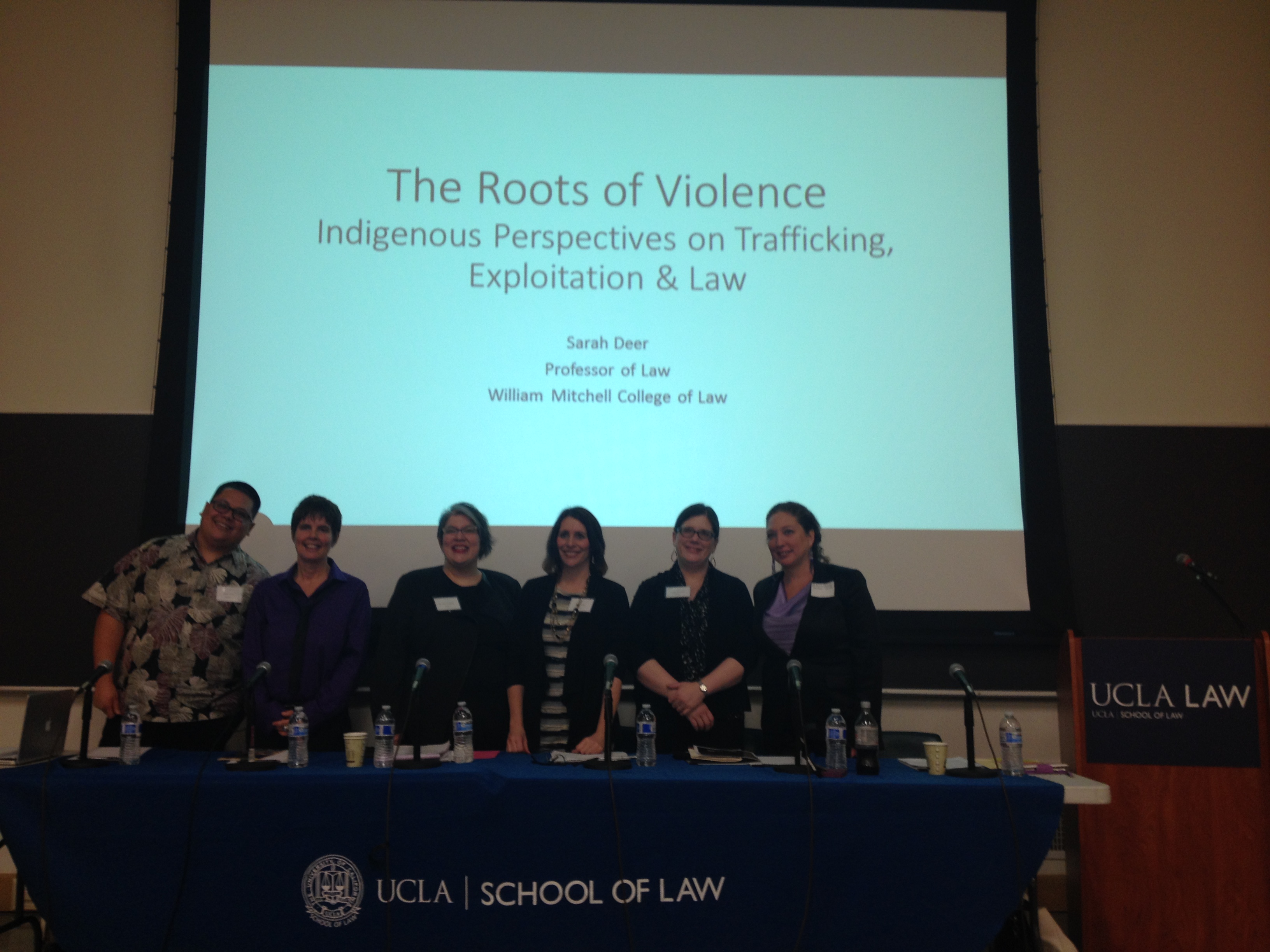
Opening Session of the UCLA Law Review Symposium, Examining the Roots of Human Trafficking and Exploitation

For the first time at a conference that doesn’t focus only on Indigenous issues, the Indigenous panel went first.

The opening session was titled The Roots of Violence: Indigenous Perspectives on Trafficking, Exploitation & Law

2015-01-29 10.32.50

Pictured: Julian Aguon, Christine Stark, Robyn Bourgeois, Victoria Sweet, Sarah Deer, Mishuana Goeman

Katherine Florey on Rule 19 after Pimentel

Katherine Florey has published “Making Sovereigns Indispensable: Pimentel and the Evolution of Rule 19” in the UCLA Law Review.

Here is the abstract:

Though Federal Rule of Civil Procedure 19 might appear to be one of the more esoteric of the Federal Rules, it is actually an exceptionally powerful device: It permits defendants to obtain dismissal of cases over which the court has valid jurisdiction, even when no other forum exists in which the action can be brought.  This Article argues that, while Rule 19 was originally intended to facilitate the consolidation of litigation by requiring joinder of absent parties, it has evolved in an important subset of cases to serve a nearly opposite purpose.  That is, in many cases in which a party may be affected by the litigation but cannot be joined because it is a sovereign possessing immunity from suit, courts have developed a near-categorical rule that the entire case may be dismissed—even if that means that the plaintiff is permanently denied a remedy.  Further, the U.S. Supreme Court recently appeared to endorse this approach, holding that Philippine human rights victims’ claims to their former regime’s assets could not be litigated because two Philippine governmental entities could not be joined in the case.

In such situations, this Article argues, Rule 19 functions almost as an abstention doctrine, permitting courts to avoid decisions in cases that may raise sensitive intergovernmental or foreign-relations issues.  This use of the rule is problematic for several reasons.  It is not authorized by (or even discussed in) Rule 19’s text, and it appears at odds with the original purpose of Rule 19: to promote consolidated litigation of disputes, not to dispose of them entirely.  Further, it permits the interests of the plaintiff—and the public interest in resolution of disputes—to be systematically slighted.  Thus, although there may be situations in which an absent party’s sovereign immunity should be taken into account, courts have gone too far in their solicitude for absent sovereigns.  This Article explores how this phenomenon has evolved and suggests ways in which courts’ analysis of Rule 19 factors should be modified to take account of the rule’s fundamental purposes

Sonia Katyal’s New Article: “Trademark Intersectionality”

Published here at the UCLA Law Review.

Here is the abstract:

Even though most scholars and judges treat intellectual property law as a predominantly content-neutral phenomenon, trademark law contains a statutory provision, section 2(a), that provides for the cancellation of marks that are “disparaging,” “immoral,” or “scandalous.” This provision has raised intrinsically powerful constitutional concerns, which invariably affect two central metaphors that are at war within trademark law: the marketplace of goods, which premises itself on the fixedness of intellectual properties, and the marketplace of ideas, which is premised on the very fluidity of language itself. Since the architecture of trademark law focuses only on how marks communicate information about a certain product or corporation within the marketplace of goods, it largely underestimates the more complex role that trademarks play within the marketplace of ideas. Conversely, by only taking into account a brand’s expressive implications, the provisions governing scandalous, disparaging, and immoral matter fail to substantively address the source-identifying functions that these marks often serve.

Wonderful material!

UCLA Law Student Note on Oliphant Fix

Samuel E. Ennis published his Comment, “Reaffirming Indian Tribal Court Criminal Jurisdiction over Non-Indians: An Argument for Statutory Abrogation of Oliphant,” (pdf) in the UCLA Law Review. The abstract:

This Comment challenges Oliphant v. Suquamish Indian Tribe, which precludes Indian tribal courts from criminally prosecuting non-Indians. Given that non-Indians often comprise the majority of reservation populations, and that the current upswing in tribal gambling enterprises brings scores of non-Indians onto reservations, it is no longer feasible for the federal or state governments to maintain the predominant criminal jurisdictional authority over Indian country. Non-Indian authorities are often situated far from reservations and do not have the manpower to thoroughly investigate and prosecute the high number of reservation crimes that fall under their jurisdiction post-Oliphant. In response, this Comment proposes a politically and constitutionally acceptable statute that would abrogate Oliphant and return criminal jurisdiction to the tribes. Continue reading

Bethany Berger on Racism

Bethany Berger has posted her paper “Red: Racism and American Indians” on SSRN. It is forthcoming in the UCLA Law Review. Here is the abstract:

How does racism work in American Indian law and policy? Scholarship on the subject has too often assumed that racism works for Indians in the same way that it does for African Americans, and has therefore either emphasized the presence of hallmarks of White-Black racism, such as uses of blood quantum, as evidence of racism, or has emphasized the lack of such hallmarks, such as prohibitions on interracial marriage, to argue that racism is not a significant factor. This Article surveys the different eras of Indian-White interaction to argue that racism has been important in those interactions, but has worked in a distinctive way. North Americans were not primarily concerned with using Indian people as a source of labor, and therefore did not have to theorize Indians as inferior individuals to control that labor. Rather, the primary concern was to obtain tribal resources and use tribes as a flattering foil for American governments. Therefore it was necessary to theorize tribal societies as fatally and racially inferior, while emphasizing the ability of Indian individuals to leave their societies and join non-Indian ones. This theory addresses the odd paradox that the most unquestionably racist eras in Indian-White interaction emphasized and encouraged assimilation of Indian individuals. It contributes to the ongoing effort to understand the varying manifestations of racism in a multi-racial America. Most important, it provides a new perspective on efforts to curtail tribal sovereignty in the name of racial equality, revealing their connection to historic efforts to maintain the inferiority of Indian tribes by treating them as racial groups rather than political entities with governmental rights.