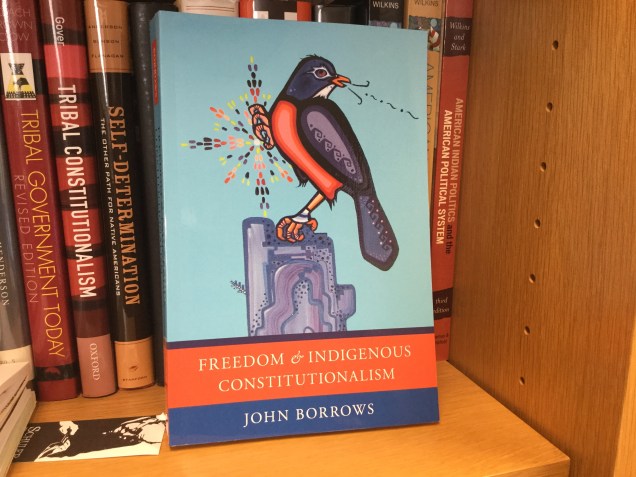
Turtle Talk Bookbag: John Borrows’ “Freedom & Indigenous Constitutionalism”

Book page here. Highly recommended.
JB.jpg

Blurb:

Indigenous traditions can be uplifting, positive, and liberating forces when they are connected to living systems of thought and practice. Problems arise when they are treated as timeless models of unchanging truth that require unwavering deference and unquestioning obedience.Freedom and Indigenous Constitutionalism celebrates the emancipatory potential of Indigenous traditions, considers their value as the basis for good laws and good lives, and critiques the failure of Canadian constitutional traditions to recognize their significance.

Demonstrating how Canada’s constitutional structures marginalize Indigenous peoples’ ability to exercise power in the real world, John Borrows uses Ojibwe law, stories, and principles to suggest alternative ways in which Indigenous peoples can work to enhance freedom. Among the stimulating issues he approaches are the democratic potential of civil disobedience, the hazards of applying originalism rather than living tree jurisprudence in the interpretation of Aboriginal and treaty rights, American legislative actions that could also animate Indigenous self-determination in Canada, and the opportunity for Indigenous governmental action to address violence against women.

Two New Books by John Borrows from University of Toronto Press

John’s work is very thought-provoking, especially for American Indian law scholars and practitioners seeking to discover and perhaps utilize Indian common law, customs and traditions.

1. Canada’s Indigenous Constitution

Canada’s Indigenous Constitution reflects on the nature and sources of law in Canada, beginning with the conviction that the Canadian legal system has helped to engender the high level of wealth and security enjoyed by people across the country. However, longstanding disputes about the origins, legitimacy, and applicability of certain aspects of the legal system have led John Borrows to argue that Canada’s constitution is incomplete without a broader acceptance of Indigenous legal traditions.

With characteristic richness and eloquence, John Borrows explores legal traditions, the role of governments and courts, and the prospect of a multi-juridical legal culture, all with a view to understanding and improving legal processes in Canada. He discusses the place of individuals, families, and communities in recovering and extending the role of Indigenous law within both Indigenous communities and Canadian society more broadly.

This is a major work by one of Canada’s leading legal scholars, and an essential companion to Drawing Out Law: A Spirit’s Guide.

2. Drawing Out Law: A Spirits’ Guide

The Anishinabek Nation’s legal traditions are deeply embedded in many aspects of customary life. In Drawing Out Law, John Borrows (Kegedonce) skillfully juxtaposes Canadian legal policy and practice with the more broadly defined Anishinabek perception of law as it applies to community life, nature, and individuals.

This innovative work combines fictional and non-fictional elements in a series of connected short stories that symbolize different ways of Anishinabek engagement with the world. Drawing on oral traditions, pictographic scrolls, dreams, common law case analysis, and philosophical reflection, Borrows’ narrative explores issues of pressing importance to the future of indigenous law and offers readers new ways to think about the direction of Canadian law.

Shedding light on Canadian law and policy as they relate to Indigenous peoples,Drawing Out Law illustrates past and present moral agency of Indigenous peoples and their approaches to the law and calls for the renewal of ancient Ojibway teaching in contemporary circumstances.

This is a major work by one of Canada’s leading legal scholars, and an essential companion to Canada’s Indigenous Constitution.

Continue reading