In 2024, the Alyce Spotted Bear and Walter Soboleff Commission on Native Children issued The Way Forward, with 29 recommendations shaped by testimony across Native communities. Several bills now respond to its call for stronger Tribal services. They’d give Tribes more resources to care for children. They wouldn’t add the state ICWA accountability measures the Commission sought in Recommendation 2.
The Senate Indian Affairs Committee’s 2025 discussion draft had nine titles, beginning with Child Welfare. The introduced Native Children’s Commission Implementation Act, S. 4976, has eight. Child welfare proposals also appear in the separately introduced Promoting Strong Native Families and Children Act, S. 4638. A third proposal addresses Tribal funding under the Child Abuse Prevention and Treatment Act, or CAPTA. NICWA is urging support for all three.
What the bills carry forward:
- S. 4976 would codify the family-centered Tiwahe Initiative, expand it beyond ten pilot sites, and authorize $100 million annually. It would also protect recurring Tribal justice base support for Tribes in Public Law 280 states.
- S. 4638 would increase several Tribal child welfare funding set-asides, create a 5% Tribal allocation in the Social Services Block Grant, and let qualifying Tribes operate a Title IV-E prevention-only program.
- Those provisions answer significant parts of Recommendation 1, though they don’t provide the full funding parity the Commission envisioned. The separate CAPTA bill addresses another part of that recommendation.
Where S. 4976 stops short:
- Recommendation 29 called for a government-wide Native data and research office. The bill proposes a Tribal Health Research Office at NIH.
- Recommendation 23 called for screening places Native children frequent for toxic exposures and providing an assessment when a patient or parent requests one. The bill would build environmental health training and referral systems, but wouldn’t require either measure.
- Recommendation 14 asked Congress to fund afterschool programs for Native children. The bill would allow afterschool programming under existing grants without providing new funding.
What remains outside these bills: Recommendation 2 called for HHS to assess how states implement ICWA and promote improvement. It also proposed specialized ICWA courts and enforceable plans to preserve a child’s connection to their Native community after adoption by a non-Native family. Those measures matter when a state fails to identify a child’s Tribe, involve it in the case, or sustain the child’s connections after adoption. None of the three bills adds them.
A 2024 ACF rule requires states to report additional ICWA-related data through AFCARS. NICWA is pressing for its full implementation and notes that the data will help ACF meet its existing duty to report to Congress on state ICWA compliance. The rule will provide data the federal government has long lacked. Neither S. 4976 nor S. 4638 would require HHS to evaluate each state’s compliance with ICWA or require a state to improve when it falls short. The Commission also recommended tying a state’s progress to its federal child welfare funding; neither bill does that.
Resources
Native Children’s Commission Implementation Act of 2026, S. 4976
Promoting Strong Native Families and Children Act, S. 4638
American Indian and Alaska Native Child Abuse Prevention and Treatment Act, S. 4179
American Indian and Alaska Native Child Abuse Prevention and Treatment Act, H.R. 8048
ACF’s 2024 AFCARS final rule on ICWA-related data collection
NICWA’s September 2026 Native Child and Family Policy Update
NICWA’s written comments for ACF’s 2026 Annual Tribal Consultation
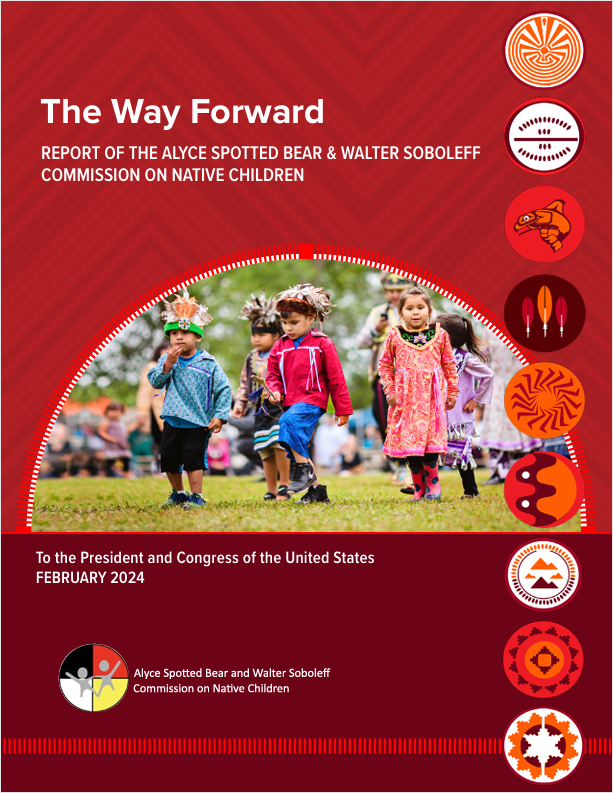
of the Alyce Spotted Bear and Walter
Soboleff Commission on Native Children.


You must be logged in to post a comment.