The Colorado governor has signed the CoICWA. This was the culmination of a lot of work by many many people, but I’m particularly mentioning James Washinawatok, in-house attorney at Southern Ute and the vice president of the Tribal In-House Counsel Association, for keeping things moving and keeping people on track. This was a major lift by the tribes and others in Colorado.
I’ll be updating the TT ICWA page with this law, as well as the google chart here later this summer.
Author: Kate Fort
AFCARS Final Rule Has Been Released
This rule finalizes revisions to the Adoption and Foster Care Analysis and Reporting System (AFCARS) regulations proposed on February 23, 2024. This final rule requires state title IV-E agencies to collect and report to ACF additional data related to the Indian Child Welfare Act of 1978 (ICWA) for children in the AFCARS Out-of-Home Care Reporting Population.
As you may recall, there was a rule promulgated in 2016 which was almost immediately withdrawn and replaced with a 2020 rule. It has taken another four years for the Biden administration to issue this rule. Regardless, if this rule holds, in three years all states will be required to collect ICWA data in state court cases.
States with ICWA Pro Hac Vice Waivers
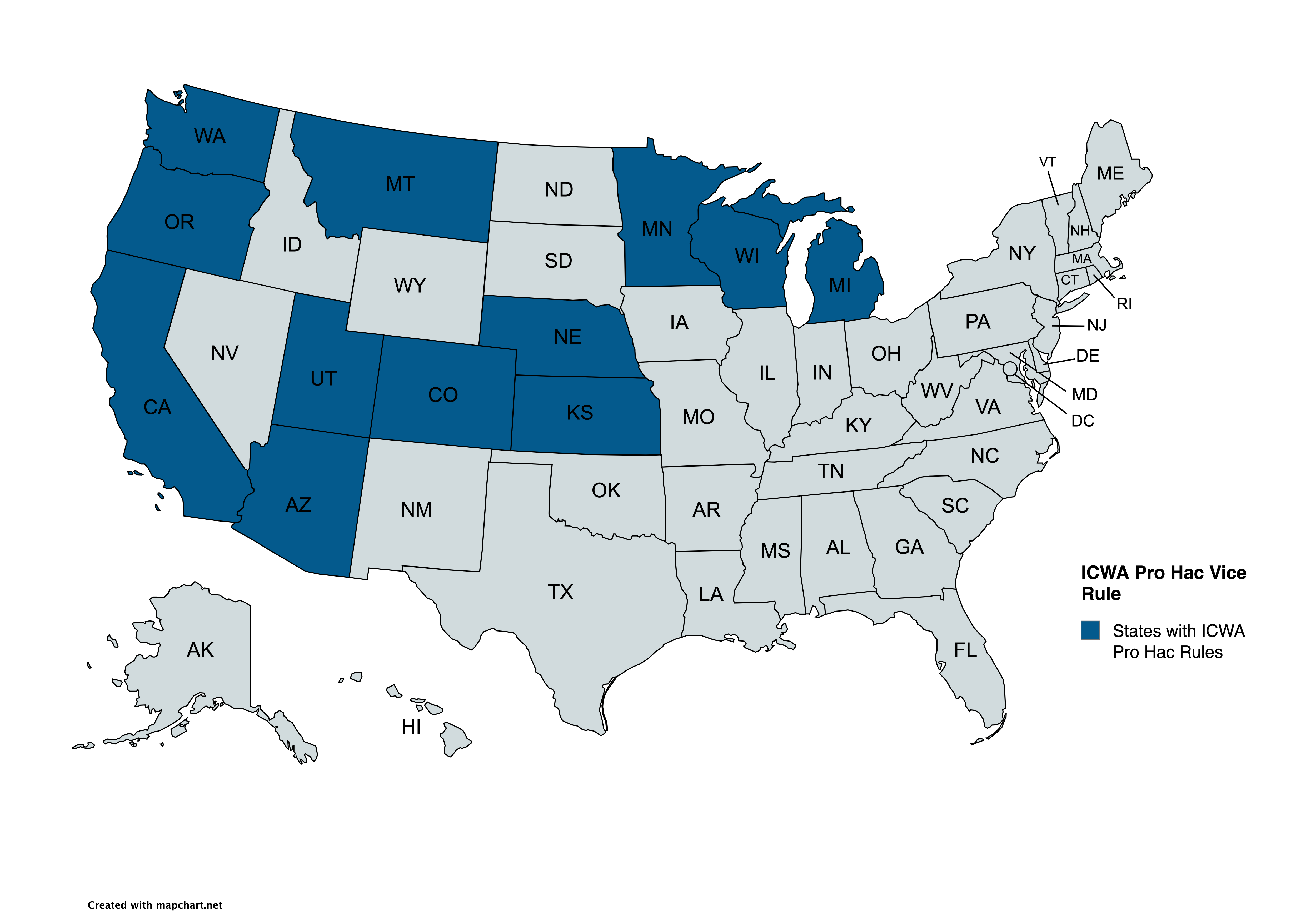
Late last month, Montana adopted a new rule allowing out of state attorneys to practice in ICWA cases and waiving certain requirements. This brings the total number of states with these kind of waivers to twelve (that I am aware of). If your state doesn’t have one of these, it’s a pretty straight forward rule to advocate for. If your state does have one of these, check in with practitioners to see if they are able to access your electronic filing system once they waive in. Or work on forms regarding appeals so intervened tribes are aware when appeals involving ICWA are filed by parents.
Anyway, great job everyone. Next year it will be ten years since Nebraska included the right in their state ICWA and nine years since we passed the rule in Michigan. These rules make a huge difference for tribal attorneys and ensures their state bar license remains safe while fully representing their tribal client in ICWA cases.
Comment by Nov. 1 on Proposed Montana Pro Hac Vice Rules for ICWA Cases
Publication: Performance Standards for Attorneys who Represent Tribal Governments in State ICWA Proceedings
From California Tribal Families Coalition (supported by Casey Family Programs), but not limited to California practice. This is a much-needed practice publication–a small part of which will be presented tomorrow at the federal ICWA training. Next week there is a full training using these standards at the TICA conference in Santa Barbara.
2023.7.6 Perf Standards For Attorneys Representing Tribes -FINAL
California ICWA Case Describing the State of Inquiry Cases
Figuring out where the California Court of Appeal courts are on the initial inquiry duty when a child is removed from their home is about as easy as detangling a ball of Christmas lights. The Samantha F. case does a nice job of going through where everything is, and what courts have held. This issue is fairly specific to California, which has certain ICWA inquiry requirements in state law and court rules for the removal of any child from their home. The question at issue seems particularly frustrating, because certain California courts have held there is no duty for contacting a child’s extended family re. tribal citizenship if the child was removed from the home with a warrant. However, there is such a duty if they were removed from the home without a warrant. In reading the cases, it feels like there was an oversight in drafting the state laws rather than some kind of legislative intent to suss out. Regardless, this has been the top litigated issue in California ICWA cases for almost a year now. In fact, it was nearly a year ago I posted about this at length. Apparently filing is finally underway in the In re Ja. O. case now. Briefing in the other set of cases appears to be complete but oral argument has not yet been set.
AFCARS Model Comment Available
As a reminder, comments for the ICWA AFCARS are due April 23. The Indian Law Clinic has developed a model comment for tribes to edit and use if they so wish. For a copy of the comment, please contact Cody Fowler, who has done the heavy lifting on this work, is an MSU grad and is helping out the Clinic for a few weeks! He can be contacted at:
fowler48@msu.edu
The proposed rule is here, as well as the link to submit comments:
https://www.federalregister.gov/documents/2024/02/23/2024-03373/adoption-and-foster-care-analysis-and-reporting-system
As a reminder, this is a proposed rule to require nationwide data collection about ICWA children in foster care. We have never had nationwide data on ICWA cases, despite nearly ten years of active litigation to try to get the 2016 rule back, and many years of activism before that to get the 2016 rule.
Washington Governor Signs Bill into Law Authorizing State LE to Enforce Tribal Warrants
Press release here. The bill is here.
OLYMPIA — People who commit crimes on tribal lands would not be able to escape justice by fleeing into Washington state lands, under legislation passed unanimously by the House Wednesday.
SB 6146 would authorize Washington state law enforcement officers to enforce warrants issued by Washington’s 29 federally recognized tribes and empower them to transport people to tribal lands for prosecution.
“This law will help keep communities in Washington and on tribal lands safe, while respecting the constitutional rights of defendants,” said Sen. Manka Dhingra (D-Redmond), sponsor of the bill. “Our laws need to reflect the realities of our world today. We have been operating under laws written when travel between jurisdictions wasn’t easy and the technology to confirm identity didn’t exist, so this legislation modernizes our laws to address the problems that arise today, when it is easy to flee from one jurisdiction into another.”
***
Chairman Steve Edwards of the Swinomish Indian Tribal Community thanked Dhingra and Lekanoff for “convening a process that brought together all 29 tribes with Washington state law enforcement and prosecutors to work collaboratively on solutions through which the state can recognize tribal warrants. This legislation will help to keep all Washingtonians safe around the state and on tribal lands.”
News article here.
Senate Bill 6146 will authorize Washington state law enforcement officers to enforce warrants issued by the 29 federally recognized tribes in Washington. The bill further allows officers to transport individuals to tribal lands for prosecution, simplifying the process of addressing criminal activities in cooperation with tribal authorities.
Reminder: AFCARS Comments on ICWA Due April 23
I posted about this here, and comments are due April 23. The Indian Law Clinic should have a model comment available for tribes to use and edit by the end of next week.
This rule proposes to require states that receive federal funding for their foster care systems to gather accurate data on children in state courts who are subject to ICWA’s protections. This is done through the Adoption and Foster Care Analysis and Reporting System (AFCARS) If you are a state worker, please encourage your state agency to comment in favor of this rule.
The proposed rule is here and is nearly identical to the one promulgated in 2016 (and then withdrawn by the Trump administration).
MSU Law Alum Sharon Avery Appointed to NIGC
Sharon Avery is an enrolled member of the Saginaw Chippewa Tribe of Michigan. She currently serves as an Associate General Counsel for the National Indian Gaming Commission’s Office of General Counsel. In this role she has gained familiarity with the agency’s structure and the important role the agency plays within the Tribal gaming industry. Prior to joining the National Indian Gaming Commission, Ms. Avery worked in the Legal Department of the Saginaw Chippewa Indian Tribe of Michigan for 10 years. She graduated from Michigan State University College of Law with a Juris Doctor degree and a certificate from the Indigenous Law and Policy Center.
Congratulations Sharon!!!
 Turtle Talk
You must be logged in to post a comment.