On Mackinac Island, developers of a new hotel discovered what appears to be a massive burial site last week. Police say it’s now clear some of the bones unearthed in the excavation are human, likely ancestors of the Sault Ste. Marie Tribe of Chippewa Indians.
Several hundred bones have been unearthed so far after a historic building known as the McNally Cottage was demolished. Property owner, Ira Green, plans to build a new three-story hotel where the building once stood. Some of the bones on the construction site belong to animals, while others are human remains. Mayor of Mackinac Island, Margaret Doud, said Saturday that she was not surprised bones had been found on the property. Downtown business owner, Tony Brodeur agreed, “You know, I’m not entirely surprised. And now… it’s going to stir up a lot of emotions… There has got to be a diplomatic solution.”
***
One historian thinks more care should be taken to preserve the historic integrity of the site. Brian Leigh Dunnigan is the curator of maps for the William L. Clements Library at the University of Michigan and released a book which is an iconographic history of the Straits of Mackinac region from 1615-1860. Dunnigan says the site is just beside the original St. Anne’s Catholic Church which was relocated in the mid-1800s. He explained further, “After the cemetery was closed in December of 1851, supposedly all of the burials were removed and put in the new Catholic cemetery behind fort Mackinac.”
Author: Kate Fort
IRS Issues Proposed Guidelines on “Essential Government Function” and “Commercial Activities” Test
College Scholarship Information for Native Students
From the University of North Carolina-Pembroke site, a nice list of scholarships for Native students in undergrad. Here.
Stories from the Elwha Klallam Heritage Center
From the Penninnsula Daily News
By Diane Urbani de la Paz
Peninsula Daily News
PORT ANGELES — Even as symbols of death stood around them, the men and the women sang hopeful songs about life.
Their songs, in the form of poetry, short stories and finally the sinewy sounds of an electric guitar, filled the Elwha Klallam Heritage Center last Tuesday night.
The evening, to mark Domestic Violence Awareness Month, became a survey of real-life comedy and tragedy, told by people you might not expect to appear at a poetry reading.
“Don’t go back,” began Christopher Thomas, a member of the Indian Voices writing group that hosted the open-mic night.
Then the enormous man paused, bowing his head. This poem is titled From a Friend, and it is his plea to a woman enmeshed in a brutal relationship.
“Don’t go back to the blue and the black,” Thomas said.
“Don’t go back . . . to the list of excuses.”
The poet stopped again, overcome by tears. The audience sat in perfect silence.
“Sorry,” Thomas said.
Then he finished “From a Friend” and went on to read a few of his trademark comedic poems.
His few minutes at the podium epitomized the evening, sprinkled as it was with smiles and tears.
Turtle Talk friend Trent Crable was also featured in the article:
Another of the poets appeared for the first time at an Indian Voices gathering; he had wanted to come for a while and had two poems ready to go.
So Trent Crable, a towering figure in a black coat and horn-rimmed glasses, walked to the front.
Crable, a Makah who grew up in California, is now the legal counsel for the Elwha tribe.
As if to show the assembly the men of the future, Crable’s 3-year-old son Carver — named after the late writer Raymond Carver — strode forward too.
“I don’t know if he’s going to let me do this,” Crable said.
But as he offered his poems, “Waiting for the 33” and “Laundry,” Carver stood close beside his father’s leg, not a word or a fidget in sight.
Then, poems read, father and son walked back to their seats, the picture of dignity.
News Coverage of Gila River Case
The article is here.
While the case and court’s opinion are unique, the possibility of a tribe being sued alone – without the federal government – is worrisome, said Michigan State University Indian law expert Matthew Fletcher. He said this case could encourage more people to sue tribes in land–use disagreements.
“That would have absolutely huge repercussions,” Fletcher said.
Fletcher called some of the courts’ statements “troubling,” as they might be used to pry open other tribal land–use claims by non–Indians.
“There are other landowners who have conflicts with tribes that could be encouraged by this,” he said.
Still, the case poses “a very narrow question, to be sure” because of its unique circumstances, Fletcher said.
Deputy Interior Secretary Criticizes Carcieri Decision
From an AP article printed in the Boston Globe, among others:
Hayes said the federal government opposes the Supreme Court’s interpretation of the law, and argued Congress should extend the right to hold land in trust to every tribe, regardless of the date of its recognition.
The administration envisions a “future in which we do not let legalistic interpretations of the law stand in the way of extending basic rights,” Hayes said at the National Congress of American Indians annual convention, which continues through Friday.
The high court’s ruling “must be overturned,” he said. His comments were met with cheers.
Hayes is the second highest-ranking official at the Interior Department. He said the Obama administration has worked to reverse a relationship between the federal government and Indian tribes that significantly deteriorated under George W. Bush’s presidency.
Supreme Court Denies Gila River Indian Community v. Lyon
Order here.
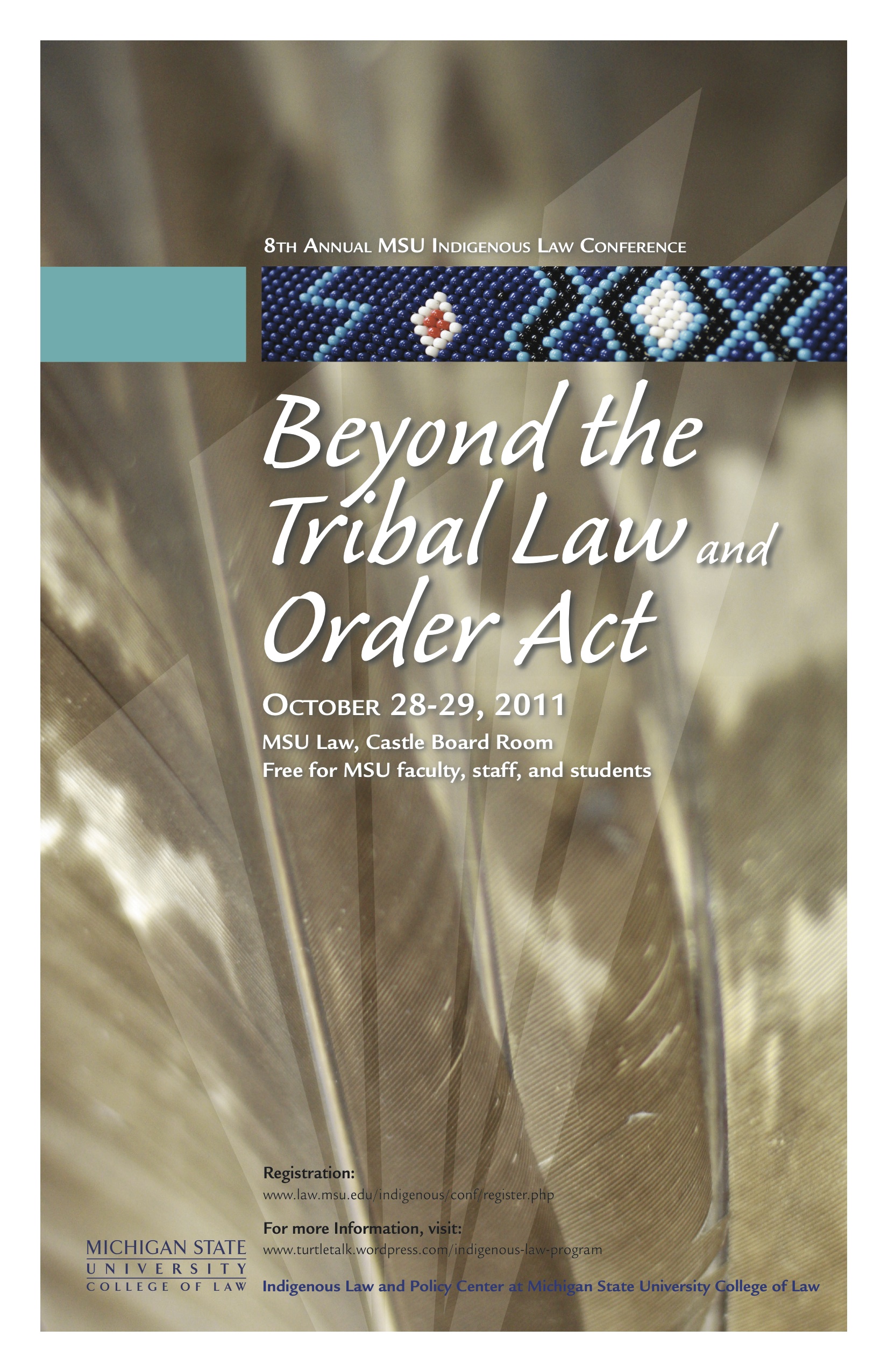
ILPC Conference Today and Tomorrow
NPR: Part 3 of ICWA Series — “Native Survivors of Foster Care Return Home”
Here. Excellent reporting.
GAO Report: IHS Response to Sexual Assaults and Domestic Violence
Here.
From the summary:
GAO’s survey of IHS and tribally operated hospitals showed that the ability of these hospitals to collect and preserve medical forensic evidence in cases of sexual assault and domestic violence—that is, to offer medical forensic services—varies from hospital to hospital. Of the 45 hospitals, 26 reported that they are typically able to perform medical forensic exams on site for victims of sexual assault on site, while 19 reported that they choose to refer sexual assault victims to other facilities. The hospitals that provided services began to do so generally in response to an unmet need, not because of direction from IHS headquarters, according to hospital officials. Partly as a result, levels of available services have fluctuated over time. GAO found that the utility of medical forensic evidence in any subsequent criminal prosecution depends on hospital staff’s properly preserving an evidentiary chain of custody, which depends largely on coordinating with law enforcement agencies.
IHS has made significant progress since 2010 in developing required policies and procedures on medical forensic services for victims of sexual assault; nevertheless, challenges in standardizing and sustaining the provision of such services remain. In March 2011, IHS took a sound first step in what is planned to be an ongoing effort to standardize medical forensic services by issuing its first agencywide policy on how hospitals should respond to adult and adolescent victims of sexual assault. Remaining challenges include systemic issues such as overcoming long travel distances between Indian reservations or Alaska Native villages and IHS or tribal hospitals and developing staffing models that overcome problems with staff burnout, high turnover, and compensation, so that standardized medical forensic services can be provided over the long term. In addition, other challenges include establishing plans to help ensure that IHS hospitals consistently implement and follow the March 2011 policy, such as with training guidelines, and developing policies on how IHS hospitals should respond to domestic violence incidents and sexual abuse involving children who have not yet reached adolescence—neither of which is included in the March 2011 policy. GAO found that IHS is aware of these challenges and has initiatives under way or under consideration to address them.
Decisions to prosecute sexual assault or domestic violence cases are based on the totality of evidence, one piece of which is medical forensic evidence collected by hospitals. In some cases, medical forensic evidence may be a crucial factor; in other cases, however, it may not be relevant or available. Law enforcement officers and prosecutors said that they also consider several other factors when deciding to refer or accept a case for prosecution. For example, some victims in small reservations or isolated villages may refuse to cooperate or may retract their initial statements because of pressure from community members who may depend on the alleged perpetrator for necessities. As a result, the victim may be unavailable to testify. Several prosecutors also told us that the availability to testify of the providers who perform medical forensic exams is an important factor, because such testimony can help demonstrate that an assault occurred or otherwise support a victim’s account. IHS’s March 2011 policy, however, does not clearly and comprehensively articulate the agency’s processes for responding to subpoenas or requests for employee testimony.
 Turtle Talk
You must be logged in to post a comment.