The Indigenous Peoples’ Journal of Law, Culture, & Resistance Call for Submissions

Please Circulate

The Indigenous Peoples’ Journal of Law, Culture & Resistance (IPJLCR) is accepting submissions for Volume 3.  Submissions are being accepted until December 31, 2015.

IPJLCR is a law journal at the University of California Los Angeles School of Law that is interdisciplinary in nature, consisting of academic articles, legal commentary, poetry, songs, stories, and artwork.  We are soliciting scholarly articles and student comments written about legal issues important to Indigenous communities and Native People in the United States and throughout the world, as well as works by artists that relate to or comment on legal issues.  We also seek works on issues or aspects of life in Native communities that are impacted by law, whether tribal law or the laws of nation-states.

IPJLCR has been out of publication since 2005 and its renewal at the law school is due to a group of dedicated students committed to Native issues, federal Indian law, and tribal law.  Past issues include: a letter to the United States Supreme Court Justice Sandra Day O’Connor about the Lyng case, an essay by Joy Harjo on resistance, writings by Matthew L.M. Fletcher, poetry by Sara Littlecrow-Russell, Mahealani Kamauu, and Shawna Shandiin Sunrise, artwork by Elizabeth Whipple and Nadema Agard Winyan Luta Red Woman, as well as photography by Anna Tsouhlarakis.

Email Submissions to: ipjlcr@lawnet.ucla.edu

Requirements: Each submission should be sent as one Microsoft Word file with Bluebook formatted citations (20th ed. 2015).  Brief bios are required, as well as 12 pt Times New Roman typed font, paginated, and should include: your name, address, phone number, and email address in the header of the first page.

Indian Law Resource Center Fellowships and Legal Internship Announcements

Fellowship Information:

The Indian Law Resource Center is a non-profit legal advocacy organization dedicated to providing legal advice, assistance, and representation to Indian tribes and indigenous communities throughout the Americas. We are also committed to developing new attorneys in the fields of Indian law and international human rights law.
To this end, we offer several fellowship and clerkship opportunities in both our Helena, Montana and Washington, D.C. offices. These fellowship and clerkship opportunities require a minimum eight week commitment and entail legal research and writing on major Indian rights issues related to current projects of the Indian Law Resource Center. The Lewis and Sidley Fellowships both offer a stipend of $3,000 for the term of the Fellowship. Applicants are welcome to supplement this stipend with additional financial support through their law school’s public interest programs or through other public interest scholarships.
The John D. B. Lewis Fellowship is a competitive Fellowship awarded each year to a law student who shows particular promise for a career in international indigenous human rights issues.
The Terrance A. Sidley Fellowship is a competitive Fellowship awarded each year to a law student who shows particular promise for a career in federal Indian law and international indigenous human rights issues.

The application deadline for Summer 2016 is October 30, 2015. Full details available here Lewis and Sidley Fellowships 2016

Legal Internship Information:

The Indian Law Resource Center seeks a legal intern for our Washington, DC office for Fall 2015. Knowledge of international and/or federal Indian law and Spanish language skills are preferred but not required. Internships are available for all levels of experience.

Applications for the Fall 2015 legal internship are accepted on a rolling basis until positions are filled. Full details available here Fall 2015 Legal Intern Announcement (3)

New Website – Sex Trafficking Resources for Tribal Coalitions

A new website is now available with the express purpose of providing sex trafficking information and resources for tribal domestic violence and sexual assault coalitions. The link to the site is here.

From the site:

This website was created to provide tribal coalitions with quick access to information their advocates need–legal resources, victim service directories, training calendars, technical assistance, and more.

Additionally, we envision this site as a place for Native women to find help when dealing with violence. Individuals can reach out to their local Tribal Coalition(s) for assistance or they can easily use our Victim Services Directory themselves. We suggest, however, that individuals contact their local tribal coalition for assistance first. A Tribal Coalition can help individuals navigate options and services, and utilizing coalition connections can increase a client’s chances of receiving services or referrals immediately. 

The site includes federal, state, and tribal laws, articles, resources, and information about victim services and will continue to include new information as it becomes available.

Kirkus Review of Sarah Deer’s New Book on Rape and Colonialism

Here.  Kirkus calls the book “[a]n incisive and imperative academic study.”  Congrats to Professor Deer!

Tribal Access to Name Based Background Checks for Emergency Placements

Tribal Access to Name Based Background Checks for Emergency Placements

For some time tribes have raised the issue of tribal child welfare agencies not having access to name-based background checks for emergency child placements.

The Bureau of Indian Affairs (BIA) Office of Justice Services is now authorized to do name-based background checks for tribal emergency placements for tribes with social services agencies.  The program is called, “BIA-OJS Purpose Code X Program.”  Children’s Bureau is working with BIA and the Department of Justice to inform tribes about the change and roll out of the process.  Two informational phone calls will be held to disseminate information about the name-based background checks and the process.  These calls will include partners with the Department of Justice and the Bureau of Indian Affairs who will be on hand to answer questions.

Two Opportunities to participate in an Informational Call-In about BIA-OJS Purpose Code X Program with Department of Justice, Bureau of Indian Affairs – Office of Tribal Justice, and Children’s Bureau:

Wednesday August 26, 2015

First Call:  3:00pm to 4:00pm (Eastern time) Noon to 1:00pm (Pacific time)

Participants can register for the conference by navigating to http://dpregister.com/10071565
Please note that registered participants will receive their dial in number upon registration.

Pre-registration fields of information to be gathered:  Name, Tribal Affiliation

Those without internet access or unable to pre-register may dial in by calling:
PARTICIPANT DIAL IN (TOLL FREE):           1-877-270-2148
PARTICIPANT INTERNATIONAL DIAL IN:  1-412-902-6510

Information gathered for unregistered parties:  Name and Company
Please ask to be joined into the United States Department of Justice call.

Second Call: 4:00pm to 5:00pm (Eastern time) 1:00pm to 2:00pm (Pacific time)

Participants can register for the conference by navigating to http://dpregister.com/10071577
Please note that registered participants will receive their dial in number upon registration.

Pre-registration fields of information to be gathered:  Name, Tribal Affiliation

Those without internet access or unable to pre-register may dial in by calling:
PARTICIPANT DIAL IN (TOLL FREE):           1-877-270-2148
PARTICIPANT INTERNATIONAL DIAL IN:   1-412-902-6510

Information gathered for unregistered parties:  Name and Company
Please ask to be joined into the United States Department of Justice call.

The U.S. Department of Justice announced on Wednesday, August 19, 2015 the Tribal Access Program for National Crime Information, or TAP, will allow federally recognized tribes to enter criminal records into and pull information out of national databases overseen by the Criminal Justice Information Services Division of the Federal Bureau of Investigation.

The U.S. Department of Justice (DOJ) has established the Tribal Access Program for National Crime Information (TAP) to provide tribes access to national crime information databases for both civil and criminal purposes. TAP will allow tribes to more effectively serve and protect their nation’s citizens by ensuring the exchange of critical data.  The new TAP program will support and train tribes as they connect with the system. Once established, they’ll be able to use the databases in the same way as outside law enforcement.

Also on Wednesday, August 19, Assistant Secretary – Indian Affairs Kevin K. Washburn announced a new Bureau of Indian Affairs’ Office of Justice Services (BIA-OJS) program to assist federally recognized tribal social services agencies seeking to place children in safe homes. “The BIA-OJS Purpose Code X Program will provide tribal social service agencies with the information they need to protect the children they place into care in emergency situations when parents are unable to provide for their welfare,” Washburn said. “This program provides BIA law enforcement personnel with the ability to provide our social service agency partners with much-needed information to help to make sure children requiring emergency placements will be placed in safe homes.” The BIA-OJS Purpose Code X Program arose out of a 2014 working group formed by the Departments of Justice (DOJ) and the Interior (DOI) that also developed the Tribal Access Program for National Crime Information (TAP).

BIA-OJS dispatch centers will be available to provide 24-hour access to criminal history records, so name-based checks can be done immediately. Protocols for operating under the new program are being developed by BIA-OJS and will be tested by a select number of tribes prior to a nationwide implementation of the program.

http://www.justice.gov/tribal/tribal-access-program-tap

Previous coverage here and here.

Assistant Secretary Washburn Announces a New Program to Assist Tribal Social Services Agencies in Placing Children in Safe Homes

Press release (copy here):

Assistant Secretary Washburn Announces a New Program to Assist Tribal Social Services Agencies in Placing Children in Safe Homes

WASHINGTON – Assistant Secretary – Indian Affairs Kevin K. Washburn today announced a new Bureau of Indian Affairs’ Office of Justice Services (BIA-OJS) program to assist federally recognized tribal social services agencies seeking to place children in safe homes.

“The BIA-OJS Purpose Code X Program will provide tribal social service agencies with the information they need to protect the children they place into care in emergency situations when parents are unable to provide for their welfare,” Washburn said. “This program provides BIA law enforcement personnel with the ability to provide our social service agency partners with muchneeded information to help to make sure children requiring emergency placements will be placed in safe homes.”

The BIA-OJS Purpose Code X Program arose out of a 2014 working group formed by the Departments of Justice (DOJ) and the Interior (DOI) to identify sustainable solutions that provide tribes access to national crime information that addresses criminal and civil needs of tribes. The outcome of this collaboration was the BIA-OJS Purpose Code X Program and DOJ Tribal Access Program for National Crime Information (TAP) TAP will allow tribes to more effectively serve and protect their communities by ensuring the exchange of critical data.

Under the BIA-OJS Purpose Code X Program, BIA-OJS dispatch centers will be available to provide 24-hour access to criminal history records, so name-based checks can be done immediately. Protocols for operating under the new program are being developed by BIA-OJS and will be tested by a select number of tribes prior to a nationwide implementation of the program.

BIA-OJS obtained authorization to perform these name-based checks from the National Crime Prevention and Privacy Compact Council, an organization which has the legal authority to promulgate rules and procedures governing the exchange of criminal records for non-criminal justice purposes.

“The BIA Office of Justice Services and DOJ’s Office of Tribal Justice have made collaboration on improving tribal access to information a high priority over the last year, and I am grateful to the Compact Council for approving our request so quickly,” said BIA OJS Deputy Director Darren A. Cruzan.

OJS has also worked to improve tribal reporting to the Uniform Crime Report system and encouraged tribal participation in the National Data Exchange (NDEx) system.

All of these efforts underscore the importance of the exchange of information between law enforcement agencies to achieving public safety in all jurisdictions, including Indian Country.

The BIA-OJS’s mission is to address public safety concerns in Indian Country by funding law enforcement, correctional departments and tribal court services to the nation’s federally recognized tribes. It also coordinates emergency preparedness support on federal Indian lands by working cooperatively with other federal, state, local and tribal law enforcement agencies throughout Indian Country. The BIA-OJS operates the Indian Police Academy in Artesia, N.M., which provides training and professional development to BIA and tribal law enforcement personnel.

Visit http://www.indianaffairs.gov/WhoWeAre/BIA/OJS/index.htm for more information about OJS and its work.

For more information on TAP, visit http://www.justice.gov/tribal/tribal-access-program-tap.

Department of Justice Announces Program to Enhance Tribal Access to National Crime Information Databases

DEPARTMENT OF JUSTICE ANNOUNCES PROGRAM TO ENHANCE TRIBAL ACCESS TO NATIONAL CRIME INFORMATION DATABASES

 Department of Justice Tribal Access Program (TAP) Will Improve the Exchange of Critical Data 

Department of the Interior Companion Program to Provide Name-Based Emergency Background Checks for Child Placement

WASHINGTON – The Department of Justice is launching an initial phase of the Tribal Access Program for National Crime Information (TAP) to provide federally-recognized tribes access to national crime information databases for both civil and criminal purposes.  TAP will allow tribes to more effectively serve and protect their communities by ensuring the exchange of critical data.

This initial phase of TAP was announced today in a meeting with tribes held during the 2015 Department of Justice/FBI Criminal Justice Information Services (CJIS) Division Tribal Conference in Tulsa, Oklahoma.

“Federal criminal databases hold critical information that can solve crimes, and keep police officers and communities safe,” said Deputy Attorney General Sally Quillian Yates.  “The Tribal Access Program is a step forward to providing tribes the access they need to protect their communities, keep guns from falling into the wrong hands, assist victims and prevent domestic and sexual violence.  Empowering tribal law enforcement with information strengthens public safety and is a key element in our ongoing strategy to build safe and healthy communities in Indian country. ”

“The FBI is pleased to participate in this initiative,” said Executive Assistant Director Amy Hess of the FBI’s Science and Technology Branch.  “This will be a positive step for the tribal agencies to receive valuable criminal information and also for those same tribal agencies to submit criminal information at the national level.  Through this partnership, information becomes richer and communities can become safer.”

TAP will support tribes in analyzing their needs for national crime information and help provide appropriate solutions, including a-state-of-the-art biometric/biographic computer workstation with capabilities to process finger and palm prints, take mugshots and submit records to national databases, as well as the ability to access CJIS systems for criminal and civil purposes through the Department of Justice.  TAP will also provide specialized training and assistance for participating tribes.

While in the Tribal Law and Order Act of 2010 Congress required the Attorney General to ensure that tribal officials that meet applicable requirements be permitted access to national crime information databases, the ability of tribes to fully participate in national criminal justice information sharing via state networks has been dependent upon various regulations, statutes and policies of the states in which a tribe’s land is located.  Therefore, improving access for tribal law enforcement to federal criminal information databases has been a departmental focus for several years.  In 2010, the department instituted two pilot projects, one biometric and one biographic, to improve informational access for tribes.  The biographic pilot continues to serve more than 20 tribal law enforcement agencies.

Departments of Justice and Interior Working Group

In 2014, the Departments of Justice and the Interior (DOI) formed a working group to assess the impact of the pilots and identify long-term sustainable solutions that address both criminal and civil needs of tribes.  The outcome of this collaboration was the TAP, as well as an additional program announced today by the DOI’s Bureau of Indian Affairs (BIA) that provides tribes with national crime information prior to making child placement decisions in emergency circumstances.  Under the BIA program, social service agencies of federally recognized tribes will be able to view criminal history information  accessed through BIA’s Office of Justice Services who will conduct name-based checks in situations where parents are unable to care for their children.

“Giving tribal government programs access to national crime databases through DOJ’s Tribal Access Program for National Crime Information is a tremendous step forward towards increasing public safety in Indian Country,” said Assistant Secretary Kevin K. Washburn for Indian Affairs at the Department of the Interior.  “The Bureau of Indian Affairs Office of Justice Services’ Purpose Code X program provides a much-needed tool for tribal social service agencies when they must find safe homes to place children during temporary emergency situations.”

In the initial phase of the TAP program, the biometric/biographic workstations will be deployed to up to 10 federally-recognized tribes who will provide user feedback.  This phase will focus on assisting tribes that have law enforcement agencies, while in the future the department will seek to address needs of the remaining tribes and find a long-term solution.  The department will continue to work with Congress for additional funding to more broadly deploy the program.

The Department of Justice’s Chief Information Officer manages TAP.

“It is our hope that TAP can minimize the national crime information gap and drive a deeper and more meaningful collaboration between the federal, state, local and tribal criminal justice communities,” said Chief Information Officer Joseph F. Klimavicz for the department.

For more information on TAP, visit www.justice.gov/tribal/tribal-access-program-tap.

For more information about the Justice Department’s work on tribal justice and public safety issues, visit: www.justice.gov/tribal.

For more information about the Department of the Interior Bureau of Indian Affairs, visit www.indianaffairs.gov/

Job Announcement: Center for Indian Country Development Coordinator, Federal Reserve Bank of Minneapolis

Position must be applied for through: https://www.minneapolisfed.org/about/careers/search-jobs?

Center for Indian Country Development Coordinator242260

Federal Reserve Bank of Minneapolis

Primary Location: MN-Minneapolis

Full-time

Employee Status: Regular

Overtime Status: Exempt

Travel: Yes, 5 % of the Time

Shift: Day Job

Job Sensitivity Tier II – No Credit Check

General Description
The Federal Reserve Bank of Minneapolis (the Bank) is looking for a coordinator to assist the Co-Directors of its Indian Country Center. This position has primary day-to-day administrative responsibilities for supporting the CICD by coordinating and performing a range of administrative, project management, and communication tasks, and assisting in designing programs and initiatives related to Indian Country community and economic development in the district and nationally.

The successful candidate will have a minimum of 3 years of demonstrated administrative and communications experience and knowledge and experience with American Indian communities. The candidate also will have a proven ability to think strategically while interacting with diverse groups. They must have the ability to meet critical deadlines, manage multiple assignments, and engage professionally with CICD partners and cohorts. The ability to conduct oneself, at all times, with integrity, honesty, and respect for every employee is paramount.

Supports the CICD and its Co-Directors by coordinating and performing a range of administrative, project management, and communication tasks, including:

Manages project communications and coordinates work activities.

Plans and schedules meetings and events for the CICD and the Bank, including meetings and communications with the CICD’s Leadership Council and Internal Partners’ Committee.

Assists in preparing cost estimates, budget projections, resource requirements, project plans, and other documentation in support of the activities of the Co-Directors and CICD.

Maintains the CICD’s internal and external website, internal Sharepoint sites, calendars, and contacts database, making edits and updates routinely and as needed. Plans and coordinates production of publications and online updates in a timely manner. Arranges for use of the preferred technologies to manage the flow of publications to print, web and digital media formats.

Assists with writing, rewriting, editing and copy editing various types of articles and papers.  Assists in managing current social platforms and develops new channels to grow social media presence and raise the Center’s awareness.  Writes short articles or blog posts and notices for inclusion in print of online publications and coordinates, assists in, or conducts the creation of art work, photographs, layout and other elements of publications.

Participates in projects and performs intermediate analytical tasks in support of CICD, Bank, or FRS initiatives.

Participates in Department, Bank, FRS and/or federal agency project teams, task forces, and work groups. Conducts or assists in special assignments, studies, and analyses; assumes leadership roles as assigned.

Analyzes and assists in the review of business functions and operational process improvements and/or enhancements. Tests, trains, and completes implementations, which may include coordinating activities such as developing plans, completing risk assessments, assigning tasks, monitoring and reporting progress, and preparing necessary communications.

Provides intermediate analytic support to assist CICD, Bank, or FRS management and staff resolve moderately complex operational and business issues. Escalates difficult and complex questions or problems to other analysts or management.

Assists in preparing and/or revising communications, including proposals, reports, and presentations for all levels of management. Develops and revises procedures, defines processes, and delivers training to users and staff.

Produces quarterly management reports. Assists in the development of annual CICD reports. Monitors and verifies compliance with applicable new and existing policies, procedures, and standards.

Monitors and verifies compliance with applicable new and existing policies, procedures, and standards. Serves as CICD’s Security Liaison, Business Continuity Plan manager, Records Retention Liaison, and Safety Coordinator. Completes security access reviews and initiates access requests, as needed. Maintains the CICD’s Business Continuity Plan and organizes updates and tests as needed. Updates the CICD’s files as needed to comply with Records Retention schedules.

Orders and maintains CICD supplies and equipment.

Performs other duties as assigned.

Provides training to less experienced analytical staff.

 Qualifications:
Bachelor’s degree or equivalent combination of higher education and/or experience.

Minimum 3 years direct work-related experience or equivalent combination of related higher education and experience for level II.  5 years for level III.

Minimum of 3 years of demonstrated administrative and communications experience and knowledge and experience with American Indian communities preferred.
Los Angeles “Tiospaye” Native Foster Family Recruitment Event

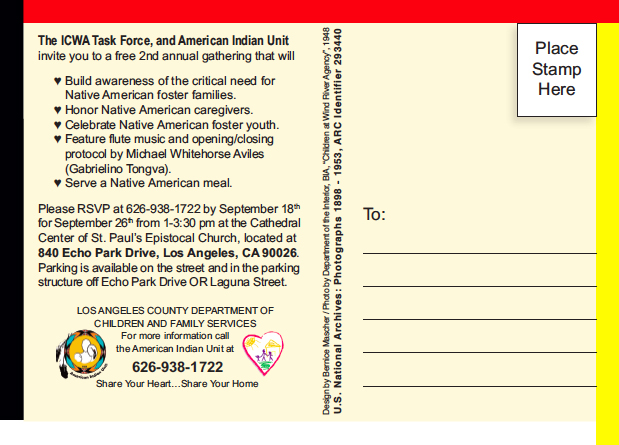
The Los Angeles County Department of Children and Family Services American Indian Unit is sponsoring its 2nd Annual Native foster family/parent recruitment event. This event is an attempt to be proactive in searching to find native homes in an urban environment for those native children in foster/adoptive care.

***SAVE THE DATE: September 26,2015***
“TIOSPAYE”: Los Angeles Foster Family Recruitment Event
Sponsored by: The Los Angeles County Department of Children and Family Services American Indian Unit
RSVP by September 18, 2015 at 626-938-1722
Place: Cathedral Center of St. Paul’s Episcopal Church (ECHO PARK)
Address: 840 Echo Park Ave, Los Angeles, CA 90026

Sept_26_2015 LA foster recruitment Back Program

Sept_26_2015 LA foster recruitment Front