Please take a look at the updated conference agenda here. Our conference will be held October 28-29. Registration for the conference is here.
Author: Kate E. Fort
2011 Great Lakes Water Quality Biennial Meeting Oct. 12-14
The conference, sponsored by the International Joint Commission, is happening at Wayne State University next week. Registration is still open. The event is free, though people can purchase a $50 food ticket.
Vice President Al Gore is the keynote speaker, and Frank Ettawageshik will be speaking on a plenary panel, along with EPA Administrator Lisa Jackson, Wednesday at 1pm.
Quarterly BIA Press Releases
Press releases we’ve received here at Turtle Talk. All of them go up immediately here.
September, 2011
BIACobell5thConsultPRnd 9-29-11
09-02-11-gaming-decisions_echo-hawk.pdf
August, 2011
AS-IA 08-15-11RRCSPbloPntdoSchlPjctsCmpltdPR
July, 2011
07-19-11LEH Visits Wounded Marine071911PR
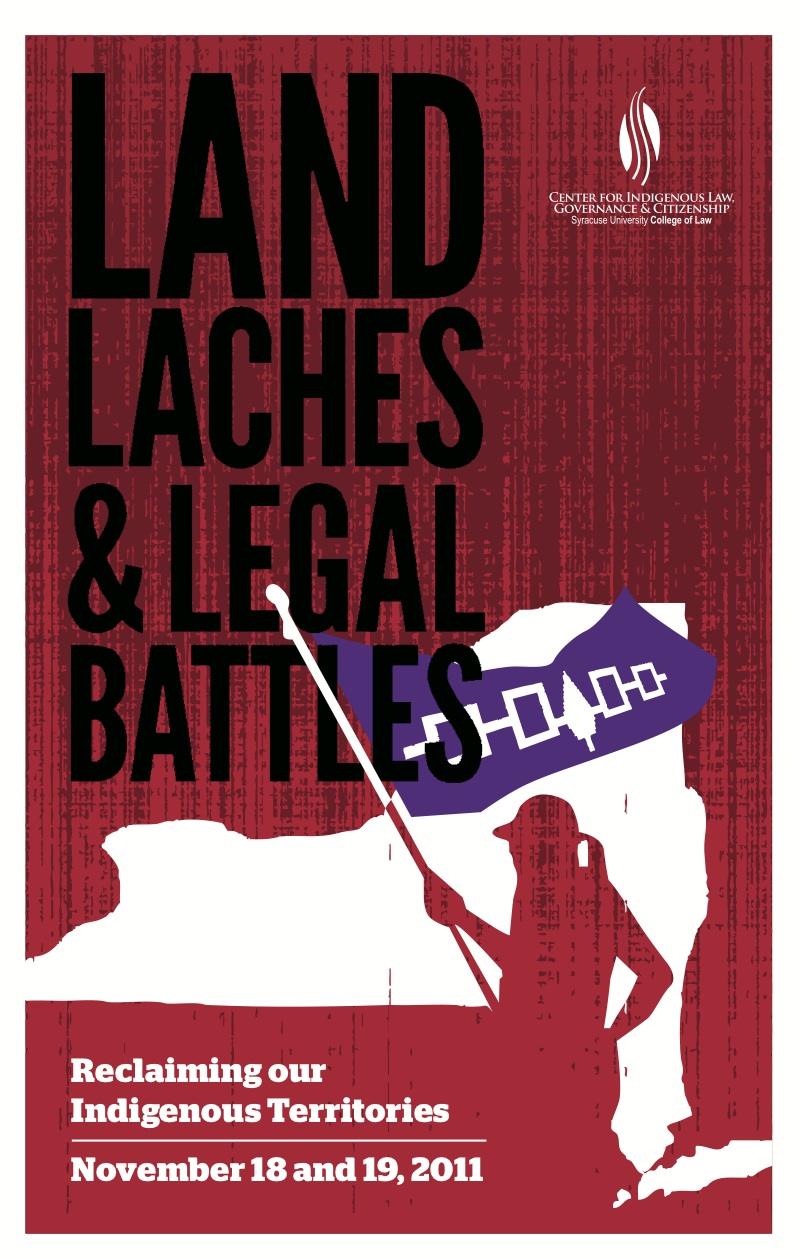
8th Annual Haudenosaunee Conference at Syracuse University
Event to be held at the Goldstein Student Center, Syracuse University
Speakers include: Sarah Krakoff, Lindsay Robertson, Matthew Fletcher, Joe Heath, Justin Schapp, Douglas Sanderson, Julie Ann Cavanaugh-Bill, Meghan McCune, Carrie Garrow, & Kathryn Fort
Registration at www.law.syr.edu/indigenous
Navajo Nation v. EEOC Denied; Oneida Land Claim Uncertain — UPDATED
The Supreme Court released its order list for the week, and all the Navajo Nation/Peabody Coal claims were denied. The Oneida land claim has not yet been granted or denied. It is possible the case may be relisted for another conference, though that’s not entirely clear. The order is here.
Update: The Court has relisted the petitions for the October 7 conference.
MIRS Article on Rumors of Lansing Casino
Bernero Talks To Sault Tribe About Casino
The city of Lansing and the Sault Ste. Marie Tribe of Chippewa Indians are in negotiations for a potential downtown casino, two sources with knowledge of the talks told MIRS today.
Lansing Mayor Virg BERNERO had hoped to make an official announcement of a deal sometime this week, but that has been pushed forward two to four weeks. If one were built, organized labor would push to be involved in the construction or renovation of a facility.
“There’s been a lot of discussion,” said UAW Local 602 President Art LUNA, who has been party to some of the discussions. “It’s an opportunity to bring jobs to Lansing.”
Attorney Richard McLELLAN, who consulted with the Bernero administration on the feasibility of a casino in Lansing, said his conclusion is that no more casinos can be built in Michigan, which is not an uncommon opinion, he said. However, Bernero is working with other legal counsel to find another legal avenue.
“If someone can figure out how to do it, more power to them,” McLellan said. “Maybe somebody has a way to do it. If they do, it will be a new theory. It will have to be.”
Sault Tribe Chairman Joe Eitrem would neither confirm nor deny its interest in “any project that may or may not be under consideration at this time.
“The Sault Tribe is regularly presented with economic development and business opportunities that we evaluate relative to our long-term tribal goals and objectives,” Eitrem said. “We will explore any and all business and development opportunities that offer the potential to help us achieve our goals of economic self-sufficiency and improving programs and services for our members.
“If and when we are prepared to announce our firm interest in any such a project, we will inform our members, the news media, and other audiences.”
A phone call to a Bernero spokesman was not returned by MIRS‘ deadline.
Tribe Involved in Commemorations of British Arrival in the Straits
From the Petoskey News:
MACKINAW CITY — In the Straits of Mackinac region 250 years ago, the French ruled as the British began making their way westward across the U.S. from the eastern seaboard. It was the time period surrounding the French and Indian War, and in Northern Michigan, everything was about to change.
In early autumn 1761, Patrick McGulpin arrived in Michilimackinac with British soldiers as part of the winding down of the French and Indian War. Their arrival ushered in radical cultural change in the previously French-dominated Straits.
To commemorate this period of change and the influence brought by the British, Emmet County, its historical commission and members of the Little Traverse Bay Bands of Odawa Indians will host an event, “The Stage for Change,” from noon-3 p.m. Saturday, Oct. 15, at McGulpin Point Lighthouse.
***
On Oct. 15, members of the Little Traverse Bay Bands of Odawa Indians, Historical Commission members and county staff will tell the stories of this era. At 1 p.m., Eric Hemenway, repatriation specialist with the tribe, will present overview information and provide a sense of place for how the Native Americans utilized the land later called McGulpin Point.
Job Postition with the BIA as a Policy Analyst (DOJ Liaison)
Description here.
Anishnaabensag Biimskowebshkigewag Exhibit Reception at MSU
This Wednesday, September 28, at noon in Snyder Phillips Hall at Michigan State University.

Interview with Tiya Miles on NPR’s Tell Me More
Prof. Miles was yesterday interviewed about the history of the Cherokee Nation and Freedmen here.
MILES: Well, I think that those legacies remain with us. And I think that in the case of the Cherokee Nation and other native nations, there’s a felt conflict between the sovereignty of those nations and the question of what the role should be, what the place should be of minorities in those nations.
So, whereas the United States can and has at times protected the status of minorities and not felt itself threatened by Canada, for instance, about what it does. Native nations definitely feel themselves threatened by the United States government. They are concerned that their sovereignty, the right to make decisions for themselves, is going to be undermined by the U.S. government as it has been so many times in the past.
But what I feel is a real problem here is that the Cherokee Nation is taking its definition from what really has been a white supremacist U.S. nation that fought to – I’m sorry. Go ahead, Michel.
She also recounts what she was doing when she found out she won a MacArthur Genius Grant:
MARTIN: So before we let you go, we always have to ask. Where were you and what were you doing when you got the call? For people who are unaware of the MacArthur so-called Genius Grants are not things you can apply for. You have to be nominated. People generally don’t find out that they’ve won until they get the call. So, what were you doing when you got the call?
MILES: I was at home cleaning the kitchen when I got the call. And this was something that was so completely out of the blue and so completely overwhelming that I actually had to just sit down. I was on the staircase in our house. I had to sit on the steps just to kind of get my bearings and to let this sink in.
MARTIN: Any idea what you’ll do with the grant?
MILES: Well, I’ve never actually contemplated so much money, but I do have a couple of ideas. One thing that I’m really excited about is continuing my research and taking it into other areas within the U.S. and Native American history. So, I’ve worked so far on the South and Indian territory. But now, I want to really look at slavery in the north and in particular in Detroit and in Michigan, because this is a place where we also don’t really think about slavery existing, but it did. And the slaves in Detroit and in Michigan and Ontario were African-American and also Native American.
MARTIN: Well, I hope you’ll get a nice bottle of wine, too, in there, maybe.
MILES: Maybe. Maybe I’ll do that.
 Turtle Talk
You must be logged in to post a comment.