Federal ICWA Litigation Documents

We don’t post every time a document is filed in the current federal ICWA cases (EDVA, AZ, MN, NDOK), but will be posting updates as orders are filed or briefing is completed on an issue, as usual.

However, many filings for all four cases are being updated regularly here.

Letter(S) to the Editor Regarding ICWA in the Washington Post

Here.

Bolstering accountability of the U.S. justice system and providing regulations for its interaction with Indian child-welfare cases secures the safety, health and well-being of Indian children and their tribal nations. The act is a public-health policy that prompts prevention-based measures to restore wellness for Indian children and their families. A sharp focus on the legal status of native children as citizens of self-determining tribal nations is fundamental. Indian children possess an inherent political status that predates the United States, a reality supported by centuries of U.S. law and policy.

Edited to add Senator Dorgan’s letter in the WaPo as well. Here:

When we talk about “blood-stained” laws, we should talk about the history of the treatment of Native Americans: laws of genocide, sterilization, forced removal and assimilation; compulsory boarding schools; underfunding of critical health care; and a trail of broken promises.

These were written in response to a particularly egregious and racist syndicated column by George Will we did not post.

On Friday he put up a second column about the Washington football team. If you want to know what he’s saying, given that his columns are syndicated and run nationwide, here are links to them that don’t boost them on a google search:

Anti-ICWA Column

Name of Washington Football Team Column

Tribal Access to Name Based Background Checks for Emergency Placements

Tribal Access to Name Based Background Checks for Emergency Placements

For some time tribes have raised the issue of tribal child welfare agencies not having access to name-based background checks for emergency child placements.

The Bureau of Indian Affairs (BIA) Office of Justice Services is now authorized to do name-based background checks for tribal emergency placements for tribes with social services agencies.  The program is called, “BIA-OJS Purpose Code X Program.”  Children’s Bureau is working with BIA and the Department of Justice to inform tribes about the change and roll out of the process.  Two informational phone calls will be held to disseminate information about the name-based background checks and the process.  These calls will include partners with the Department of Justice and the Bureau of Indian Affairs who will be on hand to answer questions.

Two Opportunities to participate in an Informational Call-In about BIA-OJS Purpose Code X Program with Department of Justice, Bureau of Indian Affairs – Office of Tribal Justice, and Children’s Bureau:

Wednesday August 26, 2015

First Call:  3:00pm to 4:00pm (Eastern time) Noon to 1:00pm (Pacific time)

Participants can register for the conference by navigating to http://dpregister.com/10071565
Please note that registered participants will receive their dial in number upon registration.

Pre-registration fields of information to be gathered:  Name, Tribal Affiliation

Those without internet access or unable to pre-register may dial in by calling:
PARTICIPANT DIAL IN (TOLL FREE):           1-877-270-2148
PARTICIPANT INTERNATIONAL DIAL IN:  1-412-902-6510

Information gathered for unregistered parties:  Name and Company
Please ask to be joined into the United States Department of Justice call.

Second Call: 4:00pm to 5:00pm (Eastern time) 1:00pm to 2:00pm (Pacific time)

Participants can register for the conference by navigating to http://dpregister.com/10071577
Please note that registered participants will receive their dial in number upon registration.

Pre-registration fields of information to be gathered:  Name, Tribal Affiliation

Those without internet access or unable to pre-register may dial in by calling:
PARTICIPANT DIAL IN (TOLL FREE):           1-877-270-2148
PARTICIPANT INTERNATIONAL DIAL IN:   1-412-902-6510

Information gathered for unregistered parties:  Name and Company
Please ask to be joined into the United States Department of Justice call.

The U.S. Department of Justice announced on Wednesday, August 19, 2015 the Tribal Access Program for National Crime Information, or TAP, will allow federally recognized tribes to enter criminal records into and pull information out of national databases overseen by the Criminal Justice Information Services Division of the Federal Bureau of Investigation.

The U.S. Department of Justice (DOJ) has established the Tribal Access Program for National Crime Information (TAP) to provide tribes access to national crime information databases for both civil and criminal purposes. TAP will allow tribes to more effectively serve and protect their nation’s citizens by ensuring the exchange of critical data.  The new TAP program will support and train tribes as they connect with the system. Once established, they’ll be able to use the databases in the same way as outside law enforcement.

Also on Wednesday, August 19, Assistant Secretary – Indian Affairs Kevin K. Washburn announced a new Bureau of Indian Affairs’ Office of Justice Services (BIA-OJS) program to assist federally recognized tribal social services agencies seeking to place children in safe homes. “The BIA-OJS Purpose Code X Program will provide tribal social service agencies with the information they need to protect the children they place into care in emergency situations when parents are unable to provide for their welfare,” Washburn said. “This program provides BIA law enforcement personnel with the ability to provide our social service agency partners with much-needed information to help to make sure children requiring emergency placements will be placed in safe homes.” The BIA-OJS Purpose Code X Program arose out of a 2014 working group formed by the Departments of Justice (DOJ) and the Interior (DOI) that also developed the Tribal Access Program for National Crime Information (TAP).

BIA-OJS dispatch centers will be available to provide 24-hour access to criminal history records, so name-based checks can be done immediately. Protocols for operating under the new program are being developed by BIA-OJS and will be tested by a select number of tribes prior to a nationwide implementation of the program.

http://www.justice.gov/tribal/tribal-access-program-tap

Previous coverage here and here.
Doe v. Pruitt, Another (Fourth) Federal ICWA Case Filed (N.D. Okla)

Here is the complaint.

This case mirrors the ongoing Doe v. Jesson case (where Mille Lacs defeated the preliminary injunction, and we are currently waiting for a decision on summary judgment). Filed after we wrote the ICWA Legal Defense memo discussing the other three ongoing cases, this case involves a voluntary adoption, the Oklahoma state ICWA, and Cherokee Nation of Oklahoma. The arguments involve right to privacy, and due process and equal protection concerns.

ICWA Defense Project Memo on Recent Federal ICWA Cases

Here.

In February 2015, the Bureau of Indian Affairs (BIA) published its revisions to the Guidelines for State Courts and Agencies in Indian Child Custody Proceedings. The new guidelines address areas of Indian Child Welfare Act (ICWA) non-compliance that have occurred over the past 36 years. In March 2015, the BIA announced its intent to advance further reform by proposing for the first time ever, legally binding federal regulations, Regulations for State Courts and Agencies in Indian Child Custody Proceedings, to govern the implementation of ICWA in state courts and agencies. The BIA received over 2,100 public comments during the notice and comment period that closed mid- May. The BIA will review these comments and then promulgate final regulations, likely by early spring 2016. A network of ICWA opponents has responded to the reforms by filing multiple lawsuits challenging the guidelines and ICWA’s constitutionality.

The National Indian Child Welfare Association (NICWA), the Native American Rights Fund (NARF), the National Congress of American Indians (NCAI), and the ICWA Appellate Clinic at Michigan State University College of Law—collectively known as the ICWA Defense Project—are working collaboratively to defend ICWA and the long overdue reforms to it introduced this year. This memo will summarize the pending litigation and describe some of the legal and communications strategies these partner organizations have developed to inform, advance, and unify a coordinated effort across Indian Country to respond to these attacks.

Also, here is the NICWA Board Resolution and
talking points for conversations with state Attorneys General.

Government’s Motion to Transfer Venue in Nat’l Council for Adoption v. Jewell (ICWA Guidelines Litigation) Denied

The Feds wanted to move the case to Arizona (the location of Goldwater v. Washburn, the class action case).

Order here.

Pleadings:

MotiontoTransfer_MemoinSupport

MotioninOppositiontoXfer

ReplyinSupportMotiontoXfer

Here is the Government’s answer to the initial complaint43 – Answer

The plaintiffs also filed a motion for summary judgment before time had run for the Government to respond to the initial complaint:

PartialSummaryJudgment_MotioninSupport

Documents filed in this case are also all being kept here (under the “Kathryn E. Fort” tab at the top of Turtle Talk’s main page).

Published California ICWA Opinion on QEW and Active Efforts

Here.

Among other things, this case demonstrates some of the confusion going on in the courts about WHEN certain provisions of ICWA are required. Must there be a qualified expert witness at disposition hearings? What if the court makes a finding about returning a child to a parent at a disposition hearing? And finally, who is responsible for getting QEW testimony?

(The answer to the last one is the State. Not the tribe, not the parent, and it’s not waive-able [though that happens] since it’s the evidentiary burden of the State to have a QEW who agrees with termination or foster care.)

Federal Grants Available for Tribal-State ICWA Programs

Here.

The purpose of this funding opportunity announcement is to support the creation of effective practice model partnerships between state courts and/or Court Improvement Program, state public child welfare agency and a tribe, group of tribes, or tribal consortia, including both the tribal child welfare agency and tribal court for effective implementation of the Indian Child Welfare Act (ICWA) of 1978 (Pub.L. 95-608).

Demonstration sites will be required to jointly develop protocols and practices to promote effective and timely:

– Identification of Indian children;
– Notice to tribes;
– Tribal participation as parties in hearings involving Indian children;
– Tribal intervention in dependency cases;
– Transfer of ICWA cases to tribal courts; and
– Placement of Indian children according to tribal preferences.

Partnership models must be co-created by states and tribes, jointly implemented, and designed to generate and capture clear, measurable outcomes such as:

– Compliance with identification methods;
– The number of Indian children identified;
– Length of time from removal or petition filed until identification is made;
– Number of notices sent;
– Length of time from identification until notice sent (state measure)
– Number of notices received (tribal measure)
– Length of time for tribal intervention or participation; (tribal measure)
– Number of cases in which a tribe intervenes; (joint measure)
– Number of transfers; (joint measure); and
– Number of Indian children placed according to tribal placement preferences (joint measure).

Assistant Secretary Washburn Announces a New Program to Assist Tribal Social Services Agencies in Placing Children in Safe Homes

Press release (copy here):

Assistant Secretary Washburn Announces a New Program to Assist Tribal Social Services Agencies in Placing Children in Safe Homes

WASHINGTON – Assistant Secretary – Indian Affairs Kevin K. Washburn today announced a new Bureau of Indian Affairs’ Office of Justice Services (BIA-OJS) program to assist federally recognized tribal social services agencies seeking to place children in safe homes.

“The BIA-OJS Purpose Code X Program will provide tribal social service agencies with the information they need to protect the children they place into care in emergency situations when parents are unable to provide for their welfare,” Washburn said. “This program provides BIA law enforcement personnel with the ability to provide our social service agency partners with muchneeded information to help to make sure children requiring emergency placements will be placed in safe homes.”

The BIA-OJS Purpose Code X Program arose out of a 2014 working group formed by the Departments of Justice (DOJ) and the Interior (DOI) to identify sustainable solutions that provide tribes access to national crime information that addresses criminal and civil needs of tribes. The outcome of this collaboration was the BIA-OJS Purpose Code X Program and DOJ Tribal Access Program for National Crime Information (TAP) TAP will allow tribes to more effectively serve and protect their communities by ensuring the exchange of critical data.

Under the BIA-OJS Purpose Code X Program, BIA-OJS dispatch centers will be available to provide 24-hour access to criminal history records, so name-based checks can be done immediately. Protocols for operating under the new program are being developed by BIA-OJS and will be tested by a select number of tribes prior to a nationwide implementation of the program.

BIA-OJS obtained authorization to perform these name-based checks from the National Crime Prevention and Privacy Compact Council, an organization which has the legal authority to promulgate rules and procedures governing the exchange of criminal records for non-criminal justice purposes.

“The BIA Office of Justice Services and DOJ’s Office of Tribal Justice have made collaboration on improving tribal access to information a high priority over the last year, and I am grateful to the Compact Council for approving our request so quickly,” said BIA OJS Deputy Director Darren A. Cruzan.

OJS has also worked to improve tribal reporting to the Uniform Crime Report system and encouraged tribal participation in the National Data Exchange (NDEx) system.

All of these efforts underscore the importance of the exchange of information between law enforcement agencies to achieving public safety in all jurisdictions, including Indian Country.

The BIA-OJS’s mission is to address public safety concerns in Indian Country by funding law enforcement, correctional departments and tribal court services to the nation’s federally recognized tribes. It also coordinates emergency preparedness support on federal Indian lands by working cooperatively with other federal, state, local and tribal law enforcement agencies throughout Indian Country. The BIA-OJS operates the Indian Police Academy in Artesia, N.M., which provides training and professional development to BIA and tribal law enforcement personnel.

Visit http://www.indianaffairs.gov/WhoWeAre/BIA/OJS/index.htm for more information about OJS and its work.

For more information on TAP, visit http://www.justice.gov/tribal/tribal-access-program-tap.

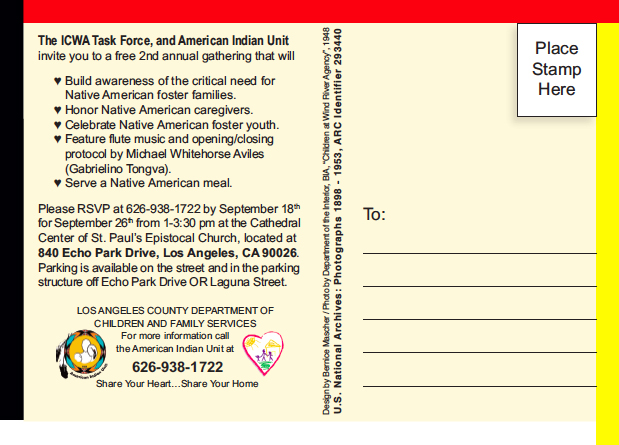
Los Angeles “Tiospaye” Native Foster Family Recruitment Event

The Los Angeles County Department of Children and Family Services American Indian Unit is sponsoring its 2nd Annual Native foster family/parent recruitment event. This event is an attempt to be proactive in searching to find native homes in an urban environment for those native children in foster/adoptive care.

***SAVE THE DATE: September 26,2015***
“TIOSPAYE”: Los Angeles Foster Family Recruitment Event
Sponsored by: The Los Angeles County Department of Children and Family Services American Indian Unit
RSVP by September 18, 2015 at 626-938-1722
Place: Cathedral Center of St. Paul’s Episcopal Church (ECHO PARK)
Address: 840 Echo Park Ave, Los Angeles, CA 90026

Sept_26_2015 LA foster recruitment Back Program

Sept_26_2015 LA foster recruitment Front