“The Indians Won” — A Blast from the Past — And a Shout-Out to Law Students

At Sam Deloria’s mention, I found a copy of the long out of print 1970 novel by Martin Cruz Smith (better known for the Arkady Renko mysteries), “The Indians Win”, and read it. It’s a short read. And fun. The edition I have includes commentary from the author who states he researched Indians for a couple months, then wrote the novel in one month. Not to give away the plot (spoiler alert), but in this fictional world, the Indians win. Yeah, the ‘Nishnaabes don’t get much play — it’s all Sitting Bull and Stand Watie and Wovoka — but the Potawatomis get a few good ones in.
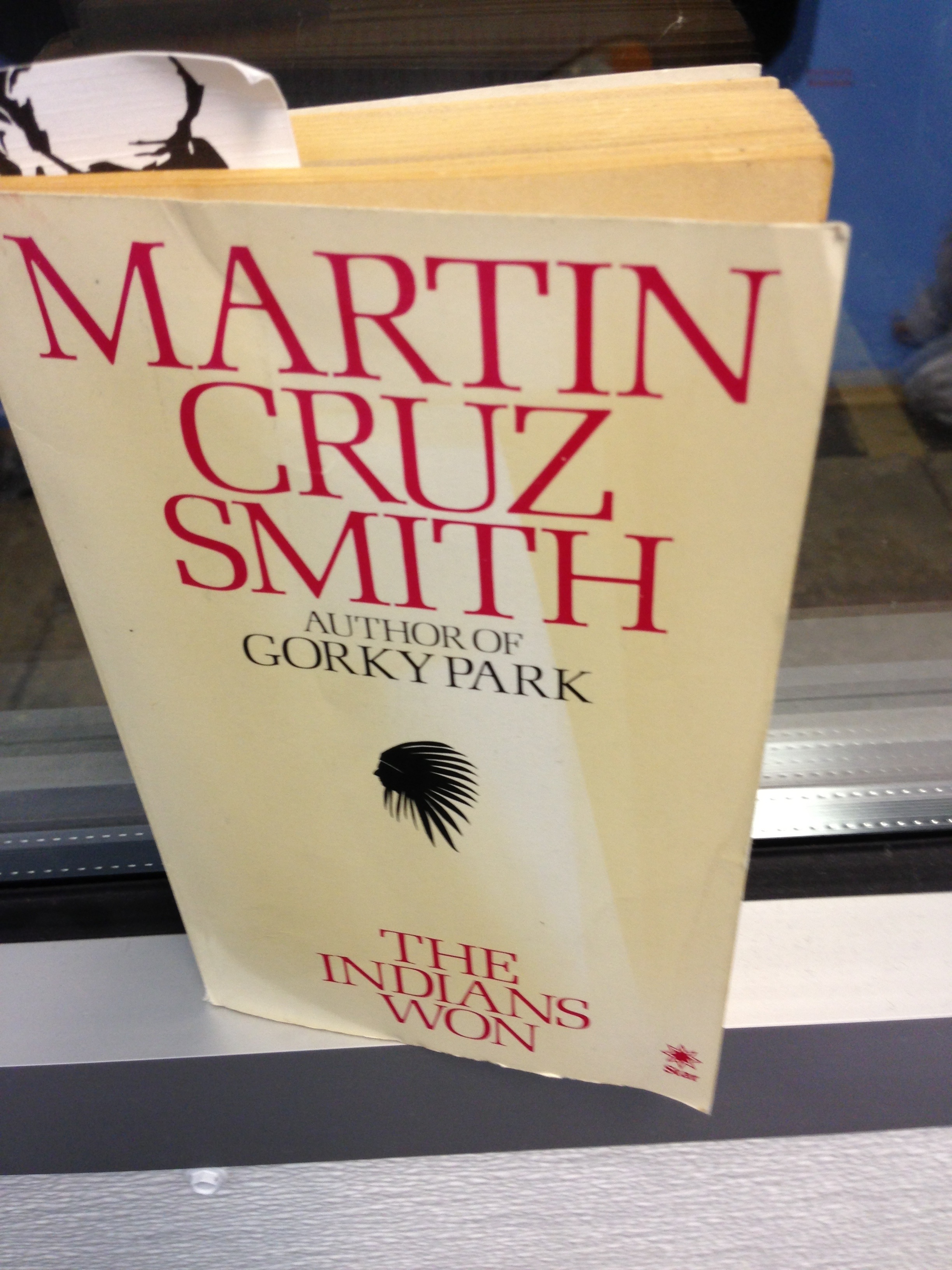
20130221-231921.jpg

For those not in the know about this novel, here is a quick plot summary. In 1876, rather than Custer’s Last Stand being the Indians’ last stand, all the remaining Indian tribes of the plains and the far west band together. Armed with European arms smuggled down from Canada through Dakota, the Indians win a bunch of military clashes with a post-Civil War American military that doesn’t put up much of a fight. It all ends up with … You guessed it … The Indians winning. Speculative fiction at its early 1970s best and funnest. The best part of the subplot is the 1952 declaration by the “Indian Nation” that they have bomb, but are unwilling to prove to the world they have the bomb by testing it because to do so would unnecessarily injure Mother Earth.

It reminds me of the National NALSA moot court competition. Year after year, law students gather to compete in a fictional world that could be like the one where “The Indians Win.” If you’re like me and you think of this reality as one reality in a universe of infinite parallel … universes, then why can’t the Indians win after all? How else could a dude like me marry the most beautiful and brilliant Odawa woman in the world?

In the end, I say this — have a great competition, law students. The National NALSA Moot Court Competition should be fun. Anything, absolutely anything can happen. US News rankings fly right out the window. Make friends, renew old friendships, network like crazy, and crush your opposition with an iron boot.

NYTs Review of Sherman Alexie’s “Blasphemy”

Here.

An excerpt:

The most disheartening aspect of this collection is the fact that, over 20 years, the jokes themselves haven’t changed. Alexie’s narrators and protagonists still see themselves as solitary outcasts on the margins of reservation life, and it shows: we hear a great deal about vodka, meth, commodity canned beef and horn-rimmed government glasses, but nothing about the intricacies of tribal politics, struggles over natural resources or efforts to preserve indigenous cultural life. Of course, a fiction writer follows the dictates of his own imagination, not any political or cultural agenda, but that’s precisely the point: Alexie’s world is a starkly limited one, and his characters’ vision of Native America, despite their sometimes crippling nostalgia, is as self-consciously impoverished as it has ever been. What began as blasphemy could now just as easily be described as a kind of arrested development. Perhaps, willingly or not, that is the lesson he’s trying to teach us.

Louise Erdrich’s “The Round House” Wins the National Book Award for Fiction

Story here. Longer NPR story on the awards here. List of other winners here.

NYTS Q&A with Louise Erdrich on “The Round House”

Here.

An excerpt:

President Obama signed the Tribal Law and Order Act into law in 2010 β€” it was an important moment of recognition. More recently the Senate Judiciary Committee crafted a helpful piece of legislation. The Violence Against Women Reauthorization Act of 2012 would have given tribal nations limited jurisdiction over sexual predators regardless of race. Right now tribal courts can only prosecute tribal members. The problem is that over 80% of the perpetrators of rapes on reservations are non-Native. Most are not prosecuted. The bill went forward only to stall in the House, blocked by Republican votes. Hate to say it, but that one’s on them.

Onion: Interior Secretary Salazar Decks Smart-Ass Buffalo

Here.

Erdrich’s The Round House is a National Book Award Finalist

Louise Erdrich’s latest book, The Round House, is a National Book Award finalist. Here.

Her NPR interview is here.

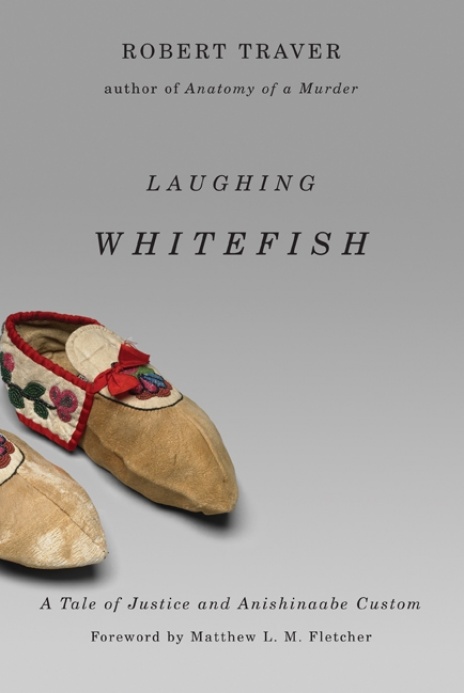
Bill Castanier on “Laughing Whitefish” in the Lansing City Pulse

From Lansing City Pulse:

By any measure the career of John D. Voelker was a phenomenal success. He was a successful author, having written the bestseller β€œAnatomy of a Murder” (later made into a movie directed by Otto Preminger and starring James Stewart, Lee Remick and George C. Scott) and he was a member of the Michigan Supreme Court. But something was gnawing at him.
As a younger man, he had heard a story about an Indian woman who had, against all odds, taken on the white power structure of the Upper Peninsula’s mining industry while seeking what she thought was compensation owed to her family.

Voelker had always wanted to do a fictional treatment of this real-life case, but the success of β€œAnatomy” and his job as a justice had kept him too busy.

In an address to the Michigan Historical Society in 1970 he said his β€œneglected Indian story receded even further into the background.”

In a brash move, Voelker decided he was fed up and had enough of the β€œbaying dogs of success” β€” he quit his job.
In his letter of resignation to Gov. G. Mennen Williams he wrote, β€œWhile other men can write my legal opinions (although I would debate that) they can scarcely write my books. I am sorry.”

Voelker, who wrote under the pen name Robert Traver, retreated to the Upper Peninsula, where he would spend two winters writing his Indian story. β€œLaughing Whitefish” was published in 1965, but soon went out of print.

Now, Michigan State University, working with the Voelker family, has reprinted the book with an introduction written by MSU College of Law Professor Matthew Fletcher, who heads the Indigenous Law and Policy Center.

In describing his book, Voelker always said it was β€œa basic story … rather simple” and β€œit was about iron ore, Indians and the infidelity to one’s own promises.”

The book tells the story of a young Indian woman, Charlotte Kawbawgam (her real name was Kobogum), who seeks compensation for her father. He had been promised a β€œwee fractional interest” after leading a group of mining executives to the world’s largest deposit of iron ore. Kawbawgam hires lawyer Willy Post, a newcomer to Marquette.

Continue reading

Sherman Alexie Story Appears in Chris Van Allsburg’s “Chronicles of Harris Burdick”

From the NYTs review:

My favorite is Sherman Alexie’s β€œStrange Day in July,” in which demonically clever twins expand their ranks by declaring a certain dress to be their triplet sister, and then bully everyone in sight into playing along with them. It’s a cheeky, oddball premise, and Alexie carries it off with breezy aplomb. Of course, just when the twins appear on the verge of having their every desire fulfilled, their plan boomerangs with a vengeance. In life, it seems, as in this beguiling book, no one ever really gets the last word.

Why Sherman Alexie and Louise Erdrich Should Win the Nobel Prize

Salon’s recent debasement of American literature as represented by the likes of Joyce Carol Oates and Philip Roth is hilarious reading for Americans who are people of color, especially in my view American Indians. While I wouldn’t go so far as to say that the giants of American literature aren’t worthy of such an honor, I am in agreement with Salon that these American giants are “insular and self-involved.”

They are, but what’s worse — they are fearful, fearful of writing about and engaging in race. Europeans, Asians, Africans, American people of color, and virtually everyone else sees how truly pathetic American discourse on race has become. Derrick Bell’s passing reminds us how far Americans have to go before they can confront the undeniably racialized origins of the United States. Derrick Bell, who would have fit in well in the pantheon of Nobel winners (in either literature or peace), talked about race in a way most white Americans simply will not do. Americans was colorblindness, they want neutrality, and they certainly don’t want comeuppance.

American literature, or what Salon views as a canon or sorts (exclusively white authors), is weak on race. Probably the best novel on race by Salon’s stable of worthy-ish writers is Roth’s The Human Stain. It’s good, but it’s not really a direct engagement on race. First, it’s set on campus at a liberal arts college, maybe the whitest place around, and a frequent safe ground for American writers. Second, it’s not really about race. It’s about a white guy who finds out he’s black. And he suffers horribly for it. That’s the best Americans can do?

Sherman Alexie and Louise Erdrich have been writing about race for decades. They confront the question of race head on. They’re honest about it, especially Alexie. Americans are racists. So are American Indians, and blacks, and Latino/as, and Asians. We all are, and American literature runs from that reality, trying to avoid it, or cover it up. Derrick Bell didn’t run from it. He dealt with it. Alexie writes about Indians in white communities, Indians who sold out to join white America and how they can’t go back home, and Indians who hate whites so much they kill them. Erdrich writes about mixed race people of every stripe you can find in the northern plains. She adds the element of gender that’s beautiful and powerful and nasty.

America’s “canon,” the people Salon deems worthy of discussion, just don’t do any of these things. Maybe they wouldn’t know how. The Nobel committee will award the Prize to someone like Alexie or Erdrich, just as they did Toni Morrison in 1993. And the American literary establishment will spend the next two decades wondering why no American has won. Really.

IPR’s Points North Show on “Laughing Whitefish”

The mp3 is here.