Notice Case from Montana [ICWA]

This is the year of notice and reason to know. Courts are finally wrestling with what the regulations do and do not require–and there is considerable concern about what to do if there is no response from a tribe. 

Whenever a court “knows or has reason to know” that a child is an “Indian child” under ICWA, the court is to verify the child’s status prior to conducting termination proceedings. 25 U.S.C. § 1912(a); In re L.D., 2018 MT 60, ¶ 13, 391 Mont. 33, 414 P.3d 768 (internal citations omitted). Whether a child is eligible for tribal membership is a question of fact dependent upon the child’s actual ancestry, and an Indian tribe provides the determination conclusively as a matter of law. 25 C.F.R. § 23.108(b); In re L.D., ¶ 14 (internal citations omitted); In re Adoption of Riffle, 273 Mont. 237, 242, 902 P.2d 542, 545 (1995).

¶22 It follows that a district court does not have authority to make a de novo conclusion regarding eligibility. 25 C.F.R. § 23.108(b); In re L.D., ¶ 14 (internal citations omitted). Instead, the district court must determine “(1) whether the court has reason to believe that a subject child may be an ‘Indian child’ and (2) whether an Indian tribe has conclusively determined that the child is a member or eligible for tribal membership.” In re L.D., ¶ 14 (internal citations omitted). Absent a conclusive tribal determination, a court abuses its discretion by terminating parental rights if there is “reason to believe” the child is an Indian child. In re L.D., ¶ 14 (internal citation omitted).

In this case, however, the issue was the Agency didn’t contact the Tribe at all, leading to the remand.

We hold the District Court abused its discretion in terminating Mother’s parental rights without a conclusive tribal determination of tribal membership status and enrollment eligibility in the United Keetoowah. Since the United Keetoowah is a federally recognized Cherokee tribe,3 and the Department did not contact the tribe, the District Court made a de novo determination regarding M.T. and L.T.’s United Keetoowah tribal eligibility, a determination which is in the sole province of the tribe.

Notice Case out of California [ICWA]

If you find the current published notice and inquiry cases out of California particularly confusing, join the club (and I’ve been trying to sort them out!). I think the important thing for tribal attorneys to know is that California is trying to do very early contact during the inquiry phase before they send formal notice. For some tribes this is very welcome, and for others, it’s a big change in practice. However, this does mean that California is trying to formalized very specific steps into law–from initial inquiry, reason to believe, further inquiry, reason to know, notice (I think). This means California case law probably won’t be particularly useful in this area in other state appeals.  

Guardianship Case out of California [ICWA]

Well all, I have absolutely fallen down on the ICWA TurtleTalk beat since the Washington Supreme Court decision in Z.J.G. Since I am getting older, I’m going to blame the new WordPress interface (please ignore that Fletcher is older than me and obviously figured it out just fine). So now, a series of posts with links to the reported cases since September 2020–don’t worry, this was an exceptionally small year for reported ICWA cases. 

 N.S. is a guardianship case (reading this, it’s possible I just wanted to end the year after Z.J.G. on a positive note). Here is the description of the lower court’s holding, which the appellate court affirmed. There is some preemption discussion on p 27-28 in the 54 page opinion, but not much. 

Regarding substantial interference with N.S.’s connection to the Tribe, the court found that “once [Grandmother] is properly informed, once the expectations are concretely articulated, . . . she will encourage [N.S.] to learn about his heritage.” The court further found that given N.S.’s development, maturity, and curiosity, he would not “permit anybody [to] dissuad[e] him from making up his own mind as to not just his Indian heritage, but how it fits into his life.” Thus, the court concluded that there was not a compelling reason not to terminate parental rights based on a substantial interference with N.S.’s connection to the Tribe. 25

Regarding the Tribe’s identification of guardianship as the best permanent plan for N.S., the court believed that N.S.’s “guardianship was a very vital tool and opportunity for him to get to this point.” However, the court asserted that, “merely identifying guardianship to maintain the status quo would not recognize the increasing, the deep, the published connection [that N.S.] has with his grandmother.” The court found that in light of N.S.’s “current developmental progression and attachment to the grandmother,” guardianship was not in his best interests; therefore, the Tribe’s identification of guardianship as N.S.’s permanent plan had not “been established as a compelling reason not to terminate parental rights.”

Fletcher and Fort’s Rewritten Opinion in Adoptive Couple v. Baby Girl

Fletcher and Fort posted “Intimate Choice and Autonomy: Adoptive Couple v. Baby Girl,” forthcoming in CRITICAL RACE JUDGMENTS (Cambridge Univ. Press, eds. Bennett Capers, Devon Carbado, Robin A. Lenhart, and Angela Onwuachi-Willig) (forthcoming 2021).

As if there was any doubt, we have reached the opposite outcome as the Supreme Court did back in 2013. A few excerpts:

This case is about a little girl (Baby Girl) who is a citizen of the Cherokee Nation, like her father, grandparents, and a multitude of generations before her. American Indian tribal citizenship with a federally recognized tribe is a unique concept in American law. E.g., Santa Clara Pueblo v. Martinez, 436 U.S. 49, 55 (1978) (“[Indian tribes] have power to make their own substantive law in internal matters. . . .”). Tribal citizens are beneficiaries of the federal government’s trust relationship with Indian tribes, and the federal government has promised to tribal citizens for centuries to assist in the maintenance of tribal governments, cultures, and sovereignty. Worcester v. Georgia, 31 U.S. 515, 556 (1831) (“[The Cherokee treaty], thus explicitly recognizing the national character of the Cherokees, and their right of self government; thus guarantying their lands; assuming the duty of protection, and of course pledging the faith of the United States for that protection; has been frequently renewed, and is now in full force.”).

And:

The ethically dubious acts of the Petitioners in this case extends to this Court’s amici. Several amici invoked the racist dog whistle of referring to the Petitioners as the “only family” Baby Girl has ever known. E.g., Brief for Guardian Ad Litem, as Representative of Respondent Baby Girl, Supporting Reversal at 56 (“Indeed, it is hard to imagine what liberty interest is more important to a 27-month old child than maintaining the only family bonds she has ever known, absent a strong showing of necessity.”) (emphasis added); Brief of Amica Curiae Birth Mother in Support of Petitioners at 3 (“The decision below effectively negated Birth Mother’s decision to place Baby Girl with Adoptive Couple, and ripped Baby Girl from the only family she has ever known, in derogation of both Birth Mother’s and Baby Girl’s rights and expectations under state law.”) (emphasis added); Brief of Amici Curiae Bonnie and Shannon Hofer; Roger, Loreal, and Sierra Lauderbaugh; and Craig and Esther Adams in Support of Petitioners at 38 (“[T]he lower court took non-Indian Petitioners’ adopted Indian daughter from them – destroying the only family she has ever known.”) (emphasis added); Brief of Amici Curiae National Council for Adoption in Support of Petitioners at 13-14 (“ICWA is implemented in some cases to traumatize children by forcing them into completely unknown environments, traumatizing them by removal from the only family they’d ever felt a connection with and imposing the developmental delays that come with the traumatic removal from a secure attachment.”) (emphasis added).[1] It appears that for some of our amici, the “only family” that matters is the non-Indian Petitioners’ family. For these amici, the Indian family and other biological relatives are strangers and foreigners. The only pain and shame of removal and separation that matters is that of the non-Indian family. It is apparent the “only family” dog whistle is designed to distract our attention from the ever-present bias against Indian parents and relatives in the child welfare and adoption system. This we will not accept. As noted above, this Court long has been complicit in dehumanizing Indian people. In Professor Harris’ words, “[C]ourts established whiteness as a prerequisite to the exercise of enforceable property rights.” Harris, supra, at 1724. No longer. We additionally suspect that this form of advocacy implicates American Bar Association Rules of Professional Conduct 3.4 (Fairness to Opposing Party and Counsel), 3.5 (Impartiality & Decorum of the Tribunal), 4.4 (Respect for Rights of Third Persons), and 8.4 (Misconduct).


[1] One commentator even referred to the Cherokee family here, who descend from an Indigenous nation that has been present in this hemisphere since time immemorial, as “foreign.” Thomas Sowell, Indian Child Welfare Act does not protect kids, Denton Record-Chronicle, Feb. 1, 2018, at 6A (“This little girl is just the latest in a long line of Indian children who have been ripped out of the only family they have ever known and given to someone who is a stranger to them, often living on an Indian reservation that is foreign to them.”) (emphasis added).
Gold Standard Lawyering in The NACC Guardian

Here

By Sheri Freemont

Imagine being a Native American person and being in a court that will judge your family and
parenting where the judge, the lawyers, the social workers, the security guard, the court
reporter, the judicial assistant, are all non-natives? As a native person who is aware of the
history of the nation to condemn Native Americans as parents, and even as humans, how
does it feel? Will native people feel comforted by the explanation that they have due process
rights? Consider: the government cannot take your child away from you without due process.
Does having due process rights mean they will still take your child away, but you get notice
and an opportunity to be heard, and a lawyer to represent you? A lawyer who has never been
inside a native person’s home, who has never heard about boarding schools or Indian massacres, or the hundreds of years of attacking the familial ways of native people. More than plain
language explaining the laws and process is needed to serve these families in child welfare
cases.5 We need to use the gold standard of legal practice, borrowing from what the Indian
Child Welfare Act can teach us about how to do child welfare practice differently.

Seattle Times: “A victory for Native children’s rights to remain with family and tribe”

Op-ed by Kitty-Ann van Doorninck, Helen Halpert and Ron J. Whitener, here, profiling the recent watershed ICWA decision by the Washington Supreme Court, authored by Justice Raquel Montoya-Lewis.

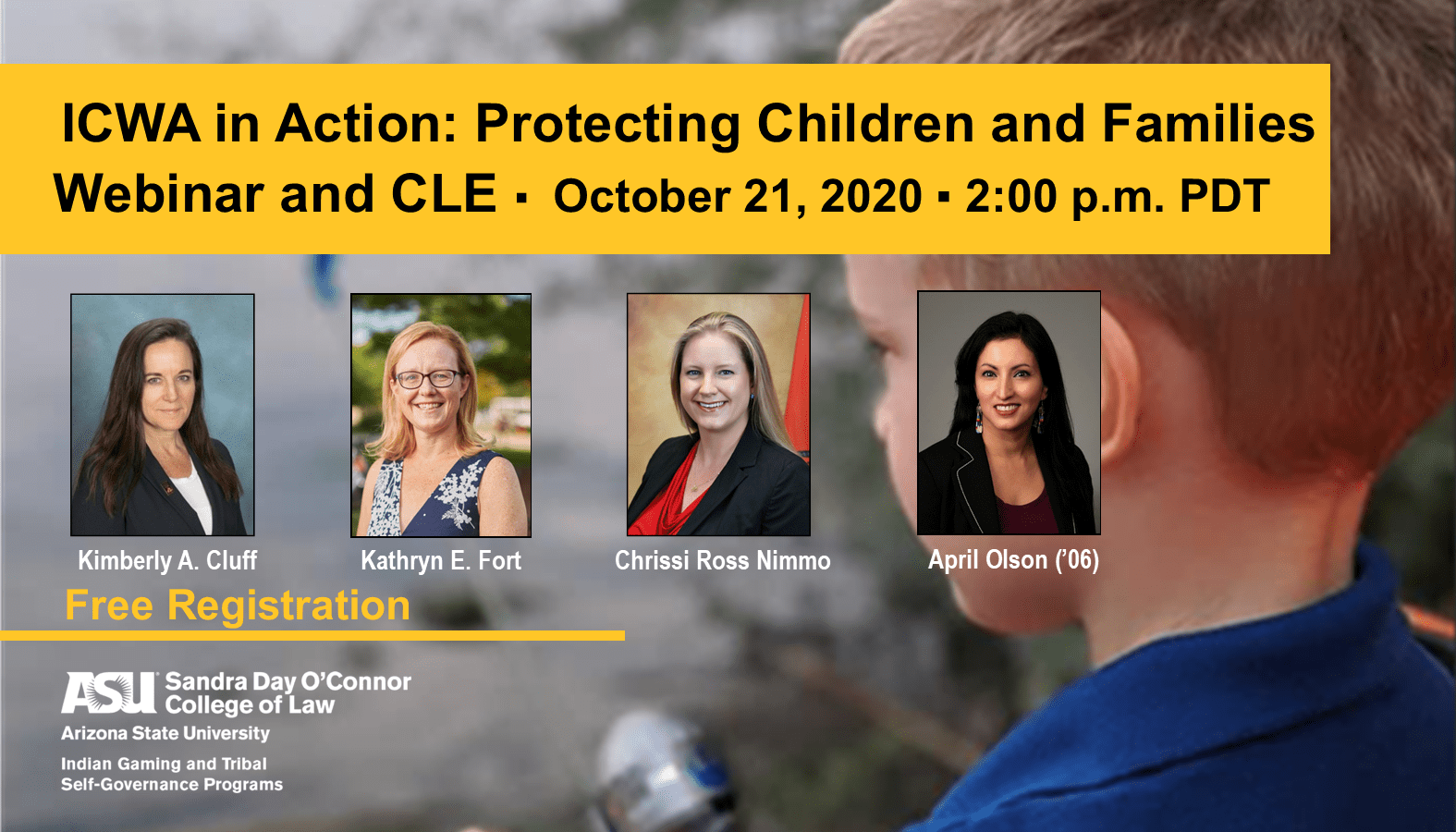
ASU Indian Child Welfare Act Webinar (10/21/2020)

ICWA in Action flyer

Indian Child Welfare Act Webinar – in 2 weeks 

October 21 

2:00-3:30 pm Pacific time 

ASU Law’s Indian Legal Program is proud to host a webinar on the latest developments in the implementation of the Indian Child Welfare Act (ICWA). Please join us for an engaging session with panelists:  

  • Kimberly A. Cluff, former General Counsel, Morongo Band of Mission Indians
  • Kathryn E. Fort, Director and Adjunct Professor, Michigan State University College of Law Indian Law Clinic
  • Chrissi Ross Nimmo, Attorney General, Cherokee Nation Deputy
  • April Olson (’06), Partner, Rothstein Donatelli LLP
  • Lawrence Roberts (Moderator), Professor of Practice and Executive Director, ASU Law’s Indian Gaming and Tribal Self-Governance Programs

Register for free webinar at: law.asu.edu/icwa

Indian Law Section OK Bar Assc Survey for Pro Hac Vice for ICWA cases

The Oklahoma Bar Association’s Indian Law Section strategic planning committee is exploring the possibility of proposing a change to the current Oklahoma Bar Association pro hac vice rules. This potential change would allow out of state attorneys representing tribal nations to participate in ICWA state court proceedings in Oklahoma without being required to comply with the state’s pro hac vice rules.

 If you could take a few minutes to complete the survey and forward this to other attorneys you know who might be interested in participating, we would greatly appreciate it.  Thank you.

 Debra Gee, Indian Law Section – Oklahoma Bar Association

Here is the survey

ICWA Regulations, Reason to Know, and the Importance of In re Z.J.G.

Now that the decision in out in In re Z.J.G., I feel like I can write about the reason this case was so important–beyond what I would consider the obvious (parent’s testimony), which I detailed in this post here.

The 2016 federal regulations for ICWA can be a double sided sword. There are portions of them that are absolutely vital and beneficial to the implementation and enforcement of ICWA. I think the most obvious one is the definition of active efforts in 25 C.F.R. 23.1, which finally gives a structure for one of the most important elements of the law. However, there are parts of the regulations that can be read in ways to counter ICWA’s protections. The reason to know section of the regulations has been one of those areas.

ICWA requires a bunch of stuff, including notice, when a court “knows or had reason to know” there is an Indian child in a child custody proceeding. 25 U.S.C. 1912(a) The regulation in contention in In re Z.J.G. was 23.107(c). That section states a court “has reason to know that a child involved in an emergency or child custody proceeding is an Indian child if:” and gives six elements. Those elements use the term “Indian child” in them–as in “any participant in the proceeding … informs the court that it has information indicating that the child is an Indian child.” 23.107(c)(2) (emphasis added). Some states, including Washington, took it upon themselves to read this regulation to mean that the child must be an “Indian child” as defined in ICWA–a member or eligible for membership and the biological child of a member–for a court to have reason to know. If this feels like circular reasoning, I’d argue that it is. Or, as Justice Montoya Lewis wrote:

However, this narrow interpretation commits the error addressed above: it assumes state agencies or participants will know and properly interpret tribal membership and eligibility rules. This interpretation diminishes the tribe’s exclusive role in determining membership and undermines the historical purpose of providing proper notification to tribes.

Decision at 30. 

And also,

While a broad interpretation serves the statute’s purposes, a narrow interpretation would undermine the protection of Indian children and tribes. The “reason to know” finding triggers the requirement of formal notification to tribes. 25 U.S.C. § 1912(a); RCW 13.38.070(1). Without formal notification, tribes are likely unaware of the child custody proceedings. Lack of notice repeats the historical harms that predicated the passage of ICWA and WICWA: Indian children are more likely to be taken and then lost in the system, often adopted when legally free, primarily to non-Native homes; tribes are denied the opportunity to make membership determinations; and tribes are unable to intervene in the case or exercise jurisdiction. 25 U.S.C. § 1911. Further, the failure to timely apply ICWA may unnecessarily deny ICWA protection to Indian children and their families, which could lead to unnecessary delays, as the court and parties may need to redo certain processes in order to comply with ICWA standards. ICWA Proceedings, 81 Fed. Reg. at 38,802; see also 25 U.S.C. § 1914 (noting that any Indian child, parent, or tribe may petition any court to invalidate a child custody action “upon a showing that such action violated any provisions of sections 1911, 1912, and 1913 of this title”). As those who practice in the area of child welfare and dependency know, if a court determines  that ICWA and WICWA should have been applied from the beginning of a case and was not, key decisions may have to be revisited because the burden of proof is higher at threshold stages of dependency cases.

Decision at 33-34.

Finally, a thing I think we forget a lot when talking about the regulations–they are the federal minimum standards. 25 C.F.R. 23.106. In Washington, for example, the state law has even more qualifying language. stating that a court has a reason to know an Indian child is involved in the case when it “knows or has reason to know a child is or may be an Indian child.” RCW 13.38.070. And while it could have done so, the Washington Supreme Court did not base its unanimous decision on just WICWA, but rather on ICWA, the regulations, and independently and alternatively on WICWA. 

Anyway, yes, I did do my first oral argument in this case, thanks to a bunch of awesome lawyers, including the two women attorneys up at CCTHITA, and we worked with the Center for Indigenous Research and Justice and Hon. Whitener (ret.) to get all the briefs filed, and was lucky to work with the very excellent parent attorney, Tara Urs (co-author of my top five favorite law review articles ever).

Also, all of this is all available publicly in all the briefing here, but I wanted to break it down into a post for those who might not read ALL of that:

98003-9 – In the Matter of the Dependency of Z.J.G. and M.E.J.G., minor children.
Hearing Date – 06/25/2020

Washington Supreme Court Finds Reason to Know in In re Greer/ZJG [ICWA]

The Supreme Court reversed the Court of Appeals. Justice Montoya-Lewis wrote the unanimous opinion.

The opinion is here: 

It is a long opinion with a lot of history, and information. Friend of the blog Sandy White Hawk is featured extensively. There are important law review articles and social science articles cited.

Importantly for future cases, the Court held “We hold that a court has a ‘reason to know” that a child is an Indian child when any participant in the proceeding indicates that the child has tribal heritage.”

The Indian Law Clinic at MSU represented the Tribes in this case, along with the Center for Indigenous Research and Justice.

(To be clear I am Very Excited about this and it is a Big Deal.)