Briefing and Oral Arguments in In re Z.J.G. [Washington Supreme Court]

This is the appeal of the court of appeals opinion posted here.

Oral arguments here

Briefs:

The MSU ICWA Appellate Project co-represented the Tribes in this case, along with the Center for Indigenous Research and Justice.

Notice Case out of California [ICWA]

Since April, the California courts of appeal have been wrestling with California’s new law defining “reason to know” from ICWA’s section 1912 and “reason to believe” (state law standard). In addition, the department has been regularly petitioning to make cases reported rather than unreported. Since April with the In re Austin J. case, California courts have been reshaping their very low bar for notice to tribes into a much higher one, with the caveat that the California standard of “reason to believe” does require contact with tribes though not necessarily formal notice. Given California’s outsized role in notice and inquiry ICWA cases, this is a trend that bears watching, with the understanding this is based on California state law, and not the federal ICWA.

Here is In re M.W., decided on May 11. The Department petitioned for publication on May 15 and it was published on June 5. Under the reason to believe standard, the social worker,

The report documented the social worker’s contact with the 12 tribes by telephone, fax, e-mail, and/or mail, the name of the designated agent for each tribe, the dates of attempted contact with each designated agent (all between May 15 and June 4, 2019), and that each tribe was provided with the minor’s “ICWA Family Tree.” As of the date of the report, four of the tribes had confirmed the minor was not an Indian child. As of the July 10, 2019 hearing, six additional tribes had confirmed the minor was not an Indian child, and the two remaining tribes (the Navajo Nation and the White Mountain Apache Tribe) had acknowledged contact but had not yet provided a definitive response.

I am curious to know how out of state tribes are feeling this system is working, given that while California may change its ways, tribes are generally set up to receive the paperwork to confirm a family’s tribal membership, and we already know that informal phone calls to confirm or deny a child’s eligibility can be problematic. Early outreach is great, if it works to give tribes MORE information and not less.

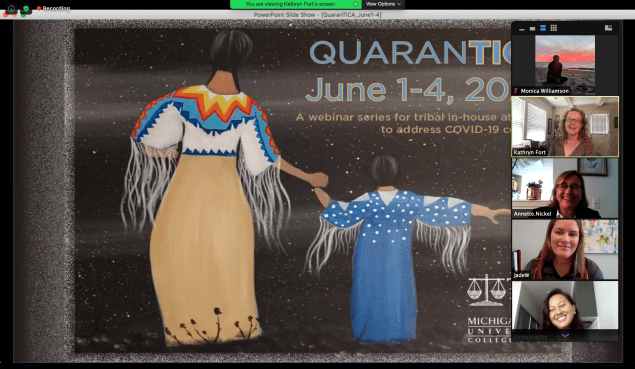
QuaranTICA COVID and Child Welfare Panel

Today:

Kate Fort, ILPC; Annette Nickel, Pokagon Band of Potawatomi Indians, Jade White, Saint Regis Mohawk Tribe, Tamera Begay, Puyallup Tribe of Indians.

QuaranTICAChildWelfareSocialServices

I’m awfully biased, but I thought it was a great panel, and a much needed good talk with some really amazing women today.

Notice and Enrollment Case from Colorado Court of Appeals [ICWA]

Here

This is a really interesting opinion, and balances a lot of interests. The issue of how to get a child who is both eligible for tribal membership and in foster care leads to a lot of questions about who gets to make the decision of enrollment. The agency has technical decision making authority for the children, but may choose to not enroll the children–as they did in this case–thus denying the application of ICWA (and a whole host of other citizenship related benefits and responsibilities). It may even mean the child can never be members, since some tribes don’t allow adults over the age of 18 to enroll. The Colorado Court of Appeals has just decided that the Court must make the final decision in those cases about whether a child should be enrolled or not.

In this case, mom told the agency the dad had Chickasaw heritage. This was enough for the agency to send notice to the Tribe. The Tribe responded that both the dad and the children were eligible for membership in the tribe, send membership applications, and asked the agency to assist the parents in enrolling the children.

The agency did NOT enroll the children, and did NOT tell the court of the Tribe’s response. The court only became aware of the response in the petition for termination. The court found ICWA did not apply, and terminated mom’s rights. The Court of Appeals determined that was not appropriate, and has created the process of an “enrollment hearing,” where the agency must deposit the Tribe’s request for enrollment with the court, and then the court must have a hearing–

Thus, once the response from the tribe has been deposited
with the juvenile court as set forth in Part II.B, we conclude that the
court must set the matter for a hearing to determine whether it is in
the best interests of the children to enroll them in the tribe. See
People in Interest of L.B., 254 P.3d 1203, 1208 (Colo. App. 2004) (A
juvenile court “must conduct a hearing to determine the proper
disposition best serving the interests of the child.”).

¶ 23 Of course, at an enrollment hearing, as at any other hearing in
a dependency and neglect proceeding, the court must give primary
consideration to the children’s best interests. See K.D., 139 P.3d at
698; C.S., 83 P.3d at 640.

¶ 24 And, in determining the children’s best interests, the juvenile
court must hear and consider the positions of the parents, as well
as the department and the guardian ad litem (GAL), all of whom
have standing, as relevant here, to speak to the merits of the tribe’s
enrollment request.

Though everyone can be heard, the court goes on to say,

Thus, at an enrollment hearing, the juvenile court should not
treat an objection, even from a parent, as a veto. On the contrary,
any reason for objection must be compelling considering ICWA’s
intent to maintain or foster the children’s connection with their
tribal culture.

Of course, the Tribe sent that letter requesting assistance enrolling the children in October of … 2018. Which means, of course, the twins who were a month old in May, 2018 are now two years old, never had any ICWA protections, and will now have their case go back to the trial court for a membership determination and a re-do of their child welfare case.
Final AFCARS Rule (2020 Version)

2020-09817-Final Rule

Here is the new final AFCARS (Adoption and Foster Care Analysis and Reporting System) rule with virtually none of the elements we asked for or worked on for the past five years with an added dollop of condescension in the response to comments.

Fort & Smith 2019 Annual ICWA Review

Here

It was kind of a crazy final edit process given the pandemic, so hopefully no major mistakes.

TICA Lunch in Indian Country CLE Tomorrow: ICWA Litigation Update

Here:

Lunch in Indian Country CLE: ICWA Litigation Update

  • When
    20 May 2020
  •  
    12:00 PM – 1:00 PM
  • Location
    Live in Tucson, AZ and available via Webcast

Join us for an update on litigation concerning the Indian Child Welfare Act (ICWA).

Presenter:        

Kathryn E. Fort, Director, Indian Law Clinic, ICWA Appellate Project, Indigenous Law and Policy Center, Michigan State University College of Law


Register at:  https://azbar.inreachce.com/Details/Information/a7f5f134-0d39-4f8b-b19a-a227bc3eb020

May Qualify for 1 CLE Credit

California Law Review Publishes “Politics, Indian Law, and the Constitution”

The article is here. PDF.

The abstract:

The question of whether Congress may create legal classifications based on Indian status under the Fifth Amendment’s Due Process Clause is reaching a critical point. Critics claim the Constitution allows no room to create race- or ancestry-based legal classifications. The critics are wrong.

When it comes to Indian affairs, the Constitution is not colorblind. I argue that, textually, the Indian Commerce Clause and Indians Not Taxed Clause serve as express authorization for Congress to create legal classifications based on Indian race and ancestry, so long as those classifications are not arbitrary, as the Supreme Court stated a century ago in United States v. Sandoval and more recently in Morton v. Mancari.

Should the Supreme Court reconsider those holdings, I suggest there are significant structural reasons as to why the judiciary should refrain from applying strict scrutiny review of congressional legal classifications. The reasons are rooted in the political question doctrine and the institutional incapacity of the judiciary. Who is an Indian is a deeply fraught question that judges have no special institutional capacity to assess.

Comments for Arizona’s Pro Hac Vice for ICWA Cases NEEDED and Due MAY 1

All comments are welcome, but they are particularly helpful from attorneys who are licensed out of state who end up in Arizona on ICWA cases. I know there are a fair number of you!

Here

Proposed Pro Hac Vice Rule Change for ICWA Cases in Utah

Please comment here by MAY 22.

Here is the proposed rule.

This is a big deal. Utah is a particularly difficult state to pro hac into–it is a multi-step, long and expensive process.

As always, the ICWA pro hac rules are updated here.