North Dakota ICWA Case on Qualified Expert Witness

Here: Interest of K.S.D. and J.S.D., 2017 ND 289

The lack of qualified expert testimony on whether the continued custody of the child by the parent or Indian custodian is likely to result in serious emotional or physical damage to the child leaves this record without evidence necessary for the district court to find the State established the ICWA requirement by proof beyond a reasonable doubt. 25 U.S.C. There is a line of authority that upholds termination of parental rights absent an ICWA qualified expert witness. We choose to follow the other branch of authority because the United States Code and the United States Code of Federal Regulations require—and do not merely suggest—that a qualified expert witness testify on the ICWA requirements in all ICWA terminations.


(Unrelated, one has to love a Court that only allows opinions to be downloaded as WordPerfect documents. That’s commitment.)

Alaska OCS-Tribal Services Compact

We’ve been getting a number of questions about this compact, likely due to the level and type of press coverage about it in Alaska (see here). We’ve hesitated to post on it, given all the people who know it much better than we do, but it’s important to see what this compact does and doesn’t do.

The compact is HERE (now as a searchable PDF because that’s how we do things).

The compact is, without question, a big step forward for the state of Alaska. It is the result of a lot of hard work of a lot of tribes, and opens doors that Alaska has long kept closed to tribes. There is recognition of tribal court protection and child support orders, as well as ensuring a child’s eligibility for federal funding regardless of tribal or state custody. The compact (Sec. 6.2.1) allows for the sharing of confidential information, and access to databases. This section alone are of particular importance and relevant for all tribes facing state intransigence on confidentiality and child welfare.

The compact is not the final step, however. The document provides an agreed upon framework for future negotiations between the state and individual tribes or tribal consortiums. The compact allows the state (OCS) to shift responsibility for providing services–and importantly, the related state funding–to tribal social services departments. But the compact does not address tribal jurisdiction, transfer to tribal court, or assume that if a tribal department takes over services that the tribe will take jurisdiction. Therefore, the compact doesn’t address tribal courts at all, or if state funding follows a child in to tribal court (spoiler alert: right now it doesn’t).

There are a lot of tribes in Alaska increasing their tribal court capacity right now, and it does seem the next step would be for tribes to exercise jurisdiction over their children without losing the funding due to those children as state citizens. It will also be interesting to see the individual tribal/tribal consortium compacts that address the details of how the services will be divided between the state and tribe.

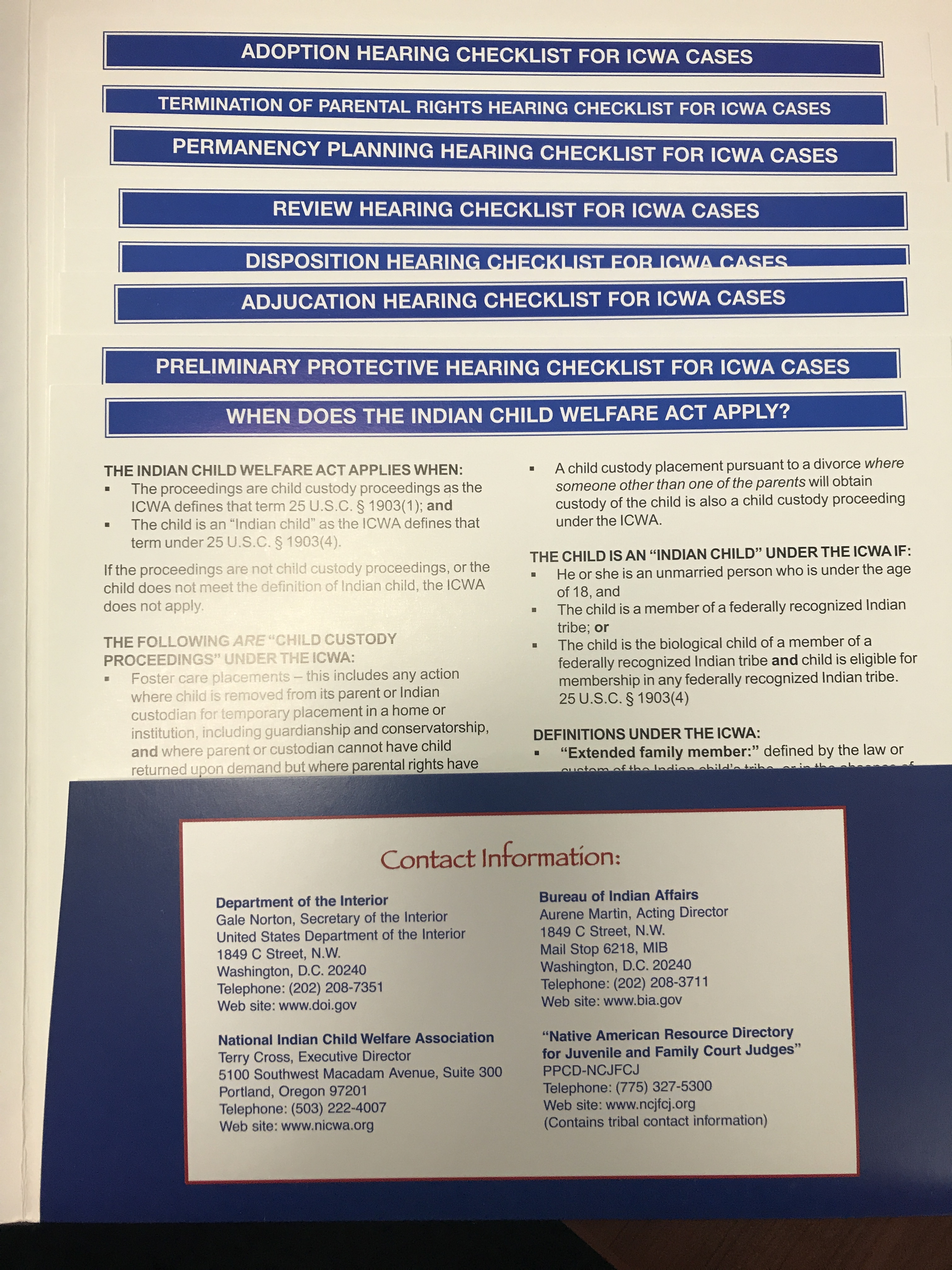
Fletcher Paper on States and American Indian Citizenship Rights (+ ICWA)

Here is “States and Their American Indian Citizens,” recently published in the American Indian Law Review.

An excerpt:

This article is intended to provide a theoretical framework for tribal advocates seeking to approach state and local governments to discuss cooperation with Indian nations, with a special emphasis on Indian child welfare. While the federal government has a special trust relationship with Indians and Indian nations, Indian people are also citizens and residents of the states in which they live. Thus, states have obligations to Indians as well.

This article posits the fairly controversial and novel position that states have obligations to guarantee equal protection to all citizens, including American Indians (and non-Indians) residing in Indian country. In other words, states have an affirmative obligation to ensure that reservation residents, Indian and non-Indian, receive the same services from states that off-reservation residents receive.

Press Release and Coverage Regarding Texas v. Zinke (ICWA Challenge)

California Tribal Families Coalition, News Release Tribal Coalition Urges Attorneys General to Protect Tribal Children

A coalition of California tribes and leaders today urged state attorneys general across 18 states and U.S. territories to stand with tribes in support of the Indian Child Welfare Act (ICWA) as it faces an outrageous legal challenge that seeks to unwind decades of critical legal protections for tribal children and families.

The letter sent on November 4, 2017 by the Sacramento-based California Tribal Families Coalition to the Conference of Western Attorneys General comes on the heels of an Oct. 25th federal lawsuit filed by the State of Texas and two foster care parents challenging the constitutionality of the ICWA.

California Daily Journal, Critics Distort Indian Child Welfare Law.

Law 360, New Indian Child Welfare Act Challenges On The Horizon

The Texas v. Zinke documents are here.


(I have seen and am choosing not to post the recent National Review op-ed by Tim Sandefur.)


NCJFCJ ICWA Bench BOOK is Now Available!

Last published in 2003 as bench cards, NCJFCJ has issued a new and improved ICWA bench book for judges. There are a few of you who have been asking me about these weekly–here they are!

Press release here

NCJFCJ_ICWA_Judicial_Benchbook_Final_Web

New!

Old!


Supreme Court Declines to Take S.S. v. CRIT (ICWA case)

Here is the order.

Here are the documents.

Remember, now in your ICWA briefs you can add that cert. denied signal if you like.

Texas and Prospective Adoptive Parents File Constitutional Challenge to ICWA and Regulations

Complaint here (northern district of Texas).

Additional documents will be posted here.

Plaintiffs thus bring this action for declaratory and injunctive relief and pray that this court:

(1) vacate and set aside the Final Rule;

(2) declare that Sections 1901–1923 and 1951–1952 of ICWA violate the Constitution;

(3) declare that Section 1915 of ICWA violates the Constitution;

(4) enjoin the defendants from implementing or administering Sections 1901–1923 and 1951–1952 of ICWA; and

(5) enjoin the defendants from implementing or administering Section 1915 of ICWA.

ICWA Inquiry Case out of Colorado Court of Appeals

Here.

To decide if the trial court complied with ICWA, we must answer a question that has yet to be decided in Colorado: When a trial court inquires at an initial temporary custody hearing at the commencement of the dependency and neglect proceeding whether there is a reason to know that the child is an Indian child, must it make another inquiry when termination is sought? We conclude that the answer is “yes,” at least when the court has not already identified the child as an Indian child and the petitioning party has not disclosed what efforts it has made to determine if the child is an Indian child.

Cert Stage Filings In S.S. v. CRIT (ICWA Case)

This is the cert petition from the Arizona Court of Appeals decision applying ICWA to step-parent or third party adoptions, where Dad attempted to terminate Mom’s rights so Step-Mom could adopt children.

Cert petition filed by the Goldwater Institute purportedly on behalf of the children.

Amicus in Support of the Cert Petition filed by the Pacific Legal Foundation

Brief in Opposition filed by the Colorado River Indian Tribes

Goldwater Reply