Comment Deadline to Feds on ICWA Needs Extended to January 12

This extension is regarding the letter in this post.

The Administration (DOI, HHS, and DOJ) are asking for input on the following:

What additional supports would Tribal leaders find helpful to build their Tribe’s capacity to exercise their rights and responsibilities under ICWA?  

Are there specific supports you believe the federal government could provide to help state courts and child welfare agencies meet their obligations under ICW A? 

In your experience, are there specific aspects or requirements of ICWA where state courts and agencies need to build greater understanding or capacity? 

Are there existing State-Tribe collaborative partnerships or processes that you believe have helped support effective implementation ofICWA? 

Montana Indian Law Section: ICWA, the Brackeen Decision & MT ICWA Statute — November 1, 2023

Here.

Tentative Agenda

Noon to 1 p.m.: The Impacts of the Brackeen Decision Moving Forward – 

1 to 2 p.m.: How the Brackeen Decision and the Recently Passed Montana ICWA Statute Will Impact Practitioners in Montana. 

Speakers

Professor Matthew Fletcher: Harry Burns Hutchins Collegiate Professor of Law the University of Michigan Law School

Kimberly Cluff: California Tribal Family Coalition

Kelly Driscoll: Montana Office of the State Public Defender, Missoula

April Olson: Rothstein Donatelli, Tempe, Arizona

Important Article on the Rise of Foster Parent Interventions in The New Yorker/ProPublica

I’ve been posting and talking about this issue for a while now, and am very happy to see it highlighted in this article. The Colorado Office of Respondent Parents’ Counsel has been collecting incredibly important data (headed up by a proud MSU alum!) on what happens when foster parents intervene. I strongly encourage anyone in the position to do so to begin collecting this same data.

https://www.propublica.org/article/foster-care-intervention-adoption-colorado

Intervenors can file motions, enter evidence and call and cross-examine witnesses to argue that a child would be better off staying with them permanently, even if the birth parents — or other family members, such as grandparents — have fulfilled all their legal obligations to provide the child with a safe home. When Carter’s foster parents intervened in the hope of keeping him, they turned to the firm of Tim Eirich, a Denver adoption attorney who charges as much as $400 an hour and has almost single-handedly systematized intervention in Colorado.

***

The Trump and Biden administrations have both pressed states to keep a larger percentage of kids with birth parents or kin. Intervention, a state-level counter-trend, is supported by foster parents’ rights groups and advocates at national conservative organizations.

***

Since 2018, South Carolina’s courts and lawmakers have affirmed the right of any state resident to file to adopt any foster child, as well as the right of foster parents to intervene. In 2020, Kentucky amended its law to let foster parents intervene as legal parties in involuntary terminations of birth parents’ rights. And this year Florida passed a law saying that if birth parents move to have their child adopted, including by a biological family member, long-term foster parents can intervene to contest that outcome. Kathryn Fort, the director of the Indian Law Clinic at Michigan State University, told me that her practice has faced three sets of intervenors this year, all of them non-Native couples seeking to adopt a Native child.

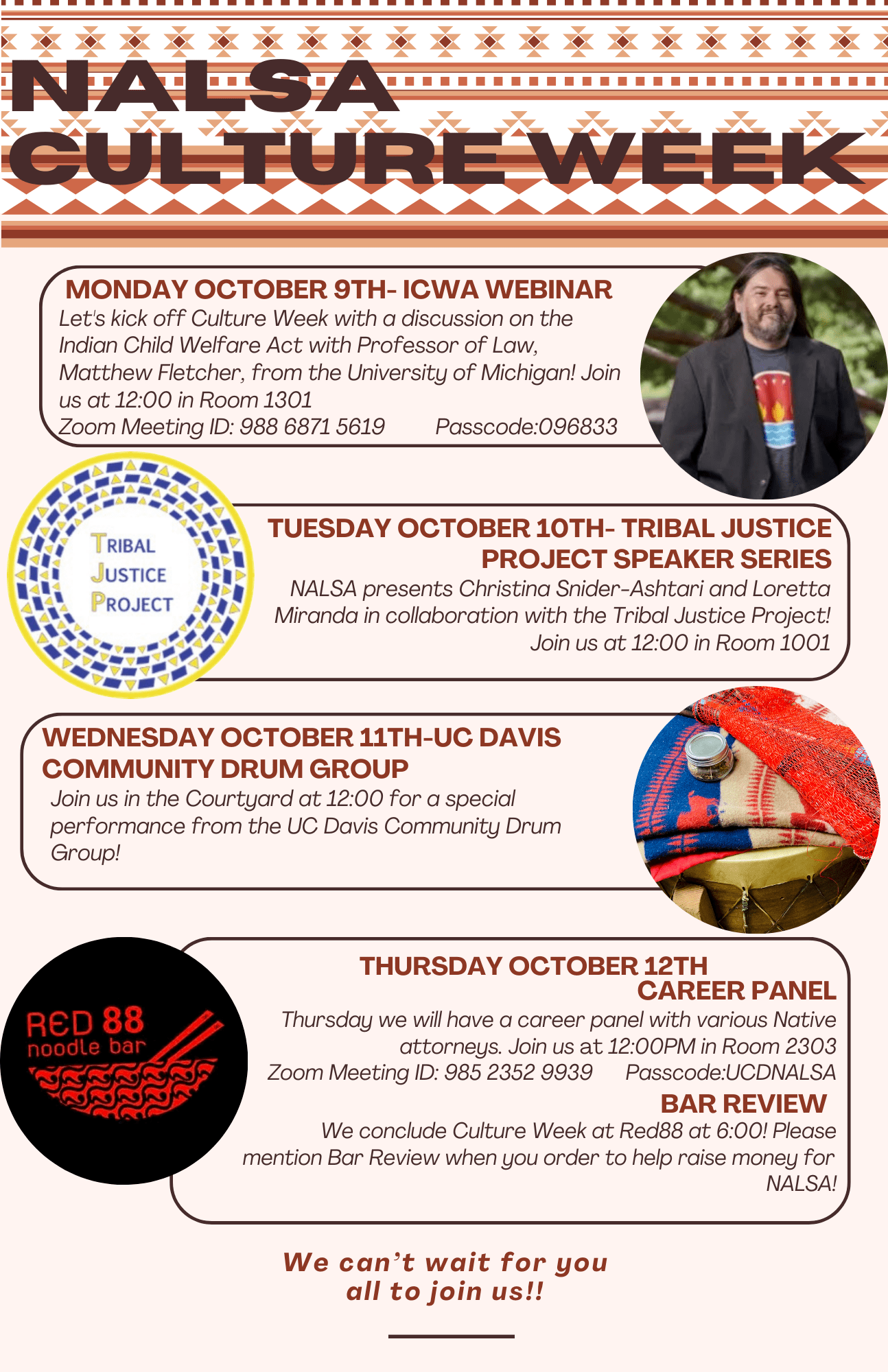
UC Davis NALSA Culture Week Events

Second ULC Listening Session on Uniform State ICWA Law on Nov. 6

In a letter that went out on September 26, the Uniform Law Commission announced a second listening session on the benefits and drawbacks of a potential model state ICWA law.

TribalLeaderLetter_092623

The registration link is here


UConn Law Review Symposium — Interrogating Haaland v. Brackeen: Family Regulation, Constitutional Power, and Tribal Resilience [October 6, 2023]

Here:

The Connecticut Law Review invites you to their 2023 symposium: Interrogating Haaland v. Brackeen: Family Regulation, Constitutional Power, and Tribal Resilience The litigation that led to Haaland v. Brackeen threatened to take down not only the Indian Child Welfare Act, but vast swaths of federal Indian policy and federal law. Instead, the Supreme Court’s decision left ICWA unscathed and affirmed the constitutional relationship between tribal nations and the United States. But threats to Native families and tribal sovereignty continue. Native children continue to be removed from their communities by a market for adoptable children. A handful of states and interest groups continue to seek ways to challenge tribal authority and federal laws that support it. And because the Supreme Court held that the Brackeen plaintiffs lacked standing to raise their equal protection challenges to ICWA, those claims can be raised another day. Leading scholars, attorneys, and tribal leaders will explore these and other issues raised by the decision in this symposium.

Connecticut Law Review Symposium on Brackeen, Oct. 6

Here.

Connecticut Law Review Symposium: 
Interrogating Haaland v. Brackeen

Family Regulation, Constitutional Power, and Tribal Resilience

Friday, October 6, 2023 | 12:00 pm-2:30 pm ET
Virtual

The Connecticut Law Review invites you to their 2023 symposium:
Interrogating Haaland v. Brackeen: Family Regulation, Constitutional Power, and Tribal Resilience

The litigation that led to Haaland v. Brackeen threatened to take down not only the Indian Child Welfare Act, but vast swaths of federal Indian policy and federal law. Instead, the Supreme Court’s decision left ICWA unscathed and affirmed the constitutional relationship between tribal nations and the United States. But threats to Native families and tribal sovereignty continue.

Native children continue to be removed from their communities by a well-funded market for adoptable children. A handful of states and interest groups continue to seek ways to undermine tribal authority and federal laws that support it. And because the Supreme Court held that the Brackeen plaintiffs lacked standing to raise their equal protection challenges to ICWA, those claims can be raised another day.

Leading scholars, attorneys, and tribal leaders, including Chairwoman Andrews-Maltais, Gregory Ablavsky, Laura Briggs, Seth Davis, Kate Fort, Ian Gershengorn, and Gerald Torres, will explore these and other issues raised by the decision in this symposium.

Dear Tribal Leader Letter Regarding Uniform State ICWA Law

The Uniform Law Commission is seeking to consult with tribes regarding the need and/or benefit of a uniform ICWA law for those states that either need to update their current state laws or do not have one yet. Consultation will be held via zoom on September 6, with written comments accepted through September 30. Please see the letter for additional details on the project. Please distribute widely.

ULC ICWA Committee Report to Scope Committee

Dear Tribal Leader Letter

State ICWA Law Chart

Over the last week, I’ve put together a (large, clunky) Google sheets of all the state ICWA laws. It isn’t perfect and subject to change as I see problems or people tell me there are problems. Sheets can be difficult, but it is nice to use to keep it updated. Someday I’ll learn how to make a proper database, but I know there is a need for this now rather than later.

I’ve linked to it on the state law page here and the link directly to the sheet is here.

Updated: California Supreme Court Granted Rare Reviews in Two Sets of ICWA Inquiry Cases

Buckle up–this is a long one. ETA: And it just keeps getting longer. See below for the latest addition.

For a while now, California courts of appeal have been struggling with the level of ICWA inquiry required in a child protection case. These inquiry cases often involve are about inquiry beyond that of asking the parents about their Native ancestry. The question usually is what is the duty of inquiry to extended family members after parents have repeatedly and unequivocally denied any Native ancestry, as it is in the as it is in the Dezi C. case. However, the other case granted, Kenneth D., the court failed to inquire of father at all. These appeals are also coming up very late in the proceedings–in both cases the appeal was of a termination of parental rights order.

The CA courts of appeal have been fighting about the standard for years, though I would say in the past two-three years it has become particularly acute. There are so many contradictory reported cases that I haven’t posted a vast majority of them. I’ve had a draft post running for almost a year trying to collect and explain what was going on, but it is far too unwieldy. In 2022, I started tracking only reported ICWA cases. In 2022, California had 35 REPORTED ICWA cases on inquiry alone:

Screenshot 2023-07-27 at 11.33.29 AM

In all of 2022, there were only 67 TOTAL reported ICWA cases, making these inquiry cases a full 53% of all ICWA cases that year.

First Set of Appeals: Inquiry of Relatives

The California Supreme Court granted review on Dezi C. and Kenneth D. from the 2022 bunch in the past year or so. As you can see, I had classified the Dezi C. case as a “reason to believe” which means the Court did analysis on the level of information it needed to determine if the case was an ICWA case.

Dezi C. Opinion

KennethD C096051

CA Supreme Court Grants

The Dezi C. opinion outlines the current state in the California courts of appeal regarding whether “defective initial inquiry is harmless.” There were three concurrent rules as of the time of the opinion (June 14, 2022 if you wondered how slowly the CA Sct works):

1. “Automatic Reversal Rule:” Any defective initial inquiry requires reversal on that issue.

2. “Readily Obtainable Information Rule:” Defective initial inquiry is harmless unless the record indicates there is “readily obtainable information” that will “bear meaningfully” on the question on if the child is an Indian child.

3. “Presumptive Affirmance Rule:” Defective initial inquiry is harmless unless the parent comes forward with a reason on appeal why further inquiry would change the outcome of the ICWA determination.

Dezi C. introduced a fourth rule–

4. “Reason to Believe Rule:” objectively the only one that quotes the actual law, this rule states the record on appeal must “contain information suggesting a reason to believe the child may be an ‘Indian child.'” The Court gives three examples that would require reversal–someone tells the Agency there may be Native ancestry and the Agency ignores it; no one inquires of the parents if they have Native ancestry; the parents are adopted themselves and may not have the required information.

The Court then goes on the explain in detail why their rule is best and the other rules are the worst (obvi).  

In applying the reason to believe rule to the facts of the case, the Court found there was no reason to believe the children were Indian children, as both parents denied to the Agency, on a form, and in court that they had any Native heritage. No one came forward claiming they did. The parents grew up with their biological families. And on appeal, the mother did not offer any evidence that either parent in fact has Native ancestry. Therefore, the failure of the Agency to do further inquiry to extended family members was harmless error. 

The question at the Supreme Court is as follows:

In Re Dezi C., S275578. (B317935; 79 Cal.App.5th 769; Los Angeles County Superior Court; 19CCJP08030.) Petition for review after the Court of Appeal affirmed orders in a juvenile dependency proceeding. This case presents the following issue: What constitutes reversible error when a child welfare agency fails to make the statutorily required inquiry concerning a child’s potential Indian ancestry?

The Kenneth D. court applied the Dezi C. fourth rule to fairly different facts. In Kenneth D. the trial court completely failed to inquire of the putative father’s Native ancestry. The court order termination of parental rights on Mrch 22, 2022 and father appealed. The Agency supplemented the record on April 28 with the following information received from the father on April 21: Father said he might be Cherokee, and that his mother (grandmother) would have the information. The Agency spoke with the grandmother who explained their entire family is from Mexico so the Native heritage result she received on a DNA test likely results from Mexico. The grandmother provided the Agency with additional family contact information.

Mother in the case originally said she might have some Native ancestry from her Kentucky relatives, but denied any family member was a tribal citizen or that she was eligible to be a tribal citizen.

The father appealed the termination order asking for a reversal because of the lack of inquiry and the court held under the Reason to Believe test that the error of the court in not conducting an initial inquiry TO A PARENT was harmless.   

The question at the California Supreme Court is as follows:

In re Kenneth D., S276649. (C096051; 82 Cal.App.5th 1027; Placer County Superior Court; 53005180.) Petition for review after the Court of Appeal affirmed an order in a juvenile dependency proceeding. This case presents the following issues: May an appellate court take additional evidence to remedy the failure of the child welfare agency and the trial court to comply with the inquiry, investigation, and notice requirements of the Indian Child Welfare Act (25 U.S.C. § 1901 et seq.; Welf. & Inst. Code, § 224 et seq.), and if so, what procedures must be followed?

Briefing in Dezi C. is here

Kenneth D is here 

Second Set of Appeals: Interpretation of California Welfare and Institutions Code Sec. 224.2(b)

In 2023, there have been fewer reported cases on inquiry so far (only 9, though there was one this week I haven’t entered into this spreadsheet, but talk about below):

Screenshot 2023-07-27 at 3.26.41 PM

There have been 28 (29 if you count Brackeen) reported cases total, so they are currently running less than half of the total.

However, there was a new issue that arose in In re Robert F. and In re Ja. O. out of the Fourth District, Div. II, regarding California’s statutory requirement of inquiry. Both of these cases have been granted review in the California Supreme Court yesterday. The question turns on an interpretation of the California statute governing this issue. For reasons that feel to me like a scrivener’s oversight/a citation lost in the drafting, the Court held that when a child is removed pursuant to a warrant, there is no statutory requirement to make ICWA inquiry. But when a child is removed without a warrant, the statute does require the inquiry.

In both cases, the children are removed and ICWA would apply if the children “Indian children,” under the law, and inquiry should be happening in both instances. It is in many ways a distinction without a difference for the purposes of ICWA inquiry. Perhaps unsurprisingly then, the Fourth District, Div. II, late last week held the exact opposition in In re Delila D.:

We conclude there is only one duty of initial inquiry, and that duty encompasses available extended family members no matter how the child is initially removed from home. Applying a narrower initial inquiry to the subset of dependencies that begin with a temporary removal by warrant frustrates the purpose of the initial inquiry and “den[ies] tribes the benefit of the statutory promise” of A.B. 3176. (In re S.S. (2023) 90 Cal.App.5th 694, 711, 307 Cal.Rptr.3d 308 (S.S.).) The goal of the initial inquiry is to determine whether ICWA’s protections may apply to the proceeding, and the way a child is initially removed from home has no bearing on the question of whether they may be an Indian child. 

California Supreme Court Results from 7/26 Conference

In re Robert F.

In re Ja.O.

In re Delila D.

Finally, did I get myself turned around and initially post the older granted cases as the new cases and then find the new cases and have to go back and fix everything? Perhaps. Special thanks to Lenny Powell for alerting me after the original post and helping sort this all out. Maybe I got excited because few of us remember the last time ICWA came up to the CA Supreme Court back in 2015-2016 with the Abbigail A. (obligation to enroll) and Isaiah W. (notice) cases.