DOJ Motion to Dismiss and Supporting Amicus Briefs in Goldwater (ICWA) Litigation

Motion to Dismiss here.

Footnote 8:

Plaintiffs do not seek the type of reliefincreased funding or systemic changes in the quality of child-welfare services provided by state agencies – that the Ninth Circuit found unworthy of Younger abstention in Jamieson, 643 F.2d at 1354; instead, they demand that this Court enjoin state courts and agencies from applying long-standing state and federal laws to their ongoing child-custody proceedings, which clearly warrants equitable restraint under Younger.

(emphasis added)

Also:

Membership in a federally recognized Indian tribe, or being born the child of a member of such a sovereign entity, is not a forced association. ICWA does not require association, but rather protects associations that already exist.

In addition, Casey Family Programs plus twelve other national child welfare organizations filed this amicus brief (gold standard brief).

Finally, it is a key best practice to require courts to follow pre-established, objective rules that operate above the charged emotions of individual cases and that presume that preservation of a child’s ties to her parents is in her best interests. See National Council of Juvenile and Family Court Judges, supra, at 14. Application of the best-interests-of-the-child standard should be guided by substantive rules and presumptions because “judges too may find it difficult, in utilizing vague standards like ‘the best interests of the child,’ to avoid decisions resting on subjective values.” Smith v. Organization of Foster Families for Equal. & Reform, 431 U.S. 816, 835 n.36 (1977). Courts should not terminate a child’s relationship to a parent based on “imprecise substantive standards that leave determinations unusually open to the subjective values of the judge.” Santosky v. Kramer, 455 U.S. 745, 762-763 (1982).

Finally, the national Native organizations (NCAI, NICWA, AAIA) also filed this amicus brief (historical brief).

The Indian Child Welfare Act must be viewed in light of the historical abuses that it was intended to stop. For most of American history prior to ICWA’s enactment, federal Indian policy favored the removal of Indian children from their homes as a means of eroding Indian culture and tribes. State and private child welfare agencies later took on the implementation of these policies, carrying them out with little concern for the families or communities they affected. By the 1970’s, the widespread and wholesale removal of Indian children from their parents and communities resulted in a crisis recognized as “the most tragic and destructive aspect of American Indian life today.” H.R. REP. No. 95- 1386, at 9 (1978), reprinted in 1978 U.S.C.C.A.N. 7530, 7532.
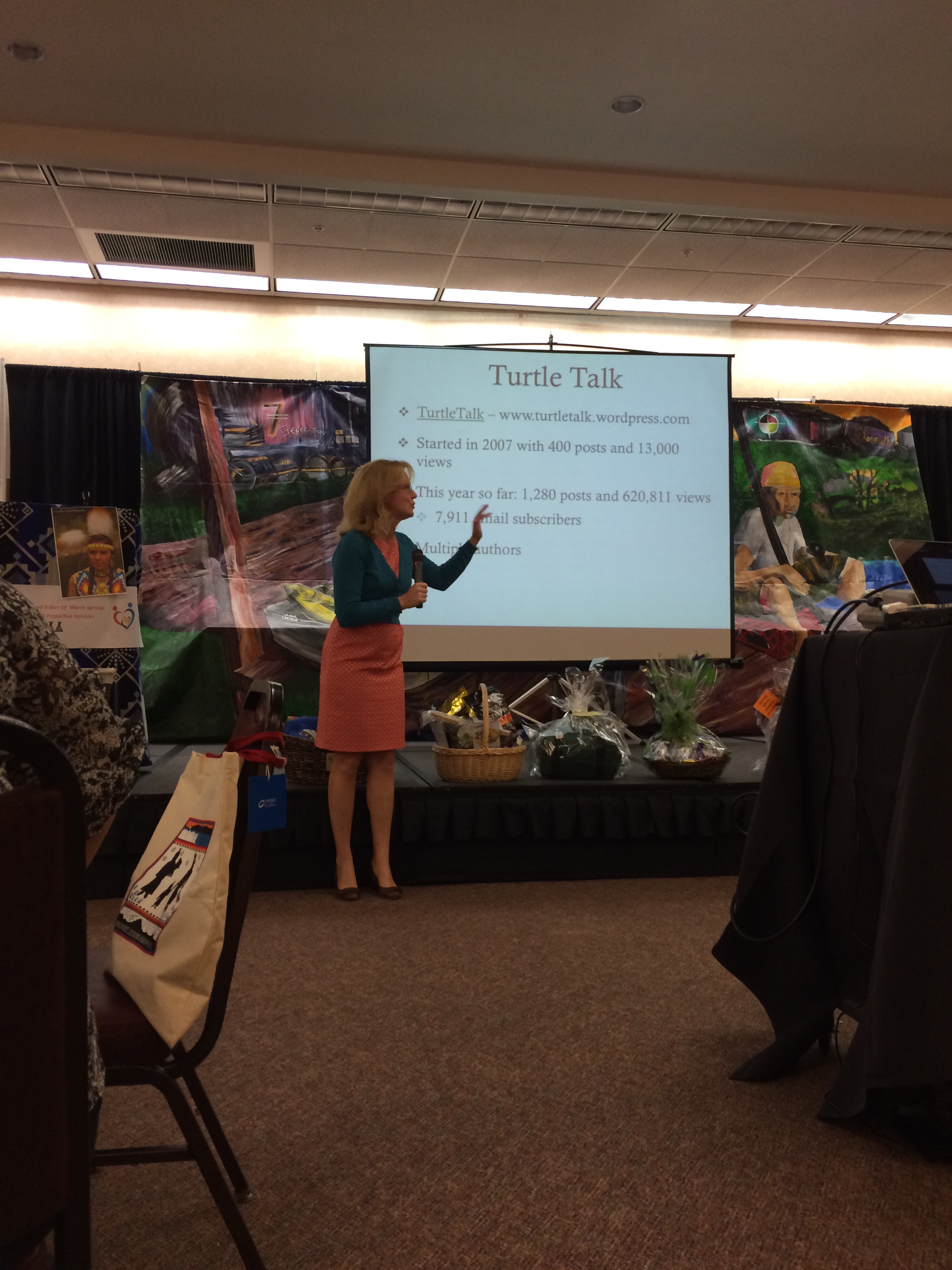
Kate Fort at the 2015 Oregon Tribal/State ICWA Conference

Here’s a picture on Turtle Talk of Kate Fort speaking about Turtle Talk at the 2015 Oregon Tribal/State ICWA Conference. Kate is a regular presenter at ICWA conferences around the country, but this may be the first time she’s presented about the blog specifically at one of these conferences.

Thanks Addie S for sending along the picture!

Fort Oregon


Michigan Tribal ICWA Attorneys Meeting

The second annual! A great opportunity for all of the attorneys who represent tribes in ICWA cases to get together and share information and develop relationships.

IMG_6467

DOJ Prevails in Partial Motion for Summary Judgment in NCFA v. Jewell (Guidelines Litigation)

Order was issued on September 29th, but the Memorandum Opinion was issued today.

This Court DENIES Plaintiffs’ for Partial Summary Judgment because (1) Plaintiffs lack standing to challenge the 2015 Guidelines, (2) the 2015 Guidelines are not “final agency action” within the meaning of the APA because they do not create legal rights and obligations, and (3) the 2015 Guidelines are non-binding interpretive rules not subject to APA notice-and-comment procedures.

Previous filings are here.

Federal ICWA Cases Update Memo

We originally posted this when the first three lawsuits were filed. There have been two additional ones since then. Here is the memo with the most recent updates.

The National Indian Child Welfare Association (NICWA), the Native American Rights Fund (NARF), the National Congress of American Indians (NCAI), and the ICWA Appellate Project at Michigan State University College of Law—collectively known as the ICWA Defense Project—are working collaboratively to defend ICWA and the long overdue reforms to it introduced this year. This memo will summarize the pending litigation and describe some of the legal and communications strategies these partner organizations have developed to inform, advance, and unify a coordinated effort across Indian Country to respond to these attacks.

Here is a link to the page where we are keeping all of the PACER documents.

Wall Street Journal Article on ICWA Lawsuits

Here.

PDF copy here.

From the end of the article:

An Interior spokeswoman said Congress has determined it “is in the best interests of an Indian child to keep that child…with the child’s parents,” extended family and tribal community.

Kathryn Fort, a lawyer with the Indigenous Law and Policy Center at Michigan State University, defends the law and the guidelines. Ms. Fort said that before the law was passed, social workers would argue that it was in the “best interests” of an Indian child to be permanently removed from a house that was merely messy or lacked the most modern conveniences. “It’s really a way of allowing—and perpetuating—discrimination against Indians,” she said.

Supporters of the law say the adoption delays often required are part of its point. The law “demands excellence in how we treat Indian children,” said Matthew Newman, a staff attorney for the Native American Rights Fund. “That often requires a bit of time.”

New Short Film on Maine Truth and Reconciliation Commission

Here.

Lots of good information here.

Press coverage here.

The longer movie is due out in 2017, but it’s very nice to have this short film and supporting website available now as an antidote to all of the Goldwater blitz.

Government Affairs Attorney Position at NICWA

Here.

The government affairs staff attorney of the National Indian Child Welfare Association (NICWA) is responsible for assisting American Indian and Alaska Native (AI/AN) communities, children, and families in their efforts to improve public policy at all levels to support effective services for and the general well-being of AI/AN children and families

And yes, this is the great Addie Smith’s position. She was appointed by the Governor of Oregon to administer the Child Dependency Task Force created by SB 222. Press release here.

Additional Findings from NNI/NICWA on Tribal Child Welfare Codes

Here.

Researchers reviewed 107 publicly available, tribal child welfare codes for U.S.-based tribes with populations ranging from 50 to 18,000 citizens. Researchers sought out the most up-to-date tribal child welfare codes available for each tribe, reporting that approximately 45% of the 107 codes were amended after 2000. The research team analyzed over 100 variables on the topics of culture, jurisdiction, tribal-state relationships, child abuse reporting, paternity, foster care, termination of parental rights, and adoption. A more detailed report on this study will be released later this fall. For more information about this project and its findings please contact the Native Nations Institute: Mary Beth Jäger (Citizen Potawatomi) jager@email.arizona.edu.

Cool poster here. First cool poster here.

DOJ Motion for Summary Judgment and National Orgs Amicus Brief Filed in Guidelines Litigation

Latest filings in Nat’l Council for Adoption v. Jewell:

DOJ Memorandum for Summary Judgment

A favorite footnote (5 is good too):

10 Finally, BAF does not elaborate as to why placement with an Indian child’s family or tribe could not also be “loving,” and its silence is telling. ICWA was designed as a remedy for precisely this type of bias: the stereotype held by some child-welfare advocates that Indian children will be better off placed with a non-Indian family. See Miss. Band of Choctaw Indians v. Holyfield, 490 U.S. 30, 37 (reiterating that Congress feared that application of a “white, middleclass standard” will, “in many cases, foreclose[] placement with [an] Indian family”). BAF’s misguided view is, at best, an “abstract concern” that is insufficient to create standing. See Lane, 703 F.3d at 675 (citing Simon, 426 U.S. at 40).

National Organizations (NCAI, NICWA, AAIA) Amicus Brief in Support