Blake Watson on the Doctrine of Discovery and the Elusive Definition of Indian Title

Blake Watson has posted his paper, “The Doctrine of Discovery and the Elusive Definition of Indian Title,” on SSRN. It is forthcoming in the Lewis & Clark Law Review.

Here is the abstract:

This article contends that, pursuant to the discovery doctrine developed and adopted by the U.S. Supreme Court, Indian tribes retained possession of their lands after European encounter, but no longer owned their land and no longer held unlimited disposition rights. This “limited possessor” definition of Indian title is particularly difficult to justify in view of contemporary norms of international indigenous rights, and should be rejected along with the doctrine of discovery.

Wash. State Bar News Piece on Chief Leschi and Gov. Stevens

Here, starting on page 19.

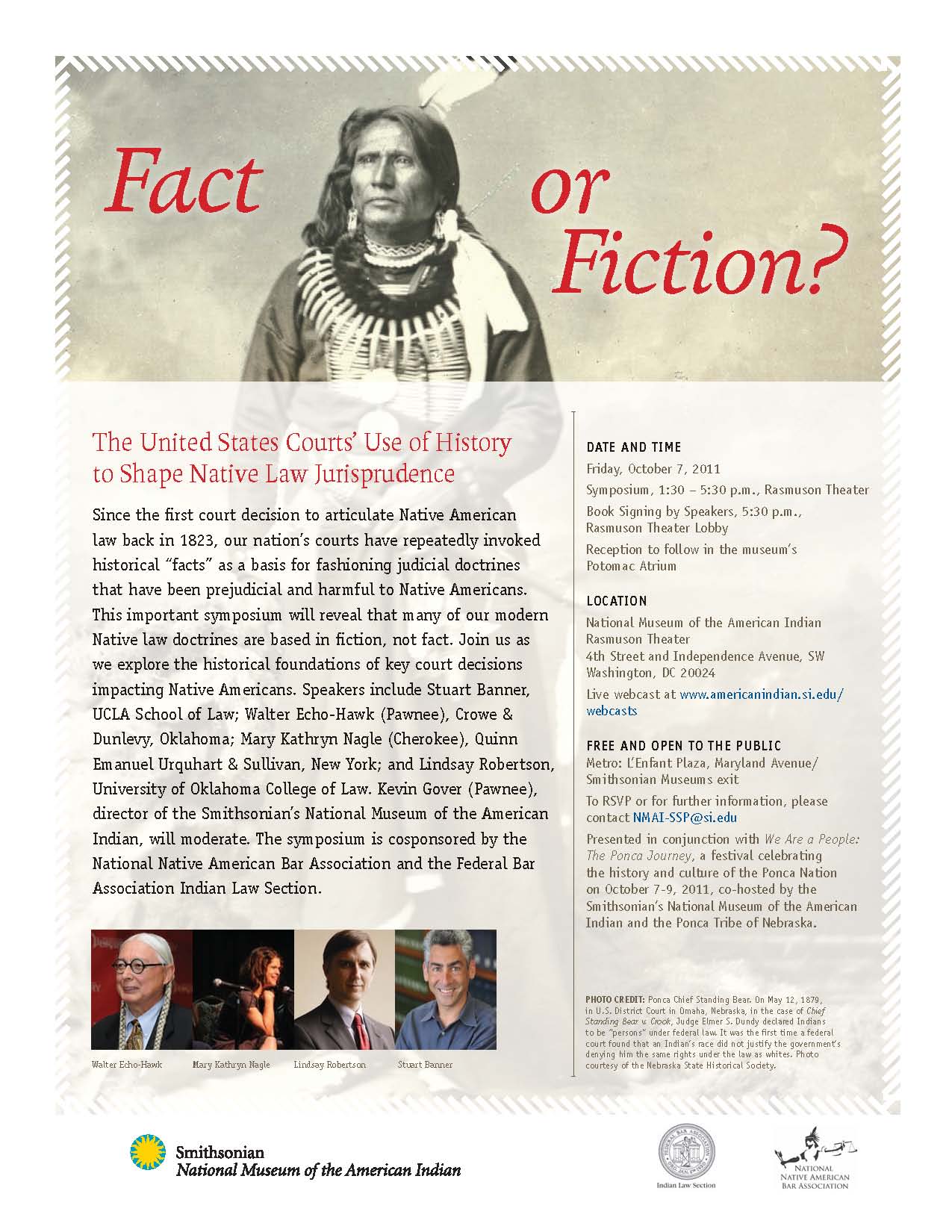
NMAI “Fact or Fiction” Meeting — October 7, 2011

Michael Blumm on Why Aboriginal Title is Fee Simple Absolute

Michael Blumm has posted a paper with the title, “Why Aboriginal Title is Fee Simple Absolute” on SSRN. It is forthcoming in the Lewis & Clark Law Review.

Here is the abstract:

The Supreme Court’s 1823 decision in Johnson v. M’Intosh is a foundation case in both Indian Law and American Property Law. But the case is one of the most misunderstood decisions in Anglo-American law. Often cited for the propositions of the plenary power of the U.S. Congress over Indian tribes and the uncompensated takings of Indian title lands, the Marshall Court decision actually is better interpreted to recognize that Indian tribes had fee simple absolute to their ancestral lands. This article explains why the “discovery doctrine” should have been interpreted to be a fee simple absolute subject to the federal government’s right of preemption. Had the doctrinel laid down by Johnson been properly interpreted, its national and international effects today would have been much less pernicious.

SCIA Hearing on the 75th Anniversary of the Indian Reorganization Act (Prepared Materials)

Here.

Panel #  1

Professor Frederick E. Hoxie
Swanlund Chair and Professor of History
University of Illinois

written materials

Professor William Rice
Associate Professor of Law
University of Tulsa, College of Law

written materials

Professor Carole E. Goldberg
Jonathan D. Varat Professor of Law
UCLA School of Law

written materials

Panel #  2

Mr. Steven Heeley
Consultant
Akin Gump Strauss Hauer & Feld, LLP

written materials

Professor Richard Monette
Associate Professor of Law
University of Wisconsin Law School

written materials

Panel #  3

Mr. John E. Echohawk
Executive Director
Native American Rights Fund

written materials

The Honorable Jefferson Keel
President
National Congress of American Indians

written materials

The Honorable Michael O. Finley
Chairman
Confederation Tribes of the Colville Reservation

written materials

Article on Tribes and Self-Defense

For anyone who’s interested, my article, “‘Hostile Indian Tribes . . . Outlaws, Wolves, . . . Bears . . . Grizzlies and Things Like That?’ How the Second Amendment and Supreme Court Precedent Target Tribal Self-Defense,” recently came out in the University of Pennsylvania Journal of Constitutional Law and is now available on Westlaw and Lexis. It examines the legal history of tribes’ and Indians’ right to self-defense (or lack thereof) and right to bear arms and argues that tribes are still being punished for past acts of self-defense.

Justice Breyer and “The Yale Lectures”

Available here, drawing from his book Making Democracy Work.

Here is an excerpt:

After the decision [in Worcester], Justice Joseph Story wrote to his wife: “Thanks be to God, the Court can wash their hands clean of the iniquity of oppressing the Indians and disregarding their rights.” A few days later, he wrote to another
correspondent: “The Court has done its duty. Let the Nation now do theirs.” Story added: “Georgia is full of anger and violence. . . . Probably she will resist . . . , and if she does, I do not believe the President will interfere . . . .”

And that is just what happened. Georgia said it would resist the decision as a “usurpation” of power. And this is the case about which President Andrew Jackson supposedly said, “John Marshall has made his decision, now let him enforce it.”
The President considered he had as good a right as the Court to decide what the Constitution meant and how it should be enforced. Worcester stayed in jail. John Marshall wrote to Story: “I yield slowly and reluctantly to the conviction that our Constitution cannot last.”

What was wrong with Jackson’s position? The President soon found out. South Carolina, noticing what Georgia could do, decided it would follow suit— but in respect to federal taxes. It passed a law prohibiting the payment of federal customs duties. And Jackson then began to realize the threat to the Union inherent in the principle. He quickly obtained a “force bill” from Congress, authorizing him to send troops to South Carolina. And South Carolina withdrew its law. The press began to write about Georgia and the Cherokees: how did Georgia and Worcester differ from South Carolina and taxes? And Georgia began to back down. It reached an agreement with Worcester, releasing him from jail. And so the Court’s order was ultimately enforced. Or was it?

There is no happy ending here. Jackson sent troops to Georgia, but not to enforce the Court’s decision or to secure the Indians their lands. To the contrary, he sent federal troops to evict the Indians. He found a handful of Cherokees willing to sign a treaty requiring departure; he ignored 17,000 other Cherokees who protested that they would die rather than agree to go; and he forced the tribe to move to Oklahoma, walking there along the Trail of Tears, so-called because so many Cherokees died along the way. Their descendants live in Oklahoma to this day.

This episode suggests a negative answer to Hotspur’s question. The Court may follow the law—even in an unpopular matter. But that does not matter very much. Force, not law, will prevail. The summoned “spirits” will not come.

Sam Morison on the Seminoles, Andrew Jackson, and American Military Justice

Samuel T. Morison has posted History and Tradition in American Military Justice on SSRN, at at.  It is forthcoming this fall in the Univ. of Penn. Journal of Int’l Law.  Here’s the abstract:

At present, there are two military commission cases involving terrorism defendants incarcerated at Guantánamo Bay making their way through the appellate courts. In both cases, the defendants are challenging their convictions for “providing material support for terrorism.” While this is a federal offense that could be prosecuted in an Article III court, the legal issue in these appeals is whether providing material support is also a war crime subject to the jurisdiction of a military tribunal. Congress incorporated the offense into the Military Commissions Act, but that is not dispositive, since it is arguably beyond Congress’ legislative competence to create war crimes out of whole cloth and then impose them on foreign nationals having no jurisdictional nexus to the United States.

As a result, the Government has not disputed that there must be at least some historical evidence that the conduct now styled “providing material support” to an enemy previously has been treated as a war crime, where the defendant was a non-resident alien who owed no duty of allegiance to the injured State. In what might be fairly described as a desperate attempt to discharge its burden of persuasion, the Government has now embraced the only “precedent” that comes close to fitting this description. This is problematic, however, because it is also one of the most notorious episodes in the history of American military justice.

In 1818, then Major General Andrew Jackson led an armed invasion of Spanish Florida, thereby instigating the First Seminole War. In the course of the conflict, his troops captured two British citizens who had been living in Florida among the Seminole Indians. In his inimitable style, Jackson impetuously ordered the summary trial and execution of these men, allegedly for “inciting” the Seminoles to engage in “savage warfare” against the United States. Worse yet, Jackson’s immediate motivation for the invasion was to recapture fugitive slaves, who had escaped from the adjacent States and found refuge among the Seminoles. In addition to territorial expansion, his mission was to return this “property” to their “rightful” owners and prevent Florida from serving as a safe haven for runaway slaves.

Remarkably, the legal basis of the Government’s assertion of military jurisdiction over material support charges therefore rests on Jackson’s decision to execute two men, who were almost certainly innocent, in the context of a war of aggression waged to vindicate the property rights of antebellum Southern slaveholders. The purpose of this essay is to reintroduce the episode to a wider audience, and to reflect on the implications of the Government’s decision to rely on it as a precedent for a modern war crimes prosecution.
Penn. Law Review Note on Judicial Abolition of Indian Slavery in Virginia

Here is a pdf link to the article, which is titled, “Making Indians “White”: The Judicial Abolition of Native Slavery in Revolutionary Virginia and its Racial Legacy.” Also available on SSRN.

An excerpt:

In 1772, George Mason, later famous as the “Father of the Bill of Rights,” represented a slave named Robin and eleven other enslaved plaintiffs in the General Court of Virginia, the colony’s highest court. The slaves claimed that maternal descent from an American Indian made their enslavement illegal, and Mason marshaled arguments from natural law and statutory history to support that contention. In a terse one-paragraph opinion typical of the era, the court agreed, freeing the plaintiffs and ordering their former master to pay them nominal damages.

Freedom suits were common in colonial Virginia. Although defined as property for almost all legal purposes and denied rights of citizenship, slaves could allege illegal enslavement and sue for their freedom. Courts recognized such claims throughout the slaveholding South from slavery’s seventeenth-century beginnings onward; these suits offered one of the few routes to manumission in early America.

The ordinary posture of the Robin v. Hardaway case, though, belied its extraordinary result. The court’s decision marked a watershed in the legal history of Virginian slavery; it was the first recorded holding of an Anglo-American court that maternal descent from an American Indian alone established the right to freedom. This outcome was remarkable in the context of early America, where, despite present-day conceptions that all slaves were Africans, Indian slavery was ubiquitous. Indian slaves could be found in all thirteen mainland British colonies in 1772, as well as in the French and Spanish colonies of North America. In Virginia alone, thousands of descendants of enslaved Indians toiled alongside African slaves on plantations. Robin v. Hardaway repudiated this history and deemed the previously common institution illegal in all but a few circumstances, inaugurating a line of cases that culminated in 1806. In the end, Virginia courts concluded that enslaved descendants of Native Americans were “prima facie free,” judicially abolishing Indian slavery in Virginia. This precedent spread: throughout the antebellum period, courts in Connecticut, Louisiana, Missouri, New Jersey, South Carolina, and Tennessee all grappled with Virginia’s decisions and debated whether maternal descent from American Indians was sufficient to establish freedom.

Fletcher & Vicaire: “Indian Wars: Old and New”

Matthew Fletcher and Peter Vicaire have posted “Indian Wars: Old and New” on SSRN (download here). This is a paper prepared for the Journal of Gender, Race, and Justice’s 15th Anniversary symposium, “War On … The Fallout of Declaring War on Social Issues.”

Here is the abstract:

This short paper analyzes American history from the modern “wars” on poverty, drugs, and terror from the perspective of American Indians and Indian tribes. These domestic “wars” are aptly named (it turns out), as the United States often blindly pursues broad policy goals without input from tribal interests, and without consideration to the impacts on Indians and tribes. With the possible exception of the “war on poverty,” these domestic wars sweep aside tribal rights, rights that are frequently in conflict with the overarching federal policy goals.

This essay explores three declared domestic wars, and their impacts on American Indian tribes and individual Indians, in loose chronological order, starting with the war on poverty. As Part 1 demonstrates, the Johnson Administration’s Great Society programs helped to bring American Indian policy out of the dark ages of the era of termination, in which Congress had declared that national policy would be to terminate the trust relationship. Part 2 describes the war on drugs, declared by the Reagan Administration, which had unusually stark impacts on reservation communities both in terms of law enforcement, but also on American Indian religious freedom. Part 3 examines the ongoing war on terror, which Bush Administration officials opined has its legal justification grounded in part on the Indian wars of the 19th century. The war on terror marks America’s return to fighting a new Indian war, where the adversary is illusive and motivated, and where the rule of law is literally obliterated.