North Dakota Passes State ICWA Law, Needs Governor’s Signature

Here is a link to the legislative page. The downloaded bill is on the Turtle Talk State ICWA Law Page.

Press coverage here:

Lawmakers voted nearly unanimously this week to pass House Bill 1536, which would weld the crux of the federal Indian Child Welfare Act (ICWA) onto North Dakota’s law books. The bipartisan legislation now goes to Gov. Doug Burgum, whose spokesman did not immediately respond to a request for comment.

ICWA Jurisdiction Case out of the Oklahoma Supreme Court

Here is the opinion

IN THE MATTER OF S.J.W.

This is a truly unfortunate opinion with absurdly weak analysis that extends the reasoning in Castro-Huerta to reservations in Oklahoma for ICWA cases involving non-member Indian children residing on reservation.

So we are all on the same page, 1911(a) of ICWA states:

An Indian tribe shall have jurisdiction exclusive as to any State over any child custody proceeding involving an Indian child who resides or is domiciled within the reservation of such tribe, except where such jurisdiction is otherwise vested in the State by existing Federal law.

(emphasis added)

This case involves the jurisdiction of the Chickasaw Nation tribal court over a Muskogee child. The parents appealed a state child protection case claiming the state did not have jurisdiction over the child after McGirt and the Chickasaw Nation had exclusive jurisdiction. There is, of course, an easy answer to this, which is the Tribes after McGirt all signed 1919 agreements with the State of Oklahoma to ensure continued concurrent jurisdiction post-McGirt when it involves an ICWA case. The Oklahoma Supreme Court would like you to know that this is a “misunderstanding of the construction of 1911(a)” which, frankly, came as a surprise to me and seems to be lacking any legal support, but here we are. 

Instead, the Oklahoma Supreme Court took it upon itself to, for the first time I’ve ever seen, claim that 1911(a) only refers to territorial jurisdiction but not subject matter jurisdiction. In fact, the Court  wrote “Whether § 1911’s ‘jurisdiction’ means ‘subject matter jurisdiction’ has received little attention, but requires our review.” I mean, I really don’t think it did, but here we are. Again. 

In doing so, the  Court decided that Castro-Huerta, involving the prosecution of non-Indians on reservation, is broad enough to hold that the state courts have subject matter jurisdiction over tribal reservations for . . . all the things?

When federal Indian law issues arise, we must take special care to determine if federal law preempts or ousts the state of its general adjudicative authority. Id. When determining jurisdictional disputes for cases arising within the external boundaries of a reservation, we must remember that Oklahoma’s sovereignty does not stop at reservation borders. Castro-Huerta, 597 U.S. at ___, 142 S. Ct. at 2488. The U.S. Constitution authorizes Oklahoma district courts to exercise jurisdiction in Indian country–Oklahoma’s territory includes “Indian country.” Id. at 2493.

Indian country is part of the State, not separate from the State. To be sure, under [the United States Supreme Court’s] precedents, federal law may preempt that state jurisdiction in certain circumstances. But otherwise, as a matter of state sovereignty, a State has jurisdiction over all of its territory, including Indian country. See U.S. CONST., Amdt. 10.

Id. The general rule is that Oklahoma is “‘entitled to the sovereignty and jurisdiction over all the territory within her limits.'” Id. (citing Lessee of Pollard v. Hagan, 44 U.S. (3 How.) 212, 228, 11 L. Ed 565 (1845)).

The State of Oklahoma by its Constitution has broadly authorized its district courts to exercise subject matter jurisdiction over “all justiciable matters” unless otherwise noted in the Constitution. Okla. Const. art. VII, § 7(a). Adjudicating children deprived surely is a “justiciable matter.” Ibid. While the parties refer to ICWA’s general reference to “jurisdiction” as “subject matter jurisdiction,” we decline to accept this characterization. This is especially so given the presumption of a district court’s general adjudicatory jurisdiction

Therefore, the Court holds that the state has concurrent jurisdiction on reservation over non-member Indian children, because 1911(a) only means tribes have territorial jurisdiction exclusive concurrent as to its members. To be fair, the opinion is fairly confusing, but ultimately states:

When a child appears before a district court judge and is subsequently determined to be a member Indian, the district court maintains subject matter jurisdiction. But the sovereign status of a tribe and its territorial jurisdiction over its members and territory necessitates disposition of the matter in that tribe’s tribal courts because self-governance is implicated. See Holyfield, 34. (Abusive state practices with respect to Indian Children “seriously undercut the tribes’ ability to continue as self-governing communities. Probably in no area is it more important that tribal sovereignty be respected than in an area as socially and culturally determinative as family relationships.” (citations omitted) (quotations omitted). Section 1911’s “jurisdiction” does not concern a district court’s subject matter jurisdiction; it concerns the connection to the forum and to the group of people (tribe). 

I mean, ICWA seems pretty clear that the exclusive jurisdiction is over any child custody proceeding, which feels like subject matter jurisdiction to me, and every court I’ve ever been in front of, but the Oklahoma Supreme Court seems to believes the state maintains subject matter jurisdiction over all child protection proceedings whether on or off reservation. It’s truly fascinating to see the Oklahoma Supreme Court claim that territorial jurisdiction “as a concept of international law, is important for our state . . .”

The Court then holds, without citation, that 1911(a) requires the Indian child to be residing on their own reservation rather than any reservation for exclusive (?) jurisdiction–though it is certainly not clear from the language of the law that is the intent. The Court notes again this question hasn’t been subject to “judicial scrutiny,” which is probably because the language is pretty straightforward and tribal jurisdiction over non-member Indians is noncontroversial. It appears from the last sentence of the opinion that the Chickasaw Court doesn’t have jurisdiction over the non-member Indian child at all.  I guess, here we are. 
 

ICWA Application Case out of Nebraska Supreme Court

Opinion here: N00009406PUB

At Fed Bar this year, I spoke about concerns regarding the definition of an Indian child for the purposes of ICWA when the child is eligible and the parent is a tribal member. This is the third case I’ve seen where there is an argument that a parent’s eligibility should be enough. Unfortunately, this isn’t the definition, and it has been an unsuccessful argument.

We hold that evidence that the tribe “considered” Amber a member for purposes of ICWA is insufficient. The plain language of § 43-1503(8) provides as relevant that an “Indian child” must have a biological parent who is a member of a tribe. The evidence adduced in the juvenile court shows that Amber is not currently a member of the tribe; the children, in turn, do not have a biological parent that is a member of the tribe.

One practice tip may be for tribes to apply for permissive intervention under the state court rules rather than the mandatory intervention under ICWA. This may be compelling for a judge when a parent is in the process of becoming a tribal member–at which point, ICWA would apply moving forward.

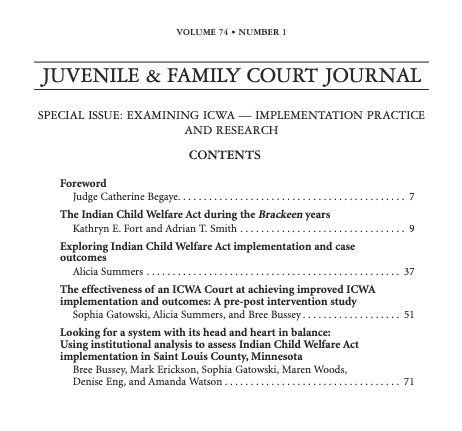
Juvenile and Family Court Journal: Examining ICWA

Screenshot 2023-03-28 at 2.17.17 PM

Here

State ICWA Law Updates (MN, WY)

This week both Minnesota and Wyoming adopted new state ICWA laws.

After nearly a year of dedicated work by stakeholders, including tremendous tribal leadership, Minnesota updated the Minnesota Indian Family Preservation Act.

Minnesota-2023-SF667-Engrossed

In addition, due to tremendous tribal leadership, the state of Wyoming adopted the entire federal ICWA into state law, creating the Wyoming Indian Child Welfare Act. This act was signed into law by the governor yesterday.

Enrolled Wyoming ICWA Bill

I’m getting a lot of calls and emails about state ICWA laws in light of the pending Brackeen case. A good state ICWA law that is specific to the state practices (see Oregon ICWA law or MIFPA as an example) can take months to complete, especially to ensure participation by all stakeholders, including tribal, parental, and state interests. Until Brackeen is released, it is very difficult to preemptively legislate, or legislate in a way that protects ICWA from the Court’s ruling. However, for states that have no state ICWA laws, if there is the political will to follow the Wyoming lead of incorporating the entire federal law into state law, this would be beneficial if the Court rules that ICWA violates commandeering concerns (ie. states can’t be forced to follow ICWA because it is federal law commandeering their agencies). 

But it is important to remember that the Court can rule in a myriad of ways, there is no way to predict the outcome, and it is entirely possible that states will have to revisit their state laws in light of the decision–even those that replicate ICWA. I particularly like the Wyoming model of also passing a law creating *and funding* a taskforce to develop a state specific ICWA as well. 

We keep state ICWA laws here: https://turtletalk.blog/icwa/comprehensive-state-icwa-laws/.

U.S. Senator Instrumental to ICWA Has Passed Away

https://www.washingtonpost.com/obituaries/2023/02/24/james-abourezk-senator-dakota-dies/

Senator James Abourezk passed away on Friday. He was 92 years old. He was the first chair of the Senate Committee on Indian Affairs. In that role, he was the lead Senator pushing for ICWA, and held hearings for over three years, taking testimony on what was happening to Native families across the country.  He sponsored S.1214,  the Senate bill that led to the House bill which became ICWA. He held the 1974 Hearings, as well as the 1977 and 1978 Hearings.  NARF has collected his letters, where he expressed unreserved support for Native children, families, and tribes. Here is the opening paragraph of one of his letters on the eve of voting:

Throughout the course of this legislation the authors of this bill have been charged with having placed the interests of Indian tribes and the parents of Indian children above the interests of the child itself. I have always rejected this charge. The central concern of this legislation is the welfare of Indian children. Both the Senate and the House version are based on the assumption and indeed the finding that the interests of Indian children are best served by preserving their relationship with their natural family whenever possible, and when that is not possible, placing them with a family or in a setting which shares their own cultural values and heritage.

ICWA was a result of the hard work of so many people, but Senator Abourezk was instrumental in not only its passage, but in preserving the testimony of Native parents, leaders, and elders about the time before ICWA. His kindness to those who were testifying about horrible treatment they received is evident in the record, as was his indignation at that treatment. He did all of this in a single term in the Senate, and was also instrumental in ISDEAA and AIRFA. From the Washington Post:

Mr. Abourezk represented South Dakota for single terms in the U.S. House and U.S. Senate during the 1970s, where he exemplified a brand of Democratic politician known as Prairie Populist. He fought passionately — and with humor — for those he felt were the downtrodden: farmers, consumers and Native American people.

Mr. Abourezk was the first chair of the Senate Committee on Indian Affairs and successfully pressed for the American Indian Policy Review Commission. It produced a comprehensive review of federal policy with American Indian tribes and sparked the Indian Self-Determination and Education Assistance Act, the American Indian Religious Freedom Act and the Indian Child Welfare Act — a landmark piece of legislation meant to cut down on the alarming rate at which Native American children were taken from their homes and placed with White families.

I never got to meet the Senator, but it is still very difficult for me to put into words the impact of his single Senate term. I can’t help but think that his leadership in the Senate, with his unreserved support for Native families and tribes, is especially needed now.

News on Proposed State ICWA Laws

Over the past few weeks, a number of states have been considering state ICWA laws. I’m keeping the bills updated here, along with their current status when I’m notified of it. https://turtletalk.blog/icwa/comprehensive-state-icwa-laws/

Today the AP had news coverage of the bills here

Finally, here is a link to the testimony that took place yesterday in the Minnesota Senate.

This bill is supported by the ICWA Law Center, one of the only organizations that provides direct, trial level legal services to Native families, and they do it very well. They are currently holding a fundraiser with Heart Berry:

And listen, I’m not responsible if you follow that link and then get sucked into buying a whole bunch of stuff from Heart Berry because it’s basically impossible not to. I don’t make the rules.

Fort & Smith on ICWA During the Brackeen Years

Forthcoming in the Juvenile & Family Court Journal

From 2017 through 2022, while the Indian Child Welfare Act (“ICWA”) was under direct constitutional attack from Texas, state courts around the country continued hearing appeals on ICWA with virtually no regard for the decision making happening in Haaland v. Brackeen in the federal courts. For practitioners following or working on both sets of cases, this duality felt surreal, as they practiced their daily work under an existential threat. The data in this article draws from the authors’ previous publications providing annual updates on ICWA appeals, and now includes cases through 2021. It provides a description of appellate data trends across this time period, as well as for each year, while also highlighting key appellate decisions from jurisdictions across the country. Perhaps what this article demonstrates more than any single thing is the amount that ICWA is a part of child welfare practitioners’ daily lives now, in a way that will be difficult to upend, regardless of the Supreme Court’s ultimate decision.

This is particularly recommended for practitioners–we’ve taken the data from all our past articles to put them into one. One of our charts still needs a labels fix from our data expert, Alicia Summers, but otherwise the article has undergone peer review and will be published soon.

Application of ICWA to Third Party Custody Petition out of Montana

2023-da-22-0405

The Court agreed that ICWA applied to a third party custody petition where the parent could not get her child back upon demand, but rejected the argument the child must be returned immediately under 1920.

These type of third party cases are particularly important to keep an eye on, as agencies often push cases in this direction to avoid filing a petition on a parent (this itself is a complicated topic). Regardless, parents and tribes shouldn’t lose certain rights under ICWA if the placement meets the definition of a foster care placement under the law.