Troubling reasoning that if the Tribe did not ask for nor provide a placement, the court did not have to abide by ICWA placement preferences.
Here.
Troubling reasoning that if the Tribe did not ask for nor provide a placement, the court did not have to abide by ICWA placement preferences.
Here.
Information and schedule here.
The University of Montana Native American Law Students Association will present Indian Law Week Monday through Friday, April 14-18. Short sessions related to Native American law topics will be held Monday through Wednesday on campus, and the all-day Indian Child Welfare Act Conference will be held Thursday and Friday at the Wingate by Wyndham Hotel, located at 5252 Airway Blvd. in Missoula.
All events are free and open to the public unless otherwise noted.
For the first time ever the National Indian Child Welfare Association’s Annual Protecting Our Children Conference will be offering CLE’s to participants. We have applied for CLEs in Minnesota and Oregon and many state offer reciprocal CLEs. Also, we will have information about how to apply to CLEs in all states. The 32nd Annual Conference is being held in Fort Lauderdale, Florida April 13–16. For more information about our conference visit http://www.nicwa.org/conference.
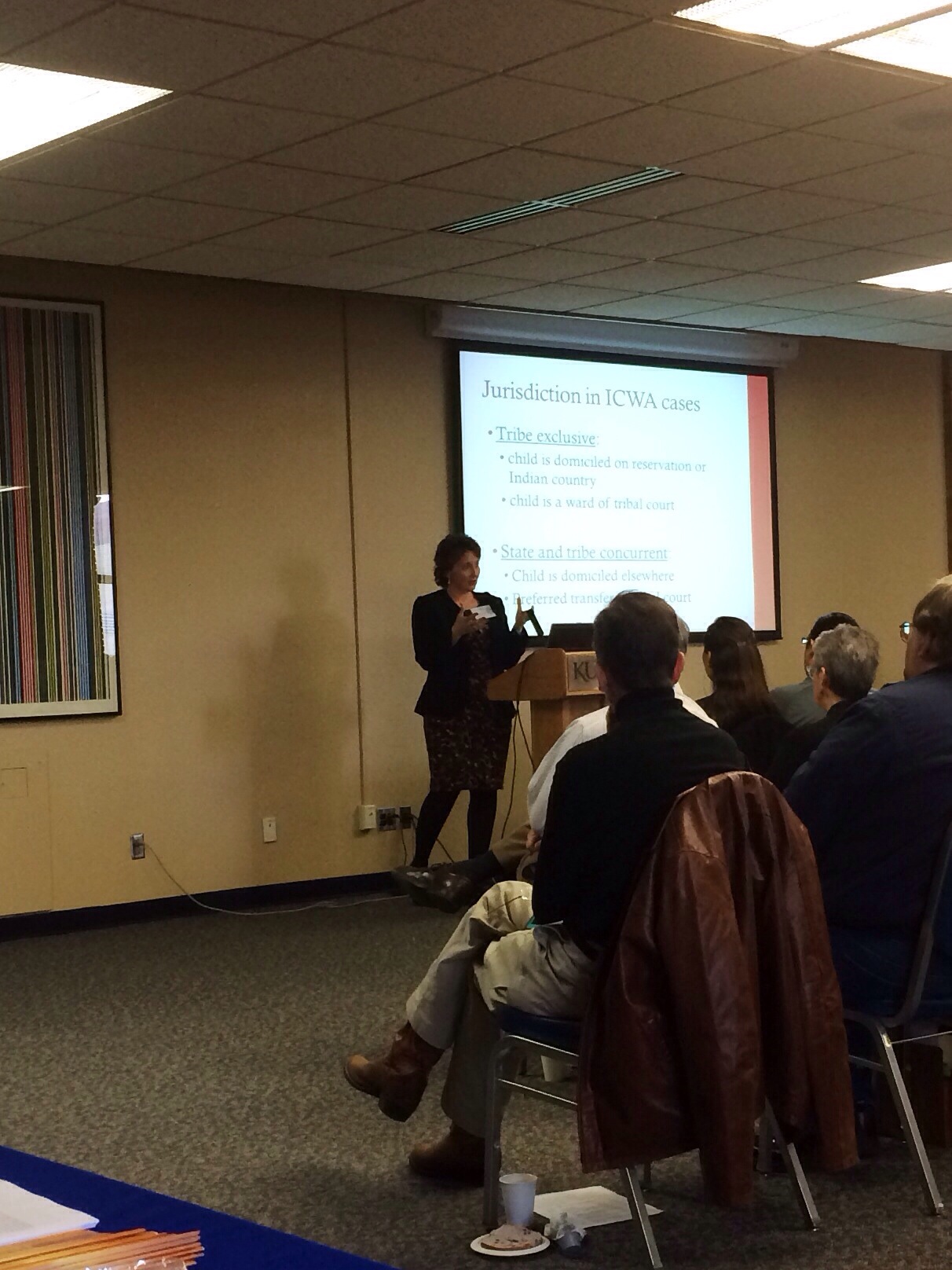
18th Annual Tribal Law & Government Conference today.
| 9:00-9:15 | Welcome Remarks Dean Stephen Mazza, KU Law Professor Elizabeth Kronk Warner, Director, KU Tribal Law & Government Center |
| 9:15-10:15 | Indian Child Welfare Act: Its Origins and Application (PDF) Dean Stacy Leeds, University of Arkansas School of Law Moderator: Burton Warrington, President and CEO of Prairie Band LLC |
| 10:15-10:30 | Break |
| 10:30-12:00 | Adoptive Couple v. Baby Girl: The Arguments, The Decision and Potential Implications Mark Fiddler, Mark Fiddler Law Office (PDF) Chrissi Nimmo, Assistant Attorney General of the Cherokee Nation (PDF) Moderator: Professor Elizabeth Kronk Warner, Director, KU Tribal Law & Government Center |
| 12:15-1:15 | Lunch, Gridiron Room, Burge Union |
| 1:30-3:00 | The Future of ICWA Russ Brien, Brien Law LLC (PDF) Vivien Olsen, Attorney with the Prairie Band Potawatomi Nation (PDF) Professor Colette Routel, William Mitchell College of Law |
| 3:00-3:15 | Break |
| 3:15-4:15 | Ethical Considerations Related to ICWA Professor Kate Fort, Michigan State University College of Law (PDF) Moderator: Rebecca Howlett, KU Law Student and KU NALSA Member |
| 4:15 | Closing Remarks |
Here.
The NCJFCJ is committed to helping state courts achieve full ICWA compliance. A new resource is now available to the courts (or Court Improvement Programs) to help achieve this goal. Measuring Compliance with the Indian Child Welfare Act: An Assessment Toolkit, provides concrete tools and recommendations for the state courts to assess their current compliance with ICWA. The Toolkit identifies strengths and weaknesses of different data collection approaches, provides sample tools or questions for the sites, and identifies resources and examples of putting this into practice. If you have any questions or would like additional information about measuring ICWA compliance in your jurisdiction, you can e-mail the research team at research@ncjfcj.org.
Here.
RSVP here.
Department of Human Services, Native American Affairs &
Tribal Services: How We Work Together to Improve Lives
March 12th
– Stacey Tadgerson, Director of the Office of Native
American Affairs, Michigan Department of Human Services (DHS)
Congress enacted the Indian Child Welfare Act (ICWA) to eliminate the
wholesale state removal of abused/neglected Indian children from their tribes
and culture. Participants in this session will learn about the history of ICWA,
Native American Affairs, and resources available to youth in care, tribal
governments, and urban Indian organizations from the DHS that will assist
tribal youth in becoming self-sufficient while reaching for their dreams.
Baby Veronica & Inside the Michigan Indian Family
Preservation Act – April 2nd
– Kate Fort, Staff Attorney and Adjunct
Professor – MSU Indigenous Law & Policy Center
The United States Supreme Court decided only the second case on the
Indian Child Welfare Act since its passage. This presentation will give the
basic facts and holding of the case, as well as its potential implications for
ICWA cases in the future. It will also address the way the Michigan Indian
Family Preservation Act helps to limit the application of the Baby Girl case.
Making Smart Choices for Health Insurance – April 16th
–
Brenda Long, Educator – MSU Extension
To help people navigate the complex and confusing health insurance
landscape, MSU Extension is teaching people how to take control of their
health insurance situation through webinars and in-person presentations.
Those who participate will be able to analyze their insurance needs, learn
important terms and concepts, compare health insurance plans, and figure
out what fits in their budget. People will also become more confident
Here.
We acknowledge that there was an effort to comply with the notice requirements. On October 14, 2011, petitioner sent a notification for each child, identifying the children’s tribal affiliation as Sault Ste. Marie Tribe of Chippewa and/or Blackfoot, to respondents, the Sault Ste. Marie Tribe of Chippewa, and the Midwest Bureau of Indian Affairs in Fort Snelling, Minnesota. The notices state that they were sent by registered mail, return receipt requested. However, there is no return receipt in the record before us.
Here.
With some troubling language, given this was an abuse and neglect case:
fn 4
In this appeal, the parties have not directly addressed whether respondent father ever had “custody” of the children, or whether respondent father is part of an “Indian family” within the meaning of ICWA or MIFPA. For purposes of this appeal only, we assume that respondent father was a parent from whose custody the Indian children were removed, within the meaning of 25 USC 1914 and MCL 712B.39. We further assume that mother, respondent father, and the children comprise an “Indian family” within the meaning of ICWA and MIFPA. Cf. In re SD, 236 Mich App 240, 244; 599 NW2d 772 (1999) (holding that no “active efforts” were required when the family had already been broken up at the time the proceedings began); Adoptive Couple v Baby Girl, ___ US ___; 133 S Ct 2552, 2563-2564; 186 L Ed 2d 729 (2013) (same).
Here.
Here, respondent-father indicated to the referee that his great-grandmother was a member of the “Blackfoot” tribe. Although petitioner argues that there is no such tribe as “Blackfoot,” the BIA’s list of federally recognized Indian tribes includes “the Blackfeet Tribe of the Blackfeet Indian Reservation of Montana.” See http://www.ncsl.org/research/state-tribal-institute/list-of- federal-and-state-recognized-tribes.aspx (last visited December 30, 2013). Respondent-father points out that the name “Blackfoot” was used by the federal government in the Treaty with the Blackfeet of 1855, which recognized the existence of a Blackfoot Tribe and Blackfoot Nation. See Treaty with the Blackfeet, 11 Stat 657 (October 17, 1855). Thus, mindful of our Supreme Court’s statement that “[i]f there must be error in determining whether tribal notice is required, let it be on the side of caution[,]” Morris, 491 Mich at 108, we hold that respondent-father provided sufficient indicia of Indian heritage to the trial court to require tribal notice. If the identity of the tribe is uncertain, 25 USC § 1912(a) allows notice to be given to the Secretary of the Interior. Here, the record does not indicate that any notice was given.
***
We therefore conditionally reverse the trial court’s termination of respondent-father’s parental rights, and remand to the trial court for resolution of the notice issue. On remand, the trial court shall ensure that notice is properly made to the appropriate entities. If the children are not Indian children or the properly noticed tribes or government entities do not respond within the allotted time, the trial court’s termination of respondent-father’s parental rights is reinstated. If, however, the trial court concludes that the ICWA does apply to the proceedings, the trial court’s termination of respondent-father’s parental rights to his four children must be vacated and proceedings begun anew in compliance with the procedural and substantive requirements of the ICWA.
 Turtle Talk
You must be logged in to post a comment.