Michigan Court of Appeals Opinion on MIFPA and ICWA Notice

The Michigan COA interpreted In re Morris to require a conditional reversal when the parent asserted that his grandmothers were Native and:

It is unclear from the record exactly how or why the caseworker came to the conclusion, reflected in the case service plans, that the minor child is not an Indian child for purposes of 25 USC 1912(a); some elaboration would have been appropriate given the father’s assertion. There is no indication that an inquiry or investigation was made specifically with respect to the father’s claim made at the preliminary hearing, nor an explanation in regard to why the father’s claim was being discounted, assuming it was evaluated or pondered in the first place, such that the ICWA notice requirement was not triggered. Of special concern to us is that the initial case service plan, in its summarization of the trial court’s preliminary hearing order, made no mention of the court’s command that the caseworker “make necessary inquiry and/or notification as to possible Native American Indian heritage.” Furthermore, there is no clear confirmation by the court itself that its initial concerns of whether the child is an Indian child were alleviated. Moreover, the father’s assertion concerning the Native American heritage of the minor child’s paternal great-grandparents fits within the parameters of the examples given by the Morris Court, quoted above, that would trigger the need to serve notice. Morris, 491 Mich at 108 n 18. Finally, petitioner itself concedes that conditional reversal is necessary in order to determine whether the minor child is an Indian child under the law.

Opinion here.
Michigan Supreme Court Rejects One Parent Doctrine as Unconstitutional

This case will have broad ramifications for child welfare cases. This is a huge victory for parents and families. While not mentioned in this opinion, this case was also an ICWA case.

Opinion, written by Justice McCormack, here.

At issue in this case is the constitutionality of Michigan’s one-parent doctrine. The one-parent doctrine permits a court to interfere with a parent’s right to direct the care, custody, and control of the children solely because the other parent is unfit, without any determination that he or she is also unfit. In other words, the one-parent doctrine essentially imposes joint and several liability on both parents, potentially divesting either of custody, on the basis of the unfitness of one. Merely describing the doctrine foreshadows its constitutional weakness.

***

Because the jurisdictional inquiry is focused on the child, once there has been an adjudication, either by trial or by plea, the court has jurisdiction over the child regardless of whether one or both parents have been adjudicated unfit. MCL 712A.2(b). In cases in which jurisdiction has been established by adjudication of only one parent, the one-parent doctrine allows the court to then enter dispositional orders affecting the parental rights of both parents.

***

Because application of the one-parent doctrine impermissibly infringes the fundamental rights of unadjudicated parents without providing adequate process, we hold that it is unconstitutional under the Due Process Clause of the Fourteenth Amendment.

Utah Appeals Court Denies Transfer to Tribal Court

Granted, it’s a strange and short decision about voluntary relinquishment. But we post it as another example of what state courts do when a tribe allows a case to go forward in state court and then moves to transfer at a later date.

After monitoring the case for approximately one year, the Tribe filed a motion to transfer the case to its tribal court. In response to the motion, the juvenile court found that good cause existed not to transfer jurisdiction to the tribal court due primarily to the fact that the case was in an advanced stage of litigation and all relevant witnesses resided in Utah.

Opinion here.

Nebraska Court of Appeals: Active Efforts Required When Children Under State Jurisdiction are In Parental Home

Opinion here.

Case law in this state has clearly established that the active efforts standard in this section requires more than the reason- able efforts standard that applies in cases not involving ICWA. See, In re Interest of Walter W., 274 Neb. 859, 744 N.W.2d 55 (2008); In re Interest of Ramon N., 18 Neb. App. 574, 789 N.W.2d 272 (2010). See, also, Neb. Rev. Stat. § 43-292(6) (Cum. Supp. 2012).
The question presented to us in this case is whether ICWA’s active efforts standard applies when the State, through DHHS, has legal custody of the children, but the children are placed in the parental home. Nebraska appellate courts have not spe- cifically addressed this question. David argues that case law from other jurisdictions should lead this court to conclude that ICWA’s protections are applicable at all stages of a juvenile court proceeding.

***

In reaching the conclusion that active efforts should be pro- vided during periods that placement of the children is with the parent or parents, we recognize that the active efforts required may certainly be different from those required during a period of removal from the home. As discussed by the Nebraska Supreme Court in In re Interest of Walter W., 274 Neb. 859, 744 N.W.2d 55 (2008), the active efforts standard requires a case-by-case analysis. See, e.g., In re Interest of Louis S. et al., supra (where further rehabilitative efforts would be futile, requirement of active efforts is satisfied); T.F. v. State, Dept. of H & S Services, 26 P.3d 1089 (Alaska 2001); People ex rel. D.G., 679 N.W.2d 497 (S.D. 2004); In re Cari B., 327 Ill. App. 3d 743, 763 N.E.2d 917, 261 Ill. Dec. 668 (2002) (degree of active efforts required to prevent Indian familial breakup reduced by parent’s incarceration).

Comments on the BIA Guidelines from AAIA, NICWA, NARF, NCAI, and Indian Law Professors

The comments are in response to the Dear Tribal Leader letter we posted about here.

Here from AAIA, NICWA, NARF, NCAI

Here from Indian law professors.

Here from Craig Dorsay.

News Article on Oglala Sioux Tribe v. Van Hunnik

Here.

While written court orders are obviously important, court transcripts reflect far more what it is like to be a parent in a fast and confusing hearing about your children. Also makes for a strong argument for these to be public hearings rather than confidential ones. It’s far from a complete solution, but sunshine usually helps more than it hurts.

Federal Court Finds No Jurisdiction for Itself in Tribal Guardianship Proceeding

Here.

Section 1914 does not confer jurisdiction upon this court because the guardianship action at issue here was not decided under State law. Rather, Plaintiff is challenging an Indian tribal court’s decision to place an Indian child in foster care. Plaintiff does not allege that the tribal court lacked jurisdiction to make a custody determination or otherwise violated his due process or equal protection rights; rather, he merely alleges that its decision violated the Indian Child Welfare Act. However, the Indian Child Welfare Act, 25 U.S.C. §§ 1901-1963, gives Indian tribes jurisdiction to determine custody of Indian children. See DeMent v. Oglala Sioux Tribal Court, 874 F.2d 510, 514 (8th Cir. 1989). The Indian Child Welfare Act does not confer jurisdiction upon this court to review the propriety of the tribal court’s guardianship decision in this case.

Alaska Supreme Court considers whether Adoptive Couple v. Baby Girl applies to State-initiated child protection proceedings

In June 2013, the Alaska Supreme Court held in Native Village of Tununak v. Dep’t of Health & Soc. Servs (Tununak I) that ICWA implicitly mandates that good cause to deviate from ICWA’s adoptive placement preferences must be proven by clear and convincing evidence, rather than a mere preponderance of the evidence. That opinion is here.

Four days later, the Supreme Court issued its ruling in Adoptive Couple v. Baby Girl.  The adoptive parents in Tununak I asked the Alaska Supreme Court to revise its ruling in light of it, based on their argument that ICWA’s placement preferences do not apply in cases where no other party has formally sought to adopt the child. This argument would extend the Baby Girl decision beyond the realm of voluntary private adoptions like the one at issue in Baby Girl and apply it to state-initiated child protection proceedings involving the removal of a Native child from her custodial parent by state authorities.

The parties and the Native Village of Kotzebue, acting as amicus curiae, filed the following supplemental briefs on the issue in November 2013:

Appellee State of Alaska’s is here:  Tununak – Supplemental Brief of Appellee State of Alaska

Appellees H.S. and K.S.’s (the adoptive couple) is here:  Tununak – Supplemental Brief of Appellees H.S. and K.S. – adoptive couple

Appellant Village of Tununak’s is here:  Tununak – Appellant Village of Tununak’s Supplemental Brief

Amicus Curiae Native Village of Kotzebue’s, prepared by NARF, is here:  Tununak – Brief of Amicus Curiae Native Village of Kotzebue

Oral argument before the Alaska Supreme Court was held on January 14, 2014, and can be viewed here.

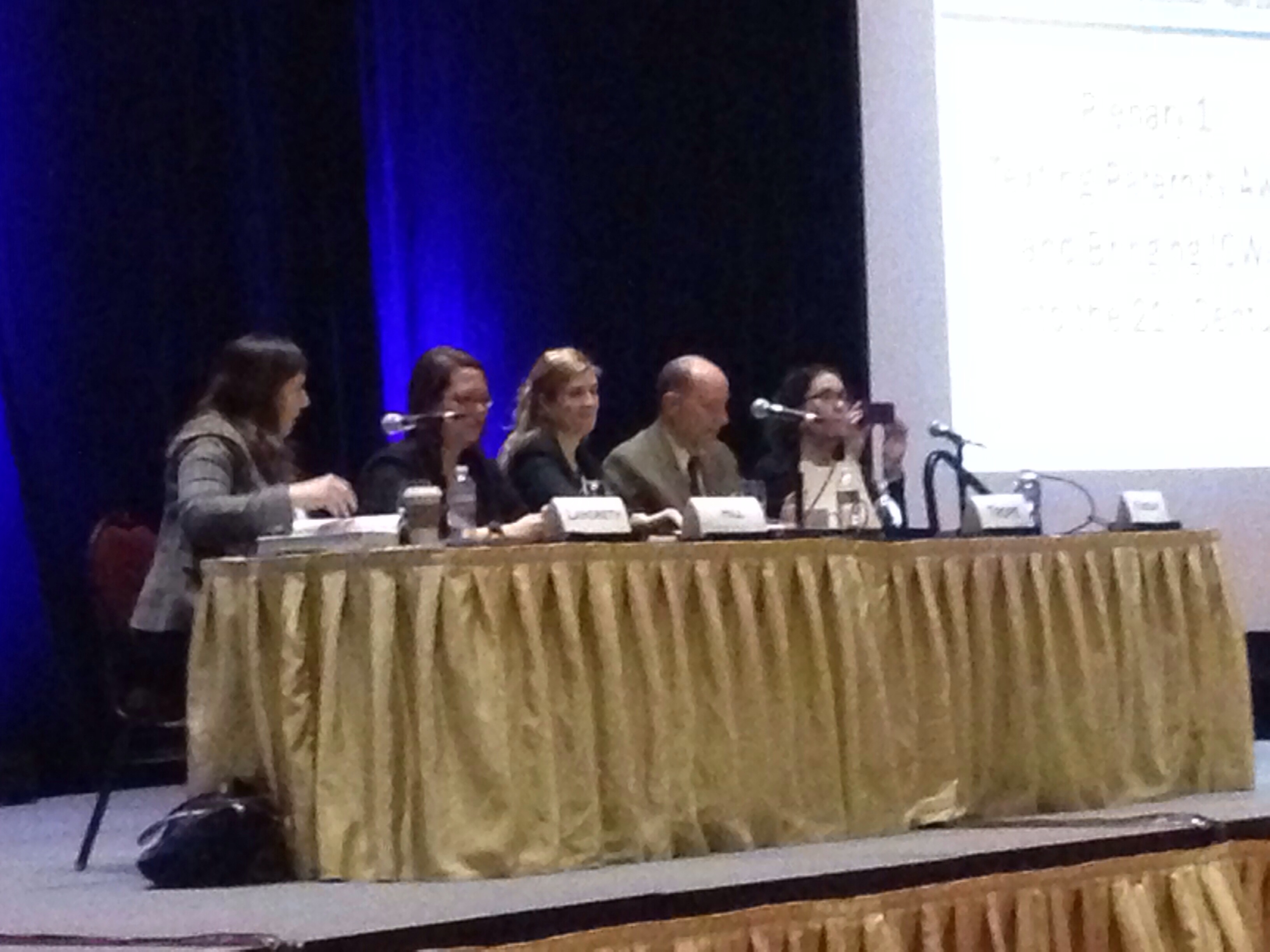
Fed Bar 2014 Panel on ICWA and Adoptive Couple

Nathalie Landreth, Sara Hill, Erin Dougherty, Jack Trope, Anita Fineday

20140410-090126.jpg

Article on Birth Mother in Adoptive Couple Case Dropping Federal Suit

Here.

In a statement Tuesday, Cherokee Nation Assistant Attorney General Chrissi Ross Nimmo said officials did not actively follow the suit because they were never served with a complaint, meaning they were unaware the case was closed until last week.

“We are pleased Ms. Maldonado and the unnamed plaintiffs voluntarily dismissed the suit,” she said. “We never believed the suit had any merit, and we’re prepared to actively defend the suit had we ever been served.”