Tribal Public Defenders Listserv and Webpage

From Cami Fraser at Michigan Indian Legal Services:

We’ve create a national list serve and web page through yahoo groups for tribal public defenders and we’re trying to get the word out that it exists. So far – we have 26 members from various states (ie Arizona, Washington, Oregon, Michigan, Colorado, and Minnesota). We have public defenders from Swinomish, Lummi, Tulalilp, Umatilla, Pascua Yaqui, Navajo, Gila River, Tohono O’odham, Sault Ste Marie, Bay Mills, etc. As you can imagine, it is hard finding and contacting all the tribal public defenders out there. It would be great if you could do a blog mentioning the group and giving the web site to join. (It requires moderator approval to join.) The web site is http://groups.yahoo.com/group/tribaldefenseattorneys/

Also – University of Washington law school is looking at doing a national conference for tribal public defenders next fall – Ron Whitener mentioned it on the list serve.

Cameron Ann Fraser,Michigan Indian Legal Services,814 S Garfield Avenue, Suite A,Traverse City, MI 49686, (231) 947-0122, cfraser@mils.org

Still More Press Coverage of Inland Settlement

From The Mining Journal:

Key dates in the battle over Indian hunting and fishing rights in Michigan:

1836: Treaty of Washington between Ottawa and Chippewa bands and the United States. Tribes cede ownership of about 13.9 million acres in northern Lower Peninsula, eastern Upper Peninsula.

1930: Michigan Supreme Court rules no Indian fishing rights exist under previous treaties.

1971: Court reverses itself, saying Bay Mills Indian Community has treaty fishing rights.

1973: Federal government files suit, seeking state recognition of tribal fishing rights.

1985: Consent decree reached, setting tribal and non-tribal fishing zones in portions of Lakes Michigan, Huron and Superior.

2000: Updated version of consent decree approved.

2003: Michigan asks court to rule that tribal fishing rights on inland waters and 1836 treaty lands have expired.

Sept. 26, 2007: State, tribes announce settlement of inland rights case.

More Press Coverage of Inland Settlement

Detroit Free Press: ” QUESTION: Why didn’t the state fight the Indian treaty rights in court? ANSWER: That’s the route Michigan took in the 1970s Great Lakes case and that Wisconsin and Minnesota elected to follow in the 1990s with even more disastrous results for sportsmen. Those other states got a series of rulings that not only upheld the treaty rights of the Indians but gave them 50% of the walleye quotas in inland lakes, allowed them to use gill nets and created inland commercial walleye fisheries.” Exactly!

Escanaba Daily Press: “The federal courts have consistently held that the passage of time changes nothing from when the original treaties were signed. It could be considered as similar to how our Constitution has held up without other interpretation, in providing our rights as citizens.”

Alpena News: “Avoiding litigation over the issue was a huge accomplishment – saving both sides a lot of money and needless aggravation. Tribal members seem content that their basic cultural identity and rights both were recognized and reserved, while conservationists seem satisfied safeguards are in place to scientifically manage our natural resources for generations into the future.”

Grand Rapids Press Editorial: “Fair Game”

The Grand Rapids Press has come out in favor of the inland treaty rights settlement. Hat tip to Indianz.com.

Here’s the text of yesterday’s editorial:

Michigan natural resources must be conscientiously respected and carefully managed. The same is true of the government’s promises to the first people of this region, American Indians. A hunting and fishing agreement among five tribes, Michigan and the United States would protect property rights, allow the state to manage fish and game and honor long-standing treaty agreements with native people.

Considering the volatile history of relationships between American Indians and the state when it comes to tribal hunting and fishing, that’s a major accomplishment. The consent decree deserves quick approval from U.S. District Judge Richard Enslen, who will have final say.

The agreement traces back to an 1836 treaty between the U.S. government and five tribes: the Grand Traverse Band; the Bay Mills Indian Community; the Little Traverse Bay Bands of Odawa Indians; the Little River Band of Ottawa Indians; and the Sault Ste. Marie Tribe of Chippewa Indians. In the treaty, the tribes ceded to the federal government land that became the western half of the Lower Peninsula and the eastern half of the Upper Peninsula.

The disputed part of the treaty gave the tribes the “right to hunt and the usual privileges of occupancy until the land is required for settlement.” The bitter controversy surrounding gill netting on the Great Lakes during the last few decades attests to how contentious such conflicts can become. That dispute involved hard feelings, vandalism, even occasional gunshots.

The decree recognizes that tribal rights under the treaty remain in tact, a fundamental point that had previously been in dispute. The agreement, which covers land and inland water in the treaty area, prohibits the tribes from hunting or

fishing on private property without permission. Hunting and fishing for commercial gain would be prohibited, too, except in very restricted instances.

The tribes would be allowed to write their own rules and issue licenses for hunting seasons that, in some cases, differ from the state’s. Nevertheless, the tribes and the Department of Natural Resources would share information and coordinate, to make consistent game management possible. Four of the tribes have ratified the settlement. The Sault Ste. Marie Tribe of Chippewa, by far the largest of the five, is conducting a referendum of its 23,870 members. A final decision is expected from Judge Enslen, likely later this month.

Judge Enslen should see the decree for what it is: a fair deal. American Indian tribes were in Michigan thousands of years before European settlers arrived. The 1836 treaty recognizes that history by granting special standing and privilege to the tribes. This consent decree recognizes that the best way to honor those obligations is to work together to manage the amazing resources we all share.
Treaty Rights Radio Program

For commentary on the inland rights settlement on Interlochen Public Radio, see here.

IPR interviewed several tribal people, including Frank Ettawageshik, chairman of the Little Traverse Bay Bands of Odawa Indians and Hank Bailey, a Grand Traverse Band elder.

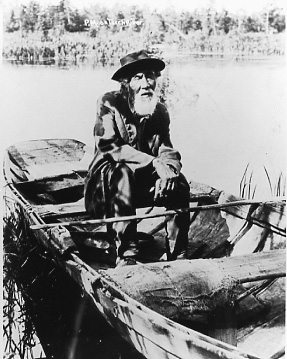
Old Indian Fisherman

One of my relatives on Torch River engaging in inland treaty fishing. They say he was well over 100 years old here.

Peter Marks

Old PM on Torch River

Grand Traverse Band Treaty Rights Timeline

Lead counsel for the Grand Traverse Band in the inland rights matter, Bill Rastetter, drafted this nice timeline of GTB’s involvement in treaty rights.

GTB Timeline