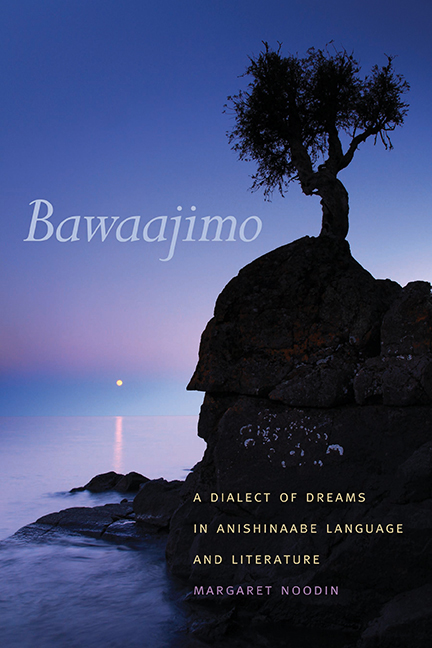
New Book: Meg Noodin’s “Bawaajimo: A Dialect of Dreams in Anishinaabe Language and Literature”

From the MSU Press Website:

Bawaajimo: A Dialect of Dreams in Anishinaabe Language and Literature combines literary criticism, sociolinguistics, native studies, and poetics to introduce an Anishinaabe way of reading. NooriCompF3.inddAlthough nationally specific, the book speaks to a broad audience by demonstrating an indigenous literary methodology. Investigating the language itself, its place of origin, its sound and structure, and its current usage provides new critical connections between North American fiction, Native American literatures, and Anishinaabe narrative. The four Anishinaabe authors discussed in the book, Louise Erdrich, Jim Northrup, Basil Johnston, and Gerald Vizenor, share an ethnic heritage but are connected more clearly by a culture of tales, songs, and beliefs. Each of them has heard, studied, and written in Anishinaabemowin, making their heritage language a part of the backdrop and sometimes the medium, of their work. All of them reference the power and influence of the Great Lakes region and the Anishinaabeakiing, and they connect the landscape to the original language. As they reconstruct and deconstruct the aadizookaan, the traditional tales of Nanabozho and other mythic figures, they grapple with the legacy of cultural genocide and write toward a future that places ancient beliefs in the center of the cultural horizon.
Two News Articles on the State of Sequoyah Conference

Here is the first on Anishinaabe veteran Jim Northrup’s talk. An excerpt:

Despite the horrors he has experienced, Northrup retained his sense of humor. His poems evoked laughter, applause, and a sense of the tragedy of battle.

In one of his poems, “The Duke,” the soldiers realize that a VIP visitor arriving by helicopter is John Wayne himself. They ask him to go for a walk with him, but he refuses to go out with the “grunts.”

Northrup wrote their experiences contained “more killing than he had seen in a quarter of a century of movie killing.”

“And I have photographs that go along with that,” he said, after reading the poem.

Today Northrup travels the country, sharing his experiences with those who can best understand them.

“We’re creating new veterans in Iraq and Afghanistan. They’re coming home as messed up as I was – some less, some more,” he said.

“A lot of them just want to unload to someone who will understand.”

Many audience members were fellow Vietnam vets. Northrup asked them to help work with these new veterans.

Following his speech, the group saw the Vietnam portion of the “Way of the Warrior” video by Patty Loew. The Vietnam section on the video about native warriors features Northrup, among several others.

Dr. Richard Allen, also a Marine Vietnam veteran, organizes the annual State of Sequoyah Conference.

He said one purpose of the Friday morning session was to explore the different way of thinking many American Indians have about their war experiences. Many young people follow a warrior tradition when they enter the service. Allen echoed Northrup’s statements.

“Now we’re in a war in Iraq and Afghanistan. A lot of these young people are coming back with PTSD. We know what that is,” he said. “These are the kinds of things that are familiar to veterans and a lot of people don’t understand them.”

The second is about Julia Coates’ talk.