New Edition of Kaighn Smith’s “Labor and Employment Law in Indian Country” Now Available

Order here.

Blurb:

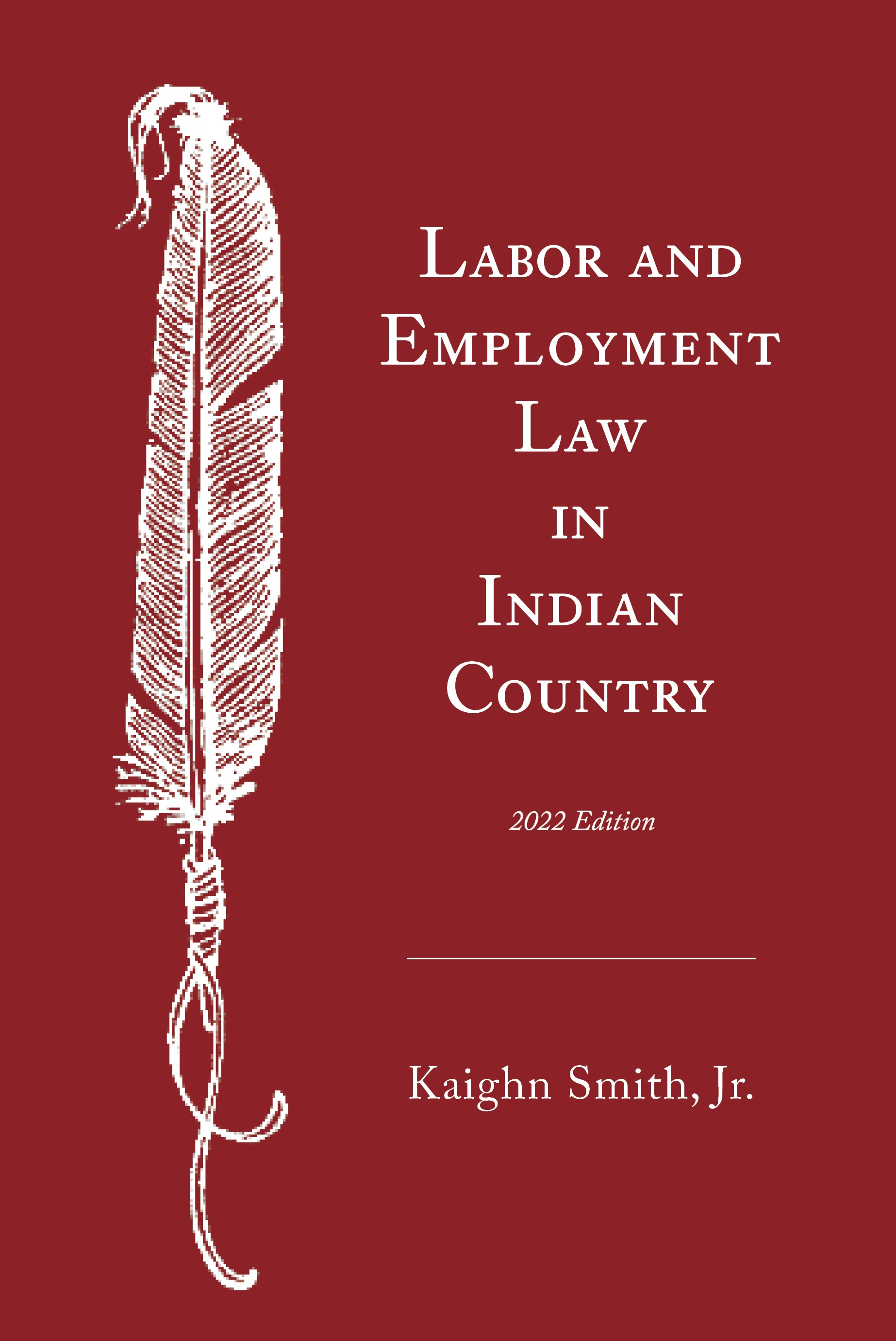
Eleven years after the first edition of this book, labor and employment law in Indian country remains a critical battleground for tribal sovereignty. We have fully updated this book with a decade’s worth of new developments.

Labor and Employment Law in Indian Country, 2022 Edition, provides a comprehensive overview of the law governing labor and employment relations in Indian country. This is a growing, controversial, and complex area of law, implicating fundamental principles of tribal sovereignty at every turn. It is a must-read for anyone involved in Indian affairs today.

The author, Drummond Woodsum attorney, Kaighn Smith, Jr., represents Indian tribes in tribal, state, and federal courts, including the U.S. Supreme Court. He and his colleagues at Drummond Woodsum’s Tribal Nations Labor and Employment Group have assisted tribes in enacting, implementing, and defending some of the first comprehensive labor and employment laws in Indian country.

Editorial Reviews

“The business of tribal sovereignty starts with tribal government. Labor and Employment Law in Indian Country is a standard-bearer for the development of modern tribal government. It should be on the bookshelf of every tribal lawyer.”

– Matthew L.M. Fletcher, Harry Burns Hutchins Collegiate Professor of Law and Professor of American Culture, University of Michigan, Founder of Turtle Talk

“Labor and Employment Law in Indian Country takes a complex and critically important subject for all Tribal Nations and lays it out in an easy-to-understand manner that balances both the big-picture outlook and the, oftentimes, gritty details that come with any law topic. This book is an essential read for all tribal leaders, tribal attorneys, tribal code drafters, as well as human resources and upper management personnel. . . .”

– Fawn Sharp, Vice President of the Quinault Indian Nation & President of the National Congress of American Indians
Update on NLRB v. Tribal Casino Cases (from Kaighn Smith at DWM)

Normally, we don’t post these kinds of updates from law firms, but this is so well done and has links to primary documents we crave (see bolded text under the fold), so here goes:

Three recent unfair labor practice cases leveled against Indian nation casinos by the National Labor Relations Board (NLRB) have gone in three different directions.  There may be ominous implications.

First, there was the complaint against the WinStar World Casino, owned and operated by the Chickasaw Nation, filed before the NLRB’s Regional Office in Oklahoma.  The NLRB charged casino managers with violating the National Labor Relations Act (NLRA) by disciplining employees who engaged in union organizing activities.  The Chickasaw Nation sued the NLRB in federal court and secured an injunction to stop the case on the ground that the NLRB has no jurisdiction over labor relations within the Chickasaw Nation’s territory.  The NLRB has appealed that decision to the U.S. Court of Appeals for the Tenth Circuit.  It argues that federal courts have no authority to stop an NLRB unfair labor practice case until after the case has proceeded to final decision by the full Board.  (Under a provision of the NLRA, parties can appeal final Board decisions to the federal courts of appeals.)

Second, there was the complaint against the Soaring Eagle Casino, owned and operated by the Saginaw Chippewa Tribe, filed before the NLRB’s Regional Office in Michigan.   In that case, the NLRB charged the casino with violating the NLRA when it fired an employee for soliciting union support in violation of the casino’s non-solicitation policy.   The Tribe sued the NLRB in federal court just like the Chickasaw Nation.  This time, however, the federal court declined to hear the case.  It said the Tribe needed to make all of its arguments to the Board before proceeding to federal court.  The unfair labor practice case then went to hearing before an Administrative Law Judge (ALJ), and the casino lost.  The ALJ ordered the casino to reinstate the employee and pay her back wages.  The ALJ also ordered the casino to post notices to employees announcing their rights under the NLRA, stating that it had violated the NLRA, and announcing that it would revoke its non-solicitation policy.  The casino has now appealed the ALJ’s decision to the full Board in Washington, D.C.  It argues that the NLRB has no jurisdiction over employment relations at its casino.

Third, there was the complaint against the Fort McDowell Casino, owned and operated by the Fort McDowell Yavapai Nation.  In that case, filed before the NLRB’s Regional Office in Arizona last February, the NLRB claimed that the casino maintained work rules that infringed on the ability of employees to engage in concerted activity in violation of the NLRA.  Before the case proceeded to hearing before the ALJ, the casino settled with the NLRB.  Under the settlement agreement on file with the NLRB’s Regional Office, the casino must post the following notice:

Continue reading

Spring Speakers Series Event: Labor Law in Indian Country

Join us if you can:

February 21, 2012, 2:00 pm (Castle Board Room, 3rd Floor of the Law College Building)

Coffee and snacks provided

Authors:

Kaighn Smith Jr.

Labor and Employment Law in Indian Country

David Kamper

The Work of Sovereignty: Tribal-Labor Relations and Self-Determination at the Navajo Nation

Commentators:

Prof. Wenona T. Singel (MSU Law)

Kaighn Smith’s “Labor and Employment Law in Indian Country” Now in Print

Announcing a Joint Publication of the Native American Rights Fund and Drummond Woodsum

by Kaighn Smith, Jr., with a Foreword by John E. Echohawk

LABOR AND EMPLOYMENT LAW IN INDIAN COUNTRY provides a comprehensive overview of the law governing labor and employment relations in Indian country. This is a growing, controversial, and complex area of law, implicating fundamental principles of tribal sovereignty at every turn. Current and up-to-date, Labor and Employment Law in Indian Country is a must read for anyone involved in Indian affairs today.

Order at www.narf.org

Labor and Employment Law in Indian Country is a long-needed wake-up call for tribal leaders . . .  This book is an essential guide for understanding, protecting and advancing tribal self-governance at a time when it is vulnerable.  It should be read not only by tribal leaders, but by anyone working with legal and jurisdictional matters in Indian country today.”

—W. Ron Allen, Tribal Chair and CEO, Jamestown S’Klallam Tribe

Continue reading

New Book by Kaighn Smith on Labor and Employment Law in Indian Country

This is such an exciting book, co-published by the Native American Rights Fund and Drummond Woodsum.

Labor and Employment Law in Indian Country (2011)

by Kaighn Smith, Jr.

Available in January, 2011. 

To pre-order, use the order form below. Books will be shipped in January, 2011. For further information, e-mail Ruth Wentzel at rwentzel@dwmlaw.com.

Drummond Woodsum is pleased to announce the publication of a new book by Kaighn Smith, Jr., published jointly with the firm and the Native American Rights Fund.

Labor and Employment Law in Indian Country provides a comprehensive overview of the law governing labor and employment relations in Indian country. This is a growing, controversial, and complex area of law, implicating fundamental principles of tribal sovereignty at every turn. Current and up-to-date, Labor and Employment Law in Indian Country is a must read for anyone involved in Indian affairs today.

The author, Drummond Woodsum attorney Kaighn Smith, Jr., has represented Indian tribes and tribal enterprises in labor and employment matters for over 15 years. He has assisted tribes in enacting, implementing, and defending some of the first comprehensive labor and employment laws in Indian country. Kaighn and his labor law colleagues at Drummond Woodsum have a nationwide practice, serving tribes in the labor and employment field.

Continue reading

ICT Editorial by Kaighn Smith re: Tribal Work Laws

From ICT:

Imagine this scenario: “If you don’t sleep with me, you can kiss your job goodbye,” the male supervisor warns the female waitress at the tribe’s gaming facility. (We’ll call her Joyce.) She consistently says no. His threats continue and even escalate.

Although he threatens to make her life miserable if she tells anyone, Joyce seeks help from the Equal Employment Opportunity Commission; EEOC informs her that federal sexual harassment laws exclude tribes. She goes to tribal court. She finds she has no remedy under tribal law. Overwhelmed by her boss’ intimidation, Joyce quits her job. Unemployed and unable to afford her rent, she moves in with her brother, Bob.

A host of other laws that are silent about their application to tribes pose similar threats to tribal sovereignty.

Bob, a union organizer, is outraged. He starts talking to Joyce’s co-workers and learns that other women have experienced similar harassment. Other workers complain that management plays favorites with tribal members, giving them better jobs and shifts than non-members. Bob says that with union representation, management would be held accountable for workers’ rights.

Continue reading