Here is the opinion in KalshiEX LLC v. Hendrick.
Briefs:
From the opinion:
We are “reluctant to read into ambiguous statutory text” a “radical or fundamental change” to that longstanding statutory scheme. Congress did not take a wrecking ball to all sports gambling regulations built up over decades by federal, state, and tribal governments when it amended the CEA to add the definition of swap we are considering today.
Additional Resource
Prediction Market Litigation Tracker by Mick Bransfield
Tribes aren’t alone in warning that the Commodity Futures Trading Commission is exceeding its authority with its proposed rule. Criticism of the rule is also raised in comments submitted by former Senator Chris Dodd, co-author of Dodd-Frank, the legislation that amended the Commodities Exchange Act provisions at the heart of CFTC’s proposed rule; Timothy Massad, a former CFTC chair; 44 state attorneys general; and leading gaming and derivatives interests.
This is the third and final post in a series (first post; second post) on the CFTC’s proposed rule governing prediction market “event contracts.”
Former Sen. Chris Dodd, co-author of Dodd-Frank, says Congress did not authorize this
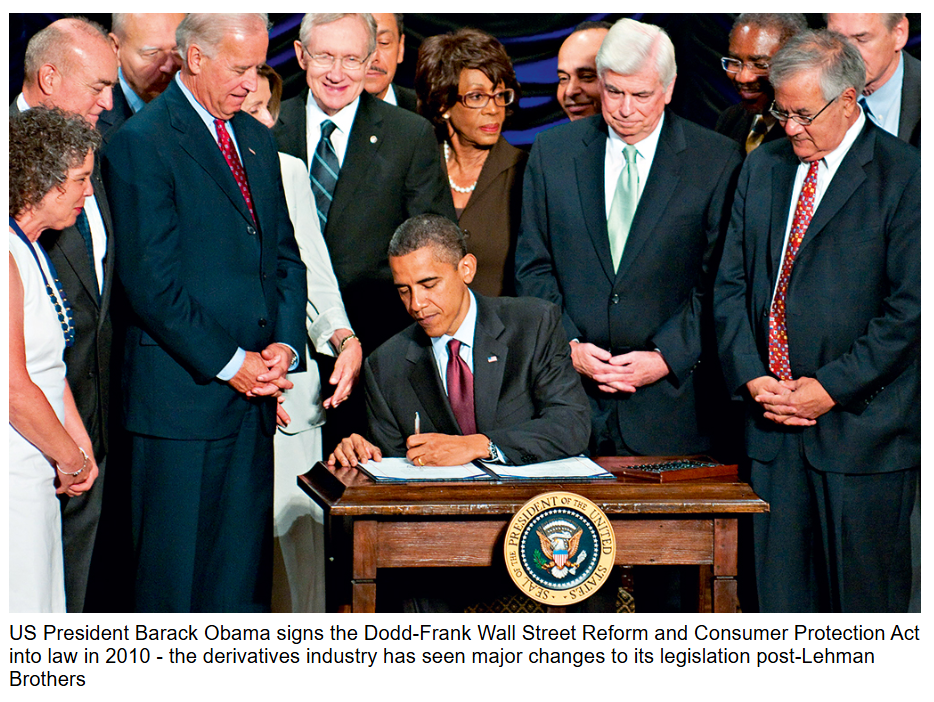
Former Senator Christopher Dodd submitted a comment stating:
The proposed regulatory amendments contradict the language and intent of the Dodd-Frank Act and promote public policies opposing what Congress clearly intended.
These amendments could well endanger consumers and promote speculation. These proposed amendments undermine the traditional police powers of states and also functionally amend the Indian Gaming Regulatory Act (IGRA), which could diminish tribal sovereignty.
A former CFTC chair says the agency has “lost its way”
Former CFTC Chair Timothy Massad opened his comment with an unusually direct statement:
“The Commodity Futures Trading Commission has lost its way . . . . Although I have not submitted comments on any rule proposal since leaving the agency, I feel it is important to do so here because the agency has lost sight of its mission and the limits of its own authority.”
Forty-four state attorneys general raise objections
A bipartisan coalition of 44 state attorneys general, led by Ohio Attorney General Andy Wilson, likewise argues:
“The CFTC in the Proposed Rule goes well beyond its statutory authority. . . . it violates both the major-questions doctrine and the federalism canon . . . . [and] clashes with the CEA’s plain text, structure, and purpose.”
Comments from the American Gaming Association and CME Group
The American Gaming Association, whose members include commercial and Tribal gaming operators, states in its comments:
The proposed rule concedes that sports event contracts involve gaming, yet creates a permissive framework designed to allow them. That approach conflicts with congressional intent, 15 years of regulatory precedent, state and federal law, and the CFTC’s own regulations. It would also displace state and tribal authority while exposing consumers and sports competitions to wagering activity without comparable licensing, geolocation, responsible gaming, integrity monitoring, or enforcement safeguards.
The CFTC is a financial markets regulator, not a national gaming commission. It lacks both the expertise and resources to replace the more than 8,400 state and tribal regulators who oversee legal gaming today. The Commission should withdraw the proposed revisions to Rule 40.11, enforce the existing prohibition on gaming event contracts, respect tribal sovereignty and states’ rights, and put an end to the unlawful nationwide expansion of sports wagering through prediction markets.
CME Group, one of the world’s largest derivatives market operators, also submitted comments, stating that “the Commission’s authority on this score is ambiguous at best, [and] deferring to Congress would be advisable.”
Each of these comments challenge the CFTC’s authority to create a nationwide market for products that function as sports betting while bypassing the federal, Tribal, and state laws that otherwise govern gaming.
The Oklahoma Indian Gaming Association’s Wins Award for Longest Comment
A final note: OIGA’s comment was the most detailed submission to the CFTC, totaling 50 pages and including 291 footnotes.
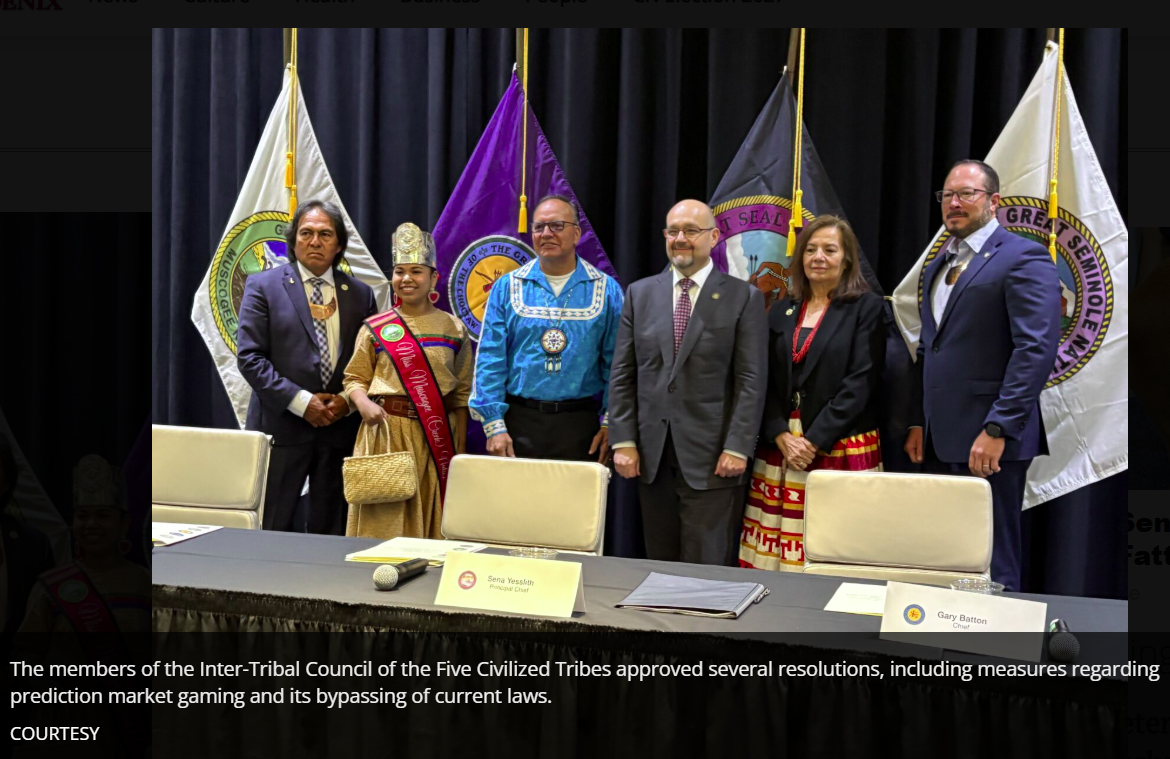
This is a follow-up to my earlier post on prediction markets and Indian gaming. A subsequent post on key comments submitted by non-Tribal persons and organizations is available here.
Below is a summary that provides a snapshot of the concerns raised by Tribes in their comments submitted in response to the CFTC’s proposed rule.
Taken together, the comments consistently emphasize that the CFTC is considering a federal workaround that could allow companies to offer nationwide sports betting while bypassing the legal framework Congress created for gaming in Indian country.
Recurring concerns raised in Tribal comments include:
Tribal Submissions
Online prediction markets present one of the most significant threats to Indian gaming and Tribal sovereign interests in decades. Prediction market companies threaten Indian gaming because they’re advancing a legal theory that could allow them to offer a product that functionally operates as sports betting nationwide without complying with the legal regime that Congress created for gaming in Indian country. These markets allow people to bet on almost anything, from sporting events and sports statistics to who will be named the next Pope and whether famous people will say certain words during a speech. One aspect of the story that’s received little attention from major media outlets is the intersection between these markets, Indian gaming, and the Trump family’s financial interests.
The Trump administration’s Commodity Futures Trading Commission (CFTC) is proposing a new rule governing prediction market “event contracts,” including contracts based on sporting events. The proposal would define “gaming” and when an event contract “involves” gaming, while replacing the CFTC’s current strongly prohibitory approach with one under which the agency would make public interest determinations about particular categories of contracts.
The distinction is enormously consequential. Prediction market companies argue that sports event contracts are derivatives subject to federal regulation under the Commodity Exchange Act rather than sports gambling subject to state law or, in Indian country, gaming under IGRA. If successful, the consequences go well beyond which federal agency regulates the new financial products of prediction markets.
As Turtle Talk readers well know, Tribes operate gaming under a system of federal law, Tribal law, Tribal gaming regulation, and for Class III gaming, Tribal-State compacts negotiated pursuant to IGRA. Prediction market companies argue that that they can offer a product that looks nearly identical to sports betting, but outside of the laws governing gaming in Indian country because wagers placed with their companies are “event contracts” governed by the CFTC and its rules.
The major issue presented by this conflict is who has to play by which rules. The CFTC proposed rule would strengthen the prediction market industry’s argument that sports contracts can operate in Indian country without being subject to IGRA. If successful, this would impair Tribal regulatory authority, Tribal-State compact enforcement, gaming compact exclusivity provisions, and gaming revenues that Tribes use to fund their governmental services.
Who Stands to Benefit?
Meanwhile, the Trump family has significant financial ties to prediction markets. Donald Trump Jr. is a strategic adviser to Kalshi and a partner in 1789 Capital, which invested tens of millions of dollars in Polymarket. Trump, Jr. also joined Polymarket as an adviser. The investment potential is profound. Kalshi was valued at $22 billion in May 2026 and was reported to be discussing a new funding round at a valuation as high as $40 billion just one month later. Industry analysts have projected that prediction markets could grow into a $1 trillion per year trading market by 2030. A federal rule strengthening the industry’s ability to offer their contracts nationwide under exclusive CFTC regulation has extraordinarily large commercial stakes.
The New Yorker recently reported on the overlap between Trump family financial interests and the administration’s approach to prediction markets in an article titled “This Is What Trumpian Self-Dealing Looks Like.” None of this alone establishes that the Trump family caused the CFTC to propose this particular rule. But it highlights the stakes of the proposed rule and the question of who stands to benefit from this administration’s policy choices.
The Trump Indian Gaming Historical Context
As TT readers know, Trump has attacked Indian gaming since at least the early 1990s, when his Atlantic City casinos competed with Tribal gaming. In 1993 congressional testimony about implementation of IGRA, Trump complained about Tribal casinos, alleged organized crime problems, and questioned the Indian identity of Tribal people, telling members of Congress that some “don’t look like Indians to me.” This significance of this history goes beyond its blatant racism. In the 1990s, Trump owned casinos that faced competition from Indian gaming, and he responded by attacking Indian gaming’s legitimacy and regulation with attack ads smearing the St. Regis Mohawk, resulting in a $250,000 fine from New York’s state lobbying commission (see the link to the Washington Post’s article, Trump’s Long History of Clashes with Native Americans, in the Additional Resources section below). Now, more than thirty years later, Tribes are responding to a federal regulatory proposal that could profoundly benefit prediction market companies, including companies with Trump family financial ties, by arguing that they offer the functional equivalent of sports betting without being subject to IGRA and Tribal-State gaming compacts.
Indian Country’s Response
Indian country responded to the proposed new CFTC rule by submitting 65 timely comments from Tribes, Tribal gaming regulators, and Tribal organizations opposing or raising significant concerns about the proposal, with more Tribal submissions posted after the deadline. These objections address the proposed rule in light of Tribal sovereignty, IGRA, Tribal-State compacts, the statutory meaning of “gaming,” CFTC’s claimed federal jurisdiction, and the adequacy of tribal consultation. I’ll post more about these comments in the coming days, including what the proposed rule could mean for Indian gaming if it’s adopted, as well as a summary of the legal arguments Tribes made in their submissions.
Importantly, Tribes are also litigating this conflict in federal courts, with cases that Turtle Talk has been following. Tribes are participating in litigation over Kalshi’s sports event contracts in multiple courts, and several tribes have sued directly:
• Ho-Chunk Nation v. Kalshi Inc. (W.D. Wis.) (a federal judge allowed the Tribe’s IGRA claims against Kalshi to proceed in May 2026)
• Blue Lake Rancheria v. Kalshi Inc. (N.D. Cal.) (currently pending before the Ninth Circuit)
• Mescalero Apache Tribe v. Kalshi Inc. (D.N.M.) (complaint filed on May 12, 2026 by Mescalero Apache, Pueblo of Pojoaque, and Sandia Pueblo)
Roughly two dozen additional Tribes and Tribal organizations, including the Indian Gaming Association, California Nations Indian Gaming Association, Arizona Indian Gaming Association, Oklahoma Indian Gaming Association, National Congress of American Indians, Native American Finance Officers Association, San Manuel Gaming and Hospitality Authority, and the United South and Eastern Tribes Sovereignty Protection Fund, have filed amicus briefs in four state-initiated challenges against Kalshi and other prediction market operators: North American Derivatives Exchange (Crypto.com) v. Hendrick (D. Nev.), KalshiEX v. Martin (D. Md.), KalshiEX v. Flaherty (D.N.J.), and Robinhood Markets v. Campbell (D. Mass.).
Finally, the question running through all of this is: after Tribes spent decades building gaming enterprises within the federal framework Congress established with IGRA, can a new generation of prediction market companies enter the same market, call the transactions “event contracts,” and operate under a different and less burdensome set of rules? If the federal government concludes that they can, then we should all question who benefits from that decision and who bears the cost.
Additional Resources
My summary of the Tribal comments submitted in response to the CFTC proposed rule is here, and highlights of non-Tribal comments from former Senator Chris Dodd, 44 State Attorney Generals, the former chair of the CFTC, and others is here.
Trump’s Long History of Clashes with Native Americans, by Shawn Boburg for the Washington Post (July 25, 2016). Access without a paywall is here. This story also reports on New York State’s state lobbying commission imposing a $250,000 fine for Trump’s violation of state lobbying laws in his campaign to smear Indian gaming in New York state through a series of ads depicting the St. Regis Mohawk as violent criminals and drug dealers in an effort to kill Tribal casino plans that would compete with his Atlantic City casino businesses.


Here are the merits briefs in Oxford v. Champion.
Opening Briefs
Response Briefs
Reply Briefs
Amicus Brief
Previous post on this matter is here.
Here is the brief in Kalshiex LLC v. Orgel:
And here is John Oliver’s takedown.
Here are the materials in Ho-Chunk Nation v. Kalshi Inc. (W.D. Wis.):
Here are the new materials in Oxford Casino Hotel v. Champion (D. Me.):
 Turtle Talk
You must be logged in to post a comment.