Eric Hemenway, Anne Henningfeld, and Emily Proctor outside their well-attended panel.
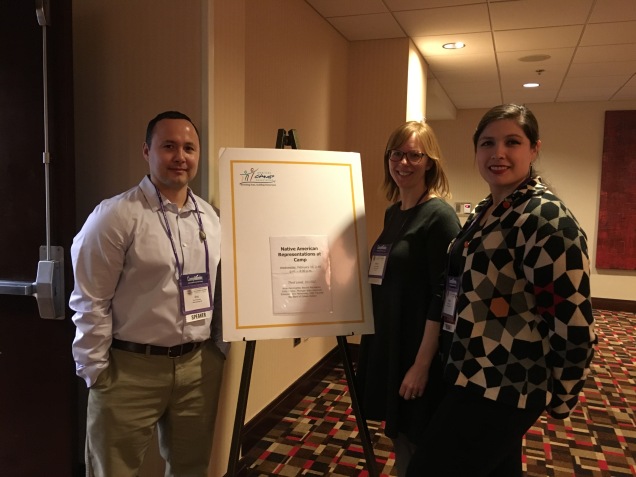
Eric Hemenway, Anne Henningfeld, and Emily Proctor outside their well-attended panel.
Here.
RSVP here.
Department of Human Services, Native American Affairs &
Tribal Services: How We Work Together to Improve Lives
March 12th
– Stacey Tadgerson, Director of the Office of Native
American Affairs, Michigan Department of Human Services (DHS)
Congress enacted the Indian Child Welfare Act (ICWA) to eliminate the
wholesale state removal of abused/neglected Indian children from their tribes
and culture. Participants in this session will learn about the history of ICWA,
Native American Affairs, and resources available to youth in care, tribal
governments, and urban Indian organizations from the DHS that will assist
tribal youth in becoming self-sufficient while reaching for their dreams.
Baby Veronica & Inside the Michigan Indian Family
Preservation Act – April 2nd
– Kate Fort, Staff Attorney and Adjunct
Professor – MSU Indigenous Law & Policy Center
The United States Supreme Court decided only the second case on the
Indian Child Welfare Act since its passage. This presentation will give the
basic facts and holding of the case, as well as its potential implications for
ICWA cases in the future. It will also address the way the Michigan Indian
Family Preservation Act helps to limit the application of the Baby Girl case.
Making Smart Choices for Health Insurance – April 16th
–
Brenda Long, Educator – MSU Extension
To help people navigate the complex and confusing health insurance
landscape, MSU Extension is teaching people how to take control of their
health insurance situation through webinars and in-person presentations.
Those who participate will be able to analyze their insurance needs, learn
important terms and concepts, compare health insurance plans, and figure
out what fits in their budget. People will also become more confident
An excerpt:
Each of the 12 federally recognized tribes of Michigan have their own tribal court and social service departments that assist women and families who are in violent situations. Michigan State University Extension continues to work with Michigan tribal nations to address the needs of communities in the area of government and public policy.
For more information, please contact Emily Proctor, MSU Extension educator on tribal nations, with questions or comments at 231-439-8927 or proctor8@anr.msu.edu.
This article was published by Michigan State University Extension. For more information, visit http://www.msue.msu.edu. To contact an expert in your area, visit http://expert.msue.msu.edu, or call 888-MSUE4MI (888-678-3464).
Here — tribal-booklet-2008-farm-bill
Thanks to Aaron.
Here is the cover page of the brochure — Brochure Page 1
And here is the agenda — Brochure Page 2
And here is the press release:
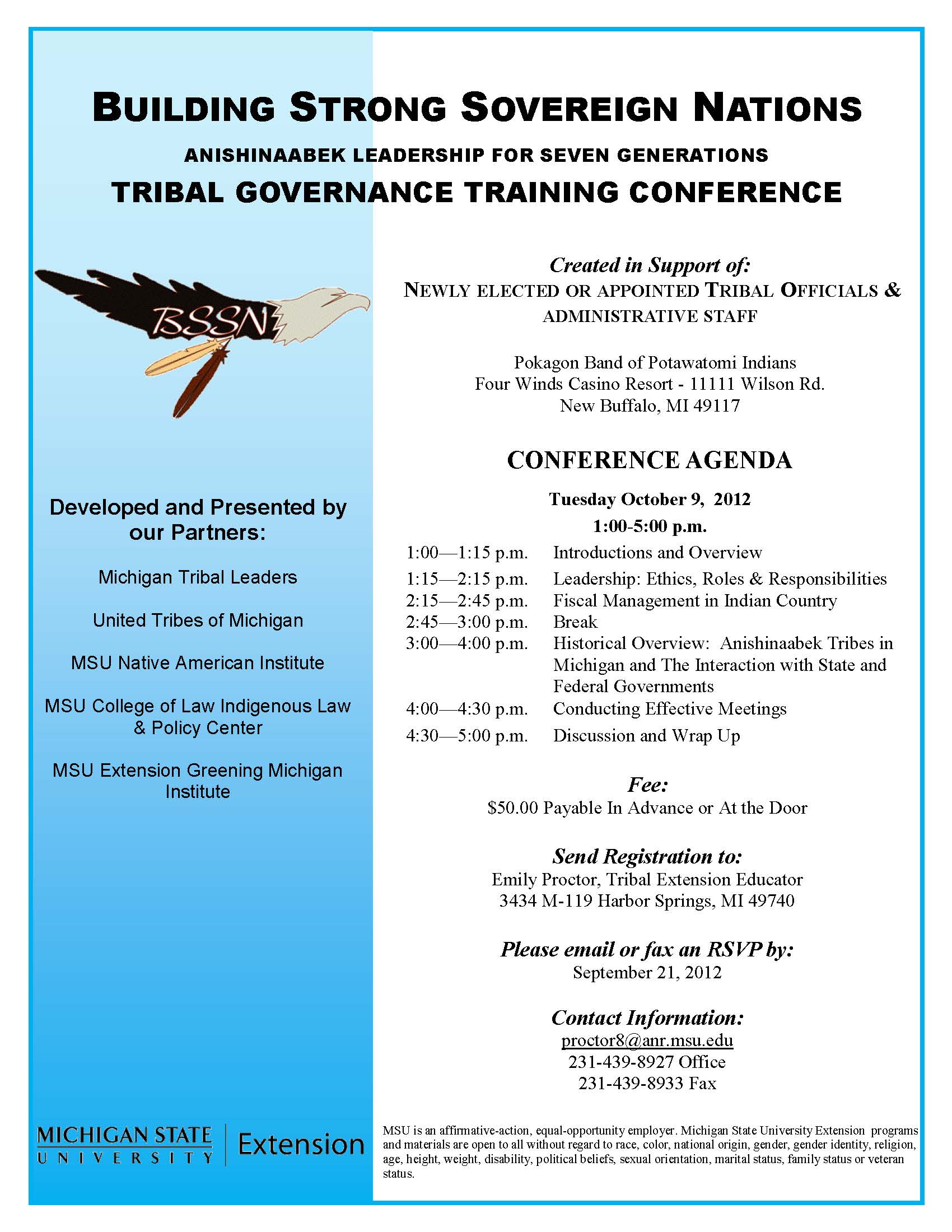
EAST LANSING, Mich. — Tribal leaders from 11 of the 12 federally recognized tribes in Michigan will attend the first Building Strong Sovereign Nations (BSSN) Conference, Feb. 4-5 at Turtle Creek Casino & Hotel, in Williamsburg, Mich.
It is the first tribal governance training of its kind that will be held on Indian land in conjunction with a university. Participants will come from tribal communities located across the upper and lower peninsulas.
“We are thrilled at the broad intertribal interest,” says Aaron Payment, American Indian liaison for Michigan State University (MSU) Extension. “This initiative is just the first step. We plan to work even more closely with tribes to identify additional training and to bring this training to them.”
Continue reading
 Turtle Talk
You must be logged in to post a comment.