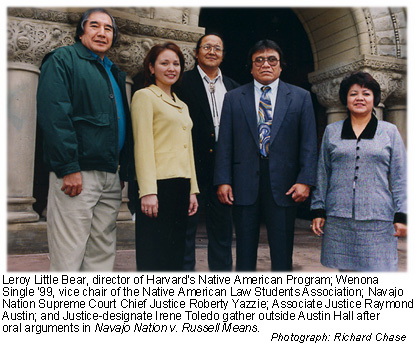
Navajo Nation Supreme Court Decides Election Law Dispute

Here is the opinion in Sandoval v. Navajo Election Administration.

The court’s syllabus:

The Supreme Court issues its opinion on reconsideration in this appeal of an OHA dismissal on an election grievance. The Court reverses the OHA and orders Leo Johnson disqualified as school board member of the Shiprock Associated Schools Inc. (SASI). The Court emphasizes the duties of the NEA and candidates when conditions concerning qualifications change before an election has taken place. The Court states that the qualifications statute for school board members specifically require mandatory enforcement throughout the term of office. The vacancy shall be filled by special election pursuant to 11 N.N.C.  § 143.
Navajo Supreme Court to Hear Oral Argument at Idaho College of Law

The University of Idaho College of Law is pleased to announce that the Supreme Court of the Navajo Nation will be sitting at the Menard Law Building, Law School Courtroom for oral argument on the morning of Thursday, March 21st from 9:30 a.m. to 10:45 a.m. The Court, consisting of Chief Justice Herb Yazzie, Associate Justice Eleanor Shirley, and Associate Justice by Designation William Platero, will hear oral argument in the case: Neptune Leasing, Inc. v. Mountain States Petroleum Corporation and Nacogdoches Oil and Gas, Inc., No. SC-CV-24-10. This will be a historic visit by the Navajo Nation Supreme Court which has jurisdiction over the largest tribal land base and population in the United States.
During the afternoon on Thursday, March 21st the Navajo Nation Justices will discuss “The Operations and Principles Guiding the Navajo Nation Supreme Court” in the Law School Courtroom from 1:30 p.m. – 2:45 p.m. Both of these sessions are open to the public. The Menard Law Building is located on the University of Idaho Moscow campus at 875 Perimeter Drive.

Navajo SCT Issues Two Opinions (on School District Elections and Family Law)

Here they are:

Mae Y. Sandoval v. Navajo Election Administration and Concerning Leo Johnson, Jr., Real Party in Interest. Opinion. Reversing the OHA, the Court finds that Dr. Leo Johnson was not qualified to run for school board member in the Shiprock Associated Schools,. Inc. (SASI) as he was an employee of that organization, which disqualified him from running. The election statute regarding sworn qualifications must be read as mandatory whether a challenge is raised before or after an election because an unqualified candidate may not hold elected office. (December 18. 2012).

Glenyal Bahe v. Adam Platero. Opinion. The Court affirms the Crownpoint Family Court’s dismissal of plaintiff’s child custody and support action concerning a Navajo family in deference to a previously filed action in the Bernalillo district court. The Court emphasizes that inherent tribal sovereignty provides Navajo courts with exclusive jurisdiction over matters concerning internal relations between tribal members, and that the courts must be watchful that they do not unnecessarily concede concurrent jurisdiction in such matters. Nevertheless, 7 NNC 253a(E) enables our courts to defer to another forum in the interest of substantial justice and in the spirit of comity. (December 20. 2012).

Profile on Navajo Chief Justice Herb Yazzie

Here. Via Pechanga.

This is interesting:

Another issue that was addressed this past year, said Yazzie, was how the tribal courts conduct hearings.

Most hearings are conducted in a combination of the English and Navajo language since elderly Navajos are more comfortable in the Navajo language while English is the language used for the court’s written records.

This causes problems, however, for the fact that court reporters, those who type the transcript of the trial, are more prone to knowing English than Navajo and when the case comes up for review, there would often be large parts of the hearings left empty with the reporter only saying that the testimony was in Navajo.

“What happens is that the most important part of the hearing and the place where fundamental Navajo law will most likely be discussed is not being translated,” Yazzie said.

He also pointed out that the tribe does not have a court reporter program of its own and often the parties are required to provide their own.

As a result, the members of the Navajo Supreme Court would have to go to the recording of the hearing and find the sections where Navajo was spoken and listen themselves to what was said, a process that is very time consuming.

Because of this, Yazzie put in for a federal grant of $200,000, which was approved, that will allow for the training of Navajo court reporters for the first time.

Navajo Nation Supreme Court Issues Opinions in Employment and Government Contracting Disputes

Here is the opinion in Meadows v. Navajo Nation Labor Commission.The court’s syllabus:

The Court grants a petition for writ of mandamus, finding that the Labor Commission lacked authority to order the recusal of the panel and all previous members. The Court remands the matter for the Commission to hear the merits of the case. (November 2, 2012).

Here is the opinion in Graven v. Morgan. An excerpt:

This case concerns an appeal of Window Rock District Court’s dismissal of a breach of contract lawsuit. Appellant Will Graven appeals the June 17, 2010 decision of the district court dismissing the suit against Appellees Speaker of the Navajo Nation Council and the Chief of  Staff of the legislative branch in their individual capacities on the basis of sovereign immunity.The Court affirms the dismissal but on other grounds.

Navajo Nation SCT Defines Customary Adoption in Family Law Case

Here is the opinion in James v. Window Rock Family Court.

Here is the court’s syllabus:

The Court grants James’ petition for writ of mandamus where James’ adoption filing was not acted on by the family court for several months. The writ compels the timely processing of cases within statutory and rule-based timeframes and emphasizes the responsibilities of the Court Administrator. The Court also addressed the family court’s erroneous interpretation of the adoption statute, which the family court interpreted as requiring a separate petition for termination of parental rights (TPRs) to be filed when an adoption is sought.  Clarifying that the Navajo Nation favors formal adoptions with TPRs only in cases of child abuse or neglect, the Court stated that the recent Alchíní bi Beehaz’áanii Act emphasizes that “customary adoptions” must be considered before all other options, including TPR as a last resort.  As the Act does not define customary adoptions, the Court provides the definition in this opinion.


Turtle Talk Voters Confirm Worcester v. Georgia as Greatest Case (Again) in the Supreme Court Tournament

Sorry for the delay. Lots been happening. But as expected you all voted Worcester v. Georgia as the Greatest Case in the Turtle Talk poll, beating out Williams v. Lee badly — 70 percent to 30 percent (83 out of 109 votes).

I recall we did a short poll a few years back, and Worcester beat out a few other cases for the same title….


Navajo Nation SCT Issues Immunity Decision

Here is the decision in Navajo Housing Authority v. Johns.

From the court’s syllabus:

In this appeal of the Crownpoint District Court’s denial of NHA’s motion to dismiss on the basis of sovereign immunity, the Court vacates the denial.  Noting that the issue of NHA’s immunity has returned time and again to the Court, first on the basis of NHA’s codified plan of operations, subsequently on amendments to both NHA’s plan of operations and the Sovereign Immunity Act, the Court finds that NHA had immunity at all times relevant to this action. In reaching its decision, the Court overrules a quartet of cases concerning NHA’s immunity and reestablishes its 1987 opinion in NHA v. Dana as the controlling case.

Navajo SCT Rules that Criminal Sentences Presumed to be Concurrent

Here is the court’s opinion in Baker v. Greyeyes.

From the court’s syllabus:

The Court grants a writ of habeas corpus filed after 6 months incarceration by an inmate serving time on multiple sentences in which it had not been specified how the sentences would run, holding that, when not stated in a judgment, multiple sentences are presumed to run concurrently.

Navajo SCT Denies Habeas Relief in Juvenile Right to Counsel Case

Here is the opinion in In re M.C.

The court’s syllabus:

The Court denies a petition for writ of habeas corpus, holding that 9 NNC 1310(A), which provides for a child’s right to assistance of counsel at “all proceedings alleging the delinquency of a child” does not attach at a detention hearing that must be held within 24 hours of detention, on the basis that detention hearings address further detention, not the merits of the charges, to which young men and women are able to speak for themselves.