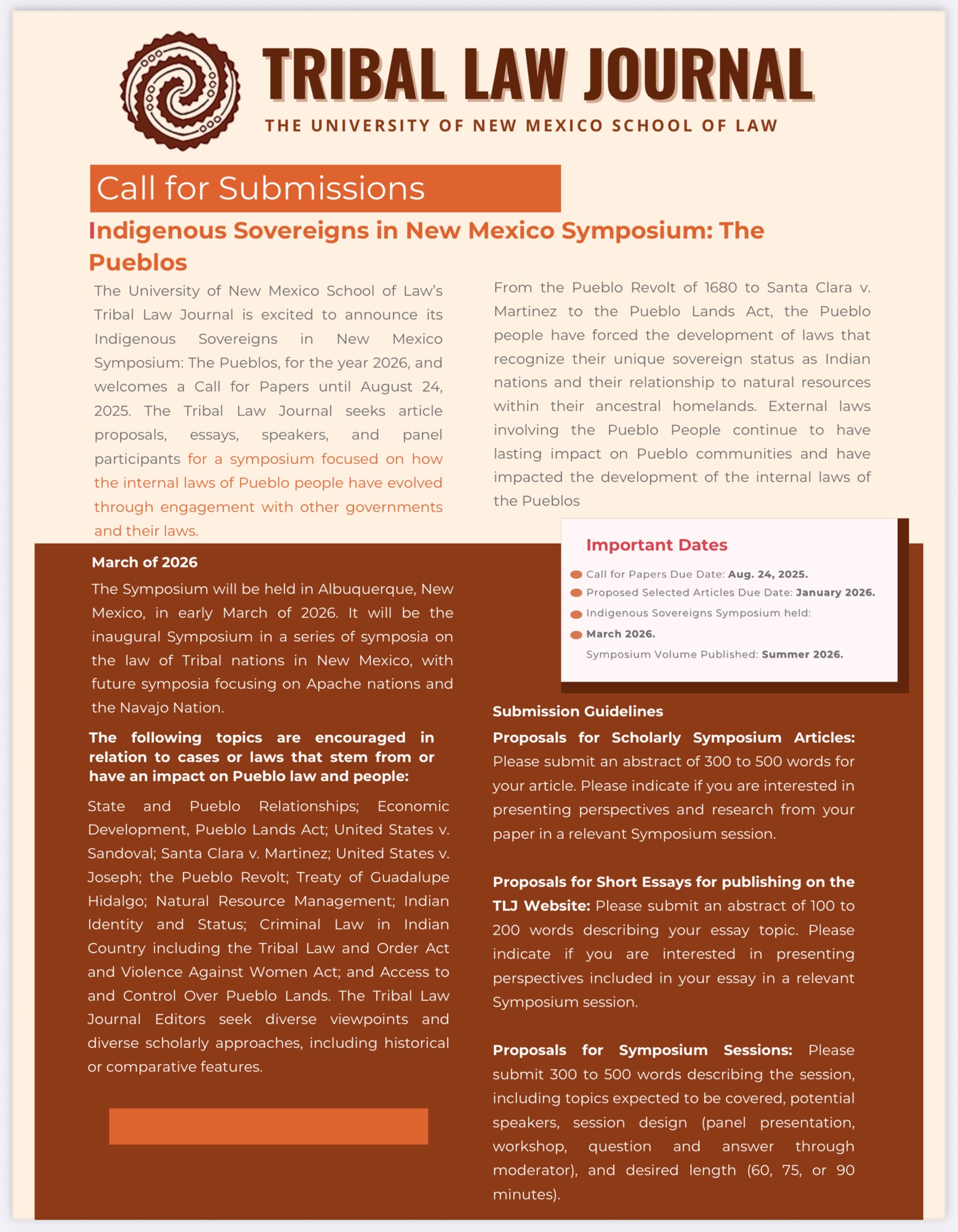
TLJ is inviting scholarly, practitioner, and student submissions addressing legal issues affecting tribal nations and their internal justice systems. Contributions may include tribal court case comments, reflections on tribal systems, the development of tribal law, the value of tribal law, interviews, and teachings. Submissions are due by August 31, 2026, and chosen work will be published by Spring 2027
Here is Bizindan Miinawa (Listen Again), available on SSRN and prepared for the Tribal Law Journal’s symposium on Johnson v. McIntosh.
An excerpt:
Are any United States Supreme Court cases real? Johnson v. McIntosh was fake as John Wayne’s teeth. That one was a property dispute, remember? Two wealthy, privileged, and powerful white people squared off over thousands of acres of land acquired from Indigenous nations who called the vast valley of Eagle River home. On one side, you had a former United States Supreme Court justice; on the other, you had a wealthy political benefactor/beneficiary — imagine if a case called Stephen Breyer v. Harlan Crow about Indian land ownership was pending in the Roberts Court’s 2023 Term. No tribal nations or Indigenous peoples to be seen or heard from, or in more modern practice were not allowed to participate. Both attorneys were secretly paid for by the same company — imagine if Stephen Breyer’s attorney (say, Neal Kaytal) was secretly retained by the Trammel Crow Company (or even better, by Club For Growth, his political action committee) to oppose Harlan Crow’s attorney, who would probably be Paul Clement or Ty Cobb. And of course, the property claims at issue barely overlapped, if at all, thanks to stipulations of the parties at the trial level that formed the basis of the factual dispute. It was a sham case.
Tomasz G. Smolinski, A Proposal for a Model Indigenous Intellectual Property Protection Tribal Code (MIIPPTC), 22 Tribal L.J. 3 (2023).
Dustin Jansen, The Role of United States v. Cooley and McGirt v. Oklahoma in Determining Criminal Jurisdiction in Indian Country, 22 Tribal L.J. 30 (2023).
Wesley James Furlong, “Subsistence is Cultural Survival”: Examining the Cultural and Legal Framework for the Recognition and Protection of Traditional Cultural Landscapes within the National Historic Preservation Act, 22 Tribal L.J. 51 (2023).
Student Articles
Noah Allaire, Experiments in Legal Hybridity: From Indian Tort Law to Tribal Tort Law, 22 Tribal L.J. 122 (2023).
Alejandro Alvarado, Tribes and H-1Bs: A Call to Reconcile U.S. Immigration Policy and Tribal Governments Through Employment-Based Visas, 22 Tribal L.J. 151 (2023).
Micah S. McNeil, Traditional Tlingit Law and Governance and Contemporary Sealaska Corporate Governance: Four Core Values and a Jurisprudence of Transformation, 22 Tribal L.J. 168 (2023).



 Turtle Talk
You must be logged in to post a comment.