The Oklahoma Supreme Court granted a stay in the order to remove Baby Girl from her father and appears to have scheduled oral arguments for today at 2pm.
Link to docket here.
CBS coverage here.
NY Times coverage here.
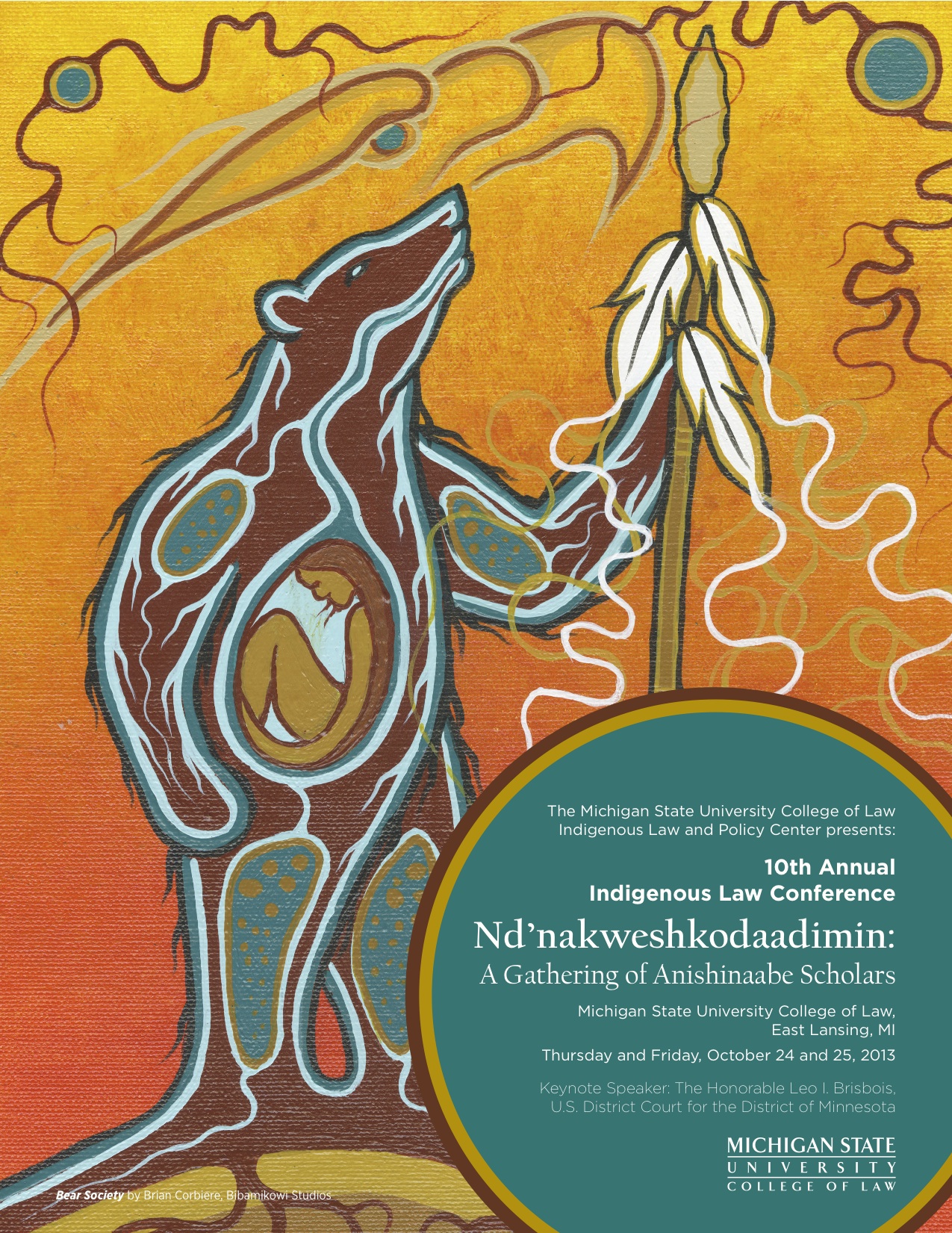
10th Annual Indigenous Law Conference
Nd’nakweshkodaadimin: A Gathering of Anishinaabe Scholars
October 24-25, 20013
Castle Board Room, MSU College of Law
Registration here
Here.
At issue is whether a small tribal court in the village of Minto, 130 road miles west of Fairbanks, could strip Parks of his parental rights to one of his daughters, named “S.P.” in legal filings, and approve her adoption by Jeff Simmonds, the cousin of the child’s mother, and Simmonds’ wife Rozella. According to court filings, S.P. is a member of the Minto tribe, as is her mother, Stearman, the victim of Parks’ rage. Jeff Simmonds is also a Minto tribe member, while Rozella Simmonds is a Zuni Pueblo Indian from the Southwest.
One of Parks’ parents is Alaska Native and Parks himself is an enrolled member of the tribe at Stevens Village, about 60 miles north of Minto on the Yukon River, according to the court filings.
To the state, that meant that the Minto court was trying to enforce its order against a nonmember of its tribe. The Minto court’s declaration on May 7, 2009, that Parks was an unfit parent was improperly reached, the state said in its brief to the Alaska Supreme Court, filed in April.
The proper venue for that question is before a state judge in Fairbanks, not the elders of the Minto court, the state said.
[Natalie] Landreth, from the Native American Rights Fund office in Anchorage, said the state is overreaching and ignoring the years of legal precedent since Congress passed the Indian Child Welfare Act in 1978.
Related case in the 9th Circuit here.
Assuming the efforts listed in the opinion are accurate, here is a case detailing what we think most ICWA experts would agree are active efforts. It is true, however, that the court denied transfer to tribal court due to essentially a forum non convenes (concern about subpoenaing witnesses, which is strange).
Here.
Story here.
Flyer here. (pdf).
DATE AND TIME:
Friday, September 20, 2013
7:30 a.m. – 8:30 a.m. – Registration and Check-In
8:30 a.m. – 5:00 p.m. – CLE Program
LOCATION:
Radisson Hotel & Conference Center
2040 Airport Dr.
Green Bay, Wisconsin
TUITION:
Early Registration – received by August 16, 2013
State Bar of Wisconsin Member: $89.00
Law Students & Non-Members: $39.00
Here.
The network and the ombudsman, Edward Schumacher-Matos, who is paid to critique NPR’s news coverage, have split sharply over his findings.
The series, which appeared in October 2011 on All Things Considered and was published on NPR.org, alleged that the state of South Dakota took Native American children and separated them from their families and tribes at an alarming rate. The series won national awards and helped inspire federal and state reviews of such policies.
***
Kelly McBride, a senior ethics scholar at The Poynter Institute, a journalism training center in St. Petersburg, Fla., and past ombudsman for ESPN, says Schumacher-Matos wanted NPR to produce a different story — one about the full crisis besetting Native American families — rather than simply critique the story it broadcast.
“In a way, it sets up an unfair challenge to NPR,” McBride says. “Because, if he wants to do a column about why they chose this story instead of that story, then he should do that column. But he essentially does both in this very long report.”
McBride argues that it’s hard to tell whether the weight of the ombudsman’s critique is warranted by the mistakes admittedly committed by NPR in this case. She faults both NPR and Schumacher-Matos for being less than clear about the source of their data.
NPR continues to stand by the stories:
In this instance, however, we find his unprecedented effort to “re-report” parts of the story to be deeply flawed. Despite the report’s sweeping claims, the only source that figures in any significant way in the ombudsman’s account is a state official whose department activities were the subject of the series. Additionally, the ombudsman’s interaction with state officials over the past 22 months has impeded NPR’s ability to engage those officials in follow-up reporting. Overall, the process surrounding the ombudsman’s inquiry was unorthodox, the sourcing selective, the fact-gathering uneven, and many of the conclusions, in our judgment, subjective or without foundation. For that reason, we’ve concluded there is little to be gained from a point-by-point response to his claims.
Here is the report. The NPR editors are correct that there is little to be gained from a point-by-point response. In a very quick scan of the first page, the line “There is some debate over whether ICWA applies to tribal judges, which I review in Chapter 6. Whether it does or not, ignoring the tribal judges is unjustifiable under NPR’s standards of completeness and fairness.” indicates to us that the Ombudsman is uninformed as to the application of ICWA, at the very least. Whether ICWA applies to tribal judges is not up for a debate. His further comments in Chapter 6 are distressing in their inaccuracy:
We have discussed how ignoring the tribal judges is journalistically wrong. It may be legally mistaken, too, under an ICWA framing. The American Bar Association’s Indian Child Welfare Act Handbook, by B.J. Jones, Mark Tilden and Kelly Gaines-Stoner, says of the law:
The beginning point for any analysis of the Indian Child Welfare Act in an understanding of what type of proceeding the act is intended to cover. The Act applies only to child custody proceedings in state courts. (My ital. p. 27, 2nd Edition).
And here is what the respected advocacy group, the National Indian Child Welfare Association, a source used in the series, says on its website:
ICWA does not apply to divorce proceedings, intra-family disputes, juvenile delinquency proceedings, or cases under tribal court jurisdiction.
I am not expert enough to take a position on the law, but clearly there is at least enough serious difference that if the tribal courts are to be lumped in with state ones on legal grounds, the story has to say why. It did not. Rather, its framing of its interpretation of ICWA was presented as a given.
It is too bad the Ombudsman didn’t just end after “I am not expert enough.” His misreading of these two sources is disturbing. A further scan of Chapter 6 indicates the Ombudsman is confused about the legal status of tribes and tribal sovereignty. We can only speculate about the timing of the release of this six chapter report during the larger national story happening right now about ICWA.
Assistant Secretary – Indian Affairs Kevin K. Washburn announced that the Department is extending the opportunity for public comment on a Preliminary Discussion Draft of potential changes to the Federal Acknowledgment Process by more than 30 days to September 25, 2013. This extended period is in response to written requests as well as requests received at the tribal consultation sessions and public meetings held in July and August.
The discussion draft, initially issued on June 21, 2013, is a preliminary precursor to the rulemaking process and is intended to provide tribes and the public an early opportunity to provide input on potential improvements to the Part 83 process. Once the Department begins the rulemaking process, tribes and the public will have additional opportunities to provide comment. The discussion draft is available for review at http://www.bia.gov/WhoWeAre/AS- IA/ORM/83revise/index.htm.
Comments on the discussion draft may be submitted by email to consultation@bia.gov (include “1076-AF18” in the message subject line) or by mail to: Elizabeth Appel, Office of Regulatory Affairs and Collaborative Action, U.S. Department of the Interior, 1849 C Street, N.W., MS- 4141-MIB, Washington, D.C. 20240 (include “1076-AF18” on the cover of the submission).
 Turtle Talk
You must be logged in to post a comment.