Interview with Tiya Miles on NPR’s Tell Me More

Prof. Miles was yesterday interviewed about the history of the Cherokee Nation and Freedmen here.

MILES: Well, I think that those legacies remain with us. And I think that in the case of the Cherokee Nation and other native nations, there’s a felt conflict between the sovereignty of those nations and the question of what the role should be, what the place should be of minorities in those nations.

So, whereas the United States can and has at times protected the status of minorities and not felt itself threatened by Canada, for instance, about what it does. Native nations definitely feel themselves threatened by the United States government. They are concerned that their sovereignty, the right to make decisions for themselves, is going to be undermined by the U.S. government as it has been so many times in the past.

But what I feel is a real problem here is that the Cherokee Nation is taking its definition from what really has been a white supremacist U.S. nation that fought to – I’m sorry. Go ahead, Michel.

She also recounts what she was doing when she found out she won a MacArthur Genius Grant:

MARTIN: So before we let you go, we always have to ask. Where were you and what were you doing when you got the call? For people who are unaware of the MacArthur so-called Genius Grants are not things you can apply for. You have to be nominated. People generally don’t find out that they’ve won until they get the call. So, what were you doing when you got the call?

MILES: I was at home cleaning the kitchen when I got the call. And this was something that was so completely out of the blue and so completely overwhelming that I actually had to just sit down. I was on the staircase in our house. I had to sit on the steps just to kind of get my bearings and to let this sink in.

MARTIN: Any idea what you’ll do with the grant?

MILES: Well, I’ve never actually contemplated so much money, but I do have a couple of ideas. One thing that I’m really excited about is continuing my research and taking it into other areas within the U.S. and Native American history. So, I’ve worked so far on the South and Indian territory. But now, I want to really look at slavery in the north and in particular in Detroit and in Michigan, because this is a place where we also don’t really think about slavery existing, but it did. And the slaves in Detroit and in Michigan and Ontario were African-American and also Native American.

MARTIN: Well, I hope you’ll get a nice bottle of wine, too, in there, maybe.

MILES: Maybe. Maybe I’ll do that.
 

ICWA, California, and “Family Lore”

A new phrase caught our eye while researching California notice cases for 2011 (far fewer than back in 2007, strangely enough, and far fewer ICWA cases nationwide). However, so far in 2011, the phrase “family lore” has popped up three times in ICWA cases in California cases. It cropped up twice (in the same unpublished case) in 2010, but not once from 2000-2009. And in case you were wondering, there have been 37 cases remanded for ICWA notice compliance so far this year in California. All three cases this year come out of the 2nd Appellate District, and have different judges. However, because they are all out of the same lower court (Superior Court of L.A. County), they share the same County counsel and Assistant County counsel (chief of the Dependency division), though each had different Principle Deputy County counsels. The phrase seems to be coming out of the juvenile court record in each case.

Here are the cases and how “family lore” is used:

In re Jeremiah L.

2011 WL 3964653 (Cal.App. 2 Dist. Sept. 9, 2011)

Father appealed whether the court had reason to know ICWA should apply. The court rejected his argument.

The Department was ordered to contact maternal great-grandmother on maternal grandfather’s side for further information. The court stated, ‘At this time the court has no reason to know that the children would fall under the Indian Child Welfare Act. It sounds like family lore at this point.’ *8

and,

The suggestion that maternal great great-grandmother was part Cherokee came from maternal grandfather, who was told this by maternal great-grandfather and maternal great great-grandmother. Maternal grandfather stated he would find out from maternal great-grandmother if there was further information. In these circumstances, the fact he did not make himself available to the social worker for a follow-up interview reasonably indicated that the story of Indian ancestry was nothing more than unfounded ‘family lore.’ *9

In re Hunter W.

2011 WL 3806151 (Cal.App. 2 Dist. Aug. 30, 2011)

The mother appealed claiming ICWA applied. The court rejected her argument.

The court held that it ‘does not believe that family lore, pursuant to case law, is reason to know a child would fall under [ICWA],’ and no notice need be given to any tribe or to the Bureau of Indian Affairs. The court ordered the parents to ‘keep [DCFS], their attorney, and the court aware of any new information relating to possible ICWA status.'” *9

and

However, as we have discussed, the court also concluded mother’s claim of Indian heritage through her father was too speculative to begin with, ruling that ‘[t]he court does not believe that family lore … is reason to know a child would fall under [ICWA].’ We conclude that this is an independent and valid reason for the court to find that ICWA did not apply. *10

In re Christina W.
2011 WL 635869 (Cal.App. 2 Dist. Feb. 23, 2011)

Mother and father appealed lack of notice for ICWA. Court reversed and remanded on the issue of notice (“Although the Father has not provided detailed information, his claim of Cherokee or Lakota ancestry was enough to satisfy the ‘minimal showing required to trigger the statutory notice provisions.'” *18).  This case also includes some of the juvenile court transcript.

‘Pursuant to 224.3, relative membership which is remote or family lore without any reason or family lore without any recent identification with any tribe is not reason to know. The court is finding, based upon this information that the court does not have, at this particular point, any reason to know that the [ICWA] is involved.’ *14 (quoting the juvenile court)

[California Welfare & Institutions Code 224.3 makes no reference to family lore nor to the remoteness of the relationship as a reason NOT to know an Indian child is involved].

In re J.T.
2010 WL 2505639 (Cal.App. 4 Dist. June 22, 2010)
Father appealed lack of inquiry to determine if ICWA applied. Court rejected the appeal.

Here, mother was asked about possible Indian ancestry, in both the current and prior cases, and denied it. Consequently, if she later discovered that family lore indicates Indian ancestry, or if she had previously known it but had chosen not to disclose it, it was up to her to disclose that information to the court or to the department in order to trigger a duty either to make further inquiry or to give notice. Such information was exclusively within her knowledge, and its disclosure was wholly within her control. (See ibid.) *7.

Constitution Day Event at Adrian College

From the press release (H/T Native Americans @ UMich):

Charlotte Black Elk will be speaking at Adrian College this Fri 9/16 at 6pm
ADRIAN, MI – Adrian College is honored to host guest speaker Charlotte Black Elk during a unique Constitution Day event on Friday, September 16, 2011 at 6:00 pm on the first floor of Caine Student Center at Adrian College. All are invited as Black Elk delivers an address titled “What the Constitution Means to the American Indian,” focusing on religious freedom and Indian self-determination.

“Ms. Black Elk is a hypnotically eloquent speaker on the history of U.S-Indian relations,” stated Professor Nathan Goetting, Director of the Romney Institute. “She explains this history with words that don’t just penetrate. They have the power to shake and transform the consciousness of those who hear them.”

Goetting continued, “It is a history she has learned because it is an experience she has lived. It is a quintessentially American history. One all of us should hear.”

Ms. Black Elk resides on Pine Ridge Indian Reservation in South Dakota and is a member of the Oglala Sioux Tribe. She is an expert on American Indian religious and cultural traditions and has been featured in a number of acclaimed PBS documentaries, including Ric Burns’ The Way West. Her great-grandfather, Nicholas Black Elk, is the author of “Black Elk Speaks,” which has been hailed as a masterpiece of world literature and is taught in classrooms around the world.

Black Elk will be welcomed to campus by the Leh-Nah-Weh Native American singers and drummers before her presentation. This event is open to the public and is sponsored by The George Romney Institute for Law and Public Policy, The Office for Multicultural Affairs and the Institute for Ethics at Adrian College. For additional information please contact Prof. Nathan Goetting at 517-265-5161 ext 3261 or Prof. Fritz Detwiler at 517-265-5161 ext 5025.

Match-E-Be-Nash-She-Wish of Pottawatomi Indians v. Patchak SCOTUSblog Petition of the Day

SCOTUSblog’s Petition of the Day:

The petitions of the day are:
Title: Match-E-Be-Nash-She-Wish Band of Pottawatomi Indians v. Patchak
Docket: 11-246
Issue(s): (1) Whether the Quiet Title Act and its reservation of the United States’ sovereign immunity in suits involving “trust or restricted Indian lands” apply to all suits concerning land in which the United States “claims an interest,” 28 U.S.C. § 2409a(a), or whether they apply only when the plaintiff claims title to the land; and (2) whether prudential standing to sue under federal law can be based on either (i) the plaintiff’s ability to “police” an agency’s compliance with the law or (ii) interests protected by a different federal statute than the one on which suit is based.
Certiorari stage documents:

Opinion below (D.C. Cir.)
Petition for certiorari

Title: Salazar v. Patchak
Docket: 11-247
Issue(s): (1) Whether 5 U.S.C. § 702 waives the sovereign immunity of the United States from a suit challenging its title to lands that it holds in trust for an Indian Tribe; and (2) whether a private individual who alleges injuries resulting from the operation of a gaming facility on Indian trust land has prudential standing to challenge the decision of the Secretary of the Interior to take title to that land in trust, on the ground that the decision was not authorized by the Indian Reorganization Act.
Certiorari stage documents:

Opinion below (D.C. Cir.)
Petition for certiorari

Sixth Circuit Grants En Banc Review of Affirmative Action Decision

Not surprisingly, the Sixth Circuit granted en banc review of the Coalition to Defend Affirmative Action v. Regents of the University of Michigan decision, which struck down Prop. 2, Michigan’s anti-affirmative action constitutional amendment.

The order is here.

News coverage here.

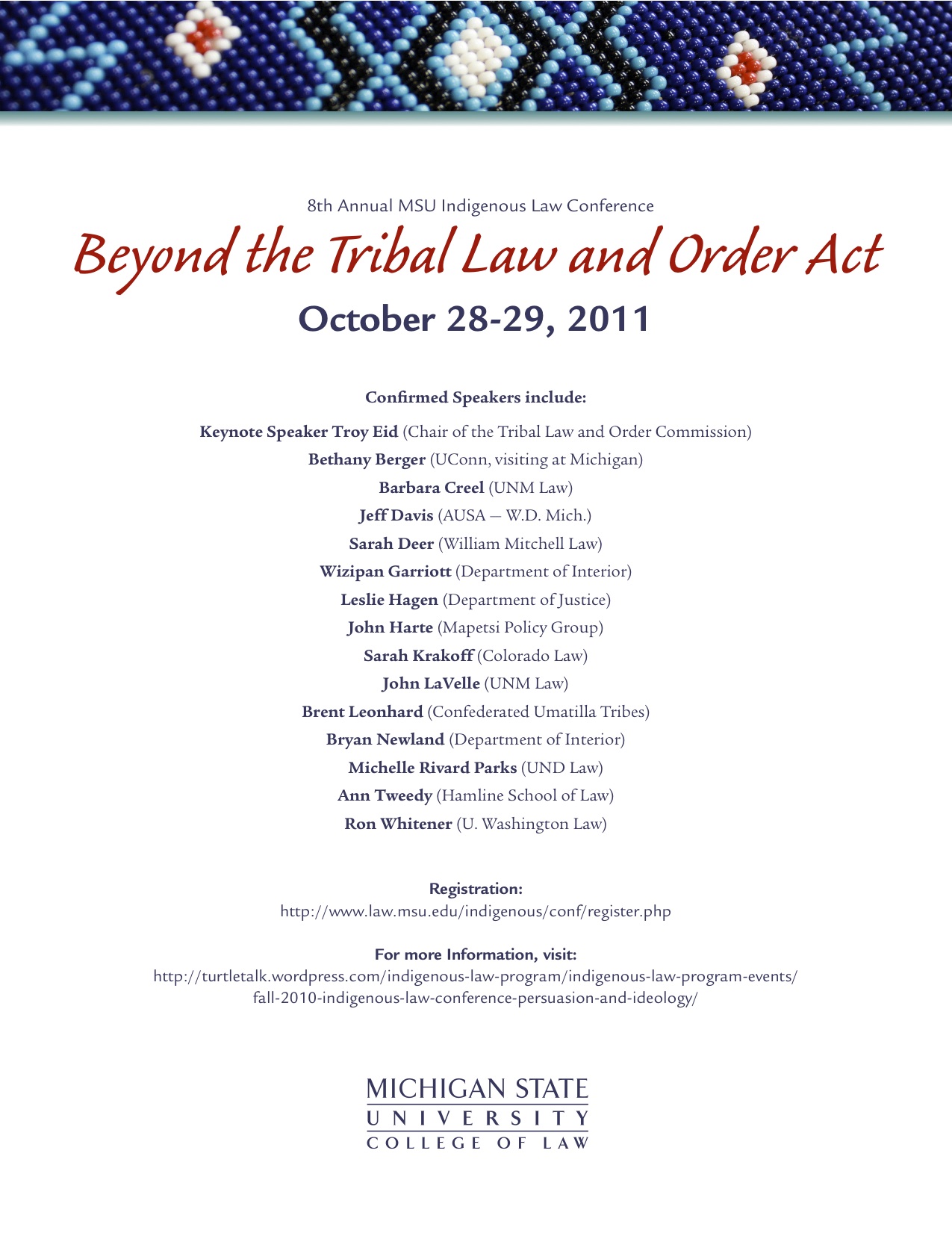
Save the Date–ILPC 8th Annual Conference on the Tribal Law and Order Act

For information, see here. Registration, see here.

Pomo of Upper Lake Explanation Letter

And one more late-Friday-before-the-holiday-(and football game–Go Green!)-document from Interior, the explanation letter from the Secretary on neither approving nor denying the gaming Compact between the Habematolel Pomo of Upper Lake and the state. The letter is here.

Four Secretarial Gaming Decisions Made Today

This information is from a press call with Asst. Sec. Larry Echohawk and Dep. Asst. Sec. Del Laverdure. A press release with fact sheets on each determination is here.

Four Indian gaming applications decisions:

1 positive Secretarial exception determination for Enterprise Rancheria of Maidu Indians, Butte Co., California, for a facility in Yuba County, California, 36 miles from existing headquarters.

1 positive secretarial exception determination for North Fork Rancheria of Mono Indians, for a gaming facility in Madera County, CA, 36 miles from tribal land base.

1 negative decision for Pueblo of Jemez, for gaming facility in Anthony, NM, nearly 300 miles from existing reservation. The decision was based on land into trust regulations, not gaming regulations. Land into trust regs require looking into use for land and distance from Pueblo. Concern was exercising actual government power over a gaming site nearly 300 miles way. Agreements with local units of government meant that local governments would be exercising the governmental power, not the Pueblo.

1 negative decision for Guidiville Band of Pomo Indians, restored for federal recognition in 1991, for gaming facility in Richmond, CA (S.F. Bay Area), more than 100 miles from gaming site. Decision was based on regulations concerning the Rancheria’s historical and modern connections to the land.

News From Indian Country Op-Ed on Cherokee Freedmen

Here.

Cherokees flee the moral high ground over Freedmen

by Robert Warrior

Cherokee Chief Chad Smith is wrong and Representative Melvin Watt (D-North Carolina) is right. As those who follow the American Indian political world know, earlier this year an overwhelming majority of Cherokee voters decided to deny descendants of the Cherokee Freedmen, freed slaves who trod the Trail of Tears with their Native American owners, rights to political enfranchisement guaranteed to them in an 1866 treaty the Cherokees signed with the United States in the aftermath of the Civil War.

***

The politics of this issue are certainly interesting—the embarrassingly low number of Cherokees, for instance, who participate in their nation’s electoral process (less than 8000 in a group of well over 150,000), the predictable way that this decision by one group exposes all American Indian nations to alienating people who have been important, reliable friends (the Congressional Black Caucus most visibly). Morality, however, has been the missing topic in the wrangling thus far, and I would argue is the basis for why it is important for everyone, especially American Indian people who have been silent thus far, to support efforts like those of Representative Watt.

The moral case against the Cherokees is straightforward. As a duly constituted nation in the nineteenth century, they legally embraced and promoted African slavery, a position they maintained after Removal to Indian Territory in the 1830s. The vast majority of Cherokees could not afford slaves, as was also the case throughout the American South, and historians of Cherokee slavery have demonstrated that some aspects of the Cherokee social world gave a different, less negative character to being enslaved by wealthy Cherokees rather than wealthy whites. Make no mistake, though. No one is on record as having volunteered to become a Cherokee slave. History records plenty of Cherokee slaves attempting to escape to freedom, as well as Cherokee slave revolts.

The institution of slavery was for Cherokees, as it has been for all people who practice it, morally and politically corruptive, and many citizens of this Native slaving nation knew it. Stories like that of the children of Shoeboots and Doll, a Cherokee slaveowner and his black concubine/wife, whose father risked his reputation as a war hero in petitioning for their recognition as Cherokees provides a picture of this ambiguity, but the cruelty, sexual violence, and physical degradation of modern slavery under Cherokees like James Vann is just as unambiguous (both are captured magnificently by University of Michigan scholar Tiya Miles in her 2005 book Ties that Bind: The Story of an Afro-Cherokee Family in Slavery and Freedom).

***

In spite of being egged on and provoked by the legislated racism of the Cherokee Nation, the vast majority of Freedmen descendants have reacted with impressive dignity befitting their proud history. Melvin Watt and other black members of Congress have likewise responded in a measured, but active way. It remains for more people, including Native American writers, scholars, and artists, not to mention elected leaders, presidents, and chiefs, to stand up and be counted on the right moral side of this question. Better yet, Chad Smith could save us all the trouble by following some of the best examples of Cherokee history rather than the morally corrupting and exclusionary ones he and his supporters have chosen thus far.

Idaho State Bar Journal, August 2011 Edition

The Advocate, the Idaho State Bar Journal, was sponsored by the Idaho Indian Law Section this month.  The entire journal (56 pages) is here.

Articles include:

Tribal Sovereignty, Jurisdiction, Zoning, and Environmental Regulations by Charissa A. Eichman

A Jury of Their Peers: Can a Native American Defendant Be Tried by a Jury of His Peers in the United States? by Jason Brown

The Native Law Program at the University of Idaho: A Third Year of Success by Angelique EagleWoman

The Tribal Law and Order Act of 2010: Toward Safe Tribal Communities by Brian P. McClatchey