Tribal Nations Conference on Talk of the Nation

A few days old, but here’s the transcript of the call-in show from just before Christmas.  The guest is James Ramos, Chair at San Manual.  Jill from LTBB called in to bring up President Bush’s flubbing of the definition of tribal sovereignty.  Here’s the excerpt:

CONAN: James Ramos is chairman of the San Manuel Band of Mission Indians, with us from California. 800-989-8255. Email: talk@npr.org. We want to hear from American Indian listeners today: What challenges do you face from the federal government? Jill is on the line, calling from Grand Rapids in Michigan. Hello, Jill, are you there?

JILL (Caller): Hi. I’m here. Hello.

CONAN: Yeah. You’re on the air. Go ahead, please.

JILL: Okay. I just want to say that I was pretty flabbergasted when President George Bush was asked what tribal sovereignty was, and all he could say was that it meant to be sovereign. I think with Obama, things are looking a little better. But tribal sovereignty is something that’s fought very hard for. My tribe wasn’t recognized, I don’t think, until 1993 or 1994. And I’m so thankful for what they did. It really opened a lot of doors for me. And I was able to go to college and so.

CONAN: Well, which tribe is that, Jill?

JILL: Little Traverse Bay Bands of Odawa Indians in Harbor Springs, Michigan.

No Surprises at SCOTUSblog This Morning

SCOTUSblog lists both Iron Thunderhorse v. Pierce and United States v. Jicarilla Apache Nation as petitions to watch in the Court’s January 7th conference.  Thunderhorse materials here and Jicarilla Apache Nation materials here.

Michigan Indians in the Civil War, Petersburg National Battlefield

From the National Parks Traveler–Eric Hemenway is quoted extensively on the next page.

H/T Indianz
American Indians in the Civil War? Petersburg National Battlefield is Part of the Story

Submitted by Jim Burnett on December 17, 2010 – 12:34am

The 150th Anniversary of the Civil War is nearly here and a recent event at Petersburg National Battlefield underscored a bit of history that often escapes much notice—the role of American Indians in the conflict.

Estimates of the number of American Indians who fought for either the Union or the Confederacy vary widely; several sources cite numbers ranging from about 6,000 to over 20,000 men. One example occurred at Petersburg, Virginia, and that story has recently received some renewed attention.

Earlier this month, descendents of Company K of the First Michigan Sharpshooters returned to the park to meet with Superintendent Lewis Rogers and his staff and pay homage to their ancestors. Company K consisted entirely of American Indians from Michigan who enlisted in the Union Army.

According to information from the park, “The 1st Michigan Sharpshooters fought valiantly in every major battle in the Petersburg campaign. The American Indians were a memorable presence at the Battle of the Crater, where they were noticed for their composure under adversity. A Union officer described watching a group of them pull their jackets over their faces and sing their death chant when trapped in the crater under Confederate fire. When Petersburg fell in April, 1865, after a nine and half month siege, the First Michigan raised the first United States flag above the city.”

It’s not hard to see how specific details about individual units get lost in the history of the Civil War, and even just at Petersburg. A park publication notes that 800 regiments of nearly 160,000 soldiers served on both sides at Petersburg. That’s a lot of history waiting to be told.

The story of the men of Company K attracted the attention of the park staff as a result of a project at Poplar Grove National Cemetery, which is maintained by Petersburg National Battlefield. The cemetery is the final resting place of over 6,000 Union Civil War soldiers, and the tombstones lie flat on the ground. The park is in the planning stages of a project to replace the stones with new, upright markers that match the original Civil War design, along with other work to rehabilitate the cultural landscape. Studies for the project revealed that some of the men of Company K were buried at Poplar Grove.

“So far, five named Indian graves have been identified, but there are probably more unnamed individuals that have not yet been identified as Indians buried here,” explained Julia Steele, the battlefield’s cultural resources manager. “Of all the amazing stories that occurred here during the war, this is one of the most striking. When we started to research the role of Company K, we were touched by how deeply they were involved in the whole campaign.”

Continue reading

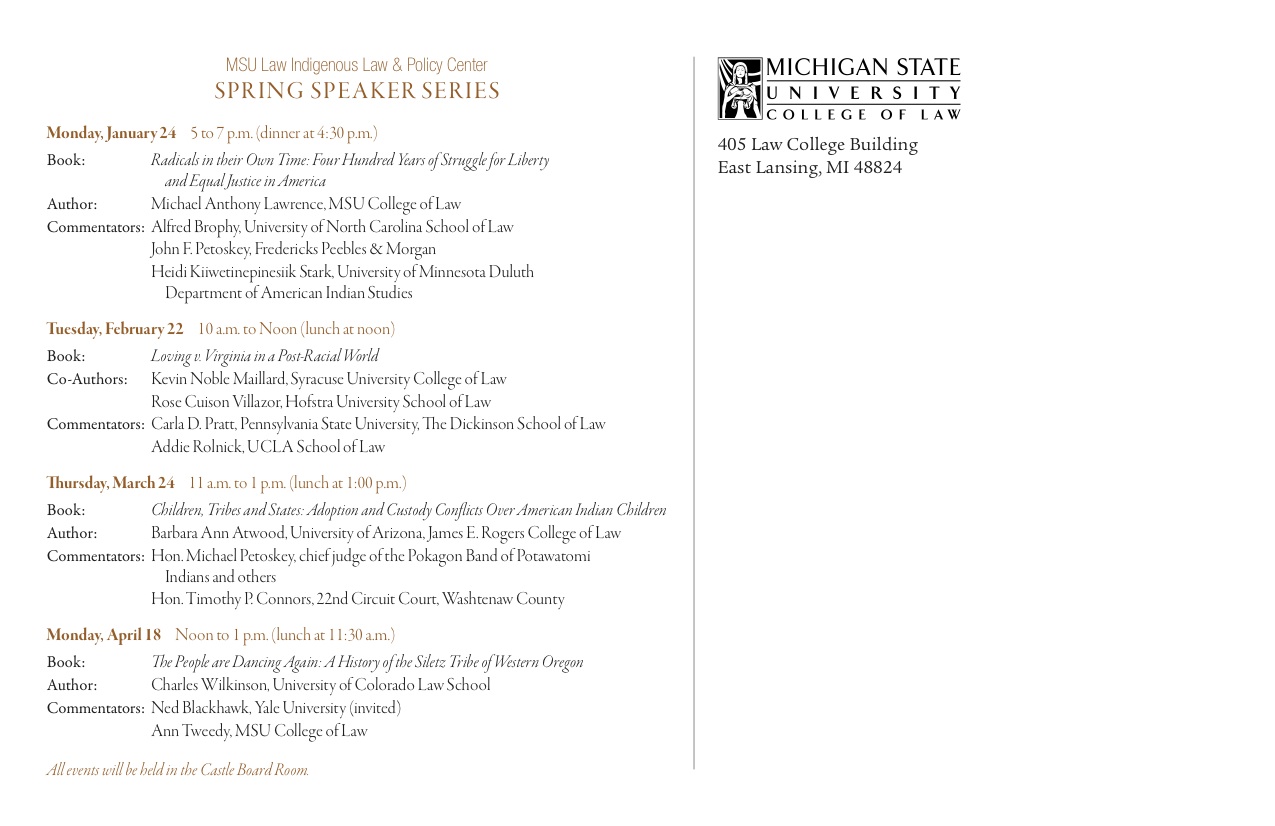
ILPC Spring Speakers Series Information

Here is our save the date card for our upcoming Spring Speakers series events.  Information will be updated here as necessary.


Update on Rincon Band case

The Supreme Court called for the views of the Solicitor General in Schwarzenegger v. Rincon Band of Luiseno Mission Indians. Previous post here. The order list is here.

SCOTUSblog Lists Rincon Band as Petition to Watch

SCOTUSblog has listed Schwarzenegger v. Rincon Band of Luiseno Mission Indians as a petition to watch in tomorrow’s conference.

Our commentary on this case is here.  Materials on the case are available at the SCOTUSblog link as well as here and here.

Asst. Sec. Echo Hawk on a Congressional Carcieri Fix

An excerpt from his op-ed in Indian Country Today this afternoon:

The Carcieri decision, and the secretary’s authority to acquire lands in trust for all Indian tribes, touches the heart of the federal trust responsibility. Without a clear reaffirmation of the secretary’s trust acquisition authority, a number of tribes will be delayed in their efforts to restore their homelands: Lands that will be used for cultural purposes, housing, education, health care and economic development.

It is important that a Carcieri fix not be tied to the issue of gaming, which is just one activity that may occur on Indian lands. Only 30 of the more than 1,350 pending land-into-trust applications before the department are for gaming purposes. At the same time, it is also important that we acknowledge the role of Indian gaming in tribal economic development.

The Indian Gaming Regulatory Act establishes the framework for regulating this activity, and has become part of the bedrock of federal Indian law over the last quarter-century. Any efforts to fundamentally alter this important law should adhere to the traditional legislative process, and allow for the full participation of all affected tribes.

Such a process is consistent with President Obama’s commitment to transparent government, tribal consultation, and the nation-to-nation relationship between the United States and Indian tribes.

I strongly object to any process that deviates from those principles, and fundamentally amends a cornerstone of federal Indian law and policy without full tribal participation.

Order in Save the Peaks v. USFS

The judge in Save the Peaks Coalition v. USFS found against the Coalition, and granted USFS’s motion for summary judgment.  The complaint is here.  Here’s the order.

Plaintiffs fail to explain how their failure to join the prior case is materially distinguishable from that of the plaintiffs in Apache Survival II, and the Court finds that Defendants will be sufficiently prejudiced to satisfy laches. Therefore, based on the particular circumstances of this case, the Court finds that Defendants have established this affirmative defense.

And here is the press release from Save the Peaks coalition:

FOR IMMEDIATE RELEASE

DATE:            Wednesday December 1, 2010

CONTACT:    Howard Shanker

928-699-3637

NOTE TO EDITORS: For a background, legal documents, photos, updates, and further information please visit:  www.TrueSnow.org . Interviews can be arranged.

District Court Rules For USFS in Save the Peaks Case
Plaintiffs will Appeal the Court’s Decision to the Ninth Circuit Court
FLAGSTAFF, AZ — The case known as The Save the Peaks Coalition, et al. v. U.S. Forest Service (USFS) was heard before Honorable Judge Mary H. Murguia and today a decision was made.

The Court ruled against the plaintiffs claims that the final FEIS prepared by the USFS ignores thorough consideration of a number of critical health issues. The plaintiffs contend that a new and thorough FEIS should be filed by the USFS. If this reveals that the use of reclaimed sewage water is a public health risk then snowmaking should not be permitted for the Arizona Snowbowl on the San Francisco Peaks.

Howard Shanker, representing the Save the Peaks Coalition and additional plaintiffs, will file an appeal to the Ninth Circuit Court. According to Shanker, “ the decision misstates the facts of this case and misapplies the law.  That’s why there is an appeal process.” Further, according to Shanker, “it is remarkable that the Obama Administration is complicitous in this effort to put treated sewer water on the San Francisco Peaks.  Not only is the site sacred to Native Americans in the Southwestern United States, the Forest Service has, at best, no idea what the long term health impacts will be on people who ingest this snow made from treated effluent.  Who figured the Snowbowl ski area was ‘too big to fail’”.
Continue reading

Attorney General Holder, Secretaries Salazar and Vilsack Applaud Final Passage of the Claims Settlement Act

From the BIA press release (and BLT’s coverage here):

Date: November 30, 2010

Contacts:
USDOJ Office of Public Affairs 202-514-2007 DOI Office of Communications 202- 208-6416 USDA Office of Communications 202-720-4623

Attorney General Holder, Secretaries Salazar and Vilsack Applaud Final Passage of the Claims Settlement Act

Washington, D.C.  – Today, the Departments of Justice, Interior and Agriculture applauded the bipartisan House passage of the Claims Settlement Act.  The Act, which recently passed the Senate, will provide long-awaited funding for the agreements reached in the Pigford II lawsuit, brought by African American farmers; the Cobell lawsuit, brought by Native Americans over the management of Indian trust accounts and resources; and four separate water rights suits made by Native American tribes.   President Obama has said that he will sign the legislation into law.

“These are truly historic settlements that do not only resolve litigation, but also offer a new relationship between many deserving Americans and the federal agencies that play an important role in their lives,” said Attorney General Eric Holder.  “Bringing this litigation to a close has been a priority for this Administration, and today’s vote in Congress is a significant, historic achievement. These cases provide fair deals for the plaintiffs and for the American taxpayers.”

“Congress’ approval of the Cobell settlement and the four Indian water rights settlements is nothing short of historic for Indian nations,” Secretary of the Interior Ken Salazar said. “The settlements honorably and responsibly address long-standing injustices and represent a major step forward in President Obama’s agenda to empower tribal governments, fulfill our trust responsibilities to tribal members and help tribal leaders build safer, stronger, healthier and more prosperous communities.”

“President Obama and I made a firm commitment not only to treat all farmers fairly and equally, but to right the wrongs in USDA’s past,” said Agriculture Secretary Tom Vilsack. “I applaud those who took this historic step to ensure black farmers who faced discrimination by their government finally receive justice. And I commend those who led this fight in the U.S. Congress and I am thankful for their unwavering determination. Today’s vote will help the Department of Agriculture move beyond this sad chapter in history.  The bill that passed the Senate and House includes strong protections against waste, fraud, and abuse to ensure integrity of the claims process. In the months and years ahead, we will not stop working to move the Department into a new era as a model employer and premier service provider. We also must continue the good work we started to resolve all remaining administrative claims.”

###

Thinking About Public Sector Unions and Tribes

Here is a review of a labor law article that has nothing to do with Indian tribes.  It does, however, look at various public sector unions rather than private sector ones.  The author researched two states with very different labor laws and how they affect the negotiations between the states and the public sector unions.  While already we know the courts have already applied the NLRA to tribal businesses, there’s no reason a tribe can’t pass labor laws to make it look more like a public sector employee if it wanted to.  Prof. Singel has already pointed out  that revenues from tribal gaming and other economic operations go toward government operations, making the tribal businesses more like a public sector employee than a private one under the NLRA.  I’ve been wondering for a while if it is even possible for tribes or tribal employees to be working with unions that understand the public sector (AFSCME, for example) rather than those accustomed to aggressive private sector negotiations (UAW, Teamsters).  There are others who can answer this question, but I still think looking at articles like this might provide a useful way to think about solutions for tribes and unions.

ETA: A person might also look at Kaighn Smith’s book coming out next year, Labor and Employment Law in Indian Country.  No spoilers, but he does discuss tribal public-sector labor relations law.