Here.
Attorney for Menominee Tribe Nominated for WI State Bar Position
Here.
Here.
Here is the case page.
And yes, the case caption should eventually change–Carter et. al. v. Tahsuda et. al. is how the U.S. brief is captioned.
The plaintiffs in the ICWA suit out of the federal court in Texas asked for time to file an amended complaint. It’s here. Case page is here.
Additional state parties are Indiana and Louisiana. Additional children involved are from White Earth and Ysleta del sur Pueblo.
A word of warning–I swore at the complaint by paragraph 4.
ETA: This interesting (related?) article out of Indiana: DCS Director Resigns
Here. This is an unpublished termination of parental rights out of the Minnesota Court of Appeals. Here is the concurrence in its entirety::
With a backdrop of historical trauma and a high number of Indian children being removed from their families and tribes by nontribal agencies, Congress passed the Indian Child Welfare Act (ICWA). See Miss. Band of Choctaw Indians v. Holyfield, 490 U.S. 30, 32-37, 109 S. Ct. 1597, 1599-1602 (1989) (detailing the background for ICWA). Government must meet a high bar to terminate a parent’s parental rights in any case. ICWA and the Minnesota Indian Family Preservation Act require an even higher standard to terminate parental rights to an Indian child: proof beyond a reasonable doubt that returning the children to the parent will likely result in serious emotional or physical harm to the child. 25 U.S.C. § 1912(f) (2016) (ICWA); Minn. Stat. § 260.771, subd. 6(a) (2016)
Scant attention was given to this high standard during trial. This is troubling. Only one witness was asked to opine on the ultimate question of proof beyond a reasonable doubt. And, as the majority points out, that witness equivocated. And even after this court remanded the case to the district court, asking the court to directly address this question, the district court did not elaborate on the critical issue. It simply amended the findings to state that “[c]ontinued custody of [the children] by [mother and father] is likely to result in serious emotional or physical damage to the Children.”
I expect more when it comes to termination of parental rights for Indian children. We all should.
Yet I concur with the majority’s decision despite my view that, based on the nature of the expert testimony, this is a close case. I concur because the majority is correct that when we dive deep into the record we see children who suffered serious emotional damage with no realistic path to a different future with their parents. I concur because the tribe was unwilling to accept a transfer of jurisdiction to tribal court. I concur because the tribe supports termination of parental rights. And, most fundamentally, I concur because these children, like all children, deserve a permanent home, without additional delay.
But I remain concerned. In a state in which out-of-home placement for Indian children far exceeds the percentage for any other group of children, we need greater diligence in adhering to the high standards dictated by ICWA and the Minnesota Indian Family Preservation Act.
Here: Interest of K.S.D. and J.S.D., 2017 ND 289
The lack of qualified expert testimony on whether the continued custody of the child by the parent or Indian custodian is likely to result in serious emotional or physical damage to the child leaves this record without evidence necessary for the district court to find the State established the ICWA requirement by proof beyond a reasonable doubt. 25 U.S.C. There is a line of authority that upholds termination of parental rights absent an ICWA qualified expert witness. We choose to follow the other branch of authority because the United States Code and the United States Code of Federal Regulations require—and do not merely suggest—that a qualified expert witness testify on the ICWA requirements in all ICWA terminations.
(Unrelated, one has to love a Court that only allows opinions to be downloaded as WordPerfect documents. That’s commitment.)
We’ve been getting a number of questions about this compact, likely due to the level and type of press coverage about it in Alaska (see here). We’ve hesitated to post on it, given all the people who know it much better than we do, but it’s important to see what this compact does and doesn’t do.
The compact is HERE (now as a searchable PDF because that’s how we do things).
The compact is, without question, a big step forward for the state of Alaska. It is the result of a lot of hard work of a lot of tribes, and opens doors that Alaska has long kept closed to tribes. There is recognition of tribal court protection and child support orders, as well as ensuring a child’s eligibility for federal funding regardless of tribal or state custody. The compact (Sec. 6.2.1) allows for the sharing of confidential information, and access to databases. This section alone are of particular importance and relevant for all tribes facing state intransigence on confidentiality and child welfare.
The compact is not the final step, however. The document provides an agreed upon framework for future negotiations between the state and individual tribes or tribal consortiums. The compact allows the state (OCS) to shift responsibility for providing services–and importantly, the related state funding–to tribal social services departments. But the compact does not address tribal jurisdiction, transfer to tribal court, or assume that if a tribal department takes over services that the tribe will take jurisdiction. Therefore, the compact doesn’t address tribal courts at all, or if state funding follows a child in to tribal court (spoiler alert: right now it doesn’t).
There are a lot of tribes in Alaska increasing their tribal court capacity right now, and it does seem the next step would be for tribes to exercise jurisdiction over their children without losing the funding due to those children as state citizens. It will also be interesting to see the individual tribal/tribal consortium compacts that address the details of how the services will be divided between the state and tribe.
Coverage of some of the tremendous problems with Canada’s foster care system.
According to a report from B.C.’s representative for children and youth, although Indigenous children are less than 10 per cent of the population, they account for 62 per cent of children in government care.
California Tribal Families Coalition, News Release Tribal Coalition Urges Attorneys General to Protect Tribal Children
A coalition of California tribes and leaders today urged state attorneys general across 18 states and U.S. territories to stand with tribes in support of the Indian Child Welfare Act (ICWA) as it faces an outrageous legal challenge that seeks to unwind decades of critical legal protections for tribal children and families.
The letter sent on November 4, 2017 by the Sacramento-based California Tribal Families Coalition to the Conference of Western Attorneys General comes on the heels of an Oct. 25th federal lawsuit filed by the State of Texas and two foster care parents challenging the constitutionality of the ICWA.
California Daily Journal, Critics Distort Indian Child Welfare Law.
Law 360, New Indian Child Welfare Act Challenges On The Horizon
The Texas v. Zinke documents are here.
(I have seen and am choosing not to post the recent National Review op-ed by Tim Sandefur.)
Opinion here. The Colorado Court disagrees with holdings in Montana and Michigan on the same issue–what does a qualified expert witness have to say for it to count under 25 U.S.C. 1912(f).
Congress’s primary reason for requiring qualified expert testimony was to prevent courts from basing decisions “solely upon the testimony of social workers who possessed neither the specialized professional education nor the familiarity with Native [American] culture necessary to distinguish between cultural variations in child-rearing practices and actual abuse or neglect.” Steven H., 190 P.3d at 185 (quoting L.G. v. State, 14 P.3d 946, 952- 53 (Alaska 2000)). This purpose would not necessarily be furthered by a requirement that an expert witness recite the precise language of 25 U.S.C. § 1912(f).
***
Although [the Regulations and Guidelines] emphasize the need for a qualified expert witness to offer testimony supporting a finding regarding likely damage to the child, they stop short of demanding a verbatim recitation of the statutory standard by the expert.
***
Additionally, the Department presented testimony from a
qualified expert witness under ICWA — a social worker with Navajo Children and Family Services. The social worker did not directly opine that the child would suffer damage in mother’s care. Rather, when asked to give her opinion regarding whether the child would suffer serious emotional or physical harm if returned to a parent, the social worker indicated that mother had not fulfilled the treatment requirements to address the reasons for the child being placed in the Department’s custody. The social worker also testified that the recent domestic violence issues between the parents were concerning.
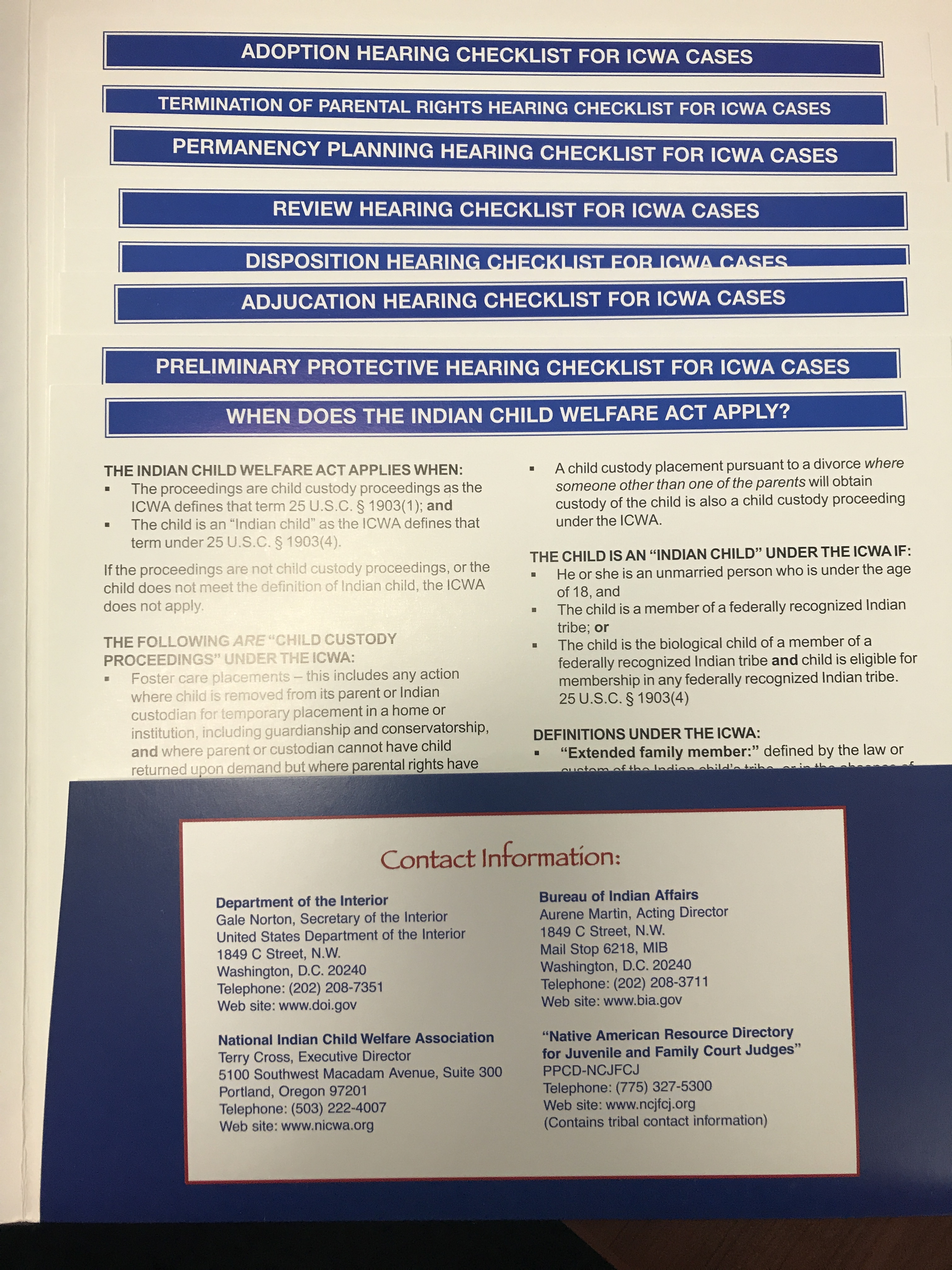
Last published in 2003 as bench cards, NCJFCJ has issued a new and improved ICWA bench book for judges. There are a few of you who have been asking me about these weekly–here they are!
Press release here
NCJFCJ_ICWA_Judicial_Benchbook_Final_Web
New!

Old!
 Turtle Talk
You must be logged in to post a comment.