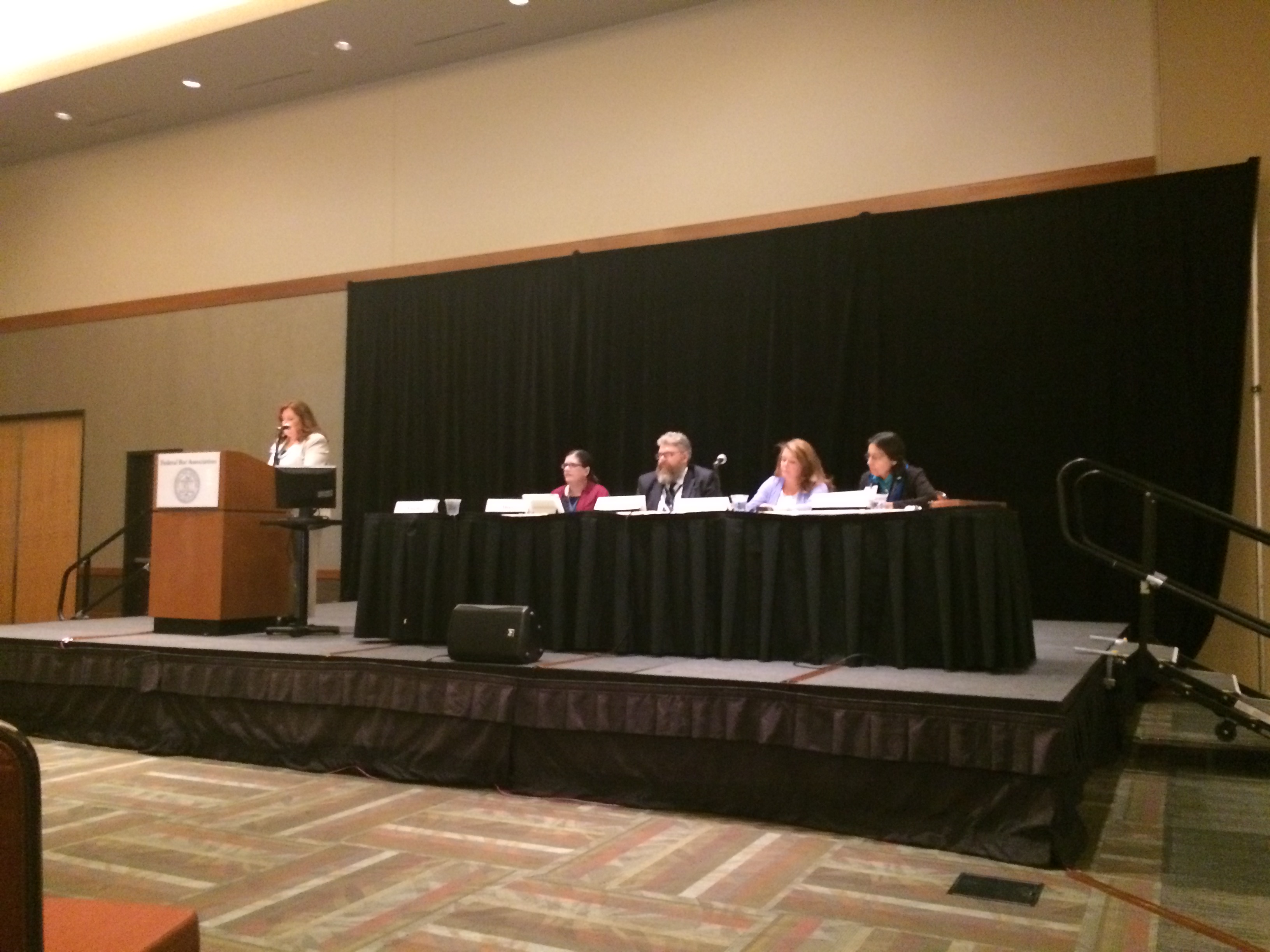
Moderator: Helen Padilla
Panelists: Sarah Deer (Geeeeenius), Brent Leonhard, Jill Tompkins, Gloria Valencia-Weber
Moderator: Helen Padilla
Panelists: Sarah Deer (Geeeeenius), Brent Leonhard, Jill Tompkins, Gloria Valencia-Weber

The 45 page order granting partial summary judgment is HERE, with a judgment order granting injunctive and declaratory relief forthcoming in May.
The court finds that Judge Davis, States Attorney Vargo, Secretary Valenti and Ms. Van Hunnick developed and implemented policies and procedures for the removal of Indian children from their parents’ custody in violation of the mandates of the Indian Child Welfare Act and in violation of the Due Process Clause of the Fourteenth Amendment to the United States Constitution.
The case directly addressed section 1922 emergency removal standard of evidence and return of the child; and due process claims at those emergency hearings (48-hour hearing) of notice, the right of parents to present evidence, to cross-examine witnesses, attorney representation, and a decision based on evidence at that hearing.
Among many other things, the judge addresses both the old and new Guidelines (which specifically mentioned this case):
A simple examination of these administrative materials should have convinced the defendants that their policies and procedures were not in conformity with ICWA § 1922, the DOI Guidelines or the Guidelines promulgated by the South Dakota Unified Judicial System. Indian children, parents and tribes deserve better.
The order grants summary judgment on the ICWA violations AND the Due Process ones:
Judge Davis and the other defendants failed to protect Indian parents’ fundamental rights to a fair hearing by not allowing them to present evidence to contradict the State’s removal documents. The defendants failed by not allowing the parents to confront and cross-examine DSS witnesses. The defendants failed by using documents as a basis for the court’s decisions which were not provided to the parents and which were not received in evidence at the 48-hour hearings.
This is amazing–congratulations and many thanks to all involved. Especially to the families.
Previous coverage here. Summary judgment briefs and exhibits here.
Via NICWA.
Link here.
Indian tribes developing title IV-E foster care programs faced resource constraints and reported challenges adopting some program requirements. According to GAO’s interviews with tribal and Department of Health and Human Services (HHS) officials, the resource constraints faced by tribes include limited numbers of staff and staff turnover. While the Fostering Connections to Success and Increasing Adoptions Act of 2008 (Fostering Connections Act) allows tribes to administer a title IV-E foster care program, it generally did not modify title IV-E’s requirements for tribes. By contrast, some other programs administered by HHS offer tribes additional flexibilities, provided they are consistent with the objectives of the program. Given tribes’ resource constraints and cultural values, adopting some title IV-E requirements has been difficult. For example, officials from 6 of 11 tribes developing title IV-E programs that GAO interviewed said that the requirement to electronically submit case-level data on all children in foster care was challenging. In addition, 7 of these 11 tribal officials reported that incorporating termination of parental rights—which severs the legal parent-child relationship in certain circumstances—into their tribal codes was challenging because it conflicts with their cultural values. HHS recognizes that termination of parental rights may not be part of an Indian tribe’s traditional beliefs; however according to the agency it lacks the statutory authority to provide a general exemption for tribal children from the requirement.
Report here (pdf, 47 pages)
We’ve written about this in the past. Here is a letter from NICWA explaining more about the regulations, and the reason for written comments (and if you scroll to the bottom, they’ve even provided a sample comments letter):
Dear Advocates for the Indian Child Welfare Act,
The National Indian Child Welfare Association has been diligently working for over 25 years to increase state compliance with the Indian Child Welfare Act (ICWA). This has included training of state and tribal workers, helping tribes develop inter-governmental agreements with states, participating in state and federal ICWA cases, and advocating for federal monitoring of state ICWA compliance. One of the areas where the greatest need exists is data collection. No federal agency collects comprehensive data on the status of native children and their families who are involved in state child welfare proceedings and subject to ICWA.
NICWA has advocated for the Administration for Children and Families (ACF) under the Department of Health and Human Services to collect ICWA data on individual cases, both because of the relationship they have with states through funding and policy, and because of federal law and policy that directs them to collect some related data. ACF has resisted efforts to collect more comprehensive ICWA data in the past, but draft regulations published in the Federal Register on February 9, 2015 propose collecting new data within the federal government’s largest data system for children who are placed in out of home care by state or county child welfare authorities. This system is the Automated Foster Care and Adoption Reporting System (AFCARS) and these proposed regulations present the best opportunity for tribal nations to finally convince ACF to collect ICWA data.
NICWA is making the case that these proposed regulations should also include ICWA data elements, which are open for public comment until April 10, 2015, but we need your help if we are going to convince ACF to do this. The process for evaluating comments and what changes should be made in AFCARS will look at the number of individual comments ACF receives as well as the content of those comments. In other words, if we are able to provide ACF with substantial numbers of comments that recommend the inclusion of ICWA data elements in AFCARS, we may finally have a federal data system that regularly collects and tracks ICWA data. To make your job of filing comments easier, NICWA has provided a sample comments letter that you can use or modify as you see fit. We are also providing instructions below on how to file your comments electronically.
This is an almost a once in a lifetime opportunity to finally get a more comprehensive collection of ICWA data. The last time AFCARS was open for substantive changes was in the early 1990’s so we probably won’t see another opportunity like this for many, many years. NICWA will be filing comments, but we also need your help too. If you have any questions about AFCARS, the proposed regulations, or how this will help ICWA compliance, please don’t hesitate to contact either myself or Addie Smith addie@nicwa.org. I want to thank you in advance for your help to increase the information and tools we have to increase protections under ICWA for our native children and families.
Best Regards,
David Simmons
Notice of Public Rulemaking on AFCARS
http://www.gpo.gov/fdsys/pkg/FR-2015-02-09/pdf/2015-02354.pdf
Instructions on how to file comments electronically via www.regulations.gov (see link below for submission)
http://www.regulations.gov/#!submitComment;D=ACF-2015-0001-0001
David Simmons, MSW | Director of Government Affairs and Advocacy
National Indian Child Welfare Association
5100 SW Macadam Avenue, Suite 300
Portland, OR 97239
Here.
OJJDP is seeking a Tribal Youth Program training and technical assistance provider to provide culturally, trauma-informed, and developmentally appropriate training; support, resources; information; and other related technical assistance to all OJJDP tribal program grantees and federally recognized tribes across the nation. When allocating resources, OJJDP-funded tribal program grantees would receive priority. The successful applicant will develop culturally specific training and technical assistance for tribes seeking to build capacity to develop, expand, improve and/or maintain their juvenile justice systems. Priority areas include juvenile healing-to-wellness courts, tribal youth-specific prevention, intervention, and treatment programming and tribal-state collaborations to meet the needs of American Indian/Alaska Native children exposed to violence. The successful applicant will collaborate closely with OJJDP’s other training and technical assistance efforts andproviders.
On average we receive around a case a day out of California that mentions ICWA, and usually in the notice context. We don’t post all of them, and the vast majority of them are unpublished. But over the last couple of days, we’ve received two that demonstrate the large inconsistencies across the state when it comes to determining if the child is an Indian child, and notice procedures. Neither of these cases are outliers from the hundreds that go up each year, other than the difference in treatment caught our eye. This also demonstrates the difficulty in identifying exactly where additional resources need to be dedicated to ICWA enforcement–it’s not on a fifty state level, it’s on a county-by-county level.
In the first, out of the First Appellate District (Del Norte County) mother says her grandma told her their family may be from the “Comanche Nation.” Notice went out to Comanche, and the Nation said the child was not eligible for enrollment. However, on appeal, the court found
As noted, the only information the Department provided for the maternal grandmother—Nina’s mother—was her name and an incomplete address (“Grant’s Pass,Oregon”). The record contains evidence,however, suggesting that with a minimal amount of inquiry, the Department would have been able to obtain additional information regarding the grandmother. First, the family was involved in a dependency proceeding when Nina was a minor. By its own admission, the Department reviewed that file as part of the instant proceeding and, at a very minimum, would have been able to glean the grandmother’s date of birth, which was unquestionably in the file. This directly refutes the Department’s claim that “there is no indication that the social worker left out any available information.”
***
It was incumbent upon the Department to interview her extended family members to obtain whatever further details it could about the family’s Native American heritage.
In the second case, out of the Fourth Appellate District (San Diego County), mother said her family was affiliated with the “Winnebago Sioux tribe in Decorah, Iowa.” The social worker talked to mother and grandmother about it, and found “no one in the family ever lived on a reservation, attended an Indian school, participated in Indian ceremonies or received services from an Indian health clinic.” The court found
We conclude that proper inquiry was conducted to determine whether K.P. was a Native American child within the meaning for ICWA. The court questioned mother and her mother concerning the family’s Native American heritage. According to these relatives, no family members had ever been registered or eligible for enrollment with a tribe and the court was not required to give notice.
In both cases, the claims were attenuated. But regardless, the claims received very different treatment between the two trial courts–in the first, where the Department did not do enough inquiry, notice at least went out to the Comanche Nation. In the second, no one notified Winnebago (nor Ho-Chunk, for that matter), nor allowed either Nation to determine whether this family might be related. And then on appeal, both received very different treatment from the appellate courts. In the first, the court had to do better notice. In the second, the court didn’t have to do any notice.
Here.
Appellant, Grand Traverse Band of Ottawa and Chippewa Indians (the “tribe”), appeals by leave granted the circuit court’s order denying its request to transfer adoption proceedings to the tribal court pursuant to section 7 of Michigan’s Indian Family Preservation Act (the “MIFPA”), MCL 712B.1 et seq. We conclude that the circuit court committed error warranting reversal in denying the tribe’s request to transfer these proceedings to the tribal court under MCL 712B.7(5). The statute only permits the circuit court to deny a transfer request in two instances, and the circuit court improperly construed the statute to give it greater authority to deny a transfer. We therefore reverse and remand for further proceedings consistent with this opinion.
The long analysis of, and comparison with, the Guidelines is already outdated, as the updated Guidelines (and proposed rule) are more inline with the Michigan Indian Family Preservation Act on when a request for transfer to tribal court can be made and when it can can occur. Ultimately, the COA decided this on a plain language analysis. MIFPA allows denial of transfer in exactly two situations–no tribal court, and undue hardship to present evidence. Given the tribal court in this case was about 5 miles from the state court, the denial of transfer–based on a best interests analysis–just didn’t comply with state law.
Given yesterday’s announcement about the proposed ICWA rules, here is a quick and general guide to how a proposed rule becomes a part of the Code of Federal Regulations (CFR). Here is the Federal Register Tutorial: What it is and how to use it (you know you want to know the historical background of the Federal Register Act).
There is also a lot of information over at the Cornell Legal Information Institute’s Regulation Room on what federal rule making is, and what makes for effective comments.
Press release here:
In keeping with President Obama’s commitment to supporting Indian families and building resilient, stable and thriving tribal communities, Assistant Secretary – Indian Affairs Kevin K. Washburn today announced that the Bureau of Indian Affairs (BIA) has published a proposed rule to govern the implementation of the Indian Child Welfare Act of 1978 (ICWA) by state courts and child welfare agencies. The proposed rule also includes changes to current regulations that govern notice to state agencies under ICWA.
“The Bureau of Indian Affairs’ proposed rule clarifies and strengthens implementation of the Act’s requirements in Indian child custody proceedings to ensure that Indian families and tribal communities do not face the unwarranted removal of their youngest and most vulnerable members,” Washburn said. “I want to thank all those who attended listening sessions and provided comments and recommendations for our updated guidelines. Their contributions helped inform this proposed rule, which seeks to protect Indian children and families. We look forward to receiving more comments and feedback throughout the rulemaking process.”
The Department will be conducting tribal consultations and public meetings on the proposed rule through May 2015 to facilitate input and comment on the proposed rule. Tribal consultations are open only to representatives of federally recognized Indian tribes. Public meetings are open to everyone.
The public and tribal hearings times and locations are listed on the press release. It looks like the first public one is in Portland during the NICWA conference. Written comments will be due 60 days after publication (3/20/15).
These are different from the recently released Guidelines in that they would be binding–not persuasive–authority.
Pre-publication regulations here. 55 pages long. From the overview–
This proposed rule addresses ICWA implementation by State courts and child welfare agencies, including updating definitions, and replacing current notice provisions at 25 CFR 23.11 with a proposed new subpart I to 25 CFR part 23. The proposed new subpart also addresses other aspects of ICWA compliance by State courts and child welfare agencies including, but not limited to, other pretrial requirements, procedures for requesting transfer of an Indian child custody proceeding to tribal court,
adjudications of involuntary placements, adoptions, and termination of parental rights, voluntary proceedings, dispositions, and post-trial rights.For example, the proposed rule clarifies ICWA applicability and codifies that there is no “Existing Indian Family Exception (EIF)” to ICWA. Since first identification of the EIF in 1982, the majority of State appellate courts that have considered the EIF have rejected it as contrary to the plain language of ICWA. Some State legislatures have also explicitly rejected the EIF within their State ICWA statutes. When Congress enacted ICWA, it intended that an “Indian child” was the threshold for application of ICWA.
The Department agrees with the States that have concluded that there is no existing Indian family exception to application of ICWA. The proposed rule also promotes the early identification of ICWA applicability. Such identifications will promote proper implementation of ICWA at an early stage, to prevent–as much as possible—delayed discoveries that ICWA applies
Federal Register site here.
 Turtle Talk
You must be logged in to post a comment.