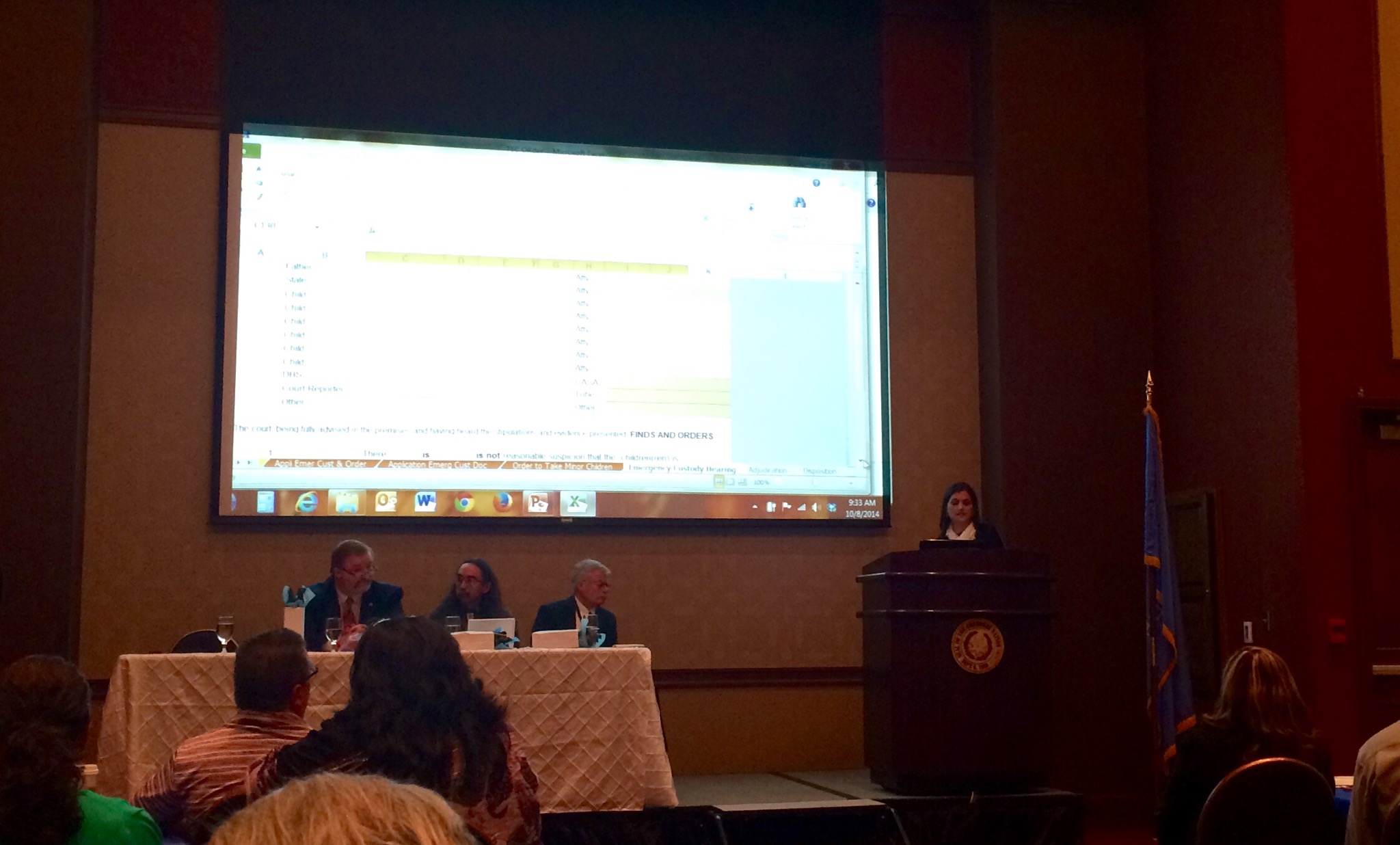
Navajo Nation Supreme Court Decision in Tsosie v. Deschene

Opinion here.

Based on the foregoing, by majority decision, the Court hereby enters a Permanent Writ of Mandamus against the Respondents. Under its administrative duties to implement the Election Code, the NEA is ordered to comply with 11 N.N.C. 44. The ballots are to be immediately reprinted without the name of the disqualified candidate, Christopher C. Deschene. It is unavoidable that the November 4, 2014 election must be postponed as agreed to by the Chief Legislative Counsel, and as permitted by 11 N.N.C. 3 to ensure a valid election.

Briefs posted here.

Unpublished Expert Witness Case out of Nebraska

Here.

In this case, the State called Patterson to testify that returning Eyllan to Nathaniel’s care was likely to result in serious emotional or physical damage to him. Patterson is currently employed as a school psychologist. Her educational background includes an education specialist degree and a bachelor’s degree in social work. Previous to her current employment position, she has worked as a social worker who specialized in and worked exclusively with Native American families. As a part of this employment, she provided expert testimony in NICWA cases, developed activities for children living outside of their tribe to maintain “cultural connectiveness,” and worked with tribes to facilitate enrollment of Indian children. In addition,Patterson has experience providing parental supervision, parenting education, and in-home counseling for Native American families. Patterson testified that she continues to have knowledge of “the prevailing social and cultural standard for rearing children within the Native American community.” She also indicated that she has experience with the Sioux Tribe, which is the tribe in which Eyllan is eligible for enrollment.

One side note–the Nebraska Court of Appeals only cites to the Nebraska ICWA rather than the federal ICWA (they do also cite to the BIA Guidelines via an NE Supreme Court case). Without reading through the whole statute, the state version does appear to essentially mirror the federal one. However, this week I had a conversation about how important it turned out to be for Michigan, specifically regarding investment in state education and state training on ICWA issues, to have a state ICWA law passed. Cases like this reinforce that belief.

White House Announces 2014 Tribal Nations Conference

The White House press release:

THE WHITE HOUSE

Office of the Press Secretary

FOR IMMEDIATE RELEASE

October 20, 2014

President Obama Announces 2014 White House Tribal Nations Conference

WASHINGTON, DC – On Wednesday, December 3, President Obama will host the 2014 White House Tribal Nations Conference at the Capital Hilton in Washington, DC. The conference will provide leaders from the 566 federally recognized tribes the opportunity to interact directly with the President and members of the White House Council on Native American Affairs. Each federally recognized tribe will be invited to send one representative to the conference. This will be the sixth White House Tribal Nations Conference for the Obama Administration, and continues to build upon the President’s commitment to strengthen the government-to-government relationship with Indian Country and to improve the lives of Native Americans. Additional details about the conference will be released at a later date.

###

Office of Public Affairs – Indian Affairs
Office of the Assistant Secretary – Indian Affairs
U.S. Department of the Interior
1849 C St., N.W., MS-3658-MIB
Washington, D.C. 20240
Main Phone: 202-208-3710
Press Line: 202-219-4152
as-ia_opa@bia.gov


Veterans Courts Panel at NAICJA

ILPC’s own Peter Vicaire presents with Magistrate Paul Warner, Dr. Elise Taylor, Judge Nightingale, and Carol Wild Scott.

FullSizeRender

Oklahoma Tribal & State Judges ICWA Panel at NAICJA

Justice Hagar, Judge Bigler, Judge Denney, and Judge Brown.

IMG_4665.JPG

Unpublished Notice Case out of California

We don’t post all of the unpublished ICWA notice cases, but they are obviously still out there. An appellate court cannot determine if ICWA notice has happened if there is nothing in the record at the trial court level:

Nor can we find that the error was harmless. While father filed an ICWA–020 form indicating that he was not aware of any Indian ancestry, no such form appears in the record with respect to appellant. Similarly, the record contains no copies of either the certified notices sent to the Cherokee tribes in 2009 or 2010 or any responses from those tribes. Finally, it does not appear that any proof of the juvenile court’s ICWA finding from the prior matter was submitted to the juvenile court in this matter. Consequently, it was not possible for the juvenile court in the present case to assess the propriety of the notice given, whether all three federally recognized Cherokee tribes received notice, whether either of the two Cherokee tribes besides the Cherokee Nation responded, or precisely what the juvenile court’s finding that ICWA did not apply was based on. (Cf. In re Jennifer A. (2002) 103 Cal.App.4th 692, 703 [finding prejudicial error where Agency stated in a report that it had sent notices to tribes in compliance with ICWA, but no evidence was presented to juvenile court concerning Agency’s communications with tribes].)


Case here.

NIGC Fall/Winter Internship

Deadline to apply is October 17th. Here.

The National Indian Gaming Commission’s Office of General Counsel is seeking applicants for a paid intern position for the winter/spring of 2015 in Washington, DC. The Office of General Counsel’s internship program is for students who have completed at least their first year of law school. The intern is expected to work at least 40 hours per week.


Montana ICWA Case: Notice, Active Efforts and a Look at Adoptive Couple Citations

Here.

A footnote in the case,

The record does not clarify whether G.S. ever had custody of M.S. The record is silent regarding G.S.’s relationship with M.S. prior to his incarceration. We recognize that 25 U.S.C. 1912(d) does not apply where the “breakup of the Indian family” has long since occurred. In re J.S., 2014 MT 79, P29, 374 Mont. 329, 321 P.3d 103 (citing Adoptive Couple v. Baby Girl, 570 U.S. __, 133 S.Ct. 2552, 2559 (2013)). Although the District Court asked during the April 22, 2013 hearing, before Baby Girl was decided, how the ICWA standard for termination applies in a situation where the child was never in the parent’s custody, the parties did not dispute that ICWA’s active efforts were required. Because this potential issue was not raised, we will not address it in this appeal.

got me looking for other cases that have cited Adoptive Couple. According to Westlaw, that would be 19 cases, including this one. Striking four of them as not child welfare cases, all 15 remaining were involuntary proceedings. Five from California, two from Montana, and one in Alaska, Nebraska, Oklahoma, North Carolina, North Dakota, Minnesota, Michigan, and Virginia.  Three cases “distinguished” Adoptive Couple, though that included the Alexandria P. case, so distinguishing Adoptive Couple doesn’t necessarily mean the court followed ICWA. Seven of the cases only cited the case (including this one).

Those that used the Adoptive Couple reasoning (instead of citing the case for fairly standard ICWA language)  include:

Native Villiage of Tununak v. State (holding that the adoption preferences of ICWA didn’t apply if the preferred placement didn’t “formally” move to adopt the child);

In re J.S. (applying the “continued custody” reasoning to a guardianship); and

In re Elise W. (discussing whether the case would change notice requirements when a parent never had custody)(unpublished case out of California’s First District).

In re T.S. (discussing when active efforts must start, in light of 1922 and 1912(d))

Report on Child Welfare from the Manitoba Chiefs Association

Article here.

Report  here

NICWA Annual Conference Call for Presentations

Here.

Deadline is Nov. 7th.