After an ugly loss like this (it’s never good when the judge says you “blatantly misstate[d]” the law), maybe it’s time for a Fat Bastard burger from the Wicked Sister in the Sault. (It’s an unsolicited, unpaid ad — I just love this description. . . .)
After decades of abuse through family regulation, Congress enacted the Indian Child Welfare Act of 1978 (“ICWA”) to prevent the breakup of Indian families and promote tribal sovereignty. While ICWA seems like an outlier that addresses one category of children, it is not an outlier. Rather, I argue that ICWA is a tool of reproductive justice. By formulating a legal rights framework for reproductive justice in American jurisprudence, I discuss how the reproductive justice movement is grounded in U.S. law beyond the right to terminate a pregnancy that the Supreme Court abrogated in Dobbs v. Jackson Women’s Health Organization. By looking at the history of reproductive rights in American Indian communities, I discuss how family regulation challenges reproductive rights and tribal sovereignty considering Dobbs and Oklahoma v. Castro-Huerta. Indian child removals exist in the same history, context, and policy that disrupted the reproductive rights of American Indian families and tribal sovereignty in other areas. Before concluding that ICWA is still good law and good policy to disrupt family regulation and protect the reproductive rights of American Indian peoples, I consider where challenges to ICWA in Haaland v. Brackeen fit into this paradigm and the ongoing need for the protection of tribal sovereignty and reproductive rights for American Indian peoples. For nearly 400 years, the disruption of reproductive rights, including family regulation, has been at the heart of federal Indian policy. The current frame of family regulation as “saving” children means that it is often divorced from the notion of reproductive rights. As the history behind and contemporary challenges to ICWA demonstrate, it should not, and cannot, be separated from the other reproductive justice issues facing American Indian communities. To strengthen legal protections for American Indian people that disrupt these government interventions, like ICWA, is to realize reproductive rights more fully in the United States.
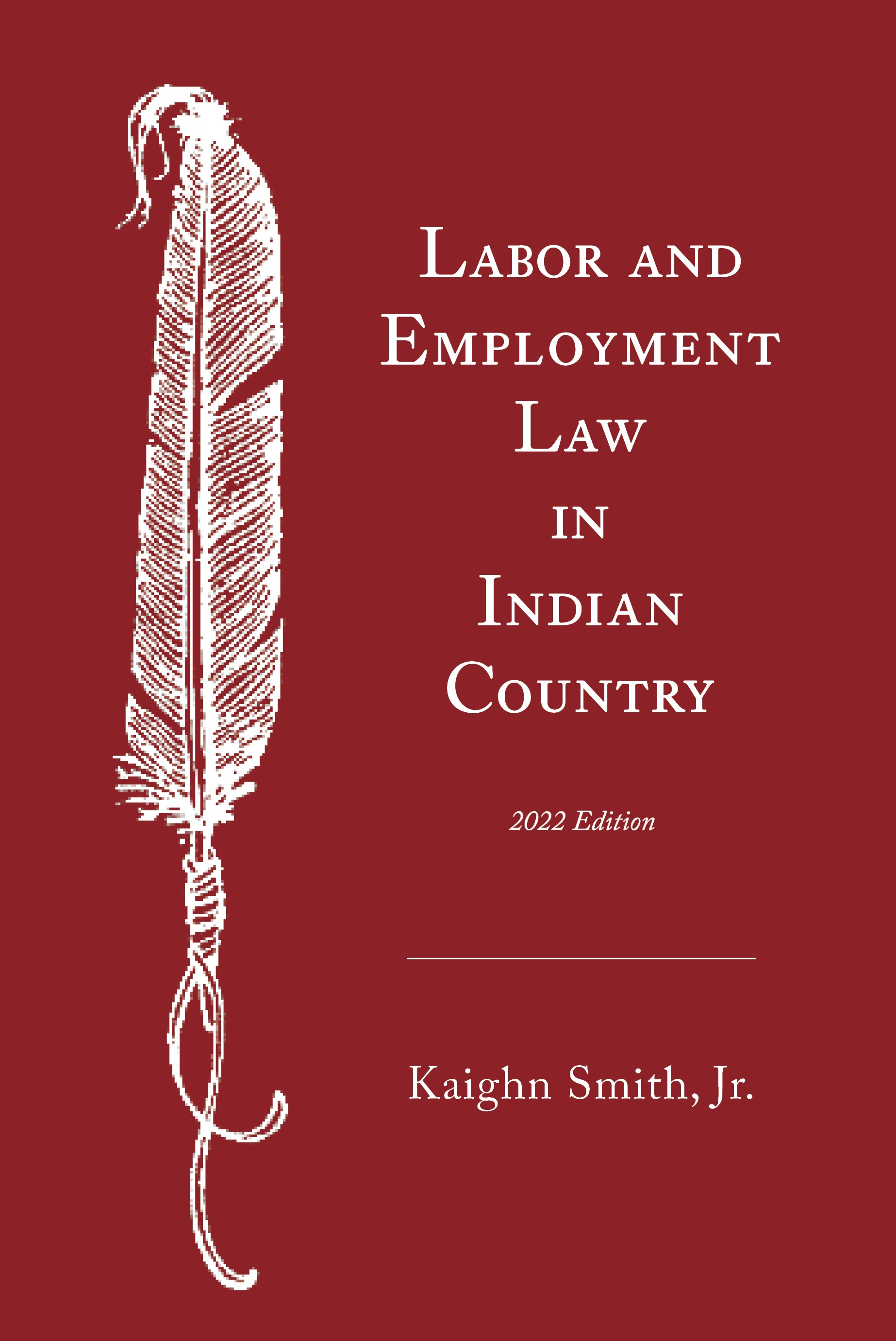
Eleven years after the first edition of this book, labor and employment law in Indian country remains a critical battleground for tribal sovereignty. We have fully updated this book with a decade’s worth of new developments.
Labor and Employment Law in Indian Country, 2022 Edition, provides a comprehensive overview of the law governing labor and employment relations in Indian country. This is a growing, controversial, and complex area of law, implicating fundamental principles of tribal sovereignty at every turn. It is a must-read for anyone involved in Indian affairs today.
The author, Drummond Woodsum attorney, Kaighn Smith, Jr., represents Indian tribes in tribal, state, and federal courts, including the U.S. Supreme Court. He and his colleagues at Drummond Woodsum’s Tribal Nations Labor and Employment Group have assisted tribes in enacting, implementing, and defending some of the first comprehensive labor and employment laws in Indian country.
Editorial Reviews
“The business of tribal sovereignty starts with tribal government. Labor and Employment Law in Indian Country is a standard-bearer for the development of modern tribal government. It should be on the bookshelf of every tribal lawyer.”
– Matthew L.M. Fletcher, Harry Burns Hutchins Collegiate Professor of Law and Professor of American Culture, University of Michigan,Founder of Turtle Talk
“Labor and Employment Law in Indian Country takes a complex and critically important subject for all Tribal Nations and lays it out in an easy-to-understand manner that balances both the big-picture outlook and the, oftentimes, gritty details that come with any law topic. This book is an essential read for all tribal leaders, tribal attorneys, tribal code drafters, as well as human resources and upper management personnel. . . .”
– Fawn Sharp, Vice President of the Quinault Indian Nation & President of the National Congress of American Indians
This year (2022), the Supreme Court agreed to review wide-ranging constitutional challenges to the Indian Child Welfare Act (ICWA) brought by the State of Texas and three non-Indian foster families in the October 2022 Term. The Fifth Circuit, sitting en banc, held that certain provisions of ICWA violated the anticommandeering principle implied in the Tenth Amendment and the equal protection component of the Fifth Amendment’s Due Process Clause. We argue that the anticommandeering challenges against ICWA are unfounded because all provisions of ICWA provides a set of legal standards to be applied in state which validly and expressly preempt state law without unlawfully commandeering the States’ executive or legislative branches. Congress’s power to compel state courts to apply federal law is long established and beyond question. Yet even if some provisions of ICWA did violate the Tenth, we argue that Section 5 of the Fourteenth Amendment sufficiently authorizes Congress’s enactment of ICWA so as to defeat the anti-commandeering concerns. Strangely, no party ever invoked Congress’s power under Section 5 of the Fourteenth Amendment to assess its constitutionality. ICWA seems like an obvious candidate for analysis under Congress’s enforcement powers under Section 5. States routinely discriminated against American Indian families on the basis of their race and ancestry (and their religion and culture), and ICWA is designed to remedy the abuses of state courts and agencies. We further have no doubt that the state legislatures that adopted ICWA in whole, in part, or as modified also possessed the power to do so, even in the event the Supreme Court holds all or portions of ICWA unconstitutional.
For over two hundred years the “whole course of judicial decision” in the United States has recognized that American Indian tribes possess inherent sovereignty to govern their lands and people. Federal recognition of that sovereignty was memorialized in countless treaties, congressionally ratified agreements, and executive orders setting aside reservations throughout the United States. Throughout that same period, and with only minimal exception, the judiciary faithfully applied those treaties to protect tribal property rights, recognize tribal sovereignty, and to bar states from imposing jurisdiction within Indian Country.
The jurisprudence in this arena has shifted, however, over the past few decades. Although the Supreme Court continues to faithfully apply its longstanding treaty analysis to protect tribal property rights, it has moved away from using that same analysis when evaluating tribal sovereignty and the scope of state jurisdiction in Indian Country. Instead, as demonstrated by its recent decision in Oklahoma v. Castro-Huerta, the Court has articulated a preemption test that is determined by judicial balancing of the tribal, federal, and state interests in the subject matter the state seeks to regulate. The approach has long been criticized for allowing courts to usurp the legislative power of Congress to make policy in federal Indian law in order to “reach outcomes consistent with their own notions of how much tribal autonomy there ought to be.” The purpose of this article is to establish that this so-called balancing test has no basis in the foundational principles of federal Indian law. Instead, the broad sweep of the field demonstrates that tribal freedom from state jurisdiction within Indian Country should proceed as a treaty right analysis.
That analysis requires courts to determine whether the treaty at issue preempts state law within the reservation. In making that determination, courts must interpret the treaty consistent with background principles of tribal sovereignty, which necessitates that ambiguities be resolved in favor of the tribe and that any sovereignty not expressly ceded has been retained. Applying these principles, the Supreme Court has repeatedly found that the treaty right to a “permanent home” implicitly included the right for tribes to “govern themselves, free from state interference.” Once established, a treaty right may only be taken away by Congress. Once again, however, there remains a strong presumption against the abrogation of tribal sovereignty. Thus, the Court has consistently required there be “clear evidence that Congress actually considered the conflict between its intended action on the one hand and Indian treaty rights on the other, and chose to resolve that conflict by abrogating the treaty.”
This article seeks to demonstrate that the Court’s treaty-based analysis of tribal sovereignty should be applied by the judiciary moving forward. It is preferable not only because it is more consistent with foundation principles of federal Indian law but also bedrock constitutional principles as well as basic twenty-first century domestic and international norms related to the treatment of indigenous peoples and self-determination.





 Turtle Talk
You must be logged in to post a comment.