DOJ, Office of Tribal Justice Seeks Attorney Advisor

The Office of Tribal Justice, U.S. Department of Justice, is seeking an experienced attorney to serve as Attorney Advisor to provide counsel and assistance to the Director and senior staff.
Justice seeks to attract, retain, and promote individuals of exceptional ability and talent from all walks of life. The work environment and atmosphere is open, diverse, collegial, and inclusive. There are active affinity groups for African-American; Asian-American; Hispanic; lesbian, gay, bisexual and transgender (LGBT); and Native American employees, which are open to all DOJ employees regardless of background. Justice fosters a work environment where people of all backgrounds and experiences may reach their full potential.

This and other attorney vacancy announcements can be found at: http://www.justice.gov/legal-careers/attorneys-vacancies.

Office of Tribal Justice (OTJ)<http://www.justice.gov/otj/index.html>
Office of Tribal Justice
Attorney
950 Pennsylvania Ave NW
Washington, DC 20530
United States
OTJ ATY-1601

About the Office: The Office of Tribal Justice (OTJ) is the primary point of contact for the Department of Justice with federally recognized Native American tribes, and advises the Department on legal and policy matters pertaining to Native Americans. OTJ promotes internal uniformity of Department policies and litigating positions relating to Indian country and ensures that the Department clearly communicates policies and positions to tribal leaders.
Job Description: OTJ is seeking an experienced attorney to serve as Attorney Advisor to provide counsel and assistance to the Director and senior staff. OTJ attorneys:
·         Provide advice on significant tribal justice matters and assist in policy and legislative development and review.
·         Provide advice to OTJ leadership on Department components litigating, protecting or otherwise addressing Native American rights and/or related issues.
·         Review proposed legal actions submitted by divisions that require OTJ approval or coordination.
·         Perform legal research on assigned questions or law or policy and prepare reports and memoranda.
·         Assist in coordinating with attorneys and officials of the Department, other government agencies, and interested parties to provide guidance and advice to ensure compliance with statutory, regulatory and policy requirements.
·         Support the office in outreach activities involving federally recognized tribes, federal agencies, state and local officials, as well as professional associations and public interest groups
·         Develop, coordinate and execute special projects as assigned by the Director or the Deputy Director.
Qualifications:
Applicants must possess a J.D. degree with at least three years of post J.D. experience, and be an active member of a bar (any jurisdiction). Applicants must be proficient in analyzing complex legal information and producing clear and thorough written work, and have excellent interpersonal skills. Experience with Federal Indian Law is required. Knowledge of or experience with federally-recognized Indian Tribes is required. Prosecution and/or litigation experience is strongly preferred. The incumbent must be able to obtain a Secret-level security clearance.
Salary: GS-14 to GS-15 ($108,887 – $160,300) range.
Travel: Frequent
Application Process: Applicants are required to submit a cover letter (highlighting relevant experience) and résumé or OF-612 (Optional Application for Federal Employment). Please reference announcement OTJ ATY-1601 in your cover letter.
Applicants are encouraged to email applications to OTJ@usdoj.gov<mailto:OTJ@usdoj.gov>
or fax them to (202) 514-9078 rather than mail them. No telephone calls please. This vacancy will be open until selections have been made.
U.S. Department of Justice
Office of Tribal Justice (Attn: Application Coordinator)
950 Pennsylvania Ave., N.W., Room 2318)
Washington, D.C. 20530
Application Deadline: Wednesday, February 10, 2016
Relocation Expenses: Relocation expenses will not be paid.
Number of Positions: 1
Updated January 19, 2016
*         *         *
Department Policies
Equal Employment Opportunity:  The U.S. Department of Justice is an Equal Opportunity/Reasonable Accommodation Employer.  Except where otherwise provided by law, there will be no discrimination because of color, race, religion, national origin, political affiliation, marital status, disability (physical or mental), age, sex, gender identity, sexual orientation, genetic information, status as a parent, membership or non-membership in an employee organization, on the basis of personal favoritism, or any other non-merit factor.  The Department of Justice welcomes and encourages applications from persons with physical and mental disabilities. The Department is firmly committed to satisfying its affirmative obligations under the Rehabilitation Act of 1973, to ensure that persons with disabilities have every opportunity to be hired and advanced on the basis of merit within the Department of Justice.

Reasonable Accommodations:  This agency provides reasonable accommodation to applicants with disabilities where appropriate. If you need a reasonable accommodation for any part of the application and hiring process, please notify the agency.  Determinations on requests for reasonable accommodation will be made on a case-by-case basis.
Outreach and Recruitment for Qualified Applicants with Disabilities:   The Department encourages qualified applicants with disabilities, including individuals with targeted/severe disabilities to apply in response to posted vacancy announcements.  Qualified applicants with targeted/severe disabilities may be eligible for direct hire, non-competitive appointment under Schedule A (5 C.F.R. § 213.3102(u)) hiring authority.  Individuals with targeted/severe disabilities are encouraged to register for the Office of Personnel Management (OPM) Shared List of People with Disabilities (the Bender Disability Employment Registry) by submitting their resume to resume@benderconsult.com<mailto:resume@benderconsult.com>
and referencing “Federal Career Opportunities” in the subject line.  Additional information about the Bender Registry is available at www.benderconsult.com [external link]<http://www.benderconsult.com/>.  Individuals with disabilities may also contact one of the Department’s Disability Points of Contact (DPOC).  See list of DPOCs<http://www.justice.gov/legal-careers/disability-points-contact>.
Suitability and Citizenship:  It is the policy of the Department to achieve a drug-free workplace and persons selected for employment will be required to pass a drug test which screens for illegal drug use prior to final appointment.  Employment is also contingent upon the completion and satisfactory adjudication of a background investigation. Only U.S. citizens are eligible for employment with the Executive Office for Immigration Review and the United States Attorneys’ Offices. Unless otherwise indicated in a particular job advertisement, non-U.S. Citizens may apply for employment with other organizations, but should be advised that appointments of non-U.S. Citizens are extremely rare; such appointments would be possible only if necessary to accomplish the Department’s mission and would be subject to strict security requirements.  Applicants who hold dual citizenship in the U.S. and another country will be considered on a case-by-case basis.
Veterans:  There is no formal rating system for applying veterans’ preference to attorney appointments in the excepted service; however, the Department of Justice considers veterans’ preference eligibility as a positive factor in attorney hiring. Applicants eligible for veterans’ preference must include that information in their cover letter or resume and attach supporting documentation (e.g., the DD 214, Certificate of Release or Discharge from Active Duty and other supporting documentation) to their submissions. Although the “point” system is not used, per se, applicants eligible to claim 10-point preference must submit Standard Form (SF) 15, Application for 10-Point Veteran Preference, and submit the supporting documentation required for the specific type of preference claimed (visit the OPM website, www.opm.gov/forms/pdf_fill/SF15.pdf <http://www.opm.gov/forms/pdf_fill/SF15.pdf> for a copy of SF 15, which lists the types of 10-point preferences and the required supporting document(s). Applicants should note that SF 15 requires supporting documentation associated with service- connected disabilities or receipt of nonservice-connected disability pensions to be dated 1991 or later except in the case of service members submitting official statements or retirement orders from a branch of the Armed Forces showing that his  or her retirement was due to a permanent service-connected disability or that he/she was transferred to the permanent disability retired list (the statement or retirement orders must indicate that the disability is 10% or more).
*         *         *
This and other vacancy announcements can be found under Attorney Vacancies<http://www.justice.gov/legal-careers/attorneys-vacancies> and Volunteer Legal Internships<http://www.justice.gov/legal-careers/volunteer-internship-opportunities>. The Department of Justice cannot control further dissemination and/or posting of information contained in this vacancy announcement. Such posting and/or dissemination is not an endorsement by the Department of the organization or group disseminating and/or posting the information.
Choctaw Nation of OK Looking for ICW Attorney

Job announcement is available here

The Power of Cultural Teachings for At Risk Youth

The White Earth Nation has released a video documenting some of the work being done to help at risk youth in the community.

Impacts of drug abuse are being felt in our homes, schools, workplaces, and in our daily lives. The devastation from this drug abuse is fragmenting our families, contributes to the neglect of our children and threatens to destroy our communities. Our culture is a guide and a source of security in good times and in bad. Many of our teachings handed down from our elders are in danger of being lost, but through our cultural teachings we as people gain strength and understanding. Watch how a determined effort by the White Earth Nation is making a positive change in our community and a difference in the lives of at risk youth.

Link to the video here

National Council of Juvenile and Family Court Judges (NCJFCJ) Announces Search for CEO

From the job announcement:

After five years of consistently strong stewardship under its current Chief Executive Officer (CEO), the National Council of Juvenile and Family Court Judges (NCJFCJ) is embarking on a transition to new leadership. To guide the organization through this transition and beyond, the NCJFCJ is seeking a dynamic, inspired leader to make an extraordinary impact. This experienced executive will lead the organization during a time of exciting growth and development. The right candidate is hands-on, ambitious, can demonstrate a track record of strategic leadership, can advocate passionately for healthy courts and their connection to healthy communities, and is inventive and creative in increasing and diversifying revenue streams to ensure long-term sustainability. The CEO will lead a dedicated staff in accelerating and enhancing the dynamic, innovative programming the NCJFCJ is known and respected for nationwide.

Interested candidates must apply by February 28, 2016.

Link to details here


Walk in Support of Safety for Native Women During Dollar General Oral Arguments

A Call to Action!
Walk in Support of Safety for Native Women on December 7!

On December 7, the Supreme Court will hear oral arguments in the Dollar General case. The National Indigenous Women’s Resource Center (NIWRC) and the Monument Quilt Project will join together in front of the Supreme Court carrying quilt squares of the Monument Quilt.

“NIWRC and the Monument Quilt Project will walk in support of safety for Native women and sovereignty of Indian nations,” said Cherrah Giles, Board President, NIWRC. “We ask everyone to join our effort to oppose Dollar General. Non-Indian corporations and sex predators must be held accountable. Race should not be a license to prey on Native women and children.”

“We invite those concerned about justice and safety of Native women to create a quilt square to share their support for justice and stories of survival,” said Rebecca Nagle, Co-director of FORCE Monument Quilt Project. “Contribute your quilt square to the growing Monument Quilt. Let us walk together on December 7 and call on the Supreme Court for justice for Native women and children.”

***Mail your quilt square by December 1, 2015, to:
FORCE: Upsetting Rape Culture, Shame on Dollar General Campaign
2315 Homewood Ave., Baltimore, MD 21218
Please add a note stating the quilt square is being made to support Native women in the ”Dollar General case.”

Link to the full announcement here

Directions on how to make the quilt square here 

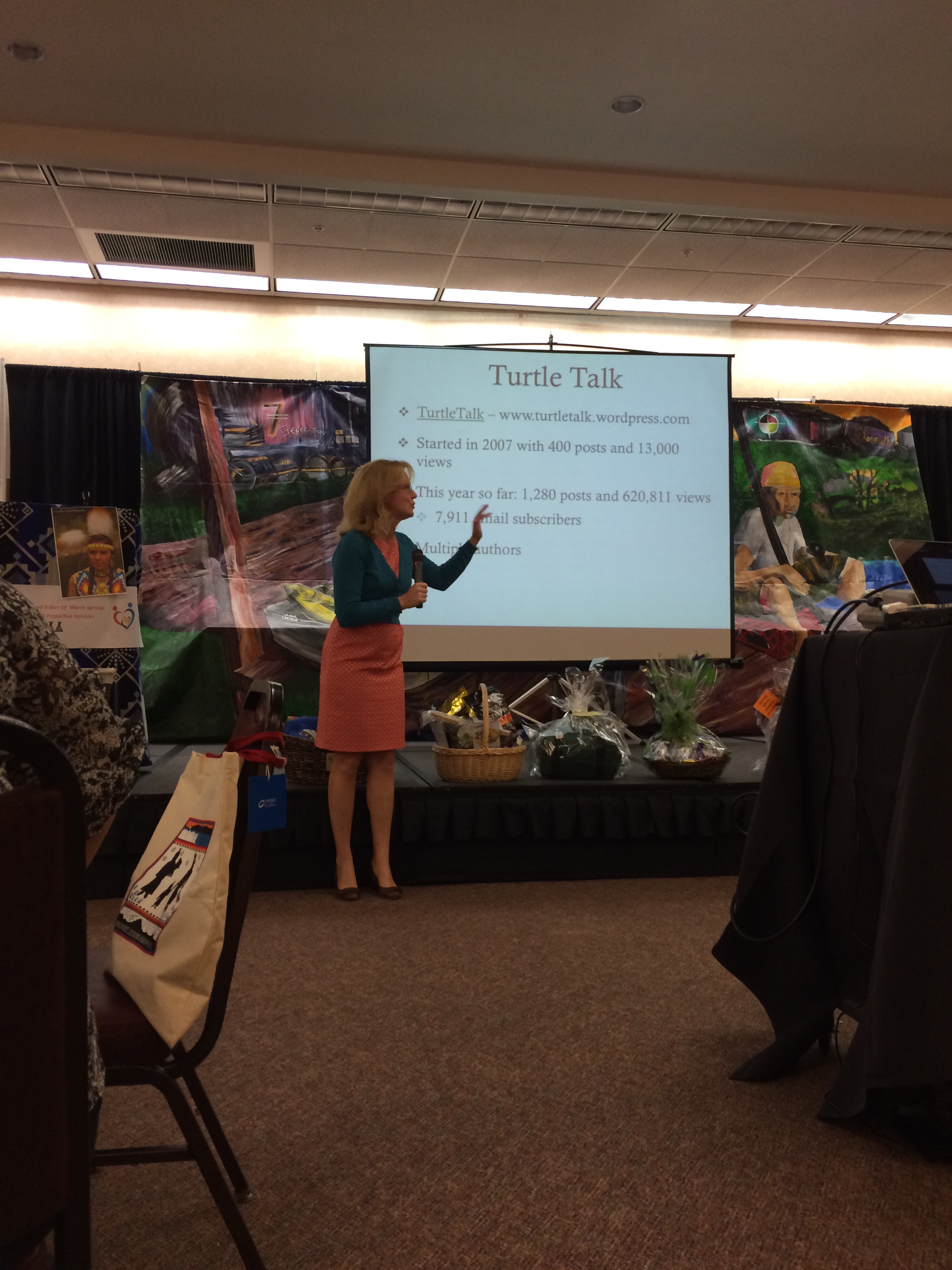
Kate Fort at the 2015 Oregon Tribal/State ICWA Conference

Here’s a picture on Turtle Talk of Kate Fort speaking about Turtle Talk at the 2015 Oregon Tribal/State ICWA Conference. Kate is a regular presenter at ICWA conferences around the country, but this may be the first time she’s presented about the blog specifically at one of these conferences.

Thanks Addie S for sending along the picture!

Fort Oregon


Indian Law Resource Center Fellowships and Legal Internship Announcements

Fellowship Information:

The Indian Law Resource Center is a non-profit legal advocacy organization dedicated to providing legal advice, assistance, and representation to Indian tribes and indigenous communities throughout the Americas. We are also committed to developing new attorneys in the fields of Indian law and international human rights law.
To this end, we offer several fellowship and clerkship opportunities in both our Helena, Montana and Washington, D.C. offices. These fellowship and clerkship opportunities require a minimum eight week commitment and entail legal research and writing on major Indian rights issues related to current projects of the Indian Law Resource Center. The Lewis and Sidley Fellowships both offer a stipend of $3,000 for the term of the Fellowship. Applicants are welcome to supplement this stipend with additional financial support through their law school’s public interest programs or through other public interest scholarships.
The John D. B. Lewis Fellowship is a competitive Fellowship awarded each year to a law student who shows particular promise for a career in international indigenous human rights issues.
The Terrance A. Sidley Fellowship is a competitive Fellowship awarded each year to a law student who shows particular promise for a career in federal Indian law and international indigenous human rights issues.

The application deadline for Summer 2016 is October 30, 2015. Full details available here Lewis and Sidley Fellowships 2016

Legal Internship Information:

The Indian Law Resource Center seeks a legal intern for our Washington, DC office for Fall 2015. Knowledge of international and/or federal Indian law and Spanish language skills are preferred but not required. Internships are available for all levels of experience.

Applications for the Fall 2015 legal internship are accepted on a rolling basis until positions are filled. Full details available here Fall 2015 Legal Intern Announcement (3)

New Website – Sex Trafficking Resources for Tribal Coalitions

A new website is now available with the express purpose of providing sex trafficking information and resources for tribal domestic violence and sexual assault coalitions. The link to the site is here.

From the site:

This website was created to provide tribal coalitions with quick access to information their advocates need–legal resources, victim service directories, training calendars, technical assistance, and more.

Additionally, we envision this site as a place for Native women to find help when dealing with violence. Individuals can reach out to their local Tribal Coalition(s) for assistance or they can easily use our Victim Services Directory themselves. We suggest, however, that individuals contact their local tribal coalition for assistance first. A Tribal Coalition can help individuals navigate options and services, and utilizing coalition connections can increase a client’s chances of receiving services or referrals immediately. 

The site includes federal, state, and tribal laws, articles, resources, and information about victim services and will continue to include new information as it becomes available.

Tribal Access to Name Based Background Checks for Emergency Placements

Tribal Access to Name Based Background Checks for Emergency Placements

For some time tribes have raised the issue of tribal child welfare agencies not having access to name-based background checks for emergency child placements.

The Bureau of Indian Affairs (BIA) Office of Justice Services is now authorized to do name-based background checks for tribal emergency placements for tribes with social services agencies.  The program is called, “BIA-OJS Purpose Code X Program.”  Children’s Bureau is working with BIA and the Department of Justice to inform tribes about the change and roll out of the process.  Two informational phone calls will be held to disseminate information about the name-based background checks and the process.  These calls will include partners with the Department of Justice and the Bureau of Indian Affairs who will be on hand to answer questions.

Two Opportunities to participate in an Informational Call-In about BIA-OJS Purpose Code X Program with Department of Justice, Bureau of Indian Affairs – Office of Tribal Justice, and Children’s Bureau:

Wednesday August 26, 2015

First Call:  3:00pm to 4:00pm (Eastern time) Noon to 1:00pm (Pacific time)

Participants can register for the conference by navigating to http://dpregister.com/10071565
Please note that registered participants will receive their dial in number upon registration.

Pre-registration fields of information to be gathered:  Name, Tribal Affiliation

Those without internet access or unable to pre-register may dial in by calling:
PARTICIPANT DIAL IN (TOLL FREE):           1-877-270-2148
PARTICIPANT INTERNATIONAL DIAL IN:  1-412-902-6510

Information gathered for unregistered parties:  Name and Company
Please ask to be joined into the United States Department of Justice call.

Second Call: 4:00pm to 5:00pm (Eastern time) 1:00pm to 2:00pm (Pacific time)

Participants can register for the conference by navigating to http://dpregister.com/10071577
Please note that registered participants will receive their dial in number upon registration.

Pre-registration fields of information to be gathered:  Name, Tribal Affiliation

Those without internet access or unable to pre-register may dial in by calling:
PARTICIPANT DIAL IN (TOLL FREE):           1-877-270-2148
PARTICIPANT INTERNATIONAL DIAL IN:   1-412-902-6510

Information gathered for unregistered parties:  Name and Company
Please ask to be joined into the United States Department of Justice call.

The U.S. Department of Justice announced on Wednesday, August 19, 2015 the Tribal Access Program for National Crime Information, or TAP, will allow federally recognized tribes to enter criminal records into and pull information out of national databases overseen by the Criminal Justice Information Services Division of the Federal Bureau of Investigation.

The U.S. Department of Justice (DOJ) has established the Tribal Access Program for National Crime Information (TAP) to provide tribes access to national crime information databases for both civil and criminal purposes. TAP will allow tribes to more effectively serve and protect their nation’s citizens by ensuring the exchange of critical data.  The new TAP program will support and train tribes as they connect with the system. Once established, they’ll be able to use the databases in the same way as outside law enforcement.

Also on Wednesday, August 19, Assistant Secretary – Indian Affairs Kevin K. Washburn announced a new Bureau of Indian Affairs’ Office of Justice Services (BIA-OJS) program to assist federally recognized tribal social services agencies seeking to place children in safe homes. “The BIA-OJS Purpose Code X Program will provide tribal social service agencies with the information they need to protect the children they place into care in emergency situations when parents are unable to provide for their welfare,” Washburn said. “This program provides BIA law enforcement personnel with the ability to provide our social service agency partners with much-needed information to help to make sure children requiring emergency placements will be placed in safe homes.” The BIA-OJS Purpose Code X Program arose out of a 2014 working group formed by the Departments of Justice (DOJ) and the Interior (DOI) that also developed the Tribal Access Program for National Crime Information (TAP).

BIA-OJS dispatch centers will be available to provide 24-hour access to criminal history records, so name-based checks can be done immediately. Protocols for operating under the new program are being developed by BIA-OJS and will be tested by a select number of tribes prior to a nationwide implementation of the program.

http://www.justice.gov/tribal/tribal-access-program-tap

Previous coverage here and here.

Assistant Secretary Washburn Announces a New Program to Assist Tribal Social Services Agencies in Placing Children in Safe Homes

Press release (copy here):

Assistant Secretary Washburn Announces a New Program to Assist Tribal Social Services Agencies in Placing Children in Safe Homes

WASHINGTON – Assistant Secretary – Indian Affairs Kevin K. Washburn today announced a new Bureau of Indian Affairs’ Office of Justice Services (BIA-OJS) program to assist federally recognized tribal social services agencies seeking to place children in safe homes.

“The BIA-OJS Purpose Code X Program will provide tribal social service agencies with the information they need to protect the children they place into care in emergency situations when parents are unable to provide for their welfare,” Washburn said. “This program provides BIA law enforcement personnel with the ability to provide our social service agency partners with muchneeded information to help to make sure children requiring emergency placements will be placed in safe homes.”

The BIA-OJS Purpose Code X Program arose out of a 2014 working group formed by the Departments of Justice (DOJ) and the Interior (DOI) to identify sustainable solutions that provide tribes access to national crime information that addresses criminal and civil needs of tribes. The outcome of this collaboration was the BIA-OJS Purpose Code X Program and DOJ Tribal Access Program for National Crime Information (TAP) TAP will allow tribes to more effectively serve and protect their communities by ensuring the exchange of critical data.

Under the BIA-OJS Purpose Code X Program, BIA-OJS dispatch centers will be available to provide 24-hour access to criminal history records, so name-based checks can be done immediately. Protocols for operating under the new program are being developed by BIA-OJS and will be tested by a select number of tribes prior to a nationwide implementation of the program.

BIA-OJS obtained authorization to perform these name-based checks from the National Crime Prevention and Privacy Compact Council, an organization which has the legal authority to promulgate rules and procedures governing the exchange of criminal records for non-criminal justice purposes.

“The BIA Office of Justice Services and DOJ’s Office of Tribal Justice have made collaboration on improving tribal access to information a high priority over the last year, and I am grateful to the Compact Council for approving our request so quickly,” said BIA OJS Deputy Director Darren A. Cruzan.

OJS has also worked to improve tribal reporting to the Uniform Crime Report system and encouraged tribal participation in the National Data Exchange (NDEx) system.

All of these efforts underscore the importance of the exchange of information between law enforcement agencies to achieving public safety in all jurisdictions, including Indian Country.

The BIA-OJS’s mission is to address public safety concerns in Indian Country by funding law enforcement, correctional departments and tribal court services to the nation’s federally recognized tribes. It also coordinates emergency preparedness support on federal Indian lands by working cooperatively with other federal, state, local and tribal law enforcement agencies throughout Indian Country. The BIA-OJS operates the Indian Police Academy in Artesia, N.M., which provides training and professional development to BIA and tribal law enforcement personnel.

Visit http://www.indianaffairs.gov/WhoWeAre/BIA/OJS/index.htm for more information about OJS and its work.

For more information on TAP, visit http://www.justice.gov/tribal/tribal-access-program-tap.